
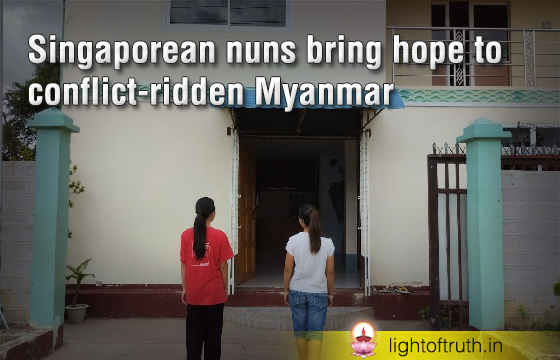
In 2021, a military junta seized power in Myanmar, plunging the country into a state of civil conflict, substantially worsening what was already a difficult humanitarian situation. For several decades, the Canossian Daughters of Charity, a religious congregation with a strong presence in Singapore, have been at work in the country, aiming to build a brighter future for Myanmar’s youth.
Canossian Sisters from Singapore first began making trips to Myanmar in 1996 – a journey of around 2,000 kilometres. They went, says Sr. Wang, in response to a request for help from the late Burmese Archbishop Matthias U Shwe, then Bishop of Taunggyi.
The Archbishop had invited them to educate the country’s young, and to help with the formation of groups of young evangelizers. Volunteers travelled regularly from Singapore to Myanmar on mission outreach trips for more than a decade, organising everything from leadership camps and English lessons to Bible courses.
Then, in 2008, the Canossians set up their first centre in the country, which became home to a small group of Sisters and lay partners. That community began a programme aimed at the integral formation of educators, with the motto: “Serve With Love.”
In 2012, they opened Canossa Home, which housed residential facilities for the formation of educators, as well as a boarding house for children from poor families living in villages with no schools.
These educators are trained to give quality care to children and teenagers staying in boarding houses run by the local Church – who otherwise would have no access to professional training – by educating them to one day become teachers themselves.
Since the centre was opened in 2008, the Sisters have trained about 350 young women, most of whom have now returned to serve in communities throughout Myanmar.
In 2017, meanwhile, the Sisters opened a preschool for children in the area.
Since the COVID-19 restrictions in 2020 and the military coup in 2021, volunteers from Singapore have not been able to travel to Myanmar. The Sisters and volunteers in Singapore keep in touch by sending parcels with food and other necessities. The communities in Myanmar, meanwhile, are kept running by six local Canossian Sisters and trained local lay staff, mentored by an experienced Sister from Singapore.

Pope Francis to open youth education hub in Indonesia during Apostolic Journey
Pope Francis will inaugurate the first regional headquarters of Scholas Occurrentes in Southeast Asia during his visit to Indonesia from Sept. 3 to 6.
The global educational project, which started in 2001 under his leadership as Archbishop of Buenos Aires, focuses on engaging youth in education, art, and sports.
On September 4, Pope Francis will visit the “Grha Pemuda” Youth House in Jakarta, where he will meet 200 Indonesian students from various islands, schools, and religions, according to a report by AsiaNews.
The visit will highlight the values of unity in diversity and the culture of encounter, key principles of Scholas Occurrentes.
Scholas Occurrentes will also launch the Scholas Citizenship program in Southeast Asia. This initiative is in partnership with Indonesia’s Ministry of Education, Culture, Research, and Technology and the Global 5P Movement.
The program will train university students and young teachers in the Scholas methodology, which they will implement in their communities.
Scholas Occurrentes said that the approach seeks to address the needs of Indonesian society, where the youth population is growing rapidly.
Scholas Occurrentes started as a project in Buenos Aires to bring together students from public and private schools, regardless of religious background, to work for the common good.
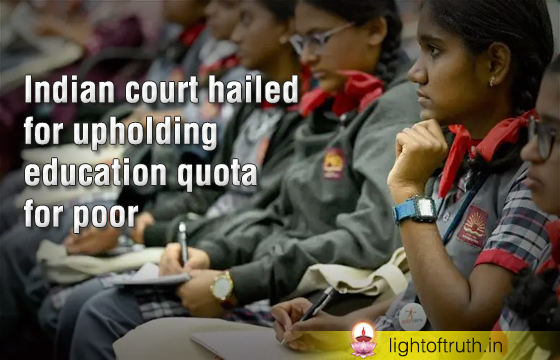
Indian court hailed for upholding education quota for poor
Christian leaders and lawyers have lauded India’s top court for upholding a legal provision that ensures the education of children from poor families in expensive private schools.
“The supreme court’s order has kept intact the rights of the children from economically weaker sections for quality education,” said Abraham Mathai, a former vice-chairman of the minorities commission in western Maharashtra state.
In February, the government in Maharashtra amended the Right to Education (RTE) Act. The law had asked private schools to admit students from poor families if they were within a 1-kilometer radius of a government or aided school. The amendment exempted private schools in the state from admitting poor children.
The Bombay High Court, the top court in the state, turned down the government’s decision. An appeal was filed in the Supreme Court, which, on Aug. 9, upheld the high court’s decision.
“I support the Supreme Court ruling upholding the Bombay High Court’s decision asking private schools to reserve 25 percent of their seats for children from economically weaker sections,” Mathai told UCA News on Aug. 12.
He said the law is crucial for children from weaker families to gain “access to quality education,” given the tardy state of affairs in government-run schools in the country.
“It is a step towards a more inclusive and equitable education system,” he added.
A bench of the Supreme Court headed by Chief Justice D Y Chandrachud dismissed the appeal by the Association of Indian Schools, a body of unaided private schools, seeking exemption from admitting students from the disadvantaged sections under the compulsory 25 percent quota.
Under the Act, students from poor families are given concessions in fees reimbursed by the respective state governments.
Private schools, however, are unhappy as the amount reimbursed is much lower than the fees they charge from other students.
The schools run by religious and linguistic minorities, including Christians, though private, are exempted from this norm as they are engaged in the welfare of their respective communities.
Both courts took the right decision; otherwise, the “RTE Act would have become toothless,” said advocate Govind Yadav, a former university student leader from Madhya Pradesh.
“Once this provision for 25 percent quota for admission is diluted, nothing is left in this law,” he added.
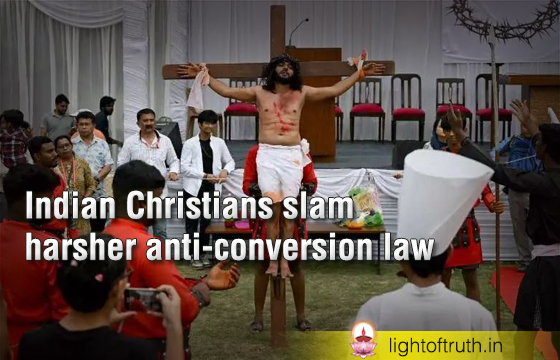
Indian Christians slam harsher anti-conversion law
Church leaders and rights activists have deplored the passing of sweeping changes to the anti-conversion law in a northern Indian state where Christians complain of harassment. The Uttar Pradesh Prohibition of Unlawful Conversion of Religion (Amendment) Bill, 2024, which provides for stricter punishment, including life imprisonment for fraudulent or forced conversion, was passed by the state assembly on July 30.
Uttar Pradesh, India’s most populous state, is ruled by the Bharatiya Janata Party (BJP). The National Council of Churches in India, in a July 31 statement, said the amended law “violates the provisions of the Indian Constitution” and “adversely affects the harmonious life in India and the basic rights of its citizens.”“Conversion itself is not an offense unless induced by undue influence, misrepresentation, or coercion, which only the victim can claim,” stressed the council, an ecumenical forum of Protestant and Orthodox churches in India. Reverend Asir Ebenezer, council general secretary, said the amended law grants extensive authority to officials and any third parties and can be misused to target specific individuals or communities based on religious prejudice. “The law is a risk… for heightened harassment and criminalization of peaceful religious practices, including baptism in Christianity,” he added. The earlier law allowed only a victim or a blood relative to file a complaint against illegal conversion. However, the amended law states that “any information related to violation of the provisions of the Act can be given by any person” to police or authorities. In the case of mass religious conversions, the jail terms have been increased to 7-14 years from 3-10, and fines to 100,000 rupees (US$1,250) from 50,000 rupees.
Earlier, the maximum punishment provided for marrying a woman by deceiving her and converting her was ten years, with a fine of Rs 50,000. The amended law prescribes imprisonment for 20 years or entire life. Also, all the alleged crimes under the amended law have been made non-bailable, which means a mere allegation of conversion can land suspects in jail with no hope of bail. The bill will become effective after the Uttar Pradesh governor, who is the constitutional head of the state, signs it. The Christian council said that “the anti-conversion law encroaches on the constitutional right to freely practice and profess religion, a fundamental human right recognized by both the Indian Constitution and international human rights standards.” Minakshi Singh, a Christian activist based in Uttar Pradesh, condemned the passing of the amendments to the anti-conversion law. “A law against conversion already exists in the state. Does it mean the government is not sure its previous law passed in 2020 was not effective enough?” she asked UCA News. Singh, who is general secretary of the charity, Unity in Compassion, said the amended law “threatens to aggravate communal tensions and undermine India’s diverse religious society.” Muhammad Arif, chairman of the Centre for Harmony and Peace, said the BJP government was playing the communal game and harassing religious minority groups. Christians make up less than 1 percent of more than 200 million people in Uttar Pradesh, and more than 80 percent of them are Hindus.

Indian Church extends help to rain-hit Himalayan states
The Indian Church has joined the government in relief work after a southwest monsoon became active over a large geographical area and torrential rains wreaked havoc across the South Asian nation. Down in the south, Kerala’s northern Wayanad district was hit by a massive landslide on July 31, killing nearly 407 people and the whereabouts of more than 200 are still unknown. India’s two Himalayan states have witnessed cloudbursts that uprooted as many as 3,500 people and killed 17 in northern Uttarakhand, according to the state-run Press Trust of India. In neighboring Himachal Pradesh, eight people lost their lives, and 45 were declared missing after houses, bridges, and roads were washed away. “The situation in both the states is worrisome.” The rains are hindering the rescue work, Bishop Vincent Nellaiparambil of Bijnor in Uttarakhand state told UCA News on Aug. 6. The Church and its social agencies have joined the state government and others to undertake rescue and relief work,” Nellaiparambil said. We are giving dry rations, medicines, water and clothes, he added. The sole Catholic diocese in Himachal Pradesh is in touch with the government to extend relief and rescue work. Simla-Chandigarh diocese has undertaken a campaign to collect essential items and money to help people in the state, said a senior priest from the Bishops’ House who did not want to be named. The Catholic Bishops’ Conference of India (CBCI) has expressed its condolences to the families of victims in Uttarakhand and Himachal Pradesh. In a statement on Aug. 3, the CBCI called on Church-run institutions to support government agencies working in affected areas. On Aug 7, the Indian Meteorological Department forecast the possibility of heavy showers in Himachal Pradesh and Uttarakhand. The metrology department said the northern states of Uttar Pradesh and Madhya Pradesh and northeastern Nagaland, Manipur, Mizoram, Tripura, Assam, and Meghalaya will also witness torrential rains. India gets 70 percent of its annual rainfall in the monsoon, which irrigates farmlands and supplies water to industry in the vast nation. Official rainfall statistics indicate that total rainfall in India jumped from 242mm on July 9 to 305.8mm on July 17. After remaining subdued till the second week of July, the southwest monsoon gathered steam towards the month’s end and is active over a large geographical area of the country. At least 80 percent of the country reported torrential rains last week.
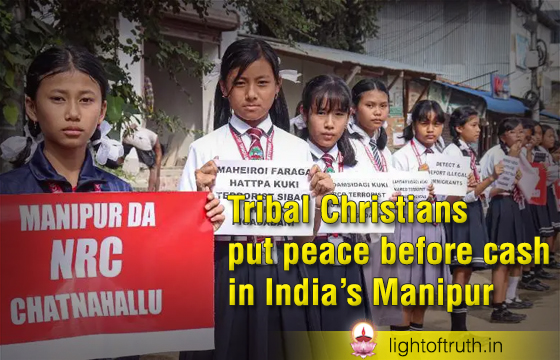
Tribal Christians put peace before cash in India’s Manipur
Indigenous Christian leaders have called on the government to restore peace instead of distributing cash to build new houses for victims of the sectarian strife in northeastern Manipur where Christians fight Hindus.
The real problem is “restoring pace,” noted a Church leader from Manipur where a 15-month-long conflict over conferring tribal status on the majority Meitei Hindu community has claimed more than 226 lives and uprooted over 60,000 people, most of them Christians.
The unprecedented violence that began on May 3, 2023, has hit more than 18,370 families, of which more than 14,800 of them have taken shelter in relief camps, Chief Minister N Biren Singh of Manipur told the state assembly. On Aug 5, Singh informed the assembly about the decision to distribute Rs 100,000 (US$1,191) to victims to build new houses. The Catholic Church has a diocese in Manipur, based in the state capital Imphal, and headed by Archbishop Linus Neli. Indigenous people mostly Christians make up 41 percent of the state’s 3.2 million people and Meitei Hindus form 53 percent. There are Christians among the Meiteis, too. Unless “peace is restored no such announcement will be of any use,” the Church leader who did not want to be named due to security reasons told UCA News on Aug. 6. “Obviously, everyone wants to have a home. People in Manipur are asking for a dignified life back in their villages from where they fled,” he added. The government needs to create an environment that will enable them to return to their homes, the Church leader said.
They have been living in relief camps for over a year with “no individual identity,” he noted. The chief minister announced the cash to build houses. But what will they do with it “unless there is peace in the state?” asked a tribal Christian leader. Singh, a member of the Bharatiya Janata Party of Prime Minister Narendra Modi, is accused of orchestrating the violence and protecting those behind it. According to government data, 11,133 houses have been set on fire, and 4,569 of them were completely gutted. Singh told the assembly that there are 12,977 boys and 13,763 girls living in government-run relief camps. The violence broke out between the wealthy Meiteis and the minority Kukiz-Zo community last year after the top court in the state asked the government to consider granting tribal status on Hindus. According to indigenous people, if the court’s request is implemented it would rob them of their share in the government’s affirmative action plan. Above all, their inclusion will allow them to purchase indigenous lands, which are mostly located in the hilly districts in the state, they complain. Indigenous people who live in the hilly districts of the picturesque state have stated categorically that they have lost trust in Singh as he is backing the Meitei community, of which he is a member. They are insisting on his removal as chief minister to restore peace in Manipur.

Wayanad: Church joins others to plan survivors’ rehabilitation
Various dioceses, religious congregations, and laity groups have formed a task force with Hindus and Muslims to implement short term and long-term rehabilitation plans for the landslide survivors in Kerala’s Wayanad district. The hilly district on July 30 witnessed one of the “worst ever landslides” in the southern Indian state that killed more than 400 people and wounded many others. More than 2,000 people are in the camps. The interreligious “Wayanad Relief Group” has decided to make temporary family shelters as an immediate step and then build permanent houses eventually. The group headed by Claretian Father George Kannanthanam has visited the affected areas, relief camps and victims’ families to make a rapid assessment of the situation and identify immediate priorities. The group under parish priest Father Mathew Periappuram’s coordination then met at St. Vincent De Paul Forane Church, Kalpeta, a major town in the district, to review the situation. Among the more than 40 participants were the representatives of religious congregations, Mananthavady Syro-Malabar diocese and Latin Archdiocese of Bangalore and diocese of Calicut. The team has also met District Collector D R Meghashree and briefed her about its proposed plan and pledged full support to the government proposal for building an exclusive township with all amenities for the victims.
The group observed that people, who are now living in temporary shelters such as schools, have to be settled back to their communities. “This process of permanent settlement with houses and other amenities will take minimum three years, and therefore, there is a need for temporary arrangements,” Father Kannanthanam told Matters India August 6. While some participants suggested building community shelters for several families others said the survivors should be given exclusive facilities to stay as families. “Therefore, it is required to create transitional houses meanwhile, so that they can stay as families and can carry on with regular life,” the meeting recommended who studied various models for a cost-effective pre fab houses of about 200 square feet with a kitchenette and toilet costing about 300,000 rupees. The group also decided to propose the plan to the government and offer to undertake its implementation while the government and other NGOs build permanent houses. Some members also have suggested to develop an education fund to support the children who lost their school and arrange counseling facilities for them. Around 53 students were killed in the landslides and several now stay in relief camps. Some have lost their parents, siblings or relatives. The group also observed that offers have come from corporate groups and the governments to build more than 500 permanent houses. “There is no scarcity of funds. So, we should make sure each house will be decent enough with at least 700-800 sq ft size with all amenities,” the group said. A new house will cost around 1.5 million rupees and those sponsoring houses should also involve in their planning and implementation too. The group proposed to involve the beneficiaries also in the planning. The group suggested creation of a coordination committee, involving members and experts, nominated from all concerned agencies, to ensure that the best ideas and practices are incorporated in the process

Indian bishops condemn Last Supper parody at Olympics
Indian bishops and laity groups have joined Catholics around the globe to deplore the parody of Leonardo da Vinci’s iconic painting of the Last Supper at the Paris Olympics opening ceremony. “The Last Supper is not merely a piece of art but a profound symbol of the Holy Eucharist, established by Jesus Christ himself,” said a press statement from the Catholic Bishops’ Conference of India (CBCI). The July 29 statement signed by CBCI’s public relations officer Father Robinson Rodrigues said the Olympic games which symbolize unity and respect among diverse cultures and faiths, should uphold the highest standards of sensitivity towards all religious beliefs. “Christ’s Last Supper event unites Christians worldwide, and its disrespect can never be perceived as a celebration of community tolerance as mentioned by the Olympics organizers,” it added. The apex body of the Catholic Church in India urged all concerned to reflect on the importance of mutual respect and understanding in fostering true global harmony. The CBCI also called upon the International Olympic Committee “to ensure that such instances of disrespect towards religious sentiments are not repeated.” A drag performance during the July 26 opening ceremony in Paris depicted a scene based on a parody of Leonardo da Vinci’s iconic wall painting in Milan’s Dominican convent, causing outrage among Christians across the world. Cardinal Oswald Gracias of Bombay said, “The Last Supper is a sacred event, which commemorates Jesus Christ’s final meal with his disciples, and is of immense significance to Christianity.” “The parody of this profound moment watched by millions is not only deeply offensive but also a blatant display of insensitivity towards the religious sentiments of believers worldwide,” he said in a statement. The cardinal stressed the need for respect towards religious beliefs in artistic expressions, particularly at globally significant events like the Olympics. “The organizers of the Olympics need to address this grave incident with the seriousness it warrants, the current apology issued by the Olympic committee is extremely condescending and a poor attempt to appease everyone,” he said.
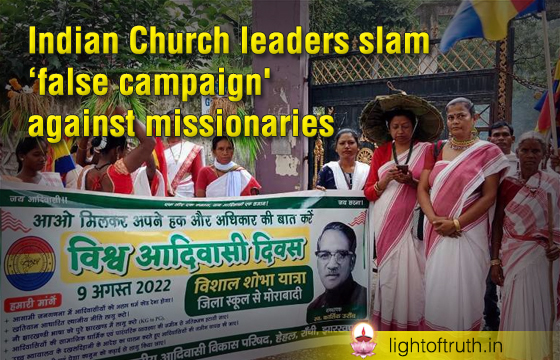
Indian Church leaders slam ‘false campaign’ against missionaries
Church leaders have criticized fringe elements in India’s ruling pro-Hindu party for giving a “communal colour” to the International Day of the World’s Indigenous Peoples celebrations in the country, which has the second-largest tribal population in the world. The day was celebrated in different parts of the country on Aug. 9. However, the Akhil Bharatiya Vanvasi Kalyan Ashram (all India tribal welfare body), alleged that “external forces and Christian missionaries in India are hatching up a large-scale conspiracy to divide society in the name of the celebration.” The organization is affiliated with the ultranationalist Rashtriya Swayamsevak Sangh (RSS), which is considered the mother organization of the Bharatiya Janata Party (BJP).
Its president Satyendra Singh said on Aug. 8 that the celebration was meant for other countries like America, Australia, New Zealand and Canada” and had no relevance for India. “All people of our country are indigenous to this land, and we are now free from the clutches of colonial forces,” Singh said. Observing the international day whose theme this year is ‘Protecting the Rights of Indigenous Peoples in Voluntary Isolation and Initial Contact’ has nothing to do with any religion, said Father Vincent Ekka. “Blaming Christian missionaries of a conspiracy is misleading,” the Jesuit priest told . Ekka, who heads the tribal studies department in the Church-run Indian Social Institute in the national capital New Delhi, said Hindu groups are afraid that the tribal people may become aware of their rights “and may revolt.” The RSS has been campaigning against Christian missionary activities among tribal people and their conversion to Christianity. Its affiliate organizations run a nationwide campaign called Ghar Wapsi (homecoming) to convert tribal people and Dalits or former untouchables and bring them into the Hindu religion. “Blaming Christian missionaries is purely a political agenda [for them], said Ekka who belongs to the Oraon tribal community in the central state of Chhattisgarh. The Jesuit appealed to fellow tribal people not to fall prey to the “false campaign.” India’s tribal people make up 8.6 percent of its 1.4 billion people, according to the last Census conducted in 2011. The RSS and its fringe elements always come up with “new ideas to attack Christian missionaries,” said Ratan Tirkey, a former member of the tribal advisory committee in eastern Jharkhand state, which has a large tribal population. “Will they recognize the contributions made by Christian missionaries” for the welfare of the tribal people, the Catholic lay leader asked.
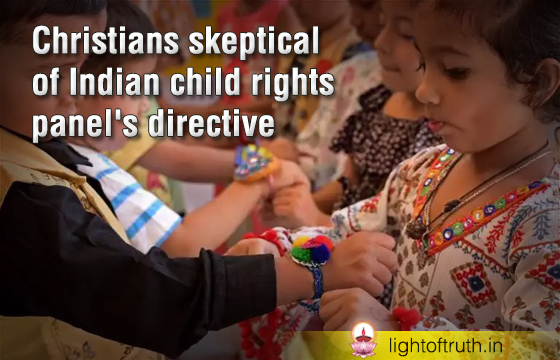
Christians skeptical of Indian child rights panel’s directive
Ahead of a Hindu festival, India’s child protection panel has issued a directive asking schools not to discriminate against children, which some Church leaders said could become a tool to harass Christian schools. The National Commission for Protection of Child Rights, in its Aug. 8 directive, asked education departments in all Indian states not to “engage in practices that expose children to any form of corporal punishment or discrimination.” The directive comes ahead of Aug. 9 Raksha Bandhan, the Hindu festival celebrating the bond of siblings. Hindu girls and women tie a sacred decorated thread (rakhi) on the wrists of their brothers, who, in turn, promise life-long protection. Christian leaders fear the directive could help the panel file non-compliance with the directive based on some children not wearing the rakhi on their wrists. “The directive is superfluous as all education departments already have ample guidelines in this regard,” said Father Babu Joseph, former spokesperson of the Indian bishops’ Conference. Priyank Kanoongo, the chairperson of the child protection panel, noted some instances of students in some schools not being allowed to wear rakhis and other Hindu symbols by teachers and school management during Hindu festivals. The directive also has asked relevant state authorities to ensure its compliance and sought a report by Aug. 17. Christian groups accuse right-wing Hindu groups of harassing Christian schools for not celebrating Hindu festivals, particularly after the pro-Hindu party of Prime Minister Narendra Modi came to power in 2014. “Our schools will abide by the decision of education departments in respective states,” Father Maria Charles, secretary of the education office national bishops’ conference told. The child rights panel has a history of targeting Christian institutions aiming to tarnish their image, said the Church leader based in the central Indian state of Madhya Pradesh, a Christian leader who did not want to be named. The panel has “unleashed targeted attacks” on our institutions and registered false cases under the draconian anti-conversion law against “our bishops, priests, nuns and other school staff,” he said. He recalled that the panel had registered several cases against Church-run institutions in his state. Christians comprise 2.3 percent of India’s 1.4 billion population. However, they run thousands of educational institutions nationwide. The Catholic Church runs some 50,000 institutions, including 400 colleges, six universities, and six medical colleges in different parts of the country. India’s constitution allows Christians who are grouped along with Muslims, Sikhs, Jains, Buddhists, and Parsees as minorities to set up schools and colleges to propagate their faith.