
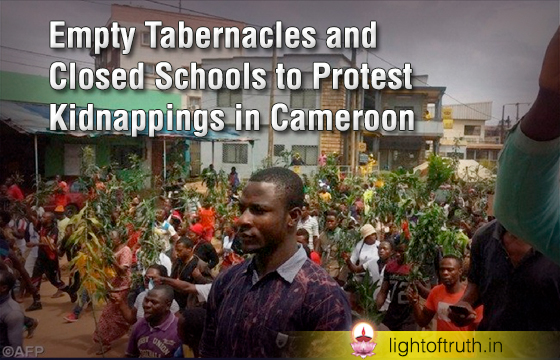
In response to the increasing number of kidnappings of religious figures in the English-speaking region of Cameroon, Archbishop Andrew Nkea of Bamenda has issued an unprecedented ultimatum. The latest kidnapping of a priest, Father John Berinyuy Tatah, prompted the Cameroonian Prelate to write a Pastoral Letter on November 23rd, threatening to close all Catholic institutions in the Ndop Deanery if the priest is not released by Wednesday, November 26th. On Saturday, November 15th, the priest and his assistant were kidnapped by a group of armed men, after the opening Mass of the Pax University Institute in Ndop. The kidnappers presented themselves as separatist fighters from «Ambazonia,» the self-proclaimed state that claims independence for the Anglophone regions of Cameroon. Days later, four priests and a layman attempted to negotiate the release of the hostages, but they too were taken captive. On the 20th , all were released except for Father John Berinyuy Tatah, for whom a ransom is being demanded. In response to this, the Archbishop of Bamenda declared in a Pastoral Letter that the position is clear: the Church never pays ransoms. The ultimatum issued by the Archbishop states that if the priest is not released, all parishes, schools, and Catholic institutions in the Deanery of Ndop — the northern part of the diocese where the kidnapping took place –, will be closed. Since neither the Archbishop himself nor the Christians he serves can guarantee the safety of the priests and religious personnel in the Deanery, the Blessed Sacrament will be removed from all churches, chapels, and oratories, leaving each tabernacle with its doors open.
Pope issues ‘motu proprio’ to solve Sister Petrini’s irregular presidency
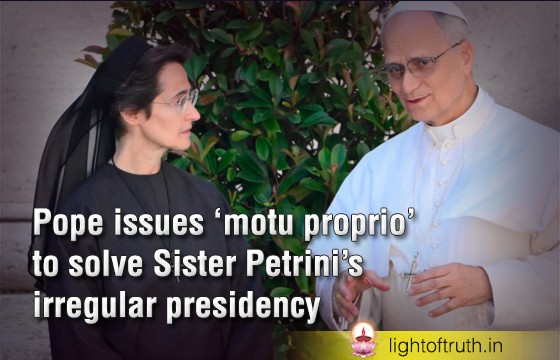
Pope Leo XIV has issued a motu proprio to restore legal clarity to the Vatican’s civil administration by formally permitting Sister Raffaella Petrini FSE to serve as President of the Pontifical Commission for Vatican City State. The document, signed on 19 November and released 21 November, amends the 2023 Fundamental Law so that the Commission “is composed of Cardinals and other members, including the President, appointed by the Supreme Pontiff for a five-year term”.
The motu proprio – Latin for “on his own impulse”, and which in Vatican parlance describes an official act taken without a formal request from another party – allows lay men, lay women, or religious sisters to lead the Commission by abrogating the Fundamental Law of Vatican City State Article 8, Section 1.
In his letter, Pope Leo speaks of “governance needs that are proving increasingly complex and pressing”, arguing that the governorate must operate in “a form of shared responsibility” consonant with the principles of Praedicate Evangelium.
The change by Leo replaces the previous wording, which required the president to be a cardinal, a stipulation that rendered Sister Petrini’s appointment in February legally irregular.
Her elevation was first revealed live on Italian television, before being confirmed officially on 15 February. It was widely noted at the time that the law, as it stood, did not permit a woman religious to hold the office.
Observers pointed out that the appointment was, in the words used by commentators close to the process, legally unthinkable. Even within the Vatican, concern focused less on the suitability of Sister Petrini, who is widely respected for her administrative expertise, and more on the suddenness of the decision and the absence of the necessary juridical framework.
By issuing the new motu proprio, Pope Leo has now regularised the situation and implicitly acknowledged the flaw. The revision solves the problem by, in effect, confirming that no such amendment had been promulgated, while also tackling the issue that the original text basically did not allow a president who was not a cardinal.
The Pontifical Commission has long been associated with the legislative life of the world’s smallest state. Its presidency has until now been tied to the cardinalate, reflecting both tradition and assumptions about seniority.
The motu proprio only took a sentence to amend the irregularity, but it marks a decisive early step in the pontificate of Leo in terms of trying to restore order and clarity with the Vatican.
Vatican defends monogamy against polygamy, polyamory
The Dicastery for the Doctrine of the Faith unveiled a newly approved text on marriage, it did so with a disarming simplicity: the mystery of two lives becoming one. Yet behind that biblical intuition lies a complex cultural moment that the Holy See considers too critical to ignore. The document, titled “Una caro (one flesh). In Praise of Monogamy,” was endorsed by Pope Leo XIV on November 21 and later presented to the press, marking a deliberate intervention in the global conversation on love, commitment, and the human desire for belonging.
The Note proposes a vision of monogamy rooted not in rule-making but in anthropology. Marriage, it states, is built on an unbreakable exclusivity, the kind that turns two people into a single story without dissolving their individual identities. In an era fascinated by limitless autonomy and ever-expanding relational models, the text argues for the enduring value of a love that chooses one person—and continues choosing them across time.
Cardinal Víctor Manuel Fernández, prefect of the Dicastery, outlines three motivations behind the document. First is the technological ethos shaping contemporary culture, a worldview that risks convincing individuals that boundaries are simply obstacles and that relationships can be endlessly customized. Second is an honest dialogue with African bishops, who have insisted that the continent’s cultures, commonly associated with polygamous traditions, in fact contain profound testimonies favouring monogamous union. Third is the Western rise of polyamory, no longer hidden but increasingly promoted as a public alternative to traditional partnership. Against this backdrop, the Note offers a counterproposal: the beauty of unity. Drawing from Christian theology, it connects the marital bond to the love between Christ and the Church, not as an abstract metaphor but as a source of strength for daily fidelity. Though primarily addressed to bishops, the Dicastery hopes the text will also serve engaged couples, young adults navigating relational complexity, and spouses seeking depth in their commitment.
Activist Nicaraguan priest: The Ortega dictatorship ‘can’t take away our faith’
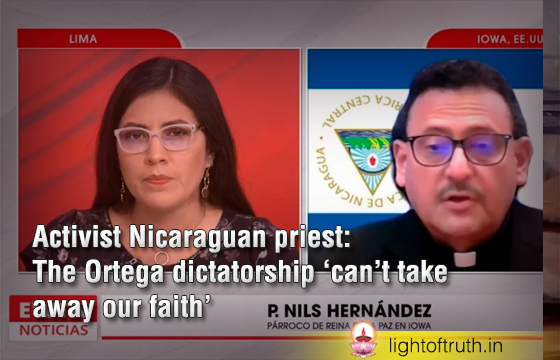
Nils de Jesús Hernández, 56, has lived in the United States for 36 years, far from his native Nicaragua. Forced to leave the country in 1988 in the midst of the civil war, he serves a parish in Iowa where he ministers to the Hispanic community and speaks out for the Nicaraguan people.
Hernández, known as the “vandal priest” for having led a student strike and supporting the 2018 protests in Nicaragua, is now the parish priest at Queen of Peace Church in Waterloo, Iowa, in the Archdiocese of Dubuque. “Vandal priest” was the defamatory, derisive label the dictatorship gave to him for his role in the protests, but the title has now turned into a sort of badge of honour.
After being declared a target of the government at the age of 19 when he was a candidate for the priesthood, Hernández said in an interview with “EWTN Noticias,” the Spanish-language broadcast edition of EWTN News, that leaving the country “meant that I was never going to return to Nicaragua. Leaving my parents, my family, everything that was familiar to me: my language, my culture, my food, everything; that is, everything that is one’s own … that was the cruelest thing I was experiencing.” The priest said he inherited his fighting spirit from his mother, who also helped with the student protests at the time.
“I believe that the persecution against the Church in Nicaragua is becoming much more aggressive, with confiscations [of Church property] that they have carried out and continue to carry out,” the priest lamented. According to Hernández, the dictatorship wants to “eradicate the Church.”
“But I always say the following: They will steal all the buildings, they can close all the churches they want to close … but they cannot take away the faith from the hearts of every Nicaraguan, because wherever there is a Nicaraguan in Nicaragua, even though they are being repressed and oppressed, there is the Catholic faith, because all of us Nicaraguans are devoted to Mary and we trust in the will of God.”
“We also have great faith that the Lord will prevail and will be victorious, because the Lord triumphed on the cross and overcame death with his resurrection,” he said. “We will be returning to Nicaragua triumphantly, because we will indeed return to Nicaragua, because this dictatorship will not last forever. They’re old and they’re not going to continue [in power] for all eternity,” he predicted.
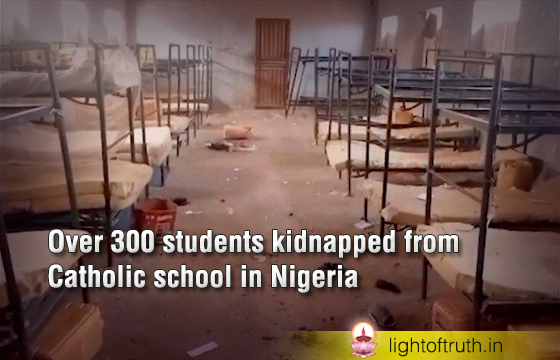
Over 300 students kidnapped from Catholic school in Nigeria
More than 300 students and teachers at the Catholic school of St. Mary in the Agwara district were forcibly taken and abducted by masked militiamen who stormed in on motorcycles and pick-up trucks. The mass abduction, in Niger State, in western Nigeria, carried out by an unidentified armed commando, marks the latest such tragedy. The episode comes just one week after the kidnapping of 25 female students in Kebbi State and the attack on the Church of Eruku, in the western state of Kwara, on 18 November. No group has yet claimed responsibility for the act committed during the night or issued ransom demands, but it is plausible that Boko Haram terrorists are behind it.
In a statement of the Diocese of Kontagora, sent to the Vatican’s Fides news agency, Diocesan Secretary Jatau Luka Joseph states that a security staff member was seriously injured during the attack, which is believed to have occurred between 1 a.m. and 3 a.m. local time. “The Diocese of Kontagora,” the statement reads, “strongly condemns the attack and expresses deep concern for the safety of the kidnapped children and their families. Security agencies were immediately informed and have launched coordinated efforts to ensure that the hostages may return safely.”
In Nigeria, mass kidnappings for extortion are quite frequent. In the central and north-western states of the country, Africa’s most populous nation and also one of its richest in oil, they are usually committed by criminal gangs that authorities generically refer to as “bandits.” The northern part of the country has also been grappling for nearly twenty years with a jihadist insurgency that, according to the United Nations, has caused 40,000 deaths and over two million displaced people.
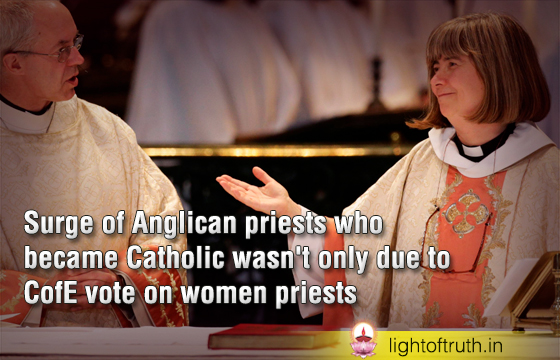
Surge of Anglican priests who became Catholic wasn’t only due to CofE vote on women priests
A new study has revealed the scale of Anglican clergy who entered into full communion with the Catholic Church over the past three decades, with hundreds of vicars and even entire groups of ministers making the journey to Rome.
The research, published on 20 November by St Mary’s University, Twickenham, shows that roughly a third of all Catholic priests ordained in England and Wales between 1992 and 2024 were formerly Anglican, marking what scholars describe as one of the most significant shifts in the religious landscape since the Oxford Movement.
The report finds that about 700 clergy and religious from the Church of England, the Church in Wales and the Scottish Episcopal Church, have been received into the Catholic Church since the early 1990s. Among them were 16 Anglican bishops and two from the Continuing Anglican movement, a cluster of churches with an Anglican identity but outside the Anglican Communion. The trend is long-running but began in earnest following the Church of England’s vote in 1992 to ordain women priests, an event that the study identifies as a watershed moment for many.
Prof Stephen Bullivant, co-author of the study from the Benedict XVI Centre for Religion and Society, said the findings showed “unequivocally a surge” in conversions after the contentious Synod vote. The legislation passed by a margin of just two votes after hours of debate, as demonstrators gathered outside Church House in Westminster to voice both support and opposition.
Prof Bullivant said those Anglcian priests who subsequently entered the Catholic Church did so “for various reasons”, but acknowledged that “the Synod vote on women priests was a big one in the 1990s”. For others, he said, the decision emerged from deeper spiritual reflection: “Some had reached a point in their lives where they felt that the time was right, this was something which had been on their conscience for a long time.”
The report also points to Pope Benedict XVI’s state visit to Britain in 2010 as another catalyst. During that visit, he beatified Cardinal John Henry Newman, himself a former Anglican priest whose reception into the Catholic Church in 1845 reshaped the ecclesial landscape of Victorian England. “Cardinal Newman is a real hero among Anglicans and Catholics,” Prof Bullivant said. “However, most of these people [converts] have a long and very personal journey.”
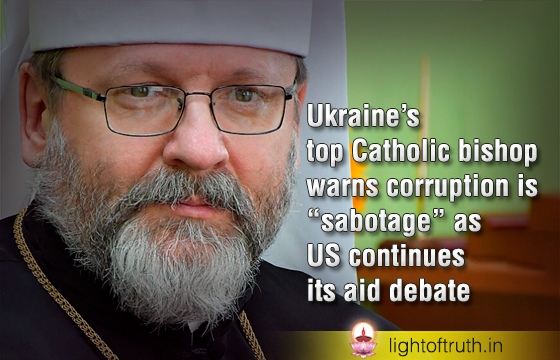
Ukraine’s top Catholic bishop warns corruption is “sabotage” as US continues its aid debate
Major Archbishop Sviatoslav Shevchuk has issued one of his starkest warnings of the war, condemning what he called a destructive network of corruption uncovered within Ukraine’s energy sector.
In his weekly video message, delivered in the 196th week of the Russian invasion, the head of the Ukrainian Greek Catholic Church said the revelations had caused “anguish” across the country as investigators alleged that officials siphoned off about $100 million from state-owned energy companies.
“Our law enforcement agencies have uncovered a criminal corruption scheme that was destroying Ukraine’s energy system,” he said. “We share the pain of our society and, fulfilling the prophetic role of the Church, we consistently denounce and condemn the phenomenon we call corruption.”
His remarks came amid sustained military pressure, with heavy fighting around Pokrovsk and renewed Russian attempts to push further into Ukrainian territory.
The Major Archbishop praised the “heroic resistance” of Ukrainian troops holding the line both in the east and near Zaporizhzhia, but said the domestic scandal had deepened the nation’s distress at a time when many households already struggle with shortages of heat and electricity. Corruption in wartime, he said, amounted to an assault on Ukraine’s survival, describing it as “a gross act of sabotage”.
He stressed that the exposure of the scheme by Ukrainian authorities was a sign of institutional resolve. He called it “encouraging” that state bodies were confronting the problem directly and urged continuing vigilance. “We hope that the Ukrainian state, our government, will consistently fight and stop this phenomenon,” he said.
He added that Ukrainians themselves, through civil society, parish life and public engagement, were shaping “the necessary public opinion, which has declared zero tolerance for any manifestations of this evil — moral, social, economic — in our society”. Corruption, he insisted, was not only a moral wrong but “a crime against Ukraine”.
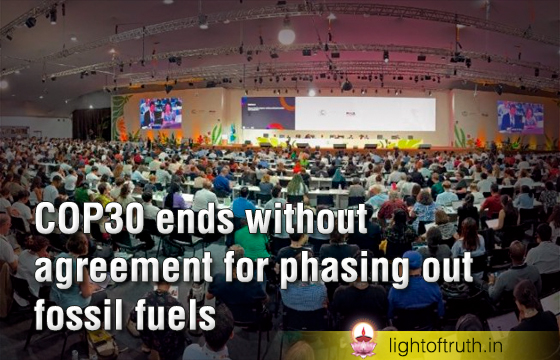
COP30 ends without agreement for phasing out fossil fuels
The halls of COP30 are empty, and as the final gavel fell, there was a sense that something essential had slipped away. What began with remarkable promise under Brazil’s presidency concluded instead with “disappointment, and, for many, the unsettling feeling of having watched the multilateral climate process take a step backwards”. “It’s been my fifteenth COP,” says Professor John Sweeney, emeritus climatologist from Maynooth University in Ireland, “and this one followed very predictable lines.” But this year’s conclusion, he stresses, is marked less by the expected frustrations and more by the collapse of ambitions many thought finally within reach.
Sweeney explains that Brazil had laid significant groundwork ahead of the summit. Hosting the conference in the Amazon carried a symbolism and urgency that the world could not ignore. The presidency hoped to produce clear commitments on forest protection, fossil fuel phase-out, and finance for vulnerable nations. Yet, as negotiations stretched deep into the night and into the weekend, the final text emerged stripped of its strongest language.
“The big winner,” Sweeney says in an interview with Vatican News “is sitting in Washington.” A meeting between the United States and Saudi Arabia, days before the final plenary, appeared to seal the fate of the communiqué: any mention of fossil fuels was removed. For the vast majority of nations pressing for decisive language on the root causes of climate change, it was a bitter defeat.
For the first time in 30 years of UN COPs, the White House had no official representation at the event in Belém. A decision that had a negative impact on the outcome of the Conference. Outside, the conference venue had battled other disappointing, somewhat climate reflecting realities, such as flooding, leaks, and even fire – all symbolic interruptions that did not go unnoticed by observers.
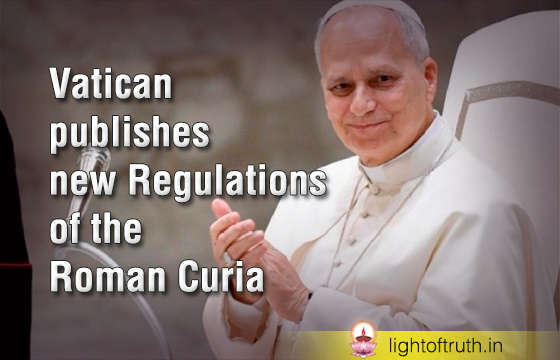
Vatican publishes new Regulations of the Roman Curia
The new General Regulation and Personnel Regulation of the Roman Curia, promulgated by Pope Leo XIV and set to take effect on 1 January 2026, signal a significant recalibration of how the Church intends to govern itself from within. Wrapped in the language of pastoral service and missionary identity, the two documents amount to a blueprint for a more accountable, transparent, and professionally structured central administration.
Although presented as provisional — ad experimentum, for a five-year period — the reforms are, in substance, anything but experimental. They reflect a clear continuity with the major constitutional overhaul initiated by Pope Francis in 2022 through Praedicate Evangelium, a text that reconfigured the architecture of the Curia but left its internal operating rules to be rewritten by a future pontificate. Leo XIV, elected on 8 May as the late Francis’ successor, has now taken up that unfinished work.
The new General Regulation applies to every organism forming the Curia: the Secretariat of State, the dicasteries, the tribunals, and the economic bodies entrusted with the Vatican’s finances. It creates a more coordinated administrative culture, beginning with something as banal — yet long overdue — as shared timetables. A minimum 36-hour work week is now mandated for all Curial institutions, coupled with regular meetings convened by the Secretary of State to harmonize their activities. It is a small but symbolic gesture toward a Curia that is meant to function as a single service body rather than a cluster of autonomous fiefdoms.
Where the regulations take a sharper tone is in matters of personnel. In a city-state often accused of opaque hiring practices and internal loyalties, the new rules impose strict barriers against nepotism. No office may employ close relatives of current staff, and recruitment is restricted to candidates whose professional competence is matched by a lived commitment to the Catholic faith, sound moral character, and — explicitly — a clean criminal record. These criteria apply to all staff, including the increasing number of lay men and women who now hold technical and administrative posts.
Leadership appointments, from prefects of dicasteries to their secretaries, remain the prerogative of the Pope, but the regulations codify a five-year term for such roles, reinforcing the reform-era principle that no Curial office is held indefinitely. Lay employees, meanwhile, will enter on probationary contracts lasting at least one year and no more than two, another step intended to professionalize a workforce historically shaped more by ecclesiastical custom than by modern personnel practices.
Transparent governance — a hallmark of Francis’ pontificate — receives particular emphasis. Every senior official must submit a biennial declaration confirming that he or she holds no assets in offshore financial centres and no stakes in companies that contradict Catholic social teaching. The omission of such declarations, or the submission of false ones, is now classified as a serious disciplinary offense.
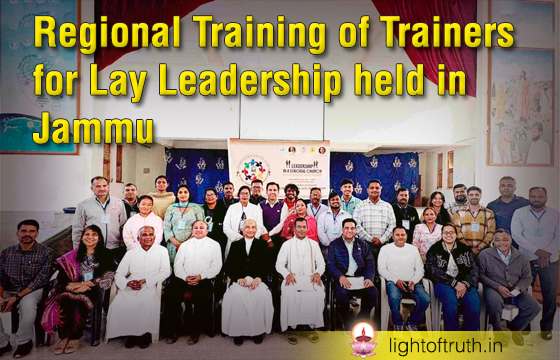
Regional Training of Trainers for Lay Leadership held in Jammu
The Commission for Laity organised a two-day Regional Training of Trainers (ToT) for lay leaders of the Northern Region at Maithri Bhavan, the Diocesan Pastoral Centre (DPC), Jammu, under the Diocese of Jammu–Srinagar. The training, held from 7 to 8 November, revolved around the theme “Leadership in a Synodal Church.”
A total of 40 lay leaders from four dioceses—Archdiocese of Delhi, Jammu–Srinagar, Shimla–Chandigarh, and Jalandhar—participated in the programme. The event was graced by Dr. Sahaya Thatheus Thomas, Chairman of the Laity Commission, Northern Region, and Dr. Ivan Pereira, Bishop of Jammu–Srinagar. Both prelates, along with other regional leaders, lit the ceremonial lamp to inaugurate the training.
In their addresses, both bishops underscored the vital role of lay leaders in fostering a truly Synodal Church. The sessions were led by Fr. Anthony Fernandes, National Executive Secretary for Laity, and Ms. Seanna Rodrigues, a professional trainer. Their inputs centred on pastoral and people-oriented leadership, exploring topics such as Mindfulness and Self-Values for Synodal Leadership, Servant Leadership, Creative Collaboration in Ministry, and Jesus’ Model of Leadership. The training encouraged active participation through group discussions and diocesan-level planning.
Adding a touch of camaraderie, cultural activities and team-building games enlivened the two-day programme, fostering fellowship and collaboration among the participants. The training concluded with diocesan teams presenting concrete action plans aligned with the National Pastoral Plan 2033, focusing on strengthening pastoral leadership at parish, deanery, and diocesan levels. The Regional ToT proved to be an enriching and empowering experience, equipping lay leaders to serve more effectively in the spirit of synodality.