
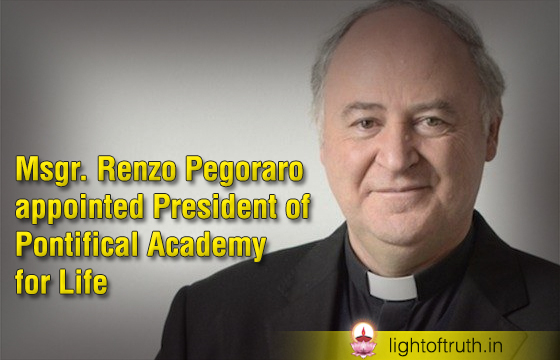
Pope Leo XIV has appointed Msgr. Renzo Pegoraro as the new President of the Pontifical Academy for Life (PAV), who has served as the Academy’s Chancellor since September 2011. Msgr. Pegoraro, a bioethi-cist with a medical degree, succeeds Arch-bishop Vincenzo Paglia, who turned 80 on April 21.
In an Academy-issued statement, Msgr. Pegoraro expressed, “I thank Pope Leo XIV for appointing me as President of the Pontifical Academy for Life.” ”The work done over these years alongside Archbishop Vincenzo Paglia, and previously with Bishop Ignacio Carrasco de Paula,” said the Italian-born priest, “has been both fascinating and stimulating, in line with the operational and thematic directions of the late Pope Francis.” Born in the northern Italian city of Padua on June 4, 1959, Msgr. Pegoraro would later be ordained a priest on June 11, 1989. He was incardinated in the Diocese of Padua.
He earned a degree in Medicine and Surgery in 1985 from the University of Padua, and, in 1990, he received a Licentiate in Moral Theology from the Pontifical Gregorian University in Rome.
He also has a Postgraduate Diploma in Bioethics from the Catholic University of the Sacred Heart.
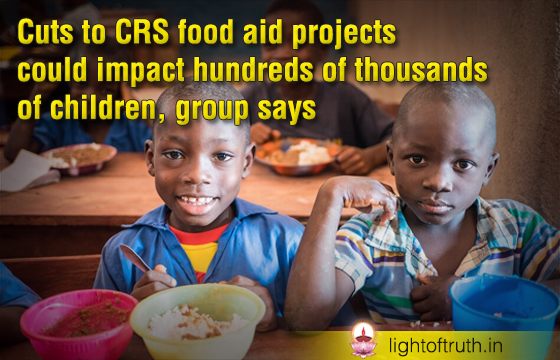
Cuts to CRS food aid projects could impact hundreds of thousands of children, group says
Catholic Relief Services said May 21 that most of its projects under a federal inter-national food aid program were terminated, leaving hundreds of thousands of children more vulnerable to hunger. The Trump administration said it was seeking to “align” its programs “with the President’s agenda.” More than 780,000 children across 11 countries will be left without their school meal, in many cases their only meal of the day, as a result of the termi-nation of 11 out of CRS’ 13 proje-cts under the McGovern-Dole International Food for Education and Child Nutrition Program being terminated, CRS said.
The program – named for the late Ambassador and Sen. George McGovern and former Sen. Robert Dole, both advo-cates of ending childhood hunger – purchases agricultural commo-dities grown in the U.S. to support school food programs and mater-nal and early childhood nutrition programs in countries around the world, with the stated purpose of reducing hunger and promoting literacy, preventing children from trying to learn with empty stomachs.
Commodities purchased by the program include flour from Oklahoma, bulgur from Kansas, beans and lentils from North Dakota, and vegetable oil from states including Arkansas, Flori-da, Illinois and Iowa, according to the Agriculture Department’s website.
Politico reported May 20 the program was among the major international food aid grants the Agriculture Department plans to cancel. The White House’s proposed fiscal 2026 spending plan called for entirely eliminating the McGovern-Dole program. The first Trump administration pro-posed a similar plan, but Congress continued to fund the program.
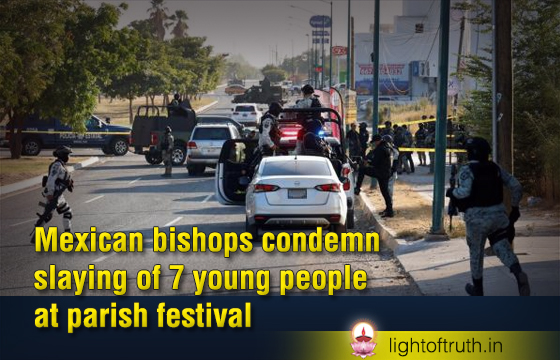
Mexican bishops condemn slaying of 7 young people at parish festival
The Mexican bishops’ conference has condemned a massacre of seven young people – including minors – at a parish festival, while urging action on the part of authorities amid rising violence and warning the population to avoid indifference in the face of recurring atrocities.
The conference also expressed outrage at the assassination of two senior officials in the Mexico City government, who were gunned down in a vehicle after they stopped outside a metro station on a busy thoroughfare in the national capital May 20.
The attack on the seven youths occurred around 2:40 a.m. on May 19 in the town square of San Bartolo de Berrios in western Guanajuato state, where gunmen “from a cartel” arrived in trucks and “brazenly opened fire on the people they found there,” according to a statement from the Archdiocese of León, signed by Archbishop Jaime Calderón Calderón.
The Guanajuato state prosecutor’s office confirmed the number of deaths but offered no additional details, The Associated Press reported.
“We are outraged, shocked and we condemn this act,” Calderón continued. “I urge our authorities to find those responsible and seek justice so these incidents never happen again in our society. Uncovering the truth and applying justice is a duty to bring comfort to the families of the victims.”
The Mexican bishops’ conference said in a May 20 statement, “As pastors of the People of God, we cannot remain indifferent to the spiral of violence that is devastating so many communities in our country. … We cannot get used to living with violent death, nor allow impunity to become the norm.”
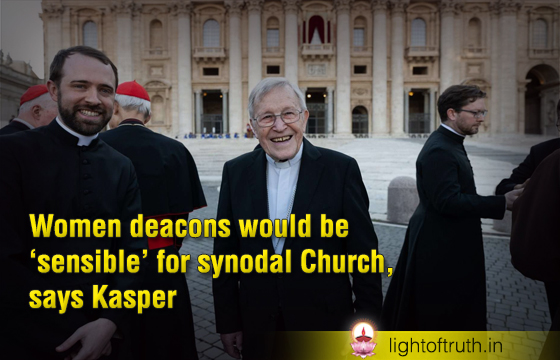
Women deacons would be ‘sensible’ for synodal Church, says Kasper
Cardinal Walter Kasper, the former head of Vatican ecumenism efforts, said he now believes there are reasons to create a women’s diaconate because a synodal Church will need a more “sibling-like” culture. “In my personal opinion, opening the permanent diaconate to women has good theological arguments in its favour and would be a sensible pastoral step,” wrote the former president of the Pontifical Council for Promoting Christian Unity in his autobiography, due to appear on 10 June. “Women and men have the same dignity before God and must therefore be recognised with their own charisms,” the 92-year-old German cardinal wrote in Der Wahrheit auf der Spur (“On the Trail of Truth”).
“We will continue to need good bishops and priests in the future, but in a synodal Church, the era of clericalism and arbitrary decisions by bishops is over,” he continued. “The laity want and should be heard, and they can also expect accountability from the bishops and priests.” Kasper said the drop in vocations could bring the institution back to the situation of the ancient Church. Advocates for a female diaconate often cite examples for this office in the letters of St Paul.
“The early Church was not a holy remnant that some dream of today; it was a holy beginning from which our Church has grown like a small mustard seed into a large tree,” he said. The Rome-based cardinal, noting changes in the world-wide faith, said developments in the Global South could “bring new momentum to the Church and soon make us Europeans look old”.
Kasper had long had doubts about women deacons, especially after the Anglican Communion split over the question of women priests and bishops while he was head of the Vatican’s ecumenism office–now the Dicastery for Promoting Christian Unity – in 2001-10, responsible for relations with other Chri-stian churches. But he said he now saw the question as a “megatopic” that Rome must face. “Without conversion, prayer, and repentance, all reforms, no matter how well-intentioned, have no future,” he said.
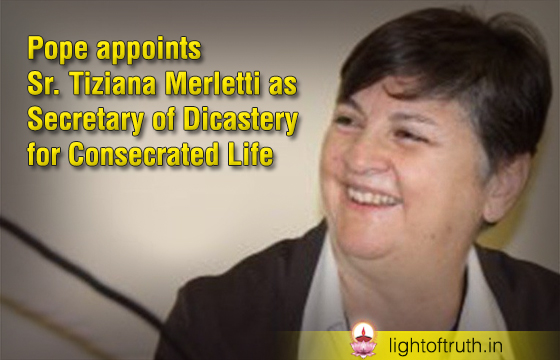
Pope appoints Sr. Tiziana Merletti as Secretary of Dicastery for Consecrated Life
Pope Leo XIV has appointed Sister Tiziana Merletti, former Superior General of the Francis-can Sisters of the Poor, as Secre-tary of the Dicastery for Institutes of Consecrated Life and Societies of Apostolic Life. The Dicastery is responsible for orders and religious congregations, as well as secular institutes.
As Secretary, Sr Merletti will serve under Sr Simona Brambilla, who was appointed to lead the Dicastery in January–becoming the first woman ever to lead a Vatican department.
From 2023 to 2025, Sr Bram-billa had served as Secretary of the Dicastery, the role now held by Sr. Merletti. The Pro-Prefect of the Dicastery for Consecrated Life is Cardinal Ángel Fernández Artime.
Sr Merletti is the third woman to hold the position of Secretary within a dicastery of the Roman Curia, following Sister Alessandra Smerilli at the Dicastery for Pro-moting Integral Human Develop-ment, and her predecessor Sister Simona Brambilla.
With Pope Francis’ Apostolic Constitution Praedicate Evan-gelium, laypeople, including women, can now lead dicasteries and become prefects, a role that had previously been reserved for cardinals and archbishops.

Vatican refreshes official website for first time in nearly 30 years
The official website of the Vatican for the first time has been refreshed since it was created in the 1990s, prominently featuring multimedia content and online links to other Vatican offices and ministries. A banner image of a waving Pope Leo XIV against a simple light blue background can now be found spread across the top half of the revamped Holy See website’s homepage published earlier this week.
Replacing the outdated dropdown mega menus found in the older version of the Holy See’s homepage is a large, clickable “Magisterium” button — which also features a small icon of the pontiff’s new coat of arms — to help online visitors find the pope’s prepared homilies and speeches and additional information about the Vatican.
Acquiring tickets for papal audiences and liturgical celebrations has also been made easier through the updated website. Earlier this year, the Prefecture of the Papal Household — which is one of four Vatican offices featured on vatican.va — launched its new website with digital registration forms for individuals and pilgrim groups wanting to see the pope.
The other three Vatican ministries featured on the updated website are the Church’s charitable organization Peter’s Pence, the Pope’s Worldwide Prayer Network, and the yearlong 2025 Jubilee Year of Hope.
Daily news and calendar events related to Pope Leo XIV and the Vatican can also be viewed on the updated homepage in nine languages: Arabic, English, Chinese, French, German, Italian, Latin, Portuguese, and Spanish.
Additional information and Church documents that can be accessed from the new homepage include the Bible, the Catechism of the Catholic Church, codes of canon law, ecumenical councils, Catholic social teaching, and reports on the Church’s response to the abuse of minors.
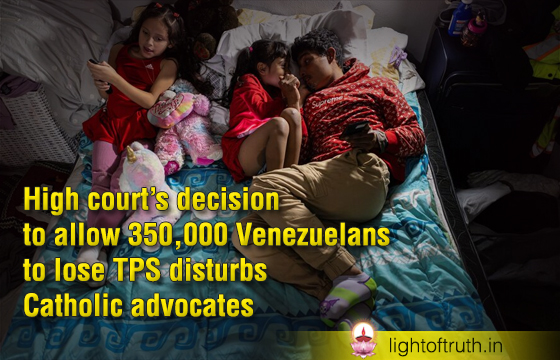
High court’s decision to allow 350,000 Venezuelans to lose TPS disturbs Catholic advocates
Catholic immigration advo-cates said they were “disturbed” by a Supreme Court order allow-ing the Trump administration to end legal protections from depor-tation for about 350,000 Vene-zuelan immigrants. The Vene-zuelans, a typically Catholic population, were permitted to remain in the United States without risk of deportation due to dangerous conditions in their homeland. The high court’s May 19 order paused a ruling by a federal judge in San Francisco that had blocked Homeland Security Secretary Kristi Noem from terminating the protections granted under a program known as Temporary Protected Status.
Anna Gallagher, executive director of the Catholic Legal Immigration Network, also known as CLINIC, said in a May 20 statement, “We have said it before: arbitrarily revoking the legal status of hundreds of thousands of vulnerable people who expected to be able to remain safely in the United States is cruel and unwarranted.”
Earlier in May, the Trump administration asked the Supreme Court to revoke TPS for the group of Venezuelan immigrants. Noem “vacated” a renewal of their TPS status in January, but those plans were blocked by a judge when those impacted by the decision argued proper procedures were not followed by the government.
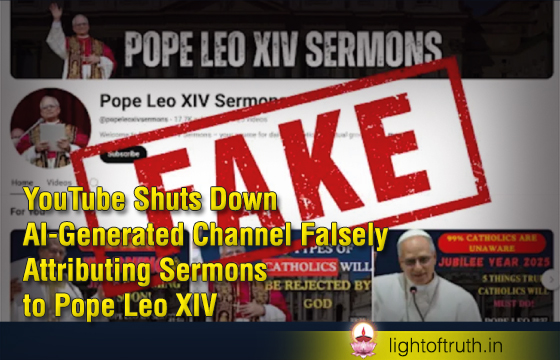
YouTube Shuts Down AI-Generated Channel Falsely Attributing Sermons to Pope Leo XIV
YouTube has removed a channel that amassed nearly a million views by publishing sermons supposedly delivered by Pope Leo XIV—sermons he never gave. The channel, titled «Sermons of Pope Leo XIV,» had gained a following of almost 18,000 subscribers before it was taken offline on May 21. Each of its 26 videos featured AI-generated texts delivered in a synthetic voice crafted to sound like the newly elected pontiff. While some scripts loosely drew inspiration from actual addresses, none were authentic papal messages.
Jack Malon, a spokesperson for YouTube, confirmed the takedown in comments to Aleteia. “We terminated the channel in question for violating our policies on spam, deceptive practices, and scams,” he said, noting that additional channels operated by the same creator were also removed. YouTube declined to identify those additional channels but emphasized that attempts to bypass bans by creating new accounts would be met with further enforcement.
The now-defunct channel had clearly struck a chord with unsuspecting viewers. Despite a disclaimer embedded by YouTube warning that the content had been digitally manipulated or generated, many comments revealed that users took the messages at face value.
The phenomenon underscores the increasingly complex challenges faced by digital platforms in an age when artificial intelligence can convincingly replicate public figures, including religious leaders. In the post-truth era, the boundary between reality and simulation is becoming harder to police, especially when deepfakes tap into the emotional and spiritual needs of believers.
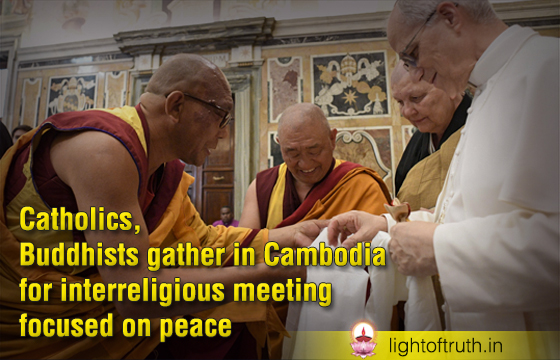
Catholics, Buddhists gather in Cambodia for interreligious meeting focused on peace
The Vatican commenced its eighth Buddhist-Christian Colloquium on 27 May in Cambodia, bringing together representatives of both religions to discuss the promotion of peace in Asia. Prefect for the Dicastery for Interreligious Dialogue Cardinal George Koovakad delivered a short speech on the first day of the May 27–29 conference on “Buddhists and Christians Working Together for Peace through Reconciliation and Resilience,” highlighting the significance of the two religions’ common commitment to peace, Vatican News reported. “Together, as Buddhists and Christians, let us explore how reconciliation and resilience can help shape peaceful and compassionate societies,” Koovakad said.
Approximately 150 people from Cambodia and abroad are participating in the three-day meeting organized by the Vatican’s Dicastery for Interreligious Dialogue, the Apostolic Vicariate of Phnom Penh, Saint Paul Institute, Preah Sihanouk Raja Buddhist University, and the MAGGA Jesuit Research Centre.
Since 1995, the Vatican has held a series of Buddhist-Christian meetings in different countries to advance mutual understanding and collaboration between the Church and non-Christian religions in the spirit of Pope Paul VI’s Second Vatican Council declaration Nostra Aetate released in 1965. The last Buddhist-Christian Colloquium in 2023 was held in Bangkok and focused on the theme of “healing a wounded humanity and the earth.”
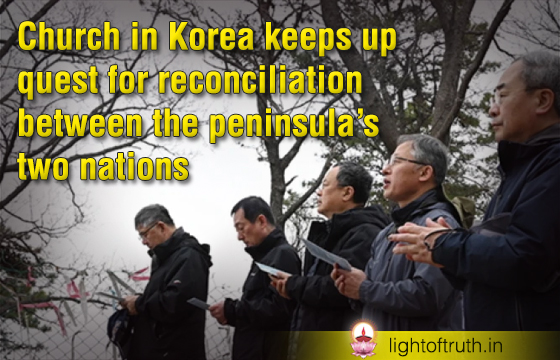
Church in Korea keeps up quest for reconciliation between the peninsula’s two nations
Eight decades after the partition of the Korean peninsula, the Catholic Church in South Korea remains one of the few actors that, with perseverance and faith, keeps alive the hope for reconciliation between the two Koreas. “Hatred and suspicion can never be a solution,” Bishop Simon Kim Jong-Gang, president of the Korean Reconciliation Commission, told ACI Prensa, CNA’s Spanish-language news partner.
Last month, the Korean bishop led a pilgrimage to Kyodong Island on the border with North Korea in a gesture that highlighted the Church’s commitment to reconciliation between the two countries. The bishops walked along the three-mile barbed-wire fence on the island that has divided the two countries since the Korean War (1950–1953) and prayed that the two countries would put their differences behind them.
For 80 years, soldiers on both sides of the demarcation line at the Panmunjom Peace Village in the Demilitarized Zone between the two Koreas have stood guard face to face, armed and under the pressure that any minor incident could trigger a new war. In 2018, as part of agreements between the two countries to build mutual trust, the Joint Security Area was cleared of firearms and military posts. But this openness was short-lived. In early 2020, North Korea closed its borders due to the COVID-19 pandemic and again ordered its soldiers to shoot at any movement across the border.
Kim noted that there are no exchanges between South and North Korea. “It’s impossible to meet people, exchange letters or phone calls, or even send emails between the two sides of Korea.”