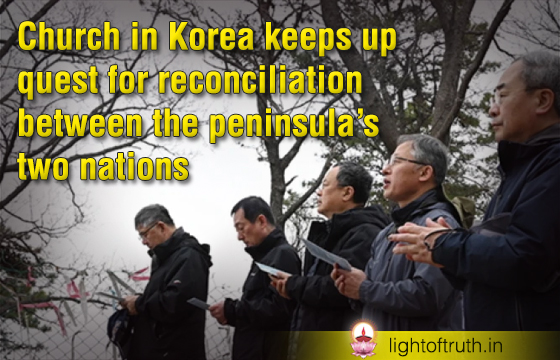
Eight decades after the partition of the Korean peninsula, the Catholic Church in South Korea remains one of the few actors that, with perseverance and faith, keeps alive the hope for reconciliation between the two Koreas. “Hatred and suspicion can never be a solution,” Bishop Simon Kim Jong-Gang, president of the Korean Reconciliation Commission, told ACI Prensa, CNA’s Spanish-language news partner.
Last month, the Korean bishop led a pilgrimage to Kyodong Island on the border with North Korea in a gesture that highlighted the Church’s commitment to reconciliation between the two countries. The bishops walked along the three-mile barbed-wire fence on the island that has divided the two countries since the Korean War (1950–1953) and prayed that the two countries would put their differences behind them.
For 80 years, soldiers on both sides of the demarcation line at the Panmunjom Peace Village in the Demilitarized Zone between the two Koreas have stood guard face to face, armed and under the pressure that any minor incident could trigger a new war. In 2018, as part of agreements between the two countries to build mutual trust, the Joint Security Area was cleared of firearms and military posts. But this openness was short-lived. In early 2020, North Korea closed its borders due to the COVID-19 pandemic and again ordered its soldiers to shoot at any movement across the border.
Kim noted that there are no exchanges between South and North Korea. “It’s impossible to meet people, exchange letters or phone calls, or even send emails between the two sides of Korea.”

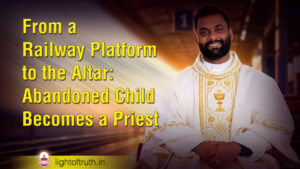
From a Railway Platform to the Altar: Abandoned Child Becomes a Priest
Twenty-eight years ago, a frightened five-year-old boy was found alone at Shoranur railway station. He had no memory of his parents or a family to