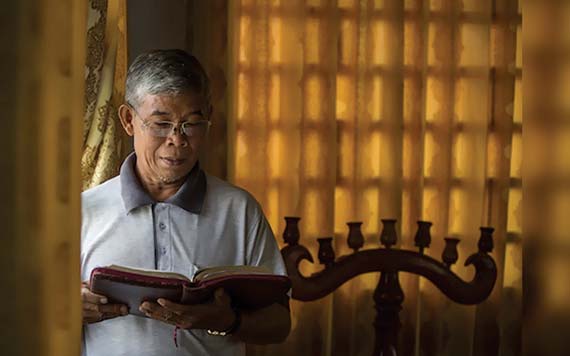
The 63-year-old Cambodian was visiting a refugee camp when a wounded soldier gave him a Bible. At first, he was reluctant but did take it.
Then after reading from the Bible the officer of the Pol Pot regime got interested and visited a church service. “I remember the first time I made a detour to get to the church,” he says. “I didn’t want people to know. I felt ashamed for going there.”
It took six weeks before Sophon, who once served as a Buddhist monk in his late teens, started believing in God.
“I had a mistress at that time, I smoked a lot, I had a drinking problem,” says Sophon. “So I asked the pastor what I should do. He told me: ‘Keep coming back to church and God will answer you.’”
“I prayed to God and felt the need to be pure and do what was good. So, I stopped smoking and drinking, and I said goodbye to my mistress.”
These days the former commander works with the Cambodian office of the Christian and Missionary Alliance. He also serves as a pastor in a church in the Cambodian capital, Phnom Penh, a position he wishes to hold until his death.
Sophon is just one of thousands of Cambodians who has converted to Christianity.
As a traditionally Buddhist country, pagodas, monasteries, and monks dressed in red or orange robes can be seen everywhere. But the country also has over 2,600 churches and just as with the number of Cambodians who have become Christians, that number is rising steadily.
According to Tep Samnang, executive director of the Evangelical Fellowship of Cambodia, missionaries have been coming to the country for generations. But it hasn’t been easy, he says.
“First, Christianity was seen as something foreign, then all religion was banned by the Khmer Rouge. It all changed with the peace agreement in 1992,” says Samnang. “Soon afterward missionaries came to bring the good news.”
Many Khmer Buddhists, especially those who suffered during the war, have become Christians because they are looking for answers, Samnang explains.
“Buddhism mainly means you need to follow your own path. But sometimes we need God to help us to find the way. And God forgives, while in Buddhism you need to solve your own problems,” he says. Erik Davis, a professor of Religious Studies at Macalester College in the United States and an expert on religion in Cambodia, says this explanation is common for people who have newly become Christians.
“Note the similarities with conversions in the West. Similar reasons are often provided, and they tend toward ‘offering or not offering me enough answers,’ instead of more traditional reasons as ‘because it’s true or sacred,’” he says.