- Valson Thampu
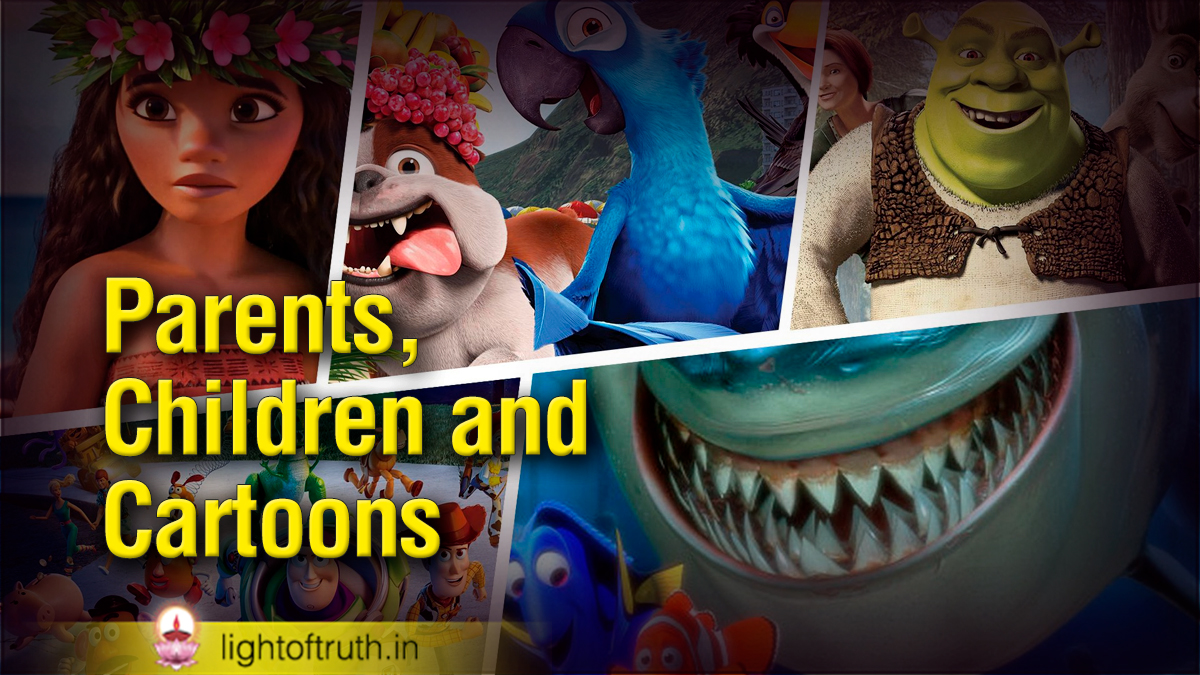
Most parents don’t have a clue to what happens to their children via their addiction to cartoons. They need to wake up. What is the stuff that cartoons are made of? Anyone can see that the world of cartoons, of which our little children are becoming captive imbibers, have nothing to do with the world in which they live and grow up. Cartoons offer to them quite the opposite: a pabulum of phantasies.
The makers of cartoons are shrewd psychologists. They know that children have an innate inclination towards the phantastic. Well, even those who carry their infantilism into their adulthood too share the same preference. It is almost impossible to get them to do any connected and directed thinking. The capacity for directed thinking, or thinking that engages with realities, marks human maturity. In comparison, the inclination to be afloat in the world of phantasies is infantile.
In this context, consider an issue of immense educational significance: the steadily decreasing attention span of our children. No one would disagree that weakening the capacity for purposive and disciplined attention to the task at hand is detrimental to the educational robustness of children. In the Indian thinking on the basic strengths of a learner, patience (kshama) has always been accorded the highest place. No one can be a good student, or sustain interest in learning, without the inner strength of patience. In the biblical vision, patience is a basic ingredient of character-formation.
To understand this issue aright, we need to reckon the two contrary modes of thinking: ‘directed thinking’ and ‘phantasy thinking’. Directed thinking, as the name suggests, is oriented towards realities. Phantasy thinking does exactly the opposite: it turns its face away from the real world. It is characterised by escapism. As a rule, these two modes exist in a relationship of inverse proportion. That is to say, the more the capacity for directed thinking is developed, the less the craving for escapes routes into the phantasy world, and vice versa.
It needs to be noted that phantasy thinking is way easier than directed thinking that taxes the mind. But, this stimulating tension proves hugely beneficial in the long run. It leads the young mind gradually to an enlarged awareness of the world of realities, and enables him or her to develop the maturity to cope with the rough and smooth of life. Sustained exposure to the phantasy world that cartoons unfurl deprives the growing mind of this necessary nourishment. The result is predictable: the child stays infantile. His or her capacity to live in creative engagement with the world of realities remains undeveloped.
Now, consider the counterpart of this pattern in religion. If we do justice to the mission of Jesus, we would see that his priority was, clearly, to challenge people to think, to enlarge their awareness and to widen their sympathies. The central tension in the Gospel is between reality-thinking and phantasy-thinking. The foremost manifestation in religion of the phantasy-orientation, as opposed to reality-orientation, is craving for wonders and miracles. Not surprisingly, Jesus condemned Pharisees and Sadducees on this count. As Immanuel Kant notes in his Religion within the Limits of Reason Alone, it is fallacious to assume that miracles kindle or deepen faith, or promote maturity in faith. On the contrary, miracle-seeking suppresses the ethical development of human beings. It anchors people in the infantile stage of religious formation.
Phantasy-oriented outlook is incompatible with truth-seeking, which is the energy of spiritual life. Phantasy runs counter to truth. People escape into a world of phantasy because they are unable to face the truth. To Jesus, truth, and truth alone, sets people free. Orientation to the phantasy world makes individuals lukewarm towards truth; and, hence, indifferent also to their freedom and development. Mature adulthood, in contrast, is marked by steadfastness, commitment and fortitude. ‘He who endures to the end,’ said Jesus, ‘will be saved’. It is against this wider backdrop that we need to view the wolf- in-sheep’s-clothing to which we expose our children in the most formative period of their life: the opium of cartoons. It is only natural that, at their stage of development, children instinctively favour the phantasy world. But Human growth takes place only through engagement with reality. Cartoons orient our children towards escapism. This is seriously harmful to their intellectual growth, of which their diminishing attention span is only one of the symptoms. How come that their attention span is impressive vis-à-vis cartoons, but poor in relation to what matters in the world they live? Thereby hangs the tail!