

The Vatican has appointed an apostolic administrator for an Eastern-rite archdiocese in southern India where a decades-old liturgical dispute continues with the change in leadership.
The Vatican named Archbishop Andrews Thazhath, an expert in the Eastern Catholic Code of Canon Law, to replace Archbishop Antony Kariyil, metropolitan vicar of Ernakulam-Angamaly Archdiocese.
Kariyil was asked to resign by the Vatican for defying the Syro-Malabar Catholic Church’s supreme synod in the liturgical dispute. Thazhath is reportedly tasked to end the dispute and implement liturgical unity by making priests of the archdiocese accept a liturgical formula approved by the Bishops’ synod.
According to the synod-approved form, the Mass celebrant turns to the altar during the eucharistic prayer, a move archdiocesan priests refuse to accept; they want to continue facing the congregation throughout the Mass.
Father Kuriakose Mundadan, representing archdiocesan priests, told that the priests and the laity in the archdiocese continue to demand Mass be celebrated in the traditional way, with the priest facing the congregation throughout.
“The change in leadership does not mean that we have changed our stand,” said Mundadan. “We have conveyed our stand to the new administrator.”
Thazhath met with priests’ representatives soon after he took charge.
Cardinal George Alencherry, head of the Eastern rite Syro-Malabar Church, believes “the process to find a solution to the dispute has begun” with the appointment of a new administrator.
“The apostolic administrator will fix a date and begin to implement” celebration of the synod-approved Mass, Alencherry told the media, but said he was not sure when “it will happen.”
Church officials familiar with the developments say winning over priests and laity will be a huge task, as the liturgical dispute had become an emotional issue.
Category Archives: National

Children In India face cyberbullying: Survey
A whopping 85% of children in India have reported being cyberbullied as well as having cyberbullied someone, according to a report released by computer security soft-ware company McAfee.
The India-centric findings are part of company’s global report titled ‘Cyberbullying in Plain Sight,’ a 10-country survey. It was conducted between June 15 and July 5, covering 11,687 parents and their children.
McAfee also claimed that the survey uncovered a startling fact – that many children take part in cyberbullying often without realizing their behavior for what it is, while parents struggle to keep up.
“Cyberbullying in India reaches alarming highs as more than 1 in 3 kids face cyber racism, sexual harassment, and threats of physical harm as early as at the age of 10 – making India the number 1 nation for reported cyberbullying in the world,” McAfee Chief Product Officer Gagan Singh said in the report.
It further said that children in India witness and experience the maximum cyber-bullying on almost every social media and messaging platform.
“85% of Indian children reported being cyberbullied as well as having cyberbullied someone else at rates well over twice the international average,” the report said.
Further, 45% of these children said they hide their cyber bullying experiences from parents, perhaps due to the relative absence of conversation.
In a release, McAfee explained the methodology it adopted for the survey, which was conducted in association with market research company MSI-ACI. The parents of children in the age group 10 and 18 were invited through e-mail to fill an online questionnaire.
The parents were first asked if their children were available to complete a survey. If yes, the parent was asked to complete a few questions themselves before turning over the survey to their child.
The 10 countries where survey was conducted are: United States, United King-dom, France, Germany, Australia, India, Canada, Japan, Brazil and Mexico.
Around 85% children in India have reported being cyberbullied and it is the highest in the world, according to a new survey released by global computer security firm McAfee Corp Monday.
Titled ‘Cyberbullying in Plain Sight’, the report is based on a 10-country survey to uncover new and “consequential trends” regarding cyberbullying.
The survey also noted that the number of Indian children reported to have cyberbullied someone is also twice the international average. Around 45% children in India said they cyberbullied a stranger, compared to 17% worldwide and 48% said they cyber-bullied someone they know, versus 21% of kids in other countries.
The top three forms of cyberbullying reported in India were spreading false rumours (39%), being excluded from groups or conversations (35%) and name calling (34%).
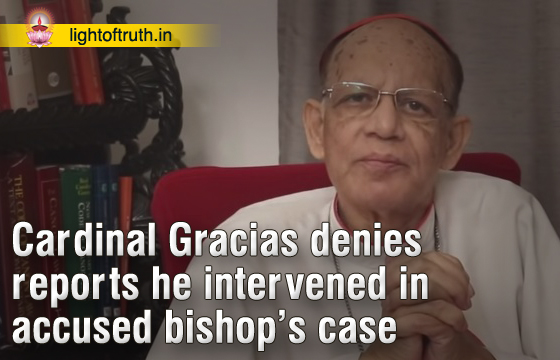
Cardinal Gracias denies reports he intervened in accused bishop’s case
Cardinal Oswald Gracias, one of Pope Francis’ closest advisers, has denied reports that he sought to intervene in the case of an Indian Bishop accused of secretly fathering a child.
In a video posted online August 7, Cardinal Gracias, who is the head of the Catholic Church in India, rebutted allegations he had arranged for Bishop Kannikadass Antony William of My-sore to take a paternity test at a Catholic hospital in order to control the outcome of the test results.
Cardinal Gracias said an audio clip from a two-year-old conversation with Bishop William, which has attracted attention among Indian Catholics in recent weeks, had been “mischievously edited to give the impression that there was collusion between Bishop William and myself for a cover-up.”
In the clip of the leaked phone call, which was promoted by the rightwing website Church Militant, the cardinal could apparently be heard telling Bishop William that Gracias would arrange for the paternity test to be conducted at a Catholic hospital “so we can control the media, control the doctors, control the publicity given to the whole thing.”
However, in his statement on August 7, Cardinal Gracias said he “categorically, emphatically and totally” denied that he had said or suggested that they could control the outcome of the test.
“At no time in the conversation or otherwise have I suggest-ed any action that would be illegal or bring disrepute to the church,” said the cardinal, who has led the Bombay Archdiocese since 2006 and has served as a member of Pope Francis’ influential Council of Cardinals since the group’s creation in 2013.
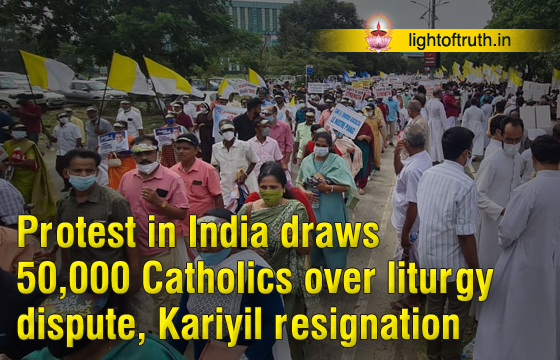
Protest in India draws 50,000 Catholics over liturgy dispute, Kariyil resignation
More than 50,000 Indian Syro-Malabar Catholics attended a protest in the southwestern city of Kochi on Sunday, demonstrating against changes that would have priests face east during parts of local Syro-Malabar Eucharistic liturgies, and opposing the recent resignation of Archbishop Antony Kariyil.
Protest Aug. 7 outside Kaloor Jawaharlal Nehru International Stadium.
The nearly two-hour protest at the Kaloor Jawaharlal Nehru International Stadium drew priests and laity from across the Ernakulam-Angamaly Syro-Malabar archdiocese, according to local media reports. Organizers said more than 320 parishes were represented, along with other nearby dioceses.
Some protesters held signs in Italian, in a possible attempt to attract Vatican attention.
A priest at the demonstration told The Pillar that the event was called the “Great gathering for the protection of Faith.”
Demonstrators have four demands, he said:
• They want to keep the liturgy in the diocese versus populum – with the priest facing the people, rather than facing liturgical east.
• They are also calling for financial restitution following a controversial sale of archdiocesan land.
• They want their Church’s senior officials to listen to the opinions of the laity on controversial matters.
• And they are calling for justice for Archbishop Antony Kariyil, who says he was forced by the Vatican to resign, without any reason given.
The protest comes amid a fierce ongoing debate over whether to implement a uniform mo-de of celebrating the Syro-Malabar Church’s Eucharistic liturgy, known as the Holy Qurbana.

Vatican asks Indian archbishop to resign over liturgical dispute
An archbishop of Eastern Rite Syro-Malabar Church re-signed following the Vatican’s directions. No reason were given. It may be part of the programme Vatican initiates dealing with land sale issue as well as liurgial difference of view.
Archbishop Antony Kariyil, the vicar of the major arch-bishop of Ernakulam-Angamaly archdiocese in southern Kerala state resigned on July 26, six days after he was summoned to the Vatican nunciature in New Delhi.
The nuncio issued a letter asking him to immediately tender his resignation, said archdiocesan officials from the eastern rite Syro-Malabar Church.
Archbishop Kariyil initially refused as no valid reason was cited for his resignation. He handed over a letter to the nuncio seeking to apprise Pope Francis about the developments, officials added.
The resignation comes after Archbishop Leopoldo Girelli, the nuncio to India, arrived at the Arch-bishop’s House on July 26 and held a discussion with Archbishop Kariyil.
As the news spread, a section of the archdiocesan priests held an emergency meeting at the Archbishop’s House and passed a resolution recording their opposition to the Vatican emissary forcefully demanding the resignation of Archbishop Kariyil.
“The Archeparchy showed tremendous unity, Christian witness and progress during the tenure of Mar Kariyil compared to the past many years. He is a true pastor who knows the hearts and minds of his flock,” the resolution by the priests stated.
Archbishop Kariyil, it said, was a bishop who was fully committed to Jesus, the Word of God and the Roman Pontiff and never violated any canon or civil laws.
“Any attempt to jeopardize his bishopric will prove detrimental to Catholic communion and harmony,” they warned.
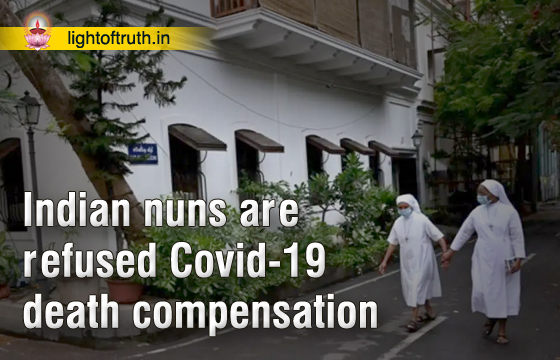
Indian nuns are refused Covid-19 death compensation
Church officials in the southern Indian state of Kerala are upset with the provincial government for refusing to pay financial compensation to Catholic nuns who died of Covid-19.
Authorities declined to pay the Covid-19 death compensation of Rs 50,000 (US$625) each to four nuns belonging to the indigenous order of Sisters of the Destitute (SD).
“I moved the claims for compensation,” Sister Kiran Mandoth, SD, told on July 22. “The officials at the village and district made me run from pillar to post to gather nearly a dozen documents including death certifi-cates. I was made to wait for over a year only to be told that nuns were not eligible for compensation.”
Sister Mandoth said the officials cited no reason for the denial of compensation. “It is not about the money. But are nuns not citizens of India,” she asked.
Father Jacob Palakkappilly, the spokesman of the Kerala Catholic Bishops Council (KCBC), said the provincial government has no right to block humanitarian services to anyone including Catholic nuns, priests or seers, regardless of their religion.
“This is injustice and discrimination against the nuns who are citizens of India,” he said.
The provincial governments were ordered to pay exgratia compensation to families of persons who died of Covid-19 by the Supreme Court of India in October 2021.
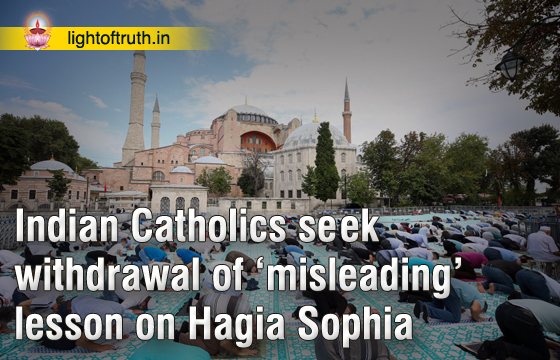
Indian Catholics seek withdrawal of ‘misleading’ lesson on Hagia Sophia
Catholics have questioned the distorted version of the history of Istanbul’s ancient Cathedral Hagia Sophia being taught in schools in communist-ruled Kerala state in southern India.
Fr Jacob G Palakkappilly, spokesman of the Kerala Catholic Bishops Council (KCBC), said “it is quite disturbing to note that students in Class Seven were being taught a false history of one of the world’s greatest Byzantine monuments originally built as a church.”
The Hagia Sophia was built in the 6th century and is also known as the Church of the Holy or Divine Wisdom, and in subsequent centuries became a mosque, a museum, and a mosque again two years ago.
The textbook for Class Seven in Kerala has a lesson under the title, “Europe in the path of trans-formation,” which described the ancient cathedral as a “historical monument” but hid the fact that it was originally a Christian church that was turned into a mosque, the priest told on July 20. “When you teach history, you need to explain who, what, when, where, and how”
Government officials said it was an old lesson that needed to be updated. But Christian leaders said it amounted to wiping out a crucial part of history involving the contributions of Christians in building the historical cathedral.
“Why did the government safely bury its Christian connection,” asked Father Palackkapilly.

Church TV channel organizes Gospel Singer Reality show
Indore, July 26, 2022: One of the popular religious channels of northern India is organizing a Gospel Singing Reality show to recognize choir members of the region.
“It was my dream to give a bigger platform for the choir members of North India. Some of them are at the service of the Church for some 25 years. Their role in the liturgy is as important as the priest minister,” says Fr Anand Chirayath, the founder director of Atmadarshan (inner vision), which is organizing the show.
Online and offline auditions were held April 23 to May 5 where 250 Christian musicians from ten states and 30 dioceses in northern India attended. Among them, 50 singers were selected for the first round that was held July 13-14 at Atmadarshan Studio in Indore, the commercial capital of Madhya Pradesh. After evaluation by the panelists and online voting, 30 will be selected for the second round scheduled for Aug 13-14.
The semi-final and final will also be held at Atmadarshan. Around 20 people will be selected for the semi-final and 10 from them for the final.
The oldest participant of the show is 67-year-old Ravindra Gupta from Bhopal, capital of Madhya Pradesh. He has been into the parish choir for more than 40 years.
Father Chirayath says the reality will give the choir members to be known beyond their parish churches and dioceses.
Fr Chirayath says he and Fr Selvin Ignatius, assistant director of Atmadarshan, traveled almost 6,000 km and conducted auditions in 15 cities of eight north Indian states in 12 days.
The first round also felicitated some renowned Catholic, non-Catholic and non-Christian musicians who have enriched the North Indian Christianity.
Holy Spirit Sister Pushpanjali, who has written and composed more than 180 songs for the Catholic liturgy, was the guest of honor in the show.
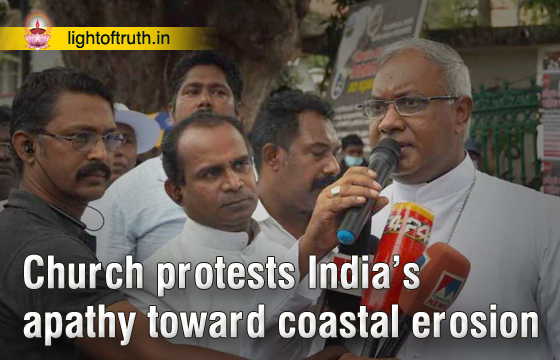
Church protests India’s apathy toward coastal erosion
Two Catholic bishops led some 100 priests and thousands of lay people as they launched an indefinite protest against government apathy toward the rehabilitation of families affected by coastline erosion in the Archdiocese of Trivandrum in the southern Indian Kerala state.
The life of common people, especially the fisher people, had become miserable due to the continued onslaught of natural calamities and disasters, said Archbishop Thomas J Netto of Thiruvananthapuram while leading the protest in front of the state secretariat on June 20.
Archbishop Netto lamented that the communist-led state government ignored their pleas for rehabilitation of the affected people and a permanent solution to coastline erosion.
The protest initiated by the Latin-rite archdiocese witnessed a huge turnout of laypeople including those from the fishing community living along the state’s coastline.
“We have at least 500 families who lost everything and have taken refuge with relatives and friends, besides the local schools and warehouses,” Auxiliary Bishop Christudas Rajappan told.
A 2018 study by India’s National Centre for Earth Science Studies showed that 60 percent of Kerala’s coastline was under erosion due to urbanization, tourism, development of new ports and “unscientific shoreline protection methods” that have caused the beaches to become unstable.
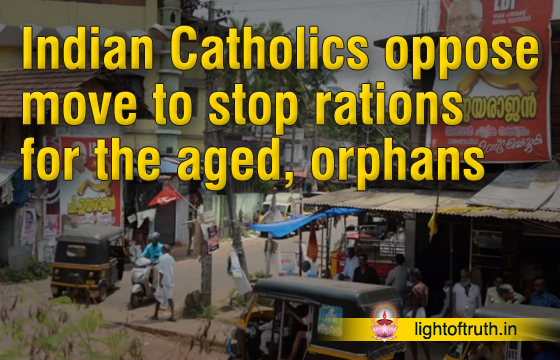
Indian Catholics oppose move to stop rations for the aged, orphans
Catholics in the southern Indian state of Kerala have launched a signature campaign against a reported move by its communist rulers to withdraw a government supply of food items to homes for the elderly and orphanages.
“It is a highly condemnable act,” said P.P. Joseph, president of the Catholic Congress in Changanassery Archdiocese, after launching the campaign at a local old people’s home on July 10.
The signatures with an appeal to not abandon the aged and orphans will be handed to Indian Prime Minister Narendra Modi and Kerala Chief Minister Pinarayi Vijayan, he said.
The signature campaign was initiated in response to an appeal from the Commission for Social Harmony and Vigilance of the Kerala Catholic Bishops’ Council.
“More than 100,000 inmates in 1,800 old people’s homes and orphanages in the state are going to be deprived of food supplied through the public distribution system,” said Father Michael Pulickal, CMI, secretary of the commission.
The Kerala government decided to discontinue the supplies though “verbal instructions to this effect to officials,” the priest alleged.
“The Catholic Church opposed the decision then and will continue to oppose this latest decision too”
The priest claimed to have got the information from reliable sources in the state’s social welfare and public distribution departments. The reason given was that the federal government had withdrawn its support for the free ration scheme in the state.
Government officials remained tight-lipped. A senior official told on July 11 that the government has “enough storage of food grains.”
The official, who did not want to be named, also denied any official information about the alleged move to discontinue food supplies.
Father Pulickal, though, appealed to the provincial government to reverse the decision and reminded of an earlier decision to withdraw the social security pension of residents at old people’s homes in the state in August 2021.