Category Archives: National

Five Catholic universities to address future of India’s higher education

Kolkata will host a national colloquium on “Future of Christian Higher Education and Contemporary Transitions in India” on November 16 to launch the 80th year of Salesian College Sonada.

“For the first time, the colloquium will witness five Catholic universities of India,” Principal of Salesian College Dr George Thadathil told Matters to India on Oct. 22.

The event will be held at Don Bosco School Park Circus in Kolkata.

Father Thadthil adds, “The topic is pertinent in the contemporary educational scenario in India and the rising number of subtle attempts in the saffronization of educational establishments in the country.”

He expressed the hope that, “the colloquium while exposing the alarming trends in higher education will also inspire a growing number of Christian Institutions of educational excellence to upgrade them- selves to serve minorities and marginalized groups.” Salesian College Sonada, Darjeeling with a campus in Sliguri planes, a constituent college of North Bengal University, has applied for Autonomous status since two years. The Catholic Universities invited to participate in the colloquium include: Assam Don Bosco University Guwahati, Christ University Bangalore, St Xavier University Bhubaneswar, St Xavier University Kolkata, and St Joseph University Kohima, Nagaland.

The colloquium will discuss topics such as: Mission in Higher Education and Contemporary Transitions in India; Church’s Social Concern and Challenges from Corporates in Higher Education.

Among the speakers are: Chancellor of Don Bosco Univeristy Fr V.M. Thomas; Former Principal of Delhi’s St Stephen’s College Dr Valson Thampu; Vice-Chancellor of Christ University Dr Thomas C. Mathew; Professor of Eminence in Sociology & HoD Social Work Tezpur Central University Dr Virginius Xaxa; and Jesuit Higher Education Commission Coordinator Dr Xavier Alphonse.

Indian bishop asks govt to protect Rohingya refugees

Bishop Ivan Pereira of Jammu–Srinagar in northern India has asked the national government to ensure the safety of Muslim Rohingya refugees threatened by right-wing Hindu groups.

Death threats have caused more than 1,200 Rohingya to flee from the Jammu region where they have been sheltering since 2012 when ethnic violence flared in Buddhist-majority Myanmar. Jammu and Kashmir, the only Muslim-majority state in India, has long endured a violent secessionist conflict involving local Muslims who want the region to become fully independent or join with Pakistan. Jammu–Srinagar Diocese covers the entire State of Jammu and Kashmir. Some Hindu groups fear the presence of Rohingya could exacerbate the internal violence.

Bishop Pereira stressed that it was strife in Myanmar’s Rakhine State that forced them to leave their homes. The Indian federal government has announced plans to deport roughly 40,000 “illegal” Rohingya from India. Of the state’s 12.5 million people, the Jammu region has roughly 6 million people, 62% of them Hindus and the rest nearly all Muslims.

Tribal organisation rallies against amendment in Land Act, conversion law

A tribal organisation held a rally in Ranchi on Oct. 23 against the Jharkhand government’s Anti-Conversion Bill and its proposed amendments in the 2013 Land Acquisition Act. The Adivasi Sengel Abhiyan (ASA) organised the rally at Morabadi ground of Ranchi. “The government’s policies are anti-tribal. The state government is working against the sentiments of indigenous and tribal people. There is need to fight against the wrong policies of the state government,” Salkhan Murmu, president of AASA, said at the rally.

He said “The Anti-conversion Law and Amendment in the 2013 Land Acquisition Bill by the state is a cruel joke. We oppose both actions of the state government.” The BJP-led Jharkhand government has passed the Religious Independence Bill 2017. If a person is found guilty of converting a person then he will be liable to three years imprisonment. The state government has passed from the assembly to amend the 2013 Land Acquisition Act so that land can be acquired for industrial and other purposes. Tribal people numbering around 10,000 participated in the rally.

South Asian Jesuits call for joint effort to improve tolerance

South Asian Jesuits are seeking collaboration with secular groups and marginalized people to make the region more tolerant and peaceful. ‘Collaboration and network for harmony’ was the theme that 112 leaders of Jesuits in Social Action (JESA) discussed on October 13-15 in Pune, western India. Program organizer and JESA secretary Father Stanislaus Jebamalai told ucanews.com the meeting focused on the ideals of freedom, justice and tolerance. JESA was started in 1973 to coordinate the work of Jesuit social workers in South Asia. The Pune gathering came two months after the Jesuit Conference of South Asia circulated a document that stressed South Asian nations were struggling against economic inequalities, caste discrimination and cultural hegemony. The statement noted that in India and Pakistan fundamentalist forces threatened religious minorities as well as progressive individuals and organizations.

Arunachal Christians upset as govern-ment promotes only indigenous faith

Two months after the BJP-led government of Pema Khandu had announced its decision to set up a separate department for protection and preservation of indigenous faiths and culture of the state, the Arunachal Christian Forum (ACF) has asked the government to roll back the decision “because it is clear favour for and promotion of one particular faith.”

“The state government is trying to show clear favour to and thereby promote one particular faith, which is gross violation of Article 27 of the Constitution. Ours is a secular country and the state cannot promote one particular faith by using tax-payers’ money,” Toko Teki, general secretary of the Forum said.

Speaking on the telephone from Itanagar, Teki also said that while the Arunachal Christian Forum had already submitted a memorandum to the chief minister several weeks ago, it has now decided to set a deadline of October 25 for the government to make its stand clear. “If we do not get any positive response from the government, then we will resort to a series of peaceful protests. We have already given an ultimatum to the chief minister on October 13,” Teki told The Indian Express.

VARIETY OF CATHOLIC RITES IN INDIA IS NOT THREAT TO UNITY, POPE SAYS

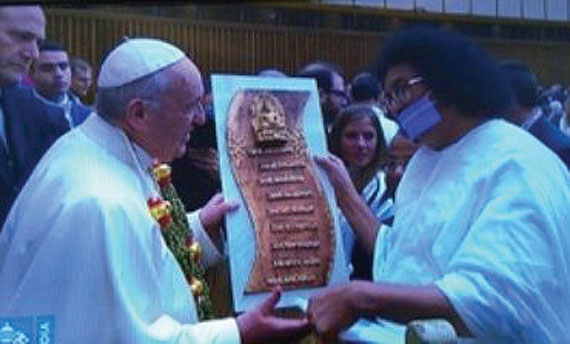
For centuries, Catholics in India have drawn support from and expressed their faith through the liturgies, traditions and spiri-tualities of three different rites; Pope Francis said it is time that all of them, no matter where they live in the country, have their own bishops.

The Vatican announced on 10 October that Pope Francis had created two new eparchies, or dioceses, for the Syro-Malabar Catholic Church and extended the boundaries of two others. A letter from Pope Francis to all the bishops of India explained the move.

Close to 20 million Catholics live in India; the Syro-Malabar Catholic Church has about 4.2 million members and the Syro-Malankara Catholic Church has about 450,000 faithful.

“In India, even after many centuries, Christians are only a small proportion of the population and, consequently, there is a particular need to demonstrate unity and to avoid any semblance of division,” Pope Francis wrote. But the different Catholic rites do not have to be a sign of division when they are, in fact, “a treasure” for the church.

“I have therefore authorized the Congregation for the Oriental Churches to provide for the pastoral care of the Syro-Malabar faithful throughout India by the erection of two Eparchies and by the extension of the boundaries of the two already in existence” Pope Francis wrote.

“I decree also that the new circumscriptions, as with those already in existence, be entrusted to the pastoral care of the Major Archbishop of Ernakulam-Angamaly and to the Synod of Bishops of the Syro-Malabar Church, according to the norms of the Code of Canons of the Eastern Churches.”

“This is a historic move,” said Fr Paul Thelakat, a senior priest of the church and its former spokesperson. “It removes administrative restrictions imposed on the church by Portuguese missionaries since the 16th century.”

Kandhamal’s violence-hit Christians continue to inspire

Catholic women leaders have drawn inspiration from the faith shown by survivors of the violent anti-Christian Kandhamal attacks when they recently visited the region in the eastern Indian State of Odisha.

On Oct. 5 a group of 20 women visited the remote, impoverished area of Odisha where villagers were attacked by rampaging Hindu nationalists in late August 2008, leaving 100 people dead and thousands homeless. They were the worst attacks on Christians in India’s history.

The women were among 50 leaders from across India who had gathered in Bhubaneswar, capital of Odisha, for a conference organized by the Indian bishops’ Commission for Women. The conference, held from Sept. 30 to Oct. 4, discussed the role of women in the family.

“I am strengthened in faith after visiting the region,” said Rosemary Sahayam from Madhya Pradesh in central India. “How families continue to live in faith and confidence even after their relations were killed for their faith is truly inspiring.”

The anti-Christian violence engulfed more than 600 villages. Those killed included the disabled and elderly people, children and women. Several rapes were reported, including that of a Catholic nun. More that 350 churches and 6,500 houses were looted and burned down during the attacks leaving 56,000 people homeless.

The anti-Christian attacks were fuelled by the gunning down on Aug. 23, 2008 of a Hindu spiritual leader, Swami Laxmanananda Saraswati, 85, and four of his associates. Hindu extremists blamed Christians for the murders even though Maoists claimed responsibility for the deaths.

Archbishop condemns Hindu leader’s comments on Mother Teresa

Archbishop Thumma Bala of Hyderabad condemned the false accusations and derogatory comments made by Hindu leader Swami Paripoornananda Saras-wathi against Mother Teresa in a recent television debate.

A Telugu Channel based in Hyderabad on Sept 22 broadcast a debate between Swami Paripoornananda Saraswathi, Head of Sreepeetham at Kakinada in Andhra Pradesh, and Dalit rights activist Professor Kancha Illaiah regarding the caste controversy and protests around Illaiah’s new book.

Swamiji diverted the topic calling Professor Illaiah “a foreign agent” and dragged Christianity and Mother Teresa into the debate. He alleged that “Mother Teresa organized the illegal trafficking of 50,000 women, making them work as nuns after converting them to Christianity.”

The Archbishop said the comments of Paripoornananda Swamiji were totally uncalled for as “the subject of the discussion was something different. It was not necessary for Swamiji to speak of the Pope and Mother Teresa.”

History is being distorted: Goan priest

Catholic priest and theologian Dr Victor Ferrao has said that history is being distorted by upper caste Hindus to promote their views.

Giving an example of such distortion, Dr Ferrao said the battle of Cuncolim gaunkars was a battle to safeguard their interest, but the same is now being promoted as the first battle for India’s Independence.

Speaking to around 50 Social Action Team members from four parishes, Dr Ferrao asked: “When did the Goan Konknno become a Hindu?” driving home the point that the Hindutva philosophy of RSS promoted aggressively by the Bharatiya Janata Party is causing communal disharmony in the country and the State.

He said the growth of the BJP is directly connected with globalization of the economy as it is only after globalization in 1991 that the BJP began emerging stronger.

“Globalisation made Indians rootless and hence they became more religious thus giving rise to religious fundamentalism,” he said and added that while Catholic religion is based on hope, Hindutva thrives on fear and that is why fear is palpable in the society today.

Believers Church barred from receiving foreign funds

The Ministry of Home Affairs (MHA) has cancelled the FCRA registrations of the Believers Church and three of its affiliates — Ayana Charitable Trust (formerly Gospel for Asia India), Love India Ministries and Last Hour Minis-try. These NGOs are among 4,864 organisations that lost their FCRA registrations during 2017, according to the MHA website.

The church authorities, however, said the registrations were subject to renewal.

The Believers Chu-rch, founded by K P Yohannan, and associated organisations had received a whopping Rs 1,348.65 crore as foreign aid last financial year. During FY16, Ayana Charitable Trust (formerly Gospel For Asia) was the single largest recipient of foreign aid in the country as it received Rs 826.27 crore. Believers Church had received Rs 342.64 crore, Last Hour Ministry Rs 103.51 crore and Love India Ministries Rs 76.23 crore during FY16.