
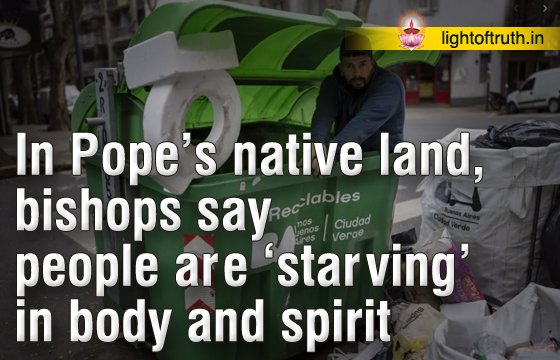
As Pope Francis’s native Argentina finds itself on the brink of hyperinflation and led by a president and vice president in a public dispute, the country’s bi-shops say the people are “starving,” hungry both in body and spirit.
“Today our homeland is a hungry, bewildered, worried and wounded people. Many families lack daily bread and decent work. Poverty has grown,” said Arch-bishop Carlos Alberto Sánchez of Tucuman on Saturday, July 9.
“There is hunger for justice and dignity, for respect and care for life in all its stages. There is hunger for social peace, respect for the constitution and authentic democracy.”
“There is hunger for dialogue, encounter and participation to overcome divisions and confrontations. There is a hunger for truth, for an education that puts the human person in first place, that does not impose ideologies, that leads to thinking and realizing oneself with dignity,” he said.
“There is a hunger for freedom and for a more secure and cordial life. There is a hunger for trust and joint work among all for the good of all. There is hunger for hope and consolation… There is hunger for fraternity and love,” saud Sánchez.
Category Archives: International
Pope to Ukrainian Bishops: ‘Stay close to your flock’
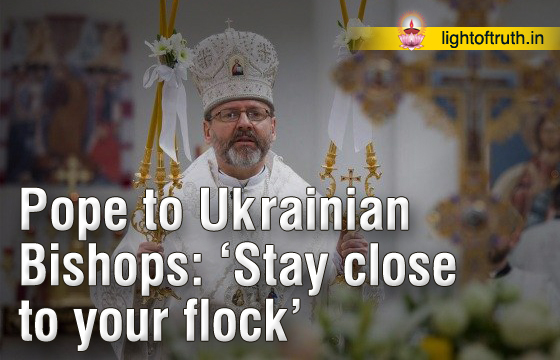
Pope Francis has urged the Ukrainian Greek Catholic Bishops to be shepherds of their flock and to be close to the faithful entrusted to their care, giving them courage and hope.
The Ukrainian Bishops are holding their annual Synod to discuss the theme of synodality in their Church. The meeting, running from 7-15 July, had to be moved from Kyiv to Przemysl, in Poland, due to the ongoing war in Ukraine. In a letter addressed to the Major Archbishop of Kyiv-Halych, Sviatoslav Shevchuk, head of the Ukrainian Greek Catholic Church (UGCC), the Pope first of all reiterated his prayers and closeness to the Ukrainian people enduring the war waged by Russia against their country.
European bishops hit back against resolution on abortion
Europe’s top body of bishops has condemned the European Parliament’s favourable vote Thursday, July 7, on a resolution calling for access to abortion to be included in the E.U. Charter of Fundamental Rights.
The resolution, titled, “European Parliament resolution on the US Supreme Court decision to overturn abortion rights in the United States and the need to safeguard abortion rights and women’s heath in the EU,” also condemns the United States’ Supreme Court’s decision last month to overturn legislation protecting federal abortion rights.
The resolution was adopted with 324 votes in favour, 155 against, and 38 abstentions.
In a July 8 statement, Father Manuel Barrios Prieto, General Secretary of the Commission of the Bishops’ Conferences of the European Union (COMECE), voiced regret for the resolution, which he said, “paves the way for a deviation from universally recognized human rights and misrepresents the tragedy of abortion for mothers in difficulties.”

Webb telescope images feed the mind and spirit, Jesuit astronomer says
The Jesuits at the Vatican Observatory were wowed like most people by the beauty of the photos from NASA’s James Webb Space Telescope, but the director said they also are excited by the scientific information the telescope will reveal. “Such images are a necessary food for the human spirit — we do not live by bread alone — especially in these times,” said Jesuit Brother Guy Consolmagno, the observatory director, after NASA released a first batch of images from what the space agency describes as “the largest, most powerful space telescope ever built.”
“The images are gorgeous, as anyone can see for themselves,” Consolmagno said. “It’s a tantalizing glimpse of what we’ll be able to learn about the universe with this telescope in the future.”
NASA described Webb’s mission as studying “every phase of 13.5 billion years of cosmic history — from within our solar system to the most distant observable galaxies in the early universe, and every-thing in between.”
“The science behind this telescope is our attempt to use our God-given intelli-gence to understand the logic of the uni-verse,” Consolmagno said. “The universe wouldn’t work if it weren’t logical. But as these images show, the universe is not only logical, it is also beautiful.”
“This is God’s creation being revealed to us, and in it we can see both his astonishing power and his love of beauty,” the Jesuit said. The Vatican Observatory director also noted that “astronomy is a small field,” so he knows many of the scientists who helped build the instruments on the telescope and plan its observations.
Their years of effort, he said, “is a tribute to the power of the human spirit, what we can do when we work together.”
“And at the same time,” he said, “I am amazed and grateful that God has given us humans, his creation, the ability to see and understand what he has done.” Pointing to the telescope’s “first spectrum of water vapor in the atmosphere of an exoplanet,” a planet that orbits a star outside the solar system, Consolmagno reminded readers of one of his Jesuit-scientist predecessors.
Pope Francis says becoming pope made him less rigid and more merciful
Pope Francis said the goals he has achieved in more than nine years as pope were simply the fruit of the ideas discussed by the College of Cardinals prior to his election. In an interview with Argentine news agency Télam published July 1, the pope said that objectives, such as the reform of the Roman Curia, were “neither my invention nor a dream I had after a night of indigestion.”
Nigerian bishop says country ‘worse off’ now
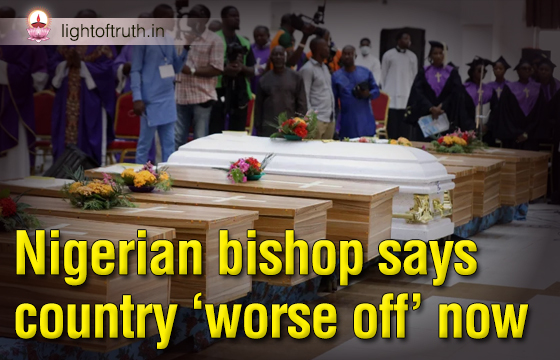
While the Catholic Church continues to play its part in helping people in Nigeria, the policies of the current government obstruct a clear path toward peace and reconciliation between Christians and Muslims, said Bishop Matthew Hassan Kukah of Sokoto, Nigeria. Addressing a virtual conference on peacebuilding, hosted by the Kroc Institute for International Peace Studies at the University of Notre Dame, Kukah said the rise of banditry and violence in Nigeria “has taken over and consumed a lot of the gains we have made” in building peace.
“Just to tell you how little progress we have made, we still have a military general as our president. And, therefore, it is little wonder that this journey has proven to be a challenge and a source of great difficulty for our people,” he said June 20. Attacks against Christians, especially Catholics, have been on the rise in the country. On June 5, gunmen entered St. Francis Xavier Church in Owo, killing at least 50 people and leaving dozens wounded.
Most recently, gunmen attacked churchgoers June 20 at St. Moses Catholic Church as well as a neighboring Baptist church in the northern state of Kaduna, killing three and kidnapping 40 people.

I Plant Secret House Churches Because I Was Saved into One
“I was raised in a Muslim family in Tehran, Iran. My mother was a teacher and the principal of an elementary school. She knew a lot about Islam and did her best to follow its teachings. She helped me learn to read the Qur’an, taught me to pray at least three times a day, and encouraged me to fast during Ramadan.” says Nathan Rostampour
“As a young Muslim, I had been taught that the Bible was corrupted, that the version we read today is a distortion of its original contents. But as I listened to this woman read from Scripture, I felt something of its power—and I felt sure that a book capable of grabbing my heart that intensely couldn’t be corrupted after all.”
Typically, my mother would get offended if someone disagreed with her Islamic values. On that day, however, something surprising happened. Instead of fighting back, she listened peace-fully and asked questions. There wasn’t a trace of defensiveness; it appeared that she simply wanted to know the truth.”
“One year after I gave my heart to Jesus, my father died of cancer. It was a great sadness for our family. But he had become a great believer, and in his last days, he was praising Jesus on his bed, even during the toughest moments of chemotherapy. I remember sitting by his bed and reading the Bible for him. Afterward, I would pray for God’s healing touch. And my father would raise his hands to show that he was praying and worshiping alongside me.”
“Meanwhile, my wife and I host a weekly Christian fellowship on Instagram for Persian-speaking people in secret house churches in places like Iran, Afghanistan, and Tajikistan. People tune in from all over the world, and we worship God together and pray for each other.” Nathan Rostampour is a church planting pastor and a leadership coach and serves with The Summit Church in Raleigh-Durham, North Carolina.
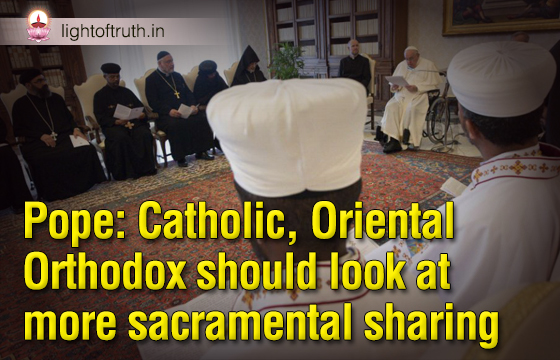
Pope: Catholic, Oriental Orthodox should look at more sacramental sharing
The theological dialogue between the Catholic Church and the Oriental Orthodox Churches has reached a point where it seems appropriate to consider expanding the opportunities for the faithful of any of the churches to receive the sacraments from one another when they are not available in their own community, Pope Francis said.
“Based on the theological consensus noted by your commission, would it not be possible to extend and multiply such pastoral arrangements, especially in contexts where our faithful are in minority and diaspora situations?” the pope asked members of the Joint International Commission for Theological Dialogue between the Catholic Church and the Oriental Orthodox Churches.
Welcoming the commission members June 23, Francis said that “ecumenism always has a pastoral character” and is not simply about theological ideas.
“Among our churches, which share apostolic succession, the broad consensus revealed by your commission not only about baptism, but also other sacraments, should encourage us to deepen a ‘pastoral ecumenism,’” he said.
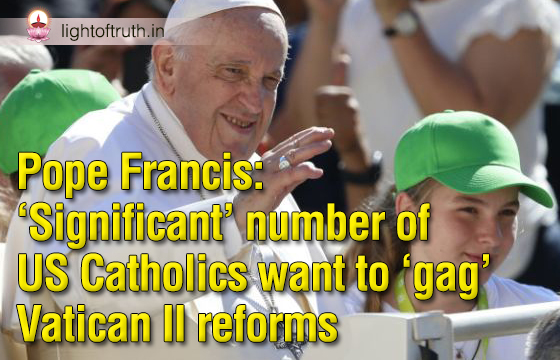
Pope Francis: ‘Significant’ number of US Catholics want to ‘gag’ Vatican II reforms
The United States contains a “significant” number of groups seeking to “gag” the reforms of the Catholic Church initiated by the Second Vatican Council, Pope Francis said in a new interview.
“In the European Church I see more renewal in the spontaneous things that are emerging: movements, groups, new bishops who remember that there is a Council behind them,” said Francis in a conversation with the editors of Jesuit journals of Europe.
“Restorationism has come to gag the Council,” he continued. “The number of groups of ‘restorers’ — for example, in the United States there are many — is significant.”
The conversation between the pope and the editors took place on May 19 and a transcript of the encounter was published in the Jesuit journal La Civiltà Cattolica on June 14.
Over the last year, Pope Francis has instituted a number of reforms meant to serve as a correction to Catholics who have rejected the teachings of the Second Vatican Council.
Among the reforms of Vatican II, which took place from 1962-1965, was the approval of the translation of the liturgy from Latin into vernacular languages, in an effort to make the Mass more accessible and involve greater participation of the laity.
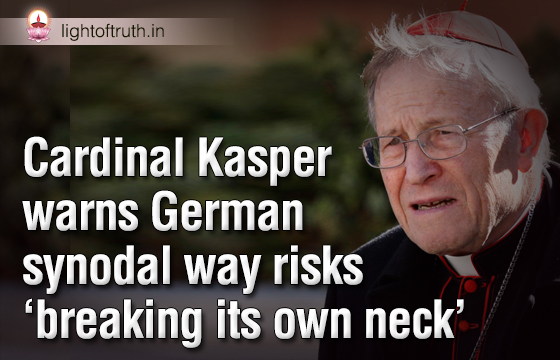
Cardinal Kasper warns German synodal way risks ‘breaking its own neck’
A theologian considered close to Pope Francis has warned that the German Synodal Way is at risk of “breaking its own neck” if it does not heed the objections raised by a growing number of bishops around the world.
Cardinal Walter Kasper also said organisers were using a “lazy trick” that in effect constituted a “coup d’etat” that could result in a collective resignation, reported CNA Deutsch, CNA’s German-language news partner.
The 89-year-old German cardinal is President Emeritus of the Pontifical Council for Promoting Christian Unity, and was Bishop of Rottenburg-Stuttgart from 1989 to 1999.
He spoke at an online study day on June 19 of the initiative “New Beginning” (Neuer Anfang), a reform movement critical of the Synodal Way.
Kasper warned that the Church was not some substance to be “remoulded and reshaped to suit the situation”.
In April, more than 100 cardinals and bishops from around the world released a “fraternal open letter” to Germany’s bishops, warning that sweeping changes to Church teaching advocated by the process may lead to schism.
In March, an open letter from the Nordic bishops expressed alarm at the German process, and in February, a strongly-worded letter from the president of Poland’s Catholic bishops’ conference raised serious concerns.
Such concerns “will be repeated and reaffirmed and, if we do not heed them, will break the neck of the Synodal Way,” Kasper warned in his speech.
It was “the original sin of the Synodal Way” that it did not base itself on the pope’s letter to the Church in Germany, he said, with its “proposal of being guided by the Gospel and the basic mission of evangelization”.
Instead, the German process, initiated by Cardinal Reinhard Marx, “took its own path with partly different criteria”, Kasper said.