
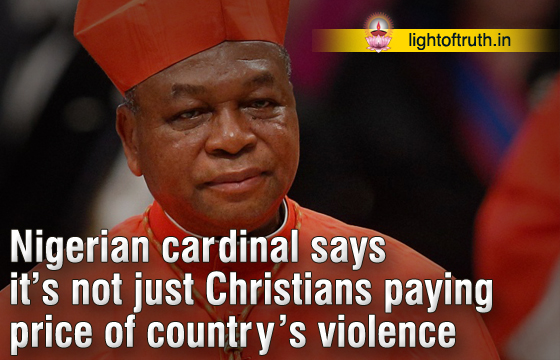
According to the former top Catholic official of Nigeria’s capital city, the violence in the country is “getting out of hand.” It’s not only Christians paying the price, he said. None of the country’s 200 million people are safe. “There is great insecurity throughout the country, people are being killed every day; bandits and terrorists seem to have a free hand,” said Cardinal John Onaiyekan, archbishop emeritus of Abuja. “We don’t know where the security forces are.”
“No one is safe, not just Christians. It is as if the government has lost control.” The country has presidential and parliamentary elections scheduled for February and March 2023.
According to the prelate, both Christians and Muslims are victims of violence, perpetrated by criminals who “go around illegally killing innocent people.”
Speaking on the occasion of the XIX Plenary Assembly of the Symposium of the Bishops’ Conference of Africa and Madagascar (SECAM), which ended on July 31 in Accra, Ghana, Onaiyekan said his country has been experiencing “indiscriminate” violence since the rise of Boko Haram in 2009.
The insurgency group is one of the largest Islamic terrorist organizations, and their stated goal is to turn Nigeria into an Islamic state, much like ISIS tried to do in Iraq.
Category Archives: International

Pope Francis on birth control: Can the teaching of the Church on contraception change?
Can the Church’s teaching on birth control change? During Pope Francis’ return flight from Canada, a journalist asked him about the possibility of a development in the Church’s teaching on contraception.
“This is very timely. But know that dog-ma, morality, is always in a path of development, but development in the same direct-ion,” Pope Francis responded on July 30.
The pope went on to say that he thinks that the development of Catholic moral doctrine, in general, is fine but recommended in particular that it follows the rules outlined by the 5th-century theologian St. Vincent of Lérins.
Pope Francis explained that St. Vincent of Lérins taught “that true doctrine in order to go forward, to develop, must not be quiet, it develops ut annis consolidetur, dilatetur tempore, sublimetur aetate.”
“That is, it consolidates with time, it expands and consolidates, and becomes more steady, but is always ‘progressing.’ That is why the duty of theologians is research, theological reflection. You cannot do theology with a ‘no’ in front of it … the magisterium will be the one to say no,” the pope added.
Francis also addressed the recent controversy over a book published by the Vatican’s publishing house, which discussed “the possible legitimacy of contraception in certain cases.”
The book “Theological Ethics of Life: Scripture, Tradition, and Practical Challenges” was a 528-page synthesis of a theological seminar sponsored by the Pontifical Academy for Life in 2021.
Pope Francis said: “On the issue of contraception, I know there is a publication out on this issue and other marriage issues.”
“These are the proceedings of a congress and in a congress there are hypotheses, then they discuss among themselves and make proposals. We have to be clear: those who made this congress did their duty because they tried to move forward in doctrine, but in an ecclesial sense, not out, as I said with that rule of St. Vincent of Lerins.”
On the subject of birth control, the Catechism of the Catholic Church states that “legitimate intentions on the part of the spouses do not justify recourse to morally unacceptable means (for example, direct sterilization or contraception).”
St. Paul VI issued Humanae Vitae, the landmark encyclical reaffirming Church teaching against contraception, on July 25, 1968.
Lambeth Conference’s opening Sunday Eucharist stresses service, hospitality
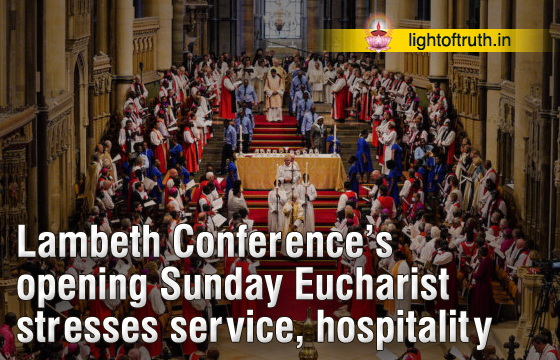
Episcopal and Anglican bishops and their spouses filled Canterbury Cathedral on July 31 for the opening Sunday Eucharist of the Lambeth Conference.
The service spanned several hours and was marked by prayer and pageantry in a worship space with more than 1,400 years of history that was described in a welcoming message as “the heart of our communion.”
More than 600 bishops representing an estimated 165 countries are attending the July 26-Aug. 8 conference.
Archbishop of Canterbury Justin Welby, head of the Anglican Church, convened the Lambeth Conference of Anglican bishops. Standing just inside the cathedral door, Archbishop Welby offered an opening prayer, seeking unity among bishops in their shared faith despite individual differences.
“Let us pray earnestly for God’s blessing upon those who are gathered here,” the archbishop said, “that through our discussions and our walking together we may grow into a deeper understanding of one another and a deeper love for the world Jesus Christ came to save.”
The Lambeth Conference is a decennial assembly of bishops of the Anglican Communion convened by the Archbishop of Canterbury. The first such conference took place at Lambeth in 1867.
As the Anglican Communion is an international association of autonomous national and regional churches and is not a governing body, the Lambeth Conferences serve a collaborative and consultative function, expressing “the mind of the communion” on issues of the day.
Lambeth is a riverside area home to Lambeth Palace, the residence of the Arch-bishop of Canterbury.
This is the 15th Lambeth Conference and the first in 14 years, after past conferences typically were held once a decade. Welby initially postponed calling his first Lambeth Conference by two years due to theological divisions between some of the provinces, and his plans to hold the conference in 2020 were delayed by another two years because of the Covid-19 pandemic.
The last Lambeth Conference was in 2008.
The bishops displayed a broad spectrum of colour, nationality and dress, reflecting the diversity of the Anglican Communion’s 42 provinces – four more provinces than existed in 2008.

Cardinal Müller: ‘The German Synodal Way was over before it even started’
Cardinal Gerhard Ludwig Müller, prefect emeritus of the Congregation for the Doctrine of the Faith, has sharply criticized the Synodal Way in Germany.
In an interview, the 74-year-old cardinal said that the Synodal Way, declared a “reform process” by its initiators, is “over” and was on an “anti-Catholic, wrong track.”
The Holy See issued a statement June 21 noting that the Synodal Way was “not authorized” to “oblige the bishops and the faithful to adopt new forms of governance and new orientations of doctrine and morals.” It was “necessary” to clarify this in order to “safeguard the freedom of the people of God and the exercise of the episcopal ministry.”
The Synodal Presidium – consisting of the German Bishops’ Conference and the Central Committee of German Catholics (ZdK) – then accused the Vatican of a lack of willingness to communicate. It stated: “Unfortunately, the synodal presidium has not been invited to a conversation until today. That this direct communication does not take place so far, we regret irritated. Synodal church goes after our under-standing differently! This also applies to the way of today’s communication, which astonishes us. It does not testify to a good style of communication within the Church when statements are published that are not signed by name.”
It was the “birth defect of this body” to set itself up as a vanguard of the Church, he said.
Baby Blues: How to Face the Church’s Growing Fertility Crisis
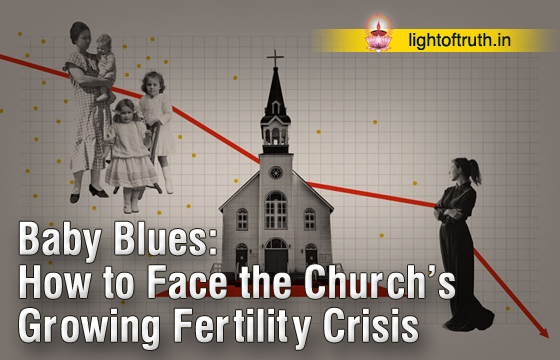
Data from the National Survey of Family Growth (NSFG) from 1982 to 2019, along with data from four waves of the Demographic Intelligence Family Survey (DIFS) from 2020 to 2022, point to a widening gap in fertility rates between more religious and less religious Americans.
In recent years, the fertility gap by religion has widened to unprecedented levels. But while this difference may comfort some of the faithful who hope higher fertility rates will ultimately yield stable membership in churches and synagogues, these hopes may be in vain. Rates of conversion into unfaith are too high, and fertility rates too low, to yield stable religious populations.
As a result, data from over 70,000 women surveyed from 1982 to as recently as 2019 can be used to estimate fertility rates for three broad groups of women: those without any religious affiliation, those with religious affiliation but less than weekly attendance, and those with at least weekly attendance.
It’s evident that birth rates among Americans who attend weekly have never dropped much below 2 children per woman, and as recently as 2008 were around 2.4 children each. Fertility among religious people did decline after the 2008 recession, but by 2017–2019, it was rising again.
Finally, fertility among non-religious women rose considerably from 1982 to 2005, then again from 2008 to 2012, showing a very different pattern than the one we see for religious women.
From 2010 to 2013, non-religious women had about the same birth rates as women who attended religious services less than weekly, before their fertility slumped through 2019.

Bishops must be good listeners, says nun at Vatican who helps select them
While the perfect Bishop does not exist, he does have to be a person who knows how to get others involved in the life of the church and to listen to everyone, including those with whom he may disagree, said a new member of the Dicastery for Bishops.
French Salesian Sister Yvonne Reungoat told Vida Nueva, a Spanish publication re-porting news about the Catholic Church, that “the ideal Bishop does not exist.” But he has to be a shepherd who is “close to the people entrusted to him, he has to know how to involve priests, laity and religious, and people of different generations.”
“The path of synodality” is essential for this process and “it must be the usual way of animating the church to favour collegiality,” she told the publication in an interview published online July 24. Canadian Cardinal Marc Ouellet, who heads the dicastery, once told Vida Nueva that “30% of those chosen to be Bishops reject the appointment.” The publication asked Sister Reungoat what might explain this situation.
“There may be a difficulty in accepting the responsibility of being Bishop of a particular church, with all the joys, challenges and complaints that it entails,” she said.
“That is why I think that, to be a Bishop, one must have the ability to listen, both to those who have the same ideas and to those who protest. Is not easy. Just think of the issue of abuse, which has marked the life of the church in various parts of the world in recent years,” she added.
In mid-July, Pope Francis named 14 new members to the dicastery responsible for helping the pope choose bishops for Latin-rite dioceses outside of the church’s mission territories. For the first time ever, the members included women: two religious and one lay. Before Pope Francis’ reform of the Roman Curia took effect in June, members of the dicastery were only cardinals and a few bishops.
Members meet twice a month to review dossiers submitted by Vatican nuncios about potential candidates and to vote on the names they recommend to the Pope.
Sister Reungoat, former superior general of her order, told Vida Nueva it is important for women to have a role in the naming of new Bishops.
Mexican parish to remember victims of violence with 130,000 candles
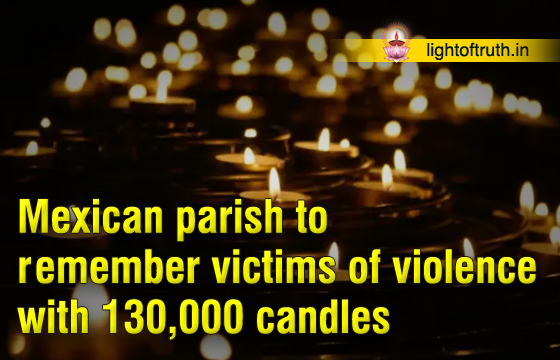
A Mexican parish will remember the victims of violence in the country with 130,000 candles to be lit the night of July 30, as part of the Day of Prayer for Peace called by the Mexican Bi-shops’ Conference.
In a video message, Father Alberto Medel, pastor of Our Father Parish in the Diocese of Xochimilco, south of Mexico City, recalled the Bishops’ conference’s invitation to pray especially on July 31 “for the perpetrators and the civil authorities, so they may open their hearts to this situation of unleashed violence that we are experiencing and that has claimed so many lives and that has caused so much pain.”
In response, the Mexican priest said, his parish seeks to prepare itself to observe that day “with a prayer vigil in which we want to light 130,000 candles” in order to “remember all those who have died in such a violent way and at the same time in such a pointless way.”
The vigil will be held July 30 at 8 p.m. Central time and will be broadcast on the YouTube channels and Facebook pages of Medel, the Diocese of Xochi-milco, the Archdiocese of Mexico, and the archdiocese’s weekly publication Desde la Fe.
According to the local press, in the three and a half years of President Andrés Manuel López Obrador’s administration, nearly 130,000 people have been murdered in Mexico. When the president completes his six-year term, it could be the most violent administration in the history of Mexico. In this same period, seven Catholic priests have been murdered.
According to official figures, from Jan. 1 to July 24 of this year, 14,943 homicides have been committed in Mexico.
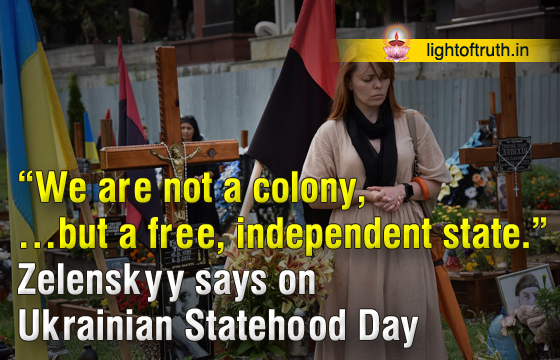
“We are not a colony, …but a free, independent state.” Zelenskyy says on Ukrainian Statehood Day
Ukrainians will fight for their statehood to the last and will not stop until they liberate the last meter of Ukrainian land, President Volodymyr Zelenskyy said in a video address for Ukrainian Statehood Day July 28.
The day marks the 988 baptism of “Kyivan Rus,” the origin of Christianity in the region, but this is the first year Ukrainians marked Statehood Day, reported Religious Information Service of Ukraine.
Zelenskyy stressed that Ukrainians need neither fireworks nor pomp to show the importance of statehood for the Ukrainian people.
“Today we defend (Ukraine) with weapons in hands. For 155 days in a row,” he said, referring to the Feb. 24 Russian invasion. “We can say that for us, State-hood Day is every day. Every day we fight so that everyone on the planet finally understands: We are not a colony, not an enclave, not a protectorate …not a province, but a free, independent, sovereign, indivisible and independent state.”
Zelenskyy outlined the main historic events that laid the basis for Ukraine’s statehood and noted: “All stages of the history of Ukraine’s statehood, its defense and struggle for it can be described in one sentence: We existed, exist and will exist. We will exist, because our state has incredible sons and daughters who have stood up for its de-fence.”
The United Nations reported July 25 more than 5,200 civilians had been killed and more than 7,000 injured in Ukraine since the war began.

Sydney McLaughlin gives ‘all the glory to God’ after smashing another world record in hurdles
Olympic track and field gold medalist Sydney McLaughlin, who broke her own world record in the 400-meter hurdles at the World Athletics Championships on July 23 in Oregon, is using her time in the limelight to share her Christian faith.
After smashing her previous record set a month ago, she gave all credit to God in a social media post that has since gone viral with over 400,000 likes.
Her 50.68-second finish was the fourth time this year that the 22-year-old New Jersey resident broke the world record in the event.
In an Instagram post following the win, McLaughlin quoted Hebrews 4:16, which describes God’s generosity in giving his people what they need: “So let us come BOLDLY to the throne of our gracious God. There we will receive His mercy, and we will find grace to help us when we need it most.”
In her Instagram caption, McLaughlin added that prayer and hard work “divinely culminated in 50.68 seconds.”
In an NBC Sports interview following her latest victory, McLaughlin was asked how she accomplished her goal. She said, “I’ll have to start off by saying all the glory to God.” She continued by saying that God gave her the strength to achieve this milestone.
McLaughlin is not Catholic, but she grew up in a devout Christian household and attended Union Catholic Regional High School in Scotch Plains, N.J.

Six years after grisly murder, France remembers Father Jacques Hamel
Six years after Father Jacques Hamel was murdered by knife-wielding terrorists while celebrating Mass at his parish church in northern France, locals gathered to commemorate his life and to pray.
“We enter into prayer where Jacques fell, victim of the madness of men,” Archbishop Dominique Lebrun of Rouen said at the suburban Rouen church of Saint-Étienne-du-Rouvray. An eyewitness said the 85-year-old priest twice told the attackers “Begone, Satan!” before they slit his throat.
Three nuns and several parishioners were present when the attack took place. One elderly parishioner was severely hurt when the attackers tried to take him hostage. The two attackers, both 19 years old, were killed by police as they exited the church.
Hamel’s death shocked France and much of the world. Pope Francis offered a Mass for the priest shortly after the attack, calling Hamel a martyr.
In March, four men were convicted of terrorist conspiracy after a three-week long trial. Three of the men convicted received between 8 and 13 years in prison.