
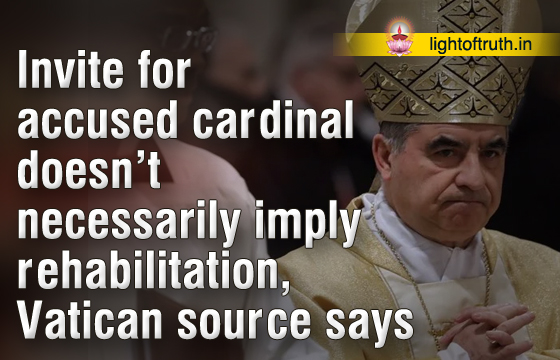
Speaking on background, a Vatican source has said Italian Cardinal Angelo Becciu’s apparent invitation to participate in a high-profile meeting of cardinals next week represents a personal gesture on the part of Pope Francis, but that it does not necessarily mean Becciu’s rights as a cardinal, stripped by the pope two years ago, are being restored. Over the weekend Becciu made headlines for telling attendees of a small, private Mass, which he celebrated Sunday, that he is being “reinstated” by Pope Francis. According to Italian media outlets, Becciu told congregants at Italy’s Golfo Aranci that, “On Saturday, the Pope phoned me to tell me that I will be reinstated in my cardinal duties and to ask me to participate in a meeting with all the cardinals that will be held in the coming days in Rome.”
Category Archives: International

Pope urges new cardinals to be meek, close to their flocks and tender
Calling for the gathered prelates to be meek, faithful, close to their flocks and tender, and to pay attention to both the big and small events of life so people can “savour the presence of Jesus alive in our midst,” Pope Francis created 20 new cardinals Saturday, including 16 eligible to vote for the next pontiff.
“To us, who in the church have been chosen from among the people for a ministry of particular service, it is as if Jesus is handing us a lighted torch and telling us: ‘take this; as the Father has sent me so I now send you’,” Francis told the cardinals. “In this way, the Lord wants to bestow on us his own apostolic courage, his zeal for the salvation of every human being, without exception.”
Francis spoke to the prelates of the “fire” that Jesus “came to bring the earth, a fire that the Holy Spirit kindles in the hearts, hands and feet of all those who follow him.” God himself, Francis said, is a “powerful flame” that “purifies, regenerates, and transfigures all things.”
But there is also a slow-burning fire, the pope said, that of the “charcoal,” which makes God’s presence warm and nourishing for everyday life.
The “fire” that comes from “presence,” he said, was once experimented and shared by Saint Charles de Foucauld, a poor hermit Francis declared a saint earlier this year. He “lived for years in a non-Christian environment, in the solitude of the desert, staking everything on presence: the presence of the living Jesus, in the word and in the Eucharist, and his own presence, fraternal, amicable and charitable,” the Pope said.
Francis listed several examples of that charcoal fire that is present in the “small” things, such as the consecrated who live in the “quiet and enduring fire in their work-place, in interpersonal relationships, in small acts of fraternity. It is also in the unassuming ministry of a parish priest, in the Christian married couples and their “homemade” prayers, and in the elderly, representing “the hearth of memory, both in the family and the life of the community.”
“How important is the fire of the elderly!” he said. “Around it families unite and learn to interpret the present in the light of past experiences and to make wise decisions.”

By the numbers: Consistory keeps expanding variety in College of Cardinals
Pope Francis led a number of major events at the end of August, starting with the creation of 20 new cardinals in St. Peter’s Basilica.
Inducting the appointees into the College of Cardinals at an ordinary public consistory Aug. 27, the Pope will give each new cardinal: a scarlet biretta — the “red hat” — whose colour signifies a cardinal’s willingness to shed his blood for the faith; a gold ring, a sign of their special bond with the church of Rome; and a scroll testifying to his new office and containing the name of his titular church in Rome.
On Aug. 28, the Pope will leave Rome for L’Aquila, 55 miles east of the capital, where he is scheduled to open a seven-centuries-old celebration of forgiveness and meet with the families of those who died in a 2009 earth-quake.
Back in Rome, the Pope then hold an important closed-door assembly with the College of Cardinals Aug. 29-30.
All the world’s cardinals have been invited to attend the consultative session to reflect on the apostolic constitution “Praedicate evangelium” (Preach the Gospel) on the reform of the Roman Curia — a project that has been an important focus of this pontificate.
The Pope will then end the day Aug. 30 with Mass with all the new cardinals and the College of Cardinals in St. Peter’s Basilica.
The Pope convening the world’s cardinals in Rome offers a rare chance for the College of Cardinals to get to know each other and to serve as a consultative body for the Pope.
With 20 new members inducted into the College of Cardinals Aug. 27, Pope Francis will bring up to 132 the number of cardinal electors, and the college as a whole will have 226 members.
Some of the significant characteristics of the college after the Aug. 27 consistory can be seen in numbers:
— The college is elderly. The average age of cardinals today is 78, and the average age among the cardinal electors is 72. Even though nine electors are under the age of 60 and one is 48 years old, nearly three-quarters of the electors are 70 and older. Almost 41% of the entire college is over the age of 80.
— The college is international. Today there are more than 90 countries represented in the entire college and 71 countries among the electors. That’s a notable increase from 2005, when all 117 eligible cardinal electors came from 53 countries.
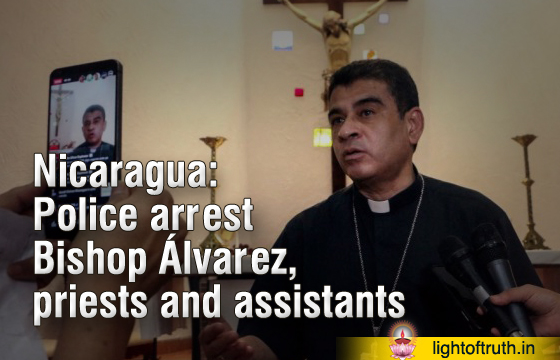
Nicaragua: Police arrest Bishop Álvarez, priests and assistants
Bishop Rolando Álvarez is under house arrest in Nicaragua’s capital Managua after being detained by police August 19 in a pre-dawn raid.
Bishop Álvarez had been confined to his residence for two weeks along with five priests, a seminarian, and a cameraman of a religious television channel. The priests and cameraman have reportedly been put in prison in the capital now, while the Bishop is under house arrest. A police statement said authorities had been waiting for several days for what they called a “positive communication” from the Diocese of Matagalpa, which had not been forthcoming. No formal charges have been announced.

Shia LaBeouf embraces the Catholic faith: Here’s what we know
Shia LaBeouf, an actor known for his roles in such movies as “Transformers” and “Fury,” made headlines this week for the personal details he shared about how his on-screen portrayal of Padre Pio led him to a newfound love of the Catholic faith.
In an 80-minute-long inter-view with Bishop Robert Barron of the Diocese of Winona-Rochester and Word on Fire ministries, LaBeouf spoke at length about his appreciation of the works of St. Augustine and Thomas Merton, his devotion to the Traditional Latin Mass, the peace he feels when he prays the rosary, and his experience receiving the Holy Eucharist for the very first time. “I start feeling a physical effect from it,” he said of going to Communion. “I start feeling a reprieve and it starts feeling, like, regenerative, and [I] start enjoying it to such a degree I don’t want to miss it, ever.”
Though revelatory — and perhaps surprising, coming from a major Hollywood star — the interview didn’t conclusively answer a question many of his Catholic fans are asking: Has Shia LaBeouf formally “converted to Catholicism,”
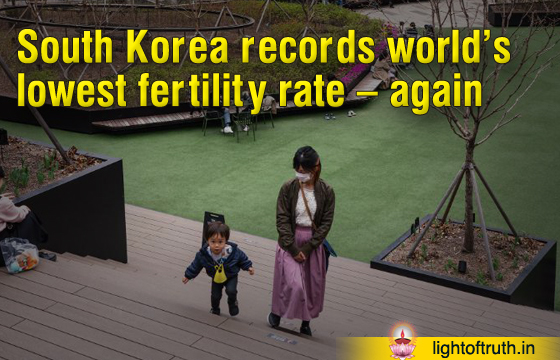
South Korea records world’s lowest fertility rate – again
South Korea has broken its own record for the world’s lowest fertility rate, according to official figures released Wednesday, as the country struggles to reverse its years-long trend of declining births.
The country’s fertility rate, which indicates the average number of children a woman will have in her lifetime, sunk to 0.81 in 2021 — 0.03% lower than the previous year, according to government-run Statistics Korea.
To put that into perspective, the 2021 fertility rate was 1.6 in the United States and 1.3 in Japan, which also saw its lowest rate on record last year. In some African countries, where fertility rates are the highest in the world, the figure is 5 or 6.
South Korea’s birth rate has been dropping since 2015, and in 2020 the country recorded more deaths than births for the first time — meaning the number of inhabitants shrank, in what’s called a “population death cross.”
And as fertility rates drop, South Korean women are also having babies later in life. The average age of women that gave birth in 2021 was 33.4 — 0.2 years older than the previous year, according to the statistics agency.

Young Sudanese woman to be stoned to death
A court in Sudan has sentenced a 20-year-old woman to be stoned to death for alleged adultery.
The judgment comes as violence toward girls and women soars in the wake of last year’s military coup.
Civil society and human rights groups in Sudan and beyond have called for the abolition of the obligatory sentence of stoning to death under the 1991 Sudan Criminal Act.
The young woman’s trial, which did not meet recognized international standards, took place in Kosti city, White Nile State in July. Human rights advocates say accusations of adultery and blasphemy are often motivated by revenge, rather than based on fact.
The previous Islamist regime of Field Marshall Omar Bashir was overthrown in 2019. Democracy activists hoped Sudan’s penal code would be reformed in line with international standards and conventions.
However, a coup in October 2021 put the military and Islamist traditionalists back in effective control. Consequently, there has been a climate of impunity for those attacking women and girls challenging traditional roles by leaving their homes to go to school or work, or to be involved in civil society.
Until recently, rape victims could be charged with adultery: in 2014, a woman in Sudan was convicted of committing indecent acts after being gang raped, apparently because the act of reporting the rape was considered proof of her sin.
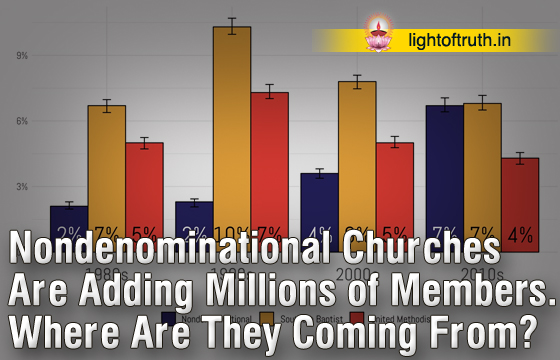
Nondenominational Churches Are Adding Millions of Members. Where Are They Coming From?
Over the last decade Baptists, Methodists, Lutherans, Presbyterians, and every other Protestant family has declined except for those who say they are nondenominational.
The 2020 US Religion Census, due out later this year, tallied 4,000 more nondenominational churches than in 2010, and nondenominational church attendance rose by 6.5 million during that time. At the same time, mainline Protestant Christianity is collapsing following five decades of declines. In the mid-1970s, nearly a third of Americans were affiliated with denominations like the United Methodist Church, the United Church of Christ, and the Episcopal Church. But now, just one in ten Americans are part of the mainline tradition.
In 2021, nondenominational Protestants in the United States outnumbered mainline Protestants. But what is causing this tremendous shift in the church landscape?

Raising banner, protesters raise questions about ‘Doctrine of Discovery’
In a brief protest at a papal Mass in Canada, Indigenous women unfurled a banner that said, “Rescind the Doctrine.”
The protest July 28 was a momentary but graphic reminder of how, when representatives of Canada’s First Nations, Métis and Inuit communities met Pope Francis at the Vatican in March and April, they asked him specifically for a formal repudiation of the so-called “Doctrine of Discovery.”
The phrase describes a collection of papal teachings, beginning in the 14th century, that blessed the efforts of explorers to colonize and claim the lands of any people who were not Christian, placing both the land and the people under the sovereignty of European Christian rulers.
The loss of the land, language, culture and spirituality of the Indigenous peoples of Canada and the foundation of the residential school system all can be traced to the doctrine, Indigenous leaders told reporters after their meetings with the Pope.
Asked July 20 if the Pope was expected to say something about the “Doctrine of Disco-very” while in Canada July 24-29, Matteo Bruni, director of the Vatican press office, said, “a reflection is underway in the Holy See on the Doctrine of Disco-very,” and the study is nearing its conclusion. However, he said he was not certain that a statement would be completed before the papal trip ends or if the Pope would speak about it while in Canada.
Sarain Fox, an activist and member of the Batchewana First Nation near Sault Ste. Marie, Ontario, told Canada’s CBC News that she was one of the people holding the banner as Mass began in the National Shrine of Sainte-Anne-de-Beaupré.
“It’s important for us to be recognized as human beings, so it’s not enough just to apologize. You need to talk about the root of everything,” which is the Doctrine of Discovery, Fox told.
The Canadian Conference of Catholic Bishops, in a 2016 statement on the Doctrine of Disco-very, acknowledged the connect-ion between it and the government’s residential school policy, which forcibly removed Indigenous children from their homes and sent them to schools where their language, cultures and spiritualities were suppressed.
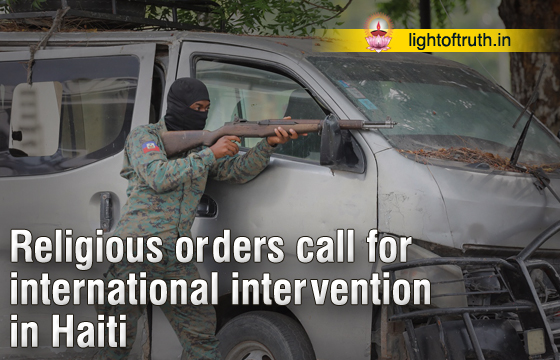
Religious orders call for international intervention in Haiti
Religious orders working in Haiti have called on the inter-national community to directly intervene to address the reign of terror of armed gangs they described as “diabolical, frightening and unacceptable.”
The same gangs are responsible for nearly four kidnappings a day in 2022 and violence that killed more than 200 and forced 3,000 to flee their homes during July alone.
In an Aug. 4 open letter to Najat Maalla M’jid, U.N. special rapporteur on violence against children, the Justice Coalition of Religious — made up of 20 religious orders — urged the inter-national community “to respond swiftly and effectively to the atrocities occurring in Haiti.”
In a document of testimonies published by the coalition, Passionist Father Rick Frechette, a doctor in Port-au-Prince, said “99% of people on the street want a foreign military force to save them.” He described the situation on the streets of Port-au-Prince as “Somalia-type battles.”
The coalition letter noted that the “Haitian state has failed in its sovereign obligation to protect the population.” It diverged from a July 29 statement from the Haitian bishops’ conference, which said state authority must be restored and that the government must take immediate action to “disarm the gangs, to allow the police to tackle violent crime and create a climate of serenity and confidence.” The bishops’ message stopped short of calling for action from the international community.