
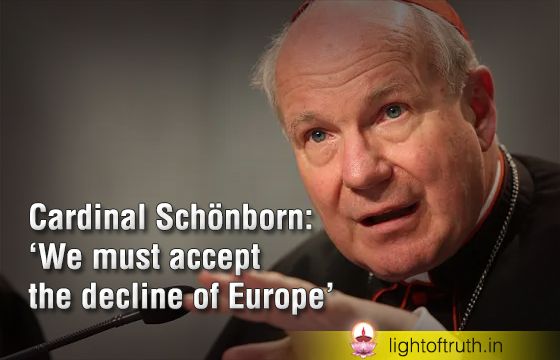
Cardinal Christoph Schönborn, OP, archbishop of Vienna, said in a recent interview with a French Catholic magazine that in the face of rising secularization and the growth of Islam in many historically Christian nations, Catholics should “trust in the work of grace” and remember that the Church is “an expert in humanity.”
“The Church is alive and will always be, albeit under different circumstances. We must accept the decline of Europe. We tend to gaze at our ecclesiastical navel, but it is an undeniable continental movement,” Schönborn said, speaking to Famille Chrétienne.
“In 20 years, the European population will not be the same as it is today, and it is already not the same as it was 50 years ago. This is inevitable, above all due to the decline in the birth rate in Europe but also due to immigration and the increasing presence of Islam. This poses new challenges for us Christians. We must also not forget that the Lord is at work in his Church! Just think of the 12,000 baptisms of adults and young people in France this year.”
The Austrian cardinal, who helped to produce the Catechism of the Catholic Church, said that despite the decline of the Church’s influence in Europe, he is convinced that the Church “has not yet breathed its last.” “Despite secularization, the great questions of men and women remain the same as before: birth, growth, education, illness, economic worries. And then there is the family, marriage, and death,” Schönborn noted. “There is a lot of talk about change, but too little attention is paid to the constants of society. The Church must remember that it is an expert in humanity, as Paul VI said.”
The cardinal called the idea that France and Europe are “no longer Christian” because of Islam’s influence “absurd,” but he firmly stressed that “Catholics should return to the Church.”
If Catholics have left the Church, we should not be surprised that they are in the minority,” he continued, calling for a “fraternal rapprochement” with Islam, echoing the words of Pope Francis, noting that Christians “do not take up arms but trust in the work of grace.”
“Both our religions have an absolute appeal. For Muslims, God has demanded that the whole world be subjected to him and the Koran. As for Christ, he has entrusted us with a universal mission: ‘Make disciples of all nations.’ Neither of them can therefore renounce their mission. But the Christians’ way of acting is not that of the Koran but the following of Christ in all dimensions of our lives,” he said.
Category Archives: International
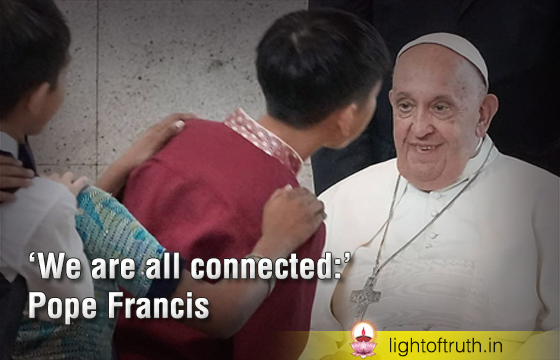
‘We are all connected:’ Pope Francis
“Be builders of hope,” Pope Francis told the over 100,000 Indonesian faithful gathered on Thursday afternoon to join him at Holy Mass in Jakarta’s main stadium, as his three-day visit to their nation came to an end.
“Guided by the word of the Lord,” he said during his homily, “I encourage you to sow seeds of love, confidently tread the path of dialogue, continue to show your goodness and kindness… and be builders of unity and peace.”
His appeal to foster fraternity in a divided and shattered world resonated loudly in this pluralistic and diverse nation of many islands, languages, and creeds.
It’s an overwhelmingly Muslim nation, proud of its tradition of tolerance and cohabitation, a nation that sought and found a friend and an ally in Pope Francis, who signed a joint declaration with the Grand Imam of Istiqlal Mosque, the largest in Southeast Asia, in which together they called for religious harmony for the sake of humanity and of creation.
The urgent need to foster and nurture Human Fraternity, the main leitmotif of the entire visit, permeated that ceremony in more ways than one when Pope Francis and the Imam stepped into the famous “Tunnel of Friendship“ that connects the Catholic Cathedral and the Mosque, both physically and symbolically.
“We all have a role to play in helping everyone pass through the tunnels of life with our eyes turned toward the light,” he said.
But the most luminous light of the day shone during his visit to a group of disabled persons waiting to welcome him at the nearby offices of the Indonesian Bishops’ Conference.
After listening to Andrew’s story of difficulty and hope, and having learnt of how Andrew has been chosen to participate in the Paralympics, the Pope expressed admiration for the young swimmer, turned to his hosts, and said: “You are all champions of love in the Olympics of life!”
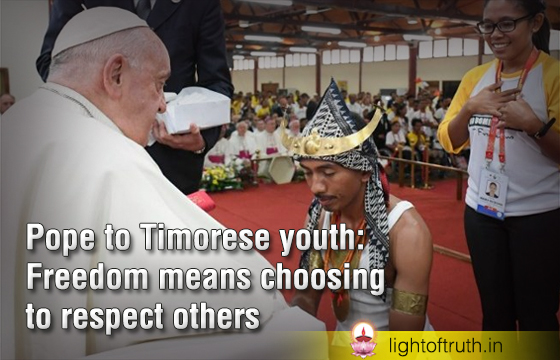
Pope to Timorese youth: Freedom means choosing to respect others
“I have two words of advice for you: make a mess and respect your elders!” Pope Francis offered those words of advice on September 11 as he met with the young people of Timor-Leste in the capital, Dili.
The encounter was held at the Congress Centre and was the final public event of the Holy Father’s Apostolic Journey to Timor-Leste. In his address, the Pope noted that young people make up a clear majority of the population of 1.4 million, of whom over 95% are Catholic, praising their enthusiasm in living the faith.
Pope Francis said he would never forget the smiles he found on the faces of the Timorese people. He also invited Timorese youth to recall the sacrifices their forefathers made in laying the foundations of the nation, and took the opportunity to urge them to respect their elders.
A society, he noted, has two treasures: young people and the elderly. “The children and the elderly,” said the Pope. “A society that has so many children like you must take care of them. And one that has so many elderly, who are the memory, must respect and care for them.”
Pope Francis spoke briefly about the three values of “freedom, commitment, and fraternity.”
He recalled a saying in the Tetum language of Timor-Leste—“ukun rasik-an” which means “everyone is able to govern themselves.” The Pope said young people should recall the true meaning and purpose of freedom. “To be free does not mean doing what we want,” he said, noting that freedom means respecting others and caring for our common home. He also recalled the value of “fraternity” and the importance of reconciliation. “You, in this smiling country, have a wonderful history of heroism, faith, martyrdom, and above all, faith and reconciliation,” he said. Pope Francis concluded his meeting with young Timorese by urging them to recall the example that Jesus gave in forgiveness and reconciliation.
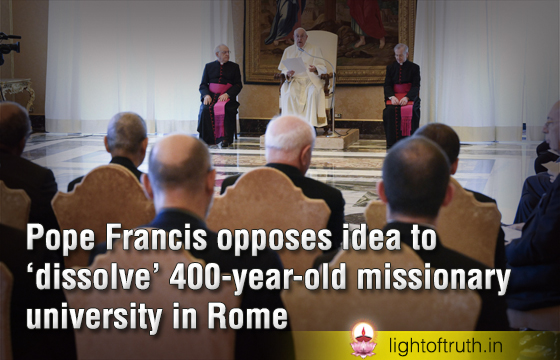
Pope Francis opposes idea to ‘dissolve’ 400-year-old missionary university in Rome
Pope Francis expressed disagreement with a proposal to absorb a 400-year-old missionary-focused university in Rome into other pontifical universities. Members of the Dicastery for Evangelization were meeting in an extraordinary plenary assembly Aug. 29–30 to discuss the future of the Pontifical Urban University, which educates priests and religious from the Catholic Church’s mission territories. “There is some plan to ‘dissolve’ [the university] with the other universities: No, this will not do,” Francis said in his address Aug. 30 to the cardinals, bishops, priests, and religious gathered for the plenary.
According to Agenzia Fides, a missionary-focused news age-ncy under the Dicastery for Evangelization, the Rome assembly is an intermediate step in discussions about “the present and future” of the Pontifical Urban University. Also known as the “Urbaniana,” the missionary university was founded as the Urban College in 1627 by Pope Urban VIII, part of the educa-tional aspect of the then-Sacred Congregation of Propaganda Fide. In 1962, it was elevated to a pontifical university. Its mission is to train and educate the priests, religious, and laypeople who help spread the Gospel in places with-out a strong Christian presence or where the Church has few financial resources.
In his speech on Friday, Pope Francis thanked the dicastery’s members for traveling to Rome “to reflect on the identity, mission, expectations, and future of the Pontifical Urbaniana University.” “I, too, would like to offer some thoughts on this,” he added, underlining that the Urbaniana “has its own identity.”
The pope reflected on the still-relevant missionary vocation of the Urban University and the need to balance that identity with the issues faced by the Church and world today.
He also said the need to raise the quality of educational and research offerings must be balanced with a necessary rationing of human and economic resources. ”Making good use of resources,” Francis said, “means unifying equal paths, sharing faculty from the six [pontifical] institutions, eliminating waste, planning activities wisely, and abandoning outdated practices and projects.” “In the specific case of the Urbaniana, it is important that, in the quality of the educational offerings, its missionary and intercultural specificity emerges even more, so that those who are being trained are able to mediate with originality the Christian message in the relationship with other cultures and religions,” he said.
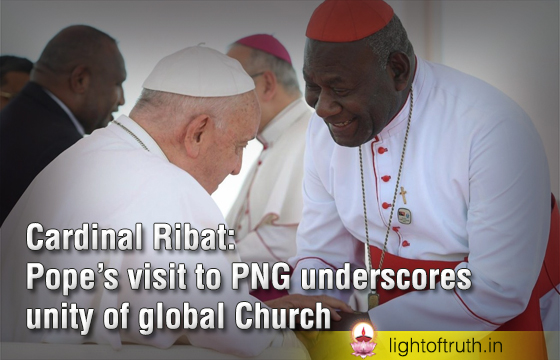
Cardinal Ribat:Pope’s visit to PNG underscores unity of global Church
One of Pope Francis’ most powerful messages in Papua New Guinea, according to Cardinal John Ribat, Archbishop of Port Moresby, was the one he deli-vered to young people on Septe-mber 09. It was plain to see that the Pope engaged in a personal connection with the 10,000 young people gathered in the Sir John Guise Stadium in Port Moresby, as he set aside his prepared text and spoke to them from the heart. Speaking to Vatican News’ Del-phine Allaire after the Pope had left the island nation, Cardinal Ribat noted that the Holy Fa-ther encouraged young Papuans to stand up when they fall and to help others who have also fallen.
“That was a powerful messa-ge for the youth,” he said, “to help one another, not just seek help from outside, but also from within themselves, and to rise together.” “He also gave them another message,” the Cardinal continued. “They need to stay connected with their grand-parents.” The Cardinal explained that, as he often does, Pope Francis highlighted the invaluable riches that come from our grand-parents– “values and culture that now, with so many modern influences, we risk disconnecting from.” The internet and social media can never provide those values, added the Cardinal.
Turning to the Pope’s off-the-cuff remarks to civil autho-rities on the rights of women, Cardinal Ribat noted that the culture of Papua New Guinea is male-dominated and “emphasises men, looking down on women.” Women are not respected or promoted for their contributions to society, said the Cardinal, add-ing that this “often leads to vio-lence against them.”
“But women are the ones who are committed; they are the great builders of society,” he continued, noting that the Pope’s words recognise and promote this fact. “Women should be respected, loved, and promoted. They, too, need to live their lives freely, just as men do, but in a responsible and positive way,” he said.
He acknowledged that every encounter had a specific message, and that at the heart of the Pope’s visit to Papua New Guinea was a message of hope, love, and faith. For the Catholic Church in Papua New Guinea, this visit offered a great encouragement to be united and to work together, said the Cardinal. Pope Francis’ Apostolic Journey to Papua New Guinea, concluded Cardinal Ribat, underscores the unity of the Church, no matter how physically distant its members may be.
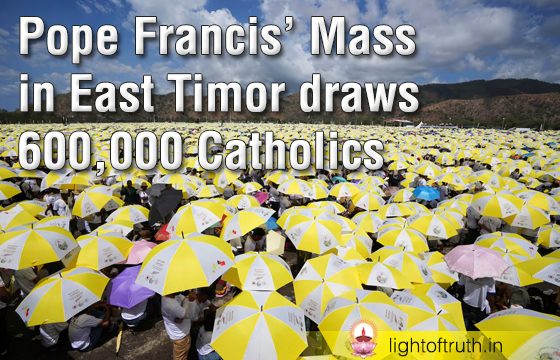
Pope Francis’ Mass in East Timor draws 600,000 Catholics
An estimated 600,000 Catholics attended Pope Francis’ Mass on 10 September in East Timor, a small island country that is 98% Catholic.
The pope celebrated the youthfulness of East Timor at the massive outdoor Mass where the crowd appeared like a sea of yellow-and-white Vatican-themed umbrellas used for protection from the island’s scorching midday sun.
“I have been thinking a lot about what is the best thing about Timor …The best thing is its people. …The best thing about this place is the smiles of the children,” Pope Francis said in off-the-cuff remarks in Spanish at the end of the Mass. I wish for you peace, that you keep having many children, and that your smile continues to be your children,” the pope told the Timorese.
East Timor is one of the world’s most Catholic countries, with 98% of its 1.3 million people identifying as Catholic. The country gained independence in 2002 after a long struggle with Indonesia, during which the Catholic Church played an important role advocating human rights. The local govern-ment declared the three days of the pope’s visit as a national holiday in which nearly all of the streets and local businesses were closed with people flocking to the Esplanade of Taci Tolu in the capital city of Dili to take part in the papal Mass.
“In East Timor it is beautiful, because there are many children: You are a young country where in every corner you can feel life pulsating and exploding. And this is a gift, a great gift: The presence of so much youth and so many children, in fact, constantly renews our energy and our life,” Pope Francis said. “But even more it is a sign, because making space for children, for the little ones, welcoming them, taking care of them, and making ourselves small before God and each other, are precisely the attitudes that open us to action of the Lord.”
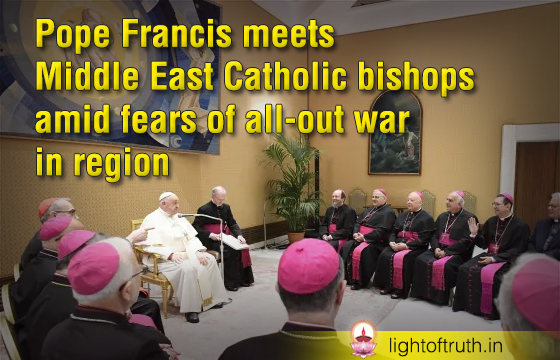
Pope Francis meets Middle East Catholic bishops amid fears of all-out war in region
Pope Francis met with the Latin-rite Catholic leaders of some of the Middle Eastern and Arabic-speaking countries amid fears of an escalation of the Israel-Hamas war. He encouraged the bishops to “bear witness to faith in [the Lord], also through respectful and sincere dialogue with everyone.”
The Aug. 28 meeting took place as part of the plenary assembly of the Conference of the Latin Bishops of the Arab Regions (CELRA), which covers Israel, Palestine, Jordan, Lebanon, Iraq, Syria, Egypt, Cyprus, Djibouti, Somalia, and the countries of the Arabian Peninsula.
CELRA is headed by Cardinal Pierbattista Pizzaballa, OFM, the Latin patriarch of Jerusalem, responsible for Latin Catholics in Israel, Palestine, Jordan, and Cyprus. The vice president is Bishop Cesar Essayan, OFM Conv, apostolic vicar for Latin Catholics in Beirut, Lebanon.
The bishops’ meeting with Pope Francis took place amid growing worries in the region about a broader war as the Lebanese militia Hezbollah and Iran, its regional patron, appeared to escalate hostilities over the past weekend.
During the meeting at the Vatican, the pope noted the “very strong tension” in the Middle East region, “which in some contexts lead to open clashes and outbursts of war.”
“The conflict, instead of finding an equitable solution, seems to be becoming chronic, with the risk that it will spread to ignite the entire region,” he said.
“This situation has caused thousands and thousands of deaths, enormous destruction, immense suffering, and the spread of feelings of hatred and resentment, which prepare the ground for new tragedies.”
Francis in his address conveyed his closeness to the prelates and to the Catholics in their flocks.
“May you keep hope alight,” he added. “Be yourselves, for everyone, signs of hope, a presence that fosters words and gestures of peace, brotherhood, and respect. A presence that, in itself, invites reason, reconciliation, overcoming with goodwill the divisions and enmities stratified and hardened over time, which are becoming increasingly inextricable.”
The pontiff also asked the Latin-rite Catholic leaders to ensure students in public schools receive a good Christian formation, especially where Christians are a minority.
“This formation is of great importance, so that the content of faith may be known and accompanied by reflection and so that faith, in confrontation with culture, may thus be strengthened and have the means to give reasons for Christian hope,” he said.
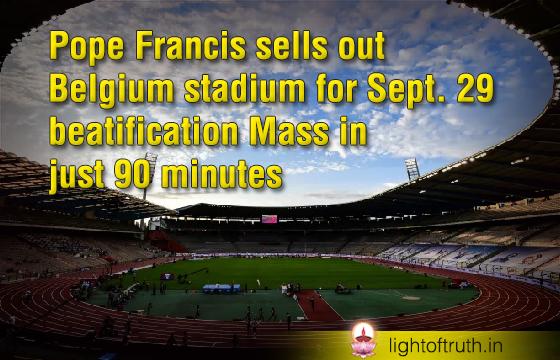
Pope Francis sells out Belgium stadium for Sept. 29 beatification Mass in just 90 minutes
Tickets for Pope Francis’ Mass in King Baudouin Stadium in Brussels at the end of September sold out in record time on 26 August.
After becoming available for free online, 32,000 tickets for the Sept. 29 Mass were snatched up in just 90 minutes, surprising local organizers of the pope’s three-day trip to Belgium.
“This pleasantly surprised us; it’s very positive to see such a high demand,” the spokesman for the Belgian bishops’ conference, Tommy Scholtes, told French Catholic newspaper La Croix.
During the Mass, Pope Francis will beatify Carmelite Sister Ana de Jesús, a spiritual daughter of St. Teresa of Ávila and a friend to St. John of the Cross. Born Ana de Lobera y Torres, the religious helped expand the Discalced Carmelites to France and Belgium at the turn of the 17th century.
The Brussels soccer stadium is Belgium’s largest, with a seating capacity of almost 50,000 people. Besides hosting the matches of the national soccer team, it has also been the venue for concerts by world-class music artists, such as Madonna, U2, and the Rolling Stones.
Organizers explained that the approximately 18,000 remaining seats in the city-owned stadium are being reserved for groups from parishes, dioceses, and movements. After group registration closes, they may be able to release a few hundred more individual tickets for those who missed out on August 26th morning.
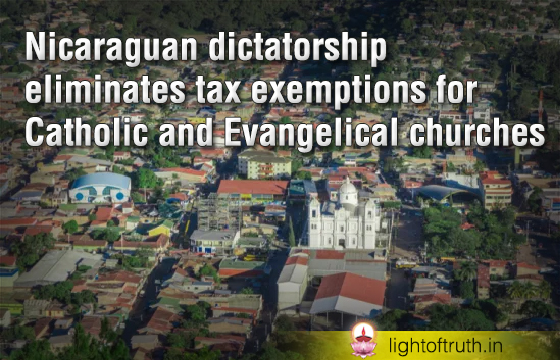
Nicaraguan dictatorship eliminates tax exemptions for Catholic and Evangelical churches
One day after cancelling the legal status of 1,500 NGOs in Nicaragua, the dictatorship of President Daniel Ortega and his wife, Vice President Rosario Murillo, eliminated the income tax exemption for churches.
Lawyer and researcher Martha Patricia Molina considers the measure a “fiscal blow” that will end up “financially suffocating the (Catholic) Church so that it falls under its own weight.”
The official government newspaper La Gaceta published Law 1212 on Aug. 22, which modifies three other laws: the law on regulation and control of non-profit organizations, the law on regulation of foreign agents, and Law 822 on tax coordination. The newspaper reported that this decision comes from the country’s legislature at Ortega’s initiative.
Article 5 of Law 1212 orders: “Repeal section 3 of article 32 of the Tax Coordination Law” of 2012, as well as its reforms.
Section 3 of article 32 stated that “Churches, denominations, confessions and religious foundations that have legal personhood, in terms of their income coming from activities and assets exclusively destined for religious purposes” were exempt from income tax.
An expert quoted but not identified by the newspaper La Prensa explains that with this decision by the dictatorship “all churches of any denomination will be subject to the fiscal terrorism to which the dictatorship has subjected the private sector and now religious institutions,” and they will have to pay between 10 and 30% in income tax.
Regarding this decision, Molina, author of the report “Nicaragua: A Persecuted Church?” which cited 870 attacks by the dictatorship against the Catholic Church since 2018, claimed that government authorities have already been to parishes asking for documents related to their accounts.
In “previous weeks, the regime’s authorities had visited parishes to request information on how they keep their accounts, they asked to see the general and minor ledgers, income and expenses, which is obviously not done this way in parish administration,” Molina wrote on X. “Now the priests will have to hire a CPA [certified public accountant] to keep all these accounts and also say who their main donors are,” she added.
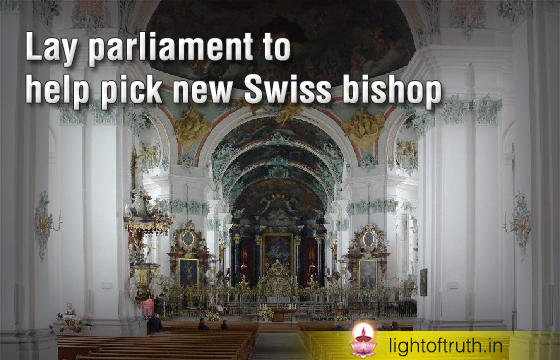
Lay parliament to help pick new Swiss bishop
One of the Catholic world’s most unusual episcopal selection processes is underway in the Swiss Diocese of St. Gallen, involving cathedral canons and a lay parliament, as well as the Pope, of course.
The St. Gallen diocese, in northeastern Switzerland, announced Aug. 15 that Pope Francis had approved the start of the process to find a new bishop after incumbent Bishop Markus Büchel submitted his resignation upon turning 75.
St. Gallen, which serves roughly 250,000 Catholics, is one of several dioceses in the German-speaking Catholic world where the cathedral chapter plays an important role in selecting new bishops.
Under the terms of an 1845 concordat and the 1847 bull Instabilis rerum humanarum natura, the Bishop of St. Gallen is appointed after a free election by the cathedral chapter within three months of a vacancy.
Candidates must be diocesan priests over the age of 35 with more than five years of priestly service. They must also have experience of administration or pastoral care in the diocese. Around 60 priests are currently eligible, with local attention focused largely on the 13 members of St. Gallen’s cathedral chapter.
Following the pope’s signal, the 13 canons have three months to prepare for the election of Büchel’s successor.
The process will begin with a three-week survey of Church groups, led by the Swiss Institute of Pastoral Sociology (SPI) in St. Gallen. Groups will be asked to identify the qualities needed in a new bishop. Consultations were also held during the last two changes of episcopal leadership.
After reviewing survey responses, the cathedral chapter will create a shortlist of six priests, which will be sent to Rome via the nuncio. The Vatican will scrutinize the list, vetting the candidates individually, before returning it to the cathedral chapter through the nuncio when they have finished.
The chapter will then schedule an election day in collaboration with the Catholic College (Katholische Kollegium), a lay parliament covering the Canton of St. Gallen, one of the 26 member states of the country officially known as the Swiss Confederation.
The lay parliament could play a significant role in the election of St. Gallen’s new bishop because it can declare that three of the six candidates identified by the cathedral chapter and scrutinized by Rome are “less favourable,” resulting in their elimination from the list.
The cathedral chapter then holds a ballot. After the chapter selects a new bishop, the candidate has a week to accept or decline. If he agrees, Pope Francis is expected to formally appoint the candidate as the new Bishop of St. Gallen.