
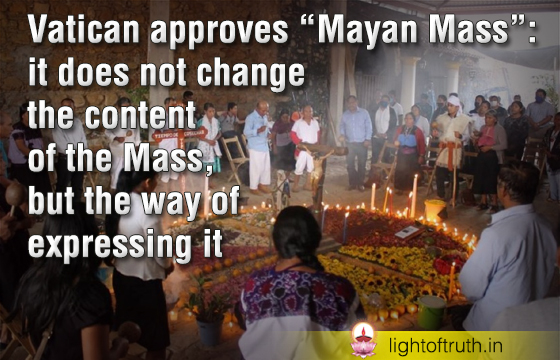
In a historic move, the Vatican has given its formal approval to a series of liturgical adaptations designed specifically for the indigenous communities of Chiapas, Mexico. This decision, announced by Cardinal Felipe Arizmendi Esquivel, Emeritus Bishop of San Cristóbal de las Casas, signifies a groundbreaking shift in how the Church incorporates indigenous cultural expressions into its worship practices.
Rather than dismissing these traditions as mere folklore or customs, the Vatican’s recognitio elevates them to the status of “liturgical expressions,” fostering a deeper sense of inclusion and respect for the faith traditions of the Tseltal, Tsotsil, Ch’ol, Tojolabal, and Zoque peoples.
Key among the approved adaptations are ritual dances integrated into various parts of the Mass, such as the offertory and thanksgiving after communion. Cardinal Arizmendi emphasized that these are not decorative acts but meditative movements reflective of indigenous spirituality. Accompanied by traditional music, these dances serve as contemplative expressions aligned with the essence of the Roman rite but through a distinctly local cultural lens. Additionally, women from these communities will now take on the ministry of incensing during Mass. Using culturally significant sahumerios instead of traditional censers, they will incense the altar, sacred images, and the congregation. Cardinal Arizmendi clarified that this inclusion is not a statement of gender equality but a faithful reflection of indigenous customs, where women traditionally hold this role in community prayers.
Another notable change is the introduction of a greater role for lay leaders of moral standing. These individuals may now guide certain communal prayers, such as the opening prayer, intentions, and moments of thanksgiving, under the supervision and authorization of the priest. Cardinal Arizmendi stressed that these adaptations aim to deepen communal participation without diminishing the priest’s role as the celebrant.
Category Archives: International
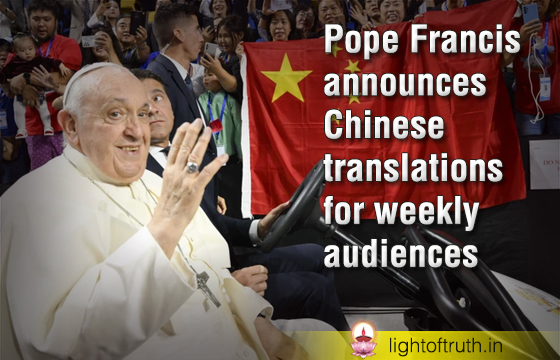
Pope Francis announces Chinese translations for weekly audiences
Starting next week, Chinese will be added as the ninth official language at papal general audiences, Pope Francis announced on Nov. 27. “Next week, with Advent, the Chinese translation will also begin here publicly,” the pope said on Nov. 27 during his general audience in St. Peter’s Square.
The addition marks a significant expansion of the languages used at the weekly papal events, where key portions — including Scripture readings, summaries of the pope’s address, and greetings — are delivered in eight languages: Italian, English, French, German, Spanish, Portuguese, Polish, and Arabic.
The translations make papal teachings accessible to pilgrims from around the world. They are traditionally delivered by staff members of the Vatican Secretariat of State or Vatican News. Mandarin Chinese is considered the world’s most spoken language, with nearly one billion speakers, ahead of Spanish and English.
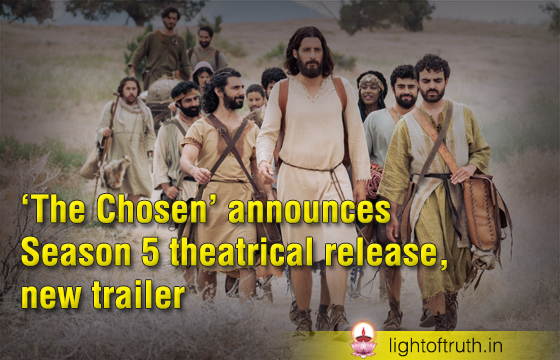
‘The Chosen’ announces Season 5 theatrical release, new trailer
The release of Season 5 of the hit series “The Chosen” was announced Nov. 25 by 5&2 Studios. “The Chosen: Last Supper” is coming to theaters during Lent, in the weeks leading up to Easter.
Season 5, which focuses on the events of Holy Week, will bring the most important week in history to viewers in a special theatrical release. During a four-week run in theaters, all episodes of Season 5 will be released in three parts starting with part one, episodes 1 and 2, to be released on March 27. Part two, episodes 3, 4, and 5, and part three, episodes 6, 7, and 8, will be released in the weeks following.
Beginning April 10, “The Chosen: Last Supper” will also be released in theaters globally in over 40 countries including Brazil, Mexico, Italy, Germany, Poland, Philippines, United Kingdom, and India.
After the full-season run in theaters concludes, the season will make its streaming debut. The newly released trailer begins with a glimpse of Jesus and the disciples during The Last Supper and teases other powerful moments including Jesus’ entry into Jerusalem, the cleansing of the temple, and Judas’ betrayal.
Dallas Jenkins, the show’s creator, director, and writer, told CNA that Season 5 is “sad at times; it’s actually heartbreaking at times because we know we’re getting closer and closer to the cross … We’re going to get to see some iconic moments from Scripture, but we’re also going to, I believe, be drawn closer to who Jesus was because of his suffering.”
Ryan Swanson, one of the writers of “The Chosen,” added that Season 5 is “truly going to feel like a different kind of series. After Season 4’s dread and doom and foreshadowing, this is when the wick is lit.”
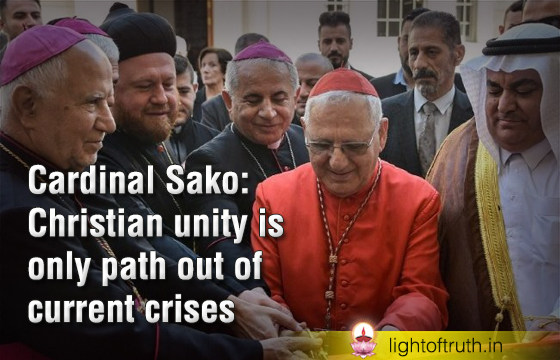
Cardinal Sako: Christian unity is only path out of current crises
Cardinal Louis Raphaël Sako, Patriarch of the Chaldean Catholic Church, has called for the four Churches that are rooted in the ancient Church of the East to work toward unity. These include the Chaldean Church, the Assyrian Church, the Ancient Church, and the Assyrian Evangelical Protestant Church.
As reported by the Vatican’s Fides News Agency, Cardinal Sako reflected on the divisions that have marked these Christian communities and likened the Churches to passengers navigating different waves but travelling together and “in the same boat.”
In a statement released by the Chaldean Patriarcate, the Cardinal stressed that unity is not only a necessity but “the only solution to the challenges of our time.” Cardinal Sako highlighted the enduring declaration of faith which is shared across these Christian Churches, which states: “I believe in One, Holy, Catholic, and Apostolic Church.”
Cardinal Sako noted that despite many centuries of division, the essence of the Church remains unified. He went on to describe schisms as being “against the will of Christ,” underscoring the profound harm caused by the fragmentation of the Church of the East into four distinct entities.
However, Cardinal Sako stressed that his call for unity is not a request to return to the past. He explained that “unity is not about returning to what we were but about focusing on what we should become”, adding that his aim is to heal the wounds of division and foster “full communion” between these historic Churches. In his appeal, Cardinal Sako outlined six practical proposals for a “new vision” of the Church of the East.
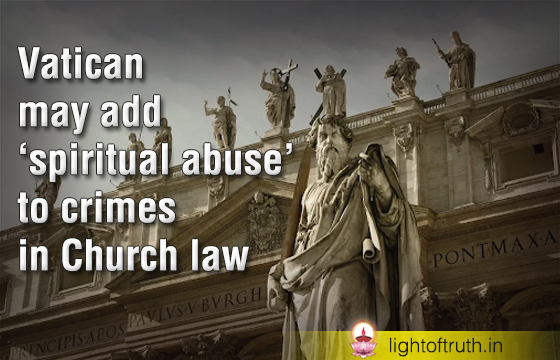
Vatican may add ‘spiritual abuse’ to crimes in Church law
The Vatican may make “spiritual abuse” a formalized crime in Church law, rather than merely an aggravating circumstance of other crimes.
The Dicastery for the Doctrine of the Faith (DDF) is forming a working group with the Dicastery for Legislative Texts with “the task of analysing this possibility and presenting concrete proposals” on the matter, according to a paper from the doctrine office dated Nov. 22 and posted online this week.
According to the note, which was signed by DDF Prefect Cardinal Víctor Manuel Fernández and approved by Pope Francis, the term “false mysticism” is an “overly broad and ambiguous expression” in need of refining in certain contexts in the Church.
The term appears in the DDF’s regulations related to “problems and behaviour connected with the discipline of the faith, such as cases of pseudo-mysticism, alleged apparitions, visions, and messages attributed to supernatural origin,” the note observes.
The expression “false mysticism” is also sometimes used by canon lawyers in the context of crimes of abuse, though it is currently not a delict, or crime, according to canon law, the document said. The DDF said that “false mysticism” also appears in the dicastery’s 2024 document Norms for Proceeding in the Discernment of Alleged Supernatural Phenomena, where it is specified that “the use of purported supernatural experiences or recognized mystical elements as a means of or a pretext for exerting control over people or carrying out abuses is to be considered of particular moral gravity.”

Pope: ‘Synod final document forms part of papal Magisterium’
Pope Francis has written a note to accompany the Final Document of the XVI Ordinary General Assembly of the Synod of Bishops, a text that captures the results of the two-year-long Synod of Bishops on Synodality which Pope Francis called for in October 2021 that concluded in October 2024.
In the text accompanying the Document, Pope Francis writes that from its very creation, the synodal path has been characterised by openness to the voice of the Holy Spirit. This spirit has guided the Church across continents, languages, and cultures. ”This journey,” Pope Francis writes, “has allowed the Church to read her own experiences and identify steps to live communion, realise participation, and promote the mission entrusted to her by Christ.”
He describes how this synodal journey actually began at the local level, moving then through national and continental phases. Now that the Assembly has concluded, Pope Francis entrusts the Final Document and its contents back to the local Churches, whom he invites to implement the contents of the Document with discernment, creativity, and respect for their unique contexts.
Pope Francis then goes on to describe the Document as part of the “ordinary Magisterium of the Successor of Peter” and asks that its authoritative nature be respected as such. “It represents a form of exercising the authentic teaching of the Bishop of Rome”, explains the Pope, adding that “it contains elements of novelty but aligns with what I clarified on October 17, 2015, when I stated that synodality is the proper interpretive framework for understanding hierarchical ministry”. However, he clarifies that the Document “is not strictly normative” but rather a call for reflection differently applied in each context.

Pope: ‘Synodality is inseparable from ecumenism’
Pope Francis on November 11 met with the Holy Synod of the Malankara Mar Thoma Syrian Church, marking an historic first visit to Rome and confirming the good relations of this ancient Oriental Indian Church.
Mar Thoma Syrian Church traces its origins back to the mission of the Apostle St. Thomas in South-Western India in the first century and consists today of about 1.5 million members most of whom reside in the Indian State of Kerala, where it is based.
The Church has communion with the Thozhiyoor (Anglican) Church and maintains an ecclesiastical relationship with the Old Catholic Church, Union of Utrecht, as well as the Church of South India (CSI).
In his address Pope Francis warmly welcomed the Holy Synod and extended his greetings to Metropolitan Theodosius Mar Thoma and the Malankara faith-ful, expressing gratitude for their ecumenical role, in bridging Eastern and Western Christianity. “Your Church,” he said, “rightly defines itself as a “bridge Church” between East and West.”
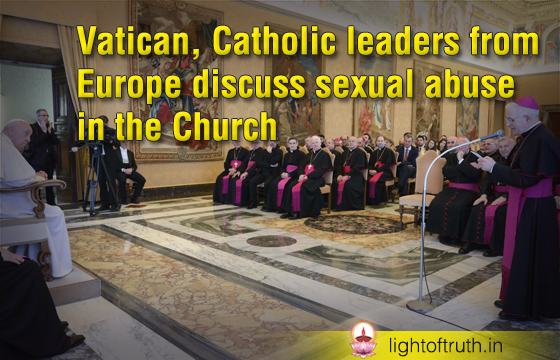
Vatican, Catholic leaders from Europe discuss sexual abuse in the Church
Catholic leaders from across Europe are in Rome this week to discuss how the Church can best protect children from sexual abuse and how to help those who have already been hurt by it. The Vatican’s Pontifical Commission for the Protection of Minors (PCPM) is hosting a conference on safeguarding in the Catholic Church in Europe from November 13–15.
The gathering, taking place in the centre of Rome at the head-quarters of the PCPM, includes participants–bishops, priests, re-ligious, and laymen and lay-women – from 25 countries in Europe. Safeguarding practices and strategies, how Church law and civil law interact, how to better help victims, and how to develop safeguarding networks are some of the topics the con-ference will address.
Vatican leaders and repre-sentatives from the European bishops’ conferences commission (COMECE) are also attending the meeting, which will include a keynote address Nov. 14 from Archbishop John J. Kennedy, secretary of the Vatican’s office responsible for the discipline of priests guilty of abuse.
In a message to conference participants Nov. 13, Pope Fran-cis said attendees’ “commitment to this cause [of safeguarding against abuse] is a sign of the Church’s continuing efforts to protect the most vulnerable in our midst.” The pontiff wrote that he is praying for the conference, which he hopes will be “a source of fruitful insights” and that their exchanges “will contribute to a safer and more compassionate Church” and a “deeper commitment to safe-guarding children and vulnerable adults within the Church.”
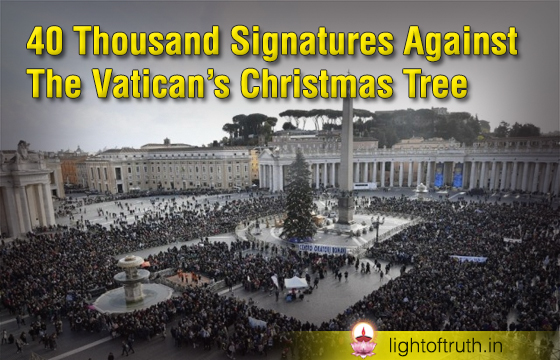
40 Thousand Signatures Against The Vatican’s Christmas Tree
In Italy’s Valley of Ledro, nestled near the old Austro-Hungarian border just kilo-meters from Lake Garda, locals are rallying to save a 200-year-old fir tree, famously known as the Green Giant. Towering at thirty meters and standing for centuries, this maje-stic tree has weathered wars, snowstorms, and survived the ax of carpenters. Now, it faces a new threat: being cut down and transported to Vatican City as the Christmas tree for St. Peter’s Square.
Residents of Ledro, who see the fir as more than just a tree, have written directly to Pope Francis in hopes of preventing what they deem an anachronistic massacre. They also launched a petition on Change.org, which has garnered 40,000 signatures so far, and secured legal counsel to help block the tree’s removal. Local environmental advocates and community associations argue that cutting down a tree for a holiday display contradicts efforts to combat climate change. Talking about protecting the environment means challenging outdated traditions like these,” they noted in a statement, emphasizing the contradiction of celebrating Christmas by sacrificing a tree that symbolizes nature itself. They propose decorating the fir where it stands in Passo Nota, allowing it to continue shading hikers who stop there after long climbs.
Residents further invoked Pope Francis’ own words on environmental stewardship, referencing his encyclicals calling for respect for nature. “We ask His Holiness to prevent this felling and instead come visit the Valley to experience its natural beauty firsthand,” the letter implores.
Beyond the emotional and environmental reasons, residents also have financial con-cerns. Lorenzo Vescovi, a representative from the Forty-Three Million Committee (a name symbolizing the 40 trees donated by the Ledro Council to the Vatican and the estimated three million Christmas trees cut down annually in Italy), notes that the trans-port of the Green Giant to the Vatican comes with a staggering 60,000 price tag. Many argue that the funds could be better used to address pressing needs within the Ledro community, such as medical care, where shortages of general practitioners are impacting health services.
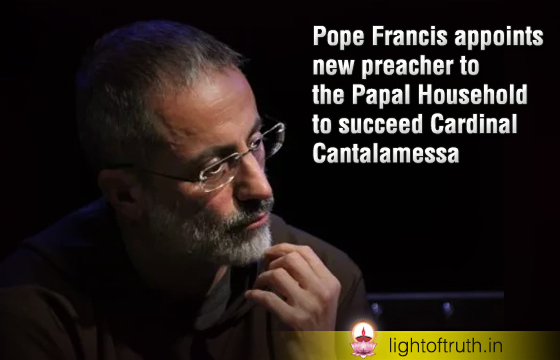
Pope Francis appoints new preacher to the Papal Household to succeed Cardinal Cantalamessa
Pope Francis on November 9 appointed Fr Roberto Pasolini, OFM Cap, as the new preacher of the Papal Household, replacing Cardinal Raniero Cantalamessa, 90, who held that position for 44 years. Cantalamessa, who was elevated to the College of Cardi-nals by Pope Francis in 2020, has been preacher of the Papal Household since 1980, when he was appointed by St. John Paul II. His successor is a professor of biblical exegesis at the Theological University of Northern Italy in Milan and is now tasked with giving the Friday meditations of Advent and Lent, among other tasks, as Cantala-messa did for years, serving three popes (John Paul II, Benedict XVI, and Francis) and the Vati-can Curia.
Pasolini was born on Nov. 5, 1971, in Milan and just turned 53. According to the Vatican Press Office, he made his perpetual vows in the Franciscan Order of Friars Minor Capuchin on Sept. 7, 2002, and was ordained a priest on Sept. 23, 2006.