
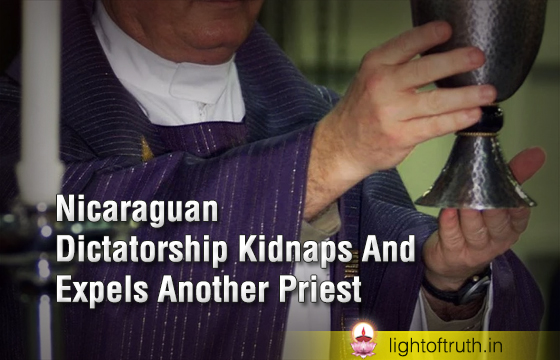
The Nicaraguan dictatorship of Daniel Ortega and his “co-president” and wife, Rosario Murillo, this week kidnapped and expelled from the country Father Floriano Ceferino Vargas, a priest of the Diocese of Bluefields.
Medardo Mairena, a former peasant leader now in exile, stated on X that “Father Floriano Ceferino Vargas, parish priest of the Church of San Martín de Porres in Nueva Guinea, has been exiled by the Sandinista regime,” further specifying that the priest is now in Panama.
In an interview with EWTN Noticias, lawyer and researcher Martha Patricia Molina said it is not known exactly why Vargas was kidnapped and expelled from the country. However, Molina said, “just because you are religious in Nicaragua, the dictatorship can kidnap you.”
Molina, who has documented hundreds of attacks by the Nicaraguan government against the Catholic Church in recent years, also indicated that it is possible that the priest had made “some comment that they [the dictatorship] consider hostile to the supposed revolution, which at every moment they say must be defended.”
The researcher also commented that, in the midst of everything, it is good to know that the priest “is not going to be in the prisons of Nicaragua, where more than 40 mechanisms of torture, cruel, inhuman, and degrading treatment are practiced.”
The priest was arrested after celebrating Mass in his parish. The kidnapping and expulsion of Vargas happened the same week Pope Francis sent a letter to the country’s Catholics in which he encouraged them and reminded them that faith and hope “work miracles.”
Growing concern for the well-being of the Catholic Church in Nicaragua was also expressed this week by the bishops of Central America, who convoked for Dec. 8, the solemnity of the Immaculate Conception, a day of prayer for the persecuted Church in the neighbouring country.
Category Archives: International
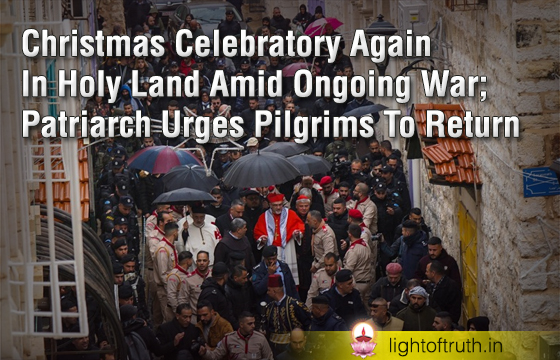
Christmas Celebratory Again In Holy Land Amid Ongoing War; Patriarch Urges Pilgrims To Return
Christmas this season in the Holy Land will be celebratory, despite ongoing blood-shed and war, the patriarchs of the Holy Land said, as Cardinal Pierbattista Pizzaballa encouraged pilgrims to come back to the birthplace of Jesus.
“Pilgrimage is now absolutely safe and also important for society,” Pizzaballa said in Cologne Dec. 3, reported KNA, a Catholic news agency in Germany. The cardinal hoped that the relative calming of the war situation in Israel will lead to more pilgrims arriving again over the Christmas season.
Pilgrimages and religious tourism are an important economic factor for many Christians in the region, with many not able to make any income for their families as tourists disappeared and stores across pilgri-mage sites remain closed for the 14th month since Oct. 7, 2023. That is when Hamas attacked Israel killing 1,200 people, which ignited the Israel-Hamas war focusing on the Gaza Strip, destroying vast parts of the enclave and killing over 45,000, according to Gaza’s health ministry.
As Advent approached, the patriarchs and heads of the churches in Jerusalem issued a statement, however, that war this year won’t stop the joyful celebration of Christmas in the land of Jesus.
This year, the patriarchs said, they “encourage our congregations and people to fully commemorate the approach and arrival of Christ’s birth by giving public signs of Christian hope.” At the same time, the patriarchs asked all of the faithful to keep the suffering people of the Holy Land in their prayers, “reaching out to them with deeds of kindness and charity, and welcoming them as Christ himself has welcomed each of us.” This way, they said, “we will echo the Christmas story itself, where the angels announced to the shepherds glad tidings of Christ’s birth in the midst of similarly dark times in our region … offering to them and to the entire world a message of divine hope and peace.”
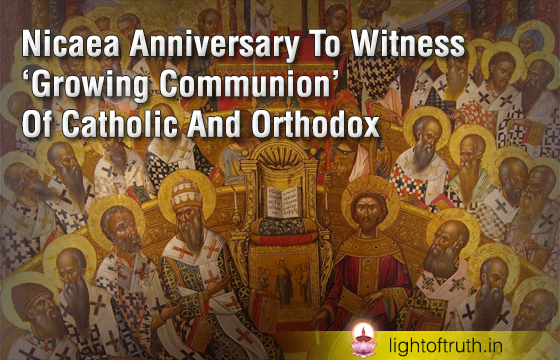
Nicaea Anniversary To Witness ‘Growing Communion’ Of Catholic And Orthodox
Pope Francis affirmed his intention to attend next year’s celebration marking 1,700 years since the first Council of Nicaea, in Iznik in north-west Turkey. “I am thinking of going there,” the Pope told participants at the Vati-can’s International Theological Commission last week. In a letter to the Ecumenical Patriarch of Constantinople Bartholomew I, he voiced his support for dialogue between the Roman Catholic Church and Eastern Orthodox Church occasioned by the anniversary.
“The now imminent 1,700th anniversary of the First Ecu-menical Council of Nicaea will be another opportunity to bear witness to the growing commu-nion that already exists among all who are baptised in the name of the Father and of the Son and of the Holy Spirit,” he said. This would “strengthen existing bonds and encourage all Churches to offer renewed testimony in today’s world.” A delegation led by Cardinal Kurt Koch, prefect of the Dicastery for Promoting Christian Unity, delivered the letter to Patriarch Bartholomew on 30 November, the Feast of St Andrew whom the patriarchate celebrates as its founder.
The first ecumenical Council of Nicaea in 325AD, conducted under the patronage of the Emperor Constantine, is recognised by both Catholics and Orthodox Christians.
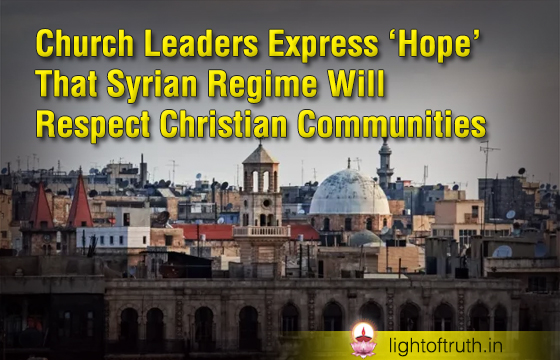
Church Leaders Express ‘Hope’ That Syrian Regime Will Respect Christian Communities
Catholic Church leaders in the U.S., Rome, and the Middle East have expressed cautious “hope” that the new regime in Syria will respect Christian communities after a lightning offensive by Islamist rebel groups toppled the regime of President Bashar al-Assad.
Bishop Elias Zaidan of the Maronite Eparchy of Our Lady of Lebanon and chairman of the U.S. Conference of Catholic Bishops’ (USCCB) Committee on International Justice and Peace issued a statement in which he called on the U.S. and the international community at large to support Syria as it “starts a new chapter in its rich history.” “In yet another dramatic development in the Middle East, after enduring more than a decade of bloody civil war, Syria is undergoing a national political transition that will surely impact the entire region,” Zaidan said.
The 53-year reign of the Assad regime crumbled in little more than 10 days after a coalition of so-called “rebel” forces led by the jihadist Sunni Muslim group Hayat Tahrir al-Sham (HTS) swept through the war-torn country’s major cities of Aleppo, Hama, Homs, and finally Damascus on Dec. 8. HTS is notorious for its early roots in Al-Qaeda and has been designated as a terror group by the U.S. and the United Nations.
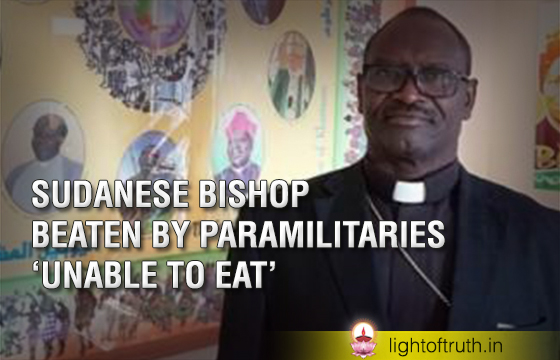
Sudanese Bishop Beaten By Paramilitaries ‘Unable To Eat’
Members of the Rapid Su-pport Force (RSF) seized Bishop Yunan Tombe Trille Kuku Andali of El-Obeid, subjected him to a beating and threatened to execute him as he travelled back to his diocese from a meeting in Juba, the capital of South Sudan.
He had attended a Eucharistic Congress on November 24 and celebrations for the Golden Jubilee of the Sudan and South Sudan Catholic Bishops’ Confe-rence, whose members called on the authorities to protect Bishop Andali following the attack.
“We condemn the violence against the innocent bishop and servant for all,” said Bishop Eduardo Hiiboro Kussala of Yambio-Tombura, in South Sudan. “We ask respect for this man of God and for all human beings,” he said. “We are deeply saddened and troubled by the news,” said Bishop Remijo Adam of Wau. He said Bishop Andali had told him in a text message that RSF gunmen had detained him and an aide as they crossed the border at the South Sudanese town of Renk, and beat him on the face, neck and the side of the head.
They had already been robbed by soldiers of the Sudan Armed Forces (SAF) during their travel. “I can’t eat food and worse of it, we narrowly missed martyr-dom,” said Bishop Andali in the message, explaining that the paramilitaries had been preparing to execute him and his companion when an RSF commander ordered their release.
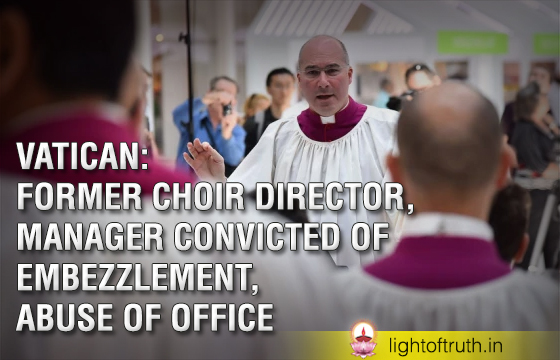
Vatican: Former Choir Director, Manager Convicted Of Embezzlement, Abuse Of Office
A pair of former Vatican officials has been found guilty of embezzlement and abuse of office as part of a long-running investigation into financial irregularities at a prominent choir there. Monsignor Massimo Palo-mbella, who previously directed the Sistine Chapel Choir in Vatican City, and Michelangelo Nardella, who was the choir’s manager, were both found guilty in the Vatican City State Tribunal on various counts of embezzlement, laundering, and abuse stemming from their time leading the choir.
Nardella’s wife, Simona Rossi, was also convicted of embezzlement in connection with the scandal. News of financial improprieties at the choir first broke in 2018 amid reports that Palombella and Nardella used choir concert pro-ceeds for personal expenses. The Vatican launched an investigation that year.
Palombella resigned his position at the choir in July 2019. In January of that same year, Pope Francis issued a motu proprio that among other things moved the Sistine Chapel Choir under the administration of the Office of Pontifical Liturgical Celebrations. Palombella was sentenced to just over three years in prison as well as a fine of 9,000 euros (about $9,500); Nardella will spend four years and eight months in prison and pay 7,000 euros (about $7,400) in fines. Nardella was also served with “perpetual disqualification from holding public office.” Rossi, meanwhile, will serve two years in prison and pay 5,000 euros (about $5,300) in fines, along with a similar disqualification from public office.
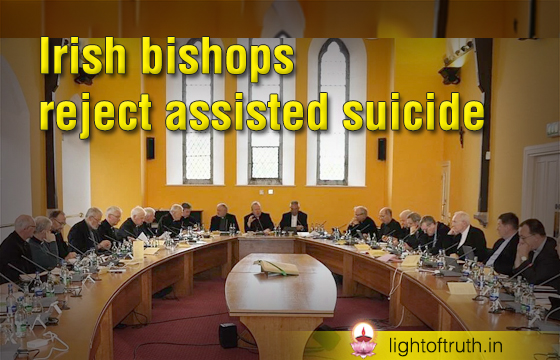
Irish bishops reject assisted suicide
The Irish Catholic Bishops’ Conference said that it “totally rejects” a recommendation the incoming government should legalise assisted suicide in restricted circumstances.
Speaking before Ireland’s general election on Friday, 29 November, the bishops said in a statement: “Over recent years, we have witnessed a diminution in the respect for human life in our political discourse.” “The value of people’s lives seems to be calculated as if it were simply part of a cost-benefit analysis. Where is the hope in this?” they challenged.
They suggested that as well as questioning candidates about their stance on assisted suicide, voters should also question them about their position on abor-tion. Since the introduction of what they termed “a very liberal abortion law” in 2018, 40,000 abortions have been carried out in Ireland.
The bishops noted that some politicians want to liberalise the abortion law, while efforts are made to make legislative provision for assisted dying. “We totally reject that recommendation because a fundamental principle of civilised society is that no person can lawfully take the life of another,” they said.
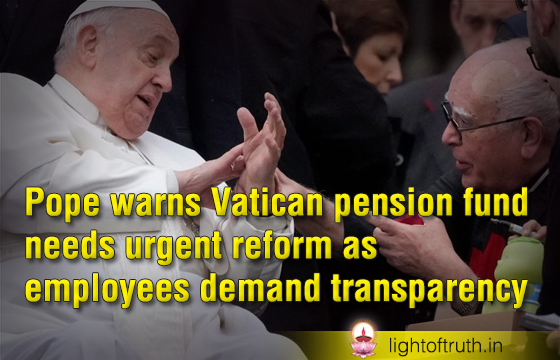
Pope warns Vatican pension fund needs urgent reform as employees demand transparency
Pope Francis, who has imposed a series of cost-cutting measures across the cash-strapped Vatican, warned Nov. 21 that the city state’s troubled pension fund needs urgent reform to guarantee future obligations.Vatican employees responded by expressing concern that their compensation might be targeted in any further cost-cutting to shore up the pension system, and asked for the fund’s finances to be made public.
In a letter to Vatican department heads and cardinals, Francis said he had named a top economic adviser, Cardinal Kevin Farrell, as a special administrator for the fund, suggesting that decisive, immediate action was necessary. The letter was the latest evidence of the Vatican’s precarious financial situation, after years of mismanagement, financial scandals and budget deficits – all worsened by COVID-19 and the monthslong closures of a key source of revenue, the Vatican Museums.
Already, Francis has cut cardinals’ salaries by 10%, suspended some seniority bonuses, trimmed special stipends for Rome-based cardinals and begun charging some market-rate rents for their apartments. The pension fund has long been the source of particular concern, and in the new letter Francis acknowledged that the current analysis “indicates a serious prospective imbalance in the fund, the size of which tends to expand over time in the absence of intervention.” “In concrete terms, this means that the current system is unable to guarantee in the medium term the fulfillment of the pension obligation for future generations,” he wrote.
The Association of Lay Vatican Employees, the closest thing the Vatican has to a labour union, voiced alarm at Francis’ warning about their pensions, insisting that lay employees had already sacrificed enough in his cost-cutting initiatives and that the Vatican leadership should listen to workers’ concerns.
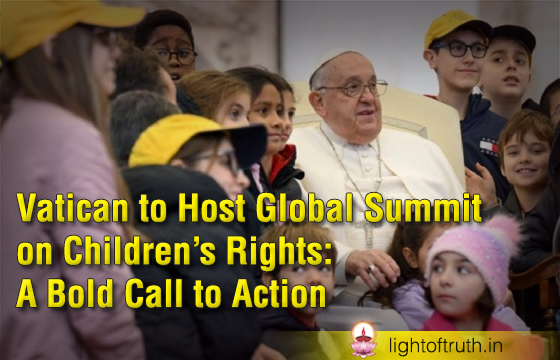
Vatican to Host Global Summit on Children’s Rights: A Bold Call to Action
On November 20, Pope Francis made a significant announcement during his weekly audience in St. Peter’s Square: the Vatican will host the “World Meeting on Children’s Rights”, titled “Love Them and Protect Them,” on February 3, 2024. Surrounded by a throng of children, the pontiff emphasized the urgent need to address the plight of millions of children worldwide who remain deprived of their basic rights.
The event will bring together experts and leaders from various nations to explore innovative strategies for safeguarding children who face exploitation, abuse, war, and extreme poverty. In a heartfelt gesture, Pope Francis highlighted the role children themselves will play in preparing for this historic day, symbolizing the essence of empowerment and inclusion.
“Millions of children live in precarious conditions, are exploited and mistreated, and suffer the devastating consequences of conflict,” Pope Francis stated, marking the occasion of the International Day of the Rights of the Child. “This meeting is an opportunity to identify new ways to help and protect them.” The announcement resonated deeply with those gathered, particularly the children present, who rushed to embrace the Holy Father. This visible connection underscored the Pope’s profound commitment to fostering a world where the youngest and most vulnerable are seen and valued.
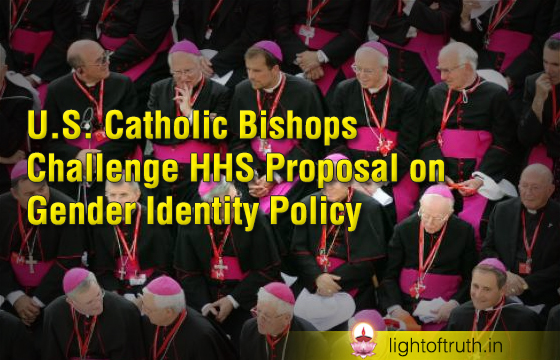
U.S. Catholic Bishops Challenge HHS Proposal on Gender Identity Policy
The United States Conference of Catholic Bishops (USCCB) is raising strong objections to a proposed regulation by the De-partment of Health and Human Services (HHS) that would impose strict anti-discrimination policies based on sexual orienta-tion and self-declared gender identity. The bishops argue the rule could force Catholic organi-zations to either compromise their religious beliefs or forfeit contra-cts with the federal agency.
The HHS draft rule mandates compliance with non-discrimina-tion policies for entities seeking federal contracts. It lacks specific definitions of what constitutes ‘discrimination’ and omits religious exemptions. Critics contend that this ambiguity could lead to mandates requiring Catholic entities to perform gender transition surgeries, provide hormone treatments, or deliver affirming counselling services–actions at odds with their religious convictions. The regulation would im-pact Catholic hospitals involved in Medicare and Medicaid, as well as organizations engaged in social services like adoption, foster care, and immigration assistance, areas where Catholic agencies have traditionally been significant contributors.
In a detailed public comment, the USCCB called on HHS to abandon the proposal, emphasizing the lack of clarity in its im-plementation and the potential conflict with constitutional protections for religious freedom.