
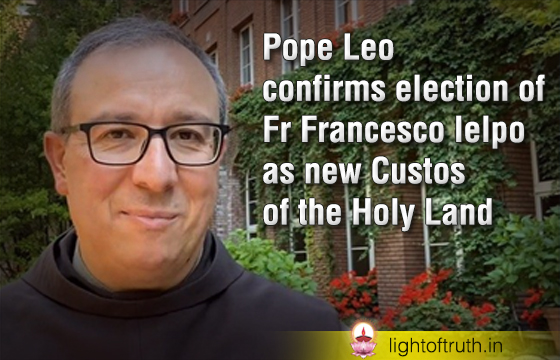
Pope Leo XIV has confirmed the election — conducted by the Minister General of the Order of Friars Minor together with his Definitory — of the Most Reverend Father Francesco Ielpo, OFM, as Custos of the Holy Land and Guardian of Mount Zion. The Minister General of the Franciscan Order, Friar Massimo Fusarelli, announced the news in an official letter sent to the friars of the Custody of the Holy Land.
Br Francesco Ielpo, an Italian national, was born in Lauria (PZ) on May 18, 1970. He professed his solemn vows in 1998 and was ordained to the priesthood in 2000.
Since 2014, he has served on the Board of Directors of the Pro Terra Sancta Association. Since 2022, he has also held the role of President of the Holy Land Foundation, while simultaneously serving as Delegate of the Custos of the Holy Land for Italy and as General Delegate for the restructuring of the Provinces in Campania, Basilicata, and Calabria.
In a press release announcing the election, the Custody of the Holy Land extended “heartfelt wishes for a fruitful service in this ‘Pearl of the Missions'” of the Franciscan Order. The statement also expressed “the profound gratitude of the Minister General and his Definitory to Br Francesco Patton, who concludes his dedicated and generous nine-year service to the mission in the Holy Land.”
In a statement to the Vatican media, Father Ielpo emphasised how “the service that the Order and the Church have asked of me immediately made me realise the enormous disproportion between my humble self and the duty required of me, particularly at this moment in history”. He recalled the words of his spiritual father, who told him, “This disproportion, this inability, is beautiful! Because it means that there is room for someone else to act, for the Holy Spirit to act!'”
Category Archives: International
Pope: Synodality is an attitude that helps Church foster communion
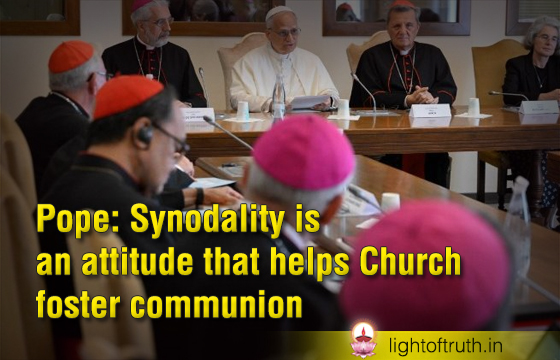
On June 26, Pope Leo XIV met with the Ordinary Council of the General Secretariat of the Synod of Bishops. In his brief remarks, the Pope reflected on a “thought that I consider central,” before listening to reflections from the Synod Secretariat. He said Pope Francis gave new impetus to the Synod of Bishops by drawing inspiration from Pope St. Paul VI.
“The legacy he has left us, in my view, is above all this: that synodality is a style, an attitude that helps us to be Church by promoting authentic experiences of participation and communion,” said Pope Leo.
The Holy Father said Pope Francis carried this vision of the Synod forward in various assemblies, especially, said Pope Leo, “those on the family.” “He then brought it to full expression in the most recent path, dedicated precisely to synodality,” said the Pope.
“The Synod of Bishops naturally retains its institutional identity, while at the same time being enriched by the fruits matured in this season,” concluded Pope Leo XIV. “And you are the body entrusted with gathering these fruits and engaging in forward-looking reflection.”
Holy See: ‘Urgent moral responsibility to address poverty’
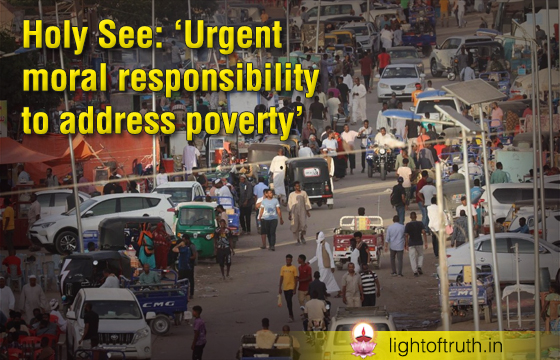
“The Holy See remains concerned about the ever-growing military expenditure, which diverts significant resources from investments in development sectors such as healthcare, education and infrastructure.” Monsignor Marco Formica, Chargé d’Affaires, a.i., of the Permanent Observer Mission of the Holy See to the United Nations, expressed this during the United Nations Security Council’s Open Debate on Poverty, Underdevelopment, and Conflict: Implications for the Maintenance of International Peace and Security in New York on 23 June 2025.
The Holy See official began his remarks acknowledging that the open debate aims to draw attention to the “interconnected challenges” of poverty, underdevelopment, and conflict, observing that these realities, “which often fuel one another, pose serious obstacles” to the maintenance of international peace and security.
He recalled that in the 2030 Agenda for Sustainable Development, the international community acknowledges that the eradication of poverty in all its forms and dimensions is “the greatest global challenge and an indispensable requirement for sustainable development, ” and that “this shared commitment underscores the urgent moral responsibility to address the root causes of poverty, which are frequently associated with injustice, exclusion, and the denial of fundamental rights.”
Msgr. Formica concluded by underscoring that lasting peace “requires a commitment to integral human development, upholding the God-given dignity of every person and promoting the conditions necessary for justice, solidarity, and the flourishing of all,” and reiterating that the Holy See “emphasizes the importance of placing integral human development at the centre of the ongoing review of the Peacebuilding Architecture,” and of “promoting strengthened cooperation among Member States in the service of peace.”
Parliamentarians from around the world gather in Rome to discuss interfaith dialogue
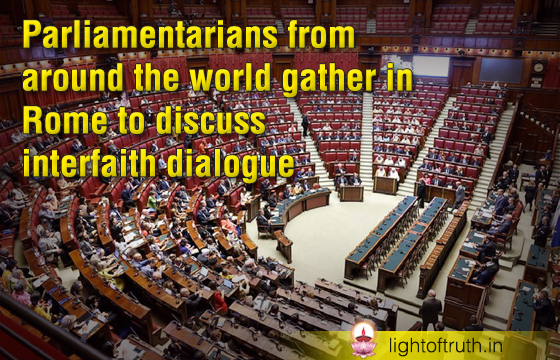
Parliamentarians and religious leaders from around the world have issued a powerful call for peace, hope and solidarity at the conclusion of the Second Parliamentary Conference on Interfaith Dialogue: Strengthening trust and embracing hope for our common future.
The event, jointly organized by the Inter-Parliamentary Union (IPU) and the Parliament of Italy with support from Religions for Peace, was held in Rome from 19 to 20 June 2025, marking the Jubilee Year declared by the late Pope Francis. Delegates had a private audience with the Pope on June 21.
The Conference brought together hundreds of MPs, including Speakers, as well as religious leaders, UN officials, civil society representatives, and international experts from close to 100 countries, responding to the motto of the Jubilee Year to be “pilgrims of hope” amid a climate of growing conflict, polarization and the weaponization of religion.
Amid escalating wars and global unrest, Rome was the epicentre of parliamentary diplomacy and interfaith dialogue this week with the IPU and the Italian Parliament creating a unique space to unite parliamentary and religious leaders from around the world to find new and badly needed avenues for peace.
In their final declaration, the Rome Communiqué, the parliamentarians and religious leaders unequivocally condemn the misuse of religion or belief to incite hatred or violence. The Communiqué emphasizes that interfaith dialogue — grounded in human dignity, inclusivity and respect for the rule of law — can prevent division, foster healing and build trust between communities. It highlights the shared roles and joint responsibility of parliamentarians and religious leaders in advancing justice, dignity and human development, working together for peaceful coexistence. Parliamentarians and religious leaders are urged to uphold democratic values, protect vulnerable groups, and promote ethical leadership through inclusion, compassion, accountability and solidarity.
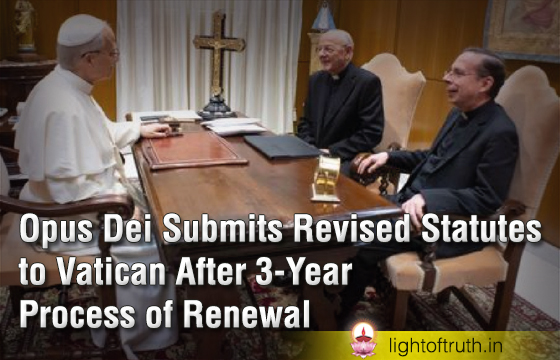
Opus Dei Submits Revised Statutes to Vatican After 3-Year Process of Renewal
On June 11, 2025, Monsignor Fernando Ocáriz, Prelate of Opus Dei, marked a significant in the institution’s history. In a message to members of the prelature, he confirmed that a new proposal of statutes has been formally submitted to the Holy See, concluding a lengthy process initiated after Pope Francis issued the motu proprio «Ad charisma tuendum» in 2022. The development is more than procedural. It represents the culmination of three years of discernment, consultation, and adaptation—an exercise in ecclesial fidelity that has unfolded against the backdrop of both papal transition and internal evolution. The Vatican’s 2022 directive called for a clearer legal alignment of personal prelatures like Opus Dei with the broader canonical structure of the Church. This entailed re-examining how the prelature understands its own identity, governance, and mission in light of the Church’s ongoing emphasis on synodality and pastoral transparency.
For decades, Opus Dei’s canonical configuration as a personal prelature—granted by St. John Paul II in 1982—has stood as a unique model of clerical and lay collaboration. The current revision aims not to undo that framework, but to refine it under the evolving legal and pastoral priorities of the universal Church.
The Vatican will now examine the proposed statutes, a process that could take several months. In the meantime, Opus Dei continues its ordinary work of formation, spiritual direction, and evangelization across the world. But internally, the act of submitting the revised statutes signals a symbolic closure of one chapter and the cautious opening of another—an era of clarified identity, deeper communion, and renewed purpose under the guidance of the Holy See.
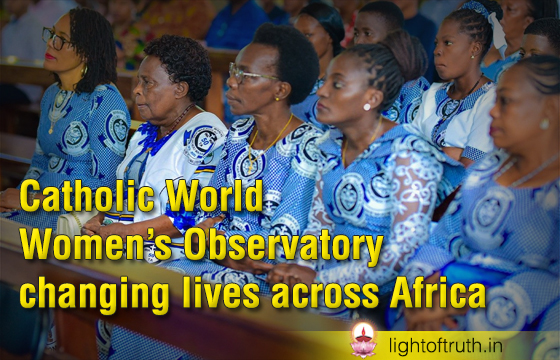
Catholic World Women’s Observatory changing lives across Africa
Operated by the World Union of Catholic Women’s Organisations (WUCWO), the World Women’s Observatory (WWO) aims to amplify the voices of women who are often unheard, particularly those living in fragile and marginalized communities. Founded in 1910, WUCWO represents more than 100 Catholic women’s organisations worldwide, uniting over 8 million members. The WWO, its flagship initiative, focuses on making women’s lived realities visible and informing Church and public policies through a Catholic lens centered on human dignity. Under the vision “Women Custodians of Mother Earth,” WWO has extended its reach across Africa, with notable activity in Tanzania, Kenya, Uganda, and Malawi.
Speaking to Vatican News, Aveline Malisa Ntenga, President of WWO Africa, said the organization’s work on the continent centres on empowering women through trauma recovery, entrepreneurship training, and reintegration support for survivors of trafficking. These programmes are run in collaboration with WUCWO-affiliated organizations in countries such as Nigeria, Cameroon, Eswatini, Ivory Coast, and Guinea Conakry, among others. Partnerships with Caritas, religious congregations, and lay associations further strengthen outreach.
The World Women’s Observatory has outlined a set of strategic recommendations for the coming year. These include organizing a continental coordination meeting for all WWO representatives in Africa, expanding digital training and ambassador networks, creating a resource library of best practices and case studies, and strengthening partnerships with religious congregations and lay movements.
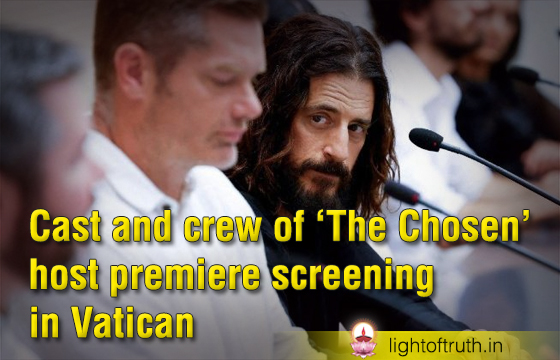
Cast and crew of ‘The Chosen’ host premiere screening in Vatican
On June 23, the cast and crew of The Chosen TV series made a special appearance in Rome for a press conference during their break from filming in Matera, Italy. Castmates Jonathan Roumie, George Xanthis, Elizabeth Tabish, Vanessa Benavente, and series creator Dallas Jenkins discussed the fifth season and what it means to the entirety of the show. Episodes of the newest season have already premiered in the US, and The Chosen is currently one of the top ten shows for viewership on Amazon Prime Video.
During the press conference, the cast and crew shared how important this season is to them as it depicts prominent biblical moments, including the events of Holy Week. For actor Jonathan Roumie, who has the role of Jesus, being a part of this project has been both eye-opening and surreal. During the conference, he commented on how he felt “sitting in the Vatican is a testament to how God wants to continue to further this mission to bring more people to Jesus.”
The show’s creator, Dallas Jenkins, also discussed key points about his ultimate goal in creating The Chosen. He shared that producing a successful show was just the start for him, but his ultimate mission has always been to point viewers in the direction of who Jesus really is. Over 30% of The Chosen’s audience do not identify with the Christian faith, and for Jenkins, being able to introduce them to the Gospel stories is the most rewarding part of his work. Jenkins explained that the show “gets us to ask questions, and that’s not just non-believers. Those of us who are believers still have so many things to learn.”
During the press conference, the conversation with the cast and crew extended beyond just the details of the new season. They also spoke about the growing unrest and tension around the world and how following the Gospel message could bring peace to the world.
Roumie argued that if “we were able to connect with each other in our humanity, the world would be a different place.” He urged world leaders to “use Jesus as an example of how to address the problems of the world.”
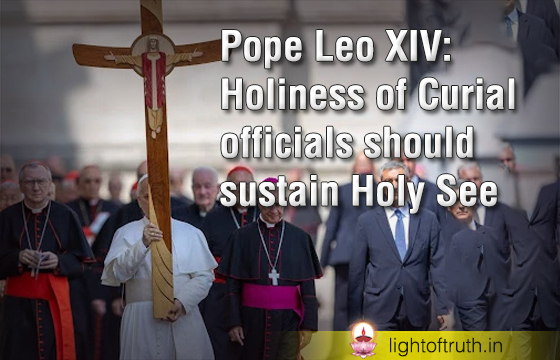
Pope Leo XIV: Holiness of Curial officials should sustain Holy See
As the Church marks the Jubilee of the Holy See, Pope Leo XIV spent on May 09 Monday morning with employees and officials of the Roman Curia. The Jubilee began with a meditation offered by Sr. Maria Gloria Riva, a Sister of the Blessed Sacrament and Our Lady. The Pope then carried a Jubilee cross and led a procession of Holy See officials through the Holy Door of St. Peter’s Basilica.
After the procession, Pope Leo XIV celebrated Mass and reflected in his homily on the spiritual foundations of the Apostolic See. “The Holy See lives in a most particular way the co-presence of two poles: Marian and Petrine,” said the Pope. “It is the Marian one that ensures the fruitfulness and holiness of the Petrine one, through her motherhood, gift of Christ and the Spirit.”
The Holy Father noted that the Jubilee of the Holy See takes place on the liturgical memorial of Mary, Mother of the Church, a day after the Solemnity of Pentecost.
The Gospel reading from John, he said, recounts that Jesus entrusted His mother to the Beloved Disciple from the Cross. Pope Leo added that the Church’s fruitfulness is “the very fruitfulness of Mary,” which is realized in the lives of the Church’s individual members.
Each Christian, he said, is called to live the love of Jesus, as experienced on the Cross.
“This fruitfulness of Mary and of the Church is inseparably linked to her holiness, that is, her conformity to Christ,” said the Pope. “The Holy See is holy as the Church is holy, in her original core, in the fabric from which she is woven.”
Pope Leo XIV said the Apostolic See safeguards the holiness of her roots, just as she is safeguarded by that holiness. “It is no less true that she also lives in the holiness of each of her members,” he said. “Therefore, the best way to serve the Holy See is to strive to be holy, each of us according to his or her state of life and the task entrusted.”
Pew report: How the global religious landscape changed from 2010 to 2020
While Christianity remained the largest global religion from 2010 to 2020, the latest Pew Re-search study found that followers of Islam outpaced every world religion in population over the course of the decade.
The recently released report, “How the Global Religious Landscape Changed from 2010 to 2020,” includes data from over 2,700 sources, including national census, demographic surveys, and population registers. Some of the estimates made in the report originate from data about 2020 that was not made available till 2024 due to the COVID-19 pande-mic, which delayed census data in at least 65 countries. The report covered 201 countries, focusing on seven religious categories: Christians, Muslims, Hindus, Buddhists, Jews, people who be-long to other lesser-known reli-gions, and religiously unaffiliated.
According to the report, the total number of Christians rose by 122 million from 2010 to 2020, while the total number of Muslims rose by 327 million – “more than all other religions combined.” The global Christian population rested at 2.3 billion in 2020, while the global Muslim population came to 2 billion.
Apart from Muslims, the only other group that grew as a per-centage of the global population were those who identify as having no religion, known as “nones.” The report described this pheno-menon as “striking” because reli-giously unaffiliated people are typically older and have lower fertility rates, putting them at a “disadvantage” for population growth. By the end of 2020, how-ever, “nones” made up 24.2% of the global population, making it the third-largest group in the study, following Christians and Muslims.
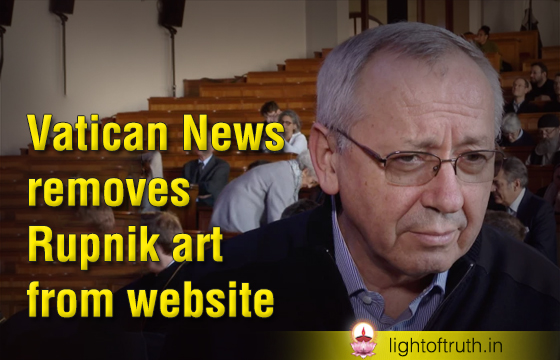
Vatican News removes Rupnik art from website
The Vatican on May 09 removed artwork by former Jesuit Father Marko Ivan Rupnik from its official web-sites. Digital images of the Slovenian priest’s sacred art, which were frequently used by Vatican News to illustrate articles of the Church’s liturgical feast days, are no longer found on the digital news service.
Catholic writer Amy Welborn took to X to show screenshots of Vatican News’ “Memorial of the Blessed Virgin Mary, Mother of the Church” article before and after Rupnik’s accompanying artwork was removed from the website on June 9.
Rupnik, who was expelled by the Society of Jesus in June 2023 for his “stubborn refusal to observe the vow of obedience,” is accused by about two dozen women, mostly former nuns, of spiritual, psychological, and sexual abuse they allege has occurred over the past three decades. The recent changes to the Vatican News and the Dicastery for Communication websites came soon after Pope Leo XIV met with members of the Pontifical Commission for the Protection of Minors on June 5.