Category Archives: International

The Orthodox Church is on the brink of a new Great Schism

For centuries, the archbishops of Constantinople could credibly claim to be the “Ecumenical Patriarch”. Their see was the “New Rome”, centre of the oikoumenç, the “inhabited world”. Today, their successor, Patriarch Bartholomew, looks beleaguered. The guards around his residence in the Phanar quarter of Istanbul reveal his threatened position in an increasingly Islamified Turkey. But now he seems poised to gain other powerful enemies, this time within the Orthodox Church itself, by unilaterally recognising a Ukrainian Orthodox Church independent of Moscow.

The renascent Church of Russia, thought to comprise more faithful than all the other Orthodox Churches combined, covets Constantinople’s leadership role. Styled “the Third Rome” since Tsarist times, Moscow believes geopolitical reality should give it more weight than Bartholomew’s aura of the Byzantine past.

Moscow has long sought to expose Bartholomew’s weakness, as when it tried to wreck the Pan-Orthodox Great and Holy Synod of 2016. The Russians and other Churches under their influence stayed away, greatly reducing the impact of the long-planned assembly where Constantinople had hoped to bolster its prestige.

But perhaps Bartholomew now has an opportunity to strike back. Since Ukraine gained independence in 1991 two distinct groups have separated from the Moscow patriarchate, seeking to establish a distinctively Ukrainian Church. One of these groups has established a patriarchate based in Kiev, while the other group, older but much smaller, makes the less radical claim of being the autocephalous (self-governing) Church of Ukraine. So far, neither has received recognition from any other canonically recognised Orthodox Church. But conflict with Russia since the 2014 revolution has reportedly enhanced the standing of these groups with patriotic Ukrainians.

Bartholomew has announced his intention to recognise an autocephalous Ukrainian Church, uniting these groups – and anyone else who will join them – into a single jurisdiction looking to Constantinople rather than Moscow as the Mother Church.

Pope: Eastern-rite priests’ families offer unique example

The families of Eastern-rite Catholic priests give an important witness to what is healthy and wonderful about family life, Pope Francis said.

Speaking to laypeople, clergy and religious of the Slovak Catholic Church – a Byzantine-rite Church that has maintained its tradition of ordaining both celibate and married men – the Pope said, “the families of priests live a unique mission today.”

“When the very model of the family is called into question, if not attacked outright, you offer a healthy and exemplary testimony of life,” he said in his talk on October 6.

The Pope encouraged the small Slovak Catholic Church, which also has a diocese in Canada – the Eparchy of Sts Cyril and Methodius of Toronto – to safeguard its Byzantine tradition, “which I, too, came to know and love when I was younger.”

“Rediscover it and live it to the full just as the Second Vatican Council taught,” he said.

“The European continent, both east and west, needs to rediscover its roots and vocation; and from Christian roots, only solid trees can grow which bear the fruits of full respect for the dignity of the human person in every condition and every phase of life,” the Pope said.

Pope Francis calls for a youth synod ‘anointed by hope’


Pope Francis began the Synod on young people Oct. 3 with a homily call-ing for the Holy Spirit to renew hope and dynamism in the Church.

Hope can “broaden our horizons, expand our hearts and transform those frames of mind that today paralyze, separate and alienate us from young people,” said Pope Francis. The Synod of Bishops commenced its fifteenth ordinary general session with Pope Francis asking to begin the assembly “anointed by hope.” “Hope challenges us, moves us and shatters that conformism which says, ‘it’s always been done like this,’” he continued.

In a historic first, two bishops from mainland China are participating in the Synod of Bishops due to the Holy See’s provisional agreement with China on the appointment of bishops in September. One of the bishops at the Synod, Bishop Giuseppe Guo Jincai of Chengde, was among the seven bishops recognized by the Vatican on Sept. 22.

“The communion of the entire Episcopate with the Successor of Peter is yet more visible thanks to their presence,” the Pope said as he welcomed the delegates from China.

“Hope asks us to get up and look directly into the eyes of young people and see their situations,” said Pope Francis, “This same hope asks us to make efforts to reverse situations of uncertainty, exclusion and violence, to which our young people are exposed.”

More than 300 participants are gathered in Rome, including clerics and religious, as well as 49 auditors, among them 36 young people from five continents.

Cardinal Marx calls for ‘fundamental, systemic change’ to confront abuse crisis

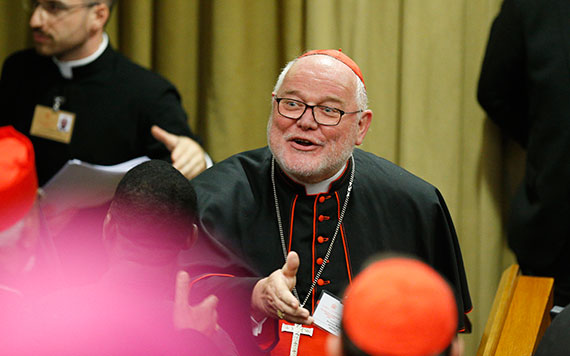
The German prelate who serves on Pope Francis’ advisory body of cardinals has called for the Catholic Church to adopt “fundamental, systemic change” in order to address the continuing clergy sexual abuse crisis. Cardinal Reinhard Marx, one of nine members on the Council of Cardinals, suggested discussions about such change could focus on three areas: adoption of “good governance” practices, compliance with safeguarding norms, and a focus on creating a “higher degree of accountability” for church leaders. “There can be no restoration of the church’s credibility without fundamental, systemic change,” Marx told participants of an Oct. 5 event at the Pontifical Gregorian University for the inauguration of the institution’s new graduate-level degree in safeguarding.

The cardinal also praised survivors of clergy abuse for coming forward.

“We must be grateful to the public pressure, the criticisms and the voice of the survivors… which help us to improve,” he said. Marx, the archbishop of Munich and Freising, also serves as the president of the German bishops’ conference, which recently released a report indicating there had been an estimated 3,700 sexual abuse cases in the country over the past seven decades.

At the Sept. 25 press conference releasing that report, the cardinal apologized for the abuse, saying it had been “covered up for far too long.”

During his address at the inauguration of the new degree program at the Gregorian, being offered by the university’s Centre for Child Protection, Marx said the abuse scandals “have plunged the church into one of its most serious crises worldwide, raising many questions and challenges for the future.” “This is challenging, exhausting, but at the same time without alternative,” said the cardinal. “We must help together to promote a variety of constructive initiatives and create synergies.”

“Leadership must be learned and practiced,” said the cardinal, adding that it is “absolutely unacceptable to say” that those who are ordained become leaders “simply by being ordained.”

Coptic Christians nominated for Nobel Peace Prize

Coptic Christians have been nominated for the 2018 Nobel Peace Prize for their refusal to retaliate against deadly and on-going persecution from governments and terrorist groups in Egypt and elsewhere.

The Copts, the indigenous people of Egypt, are one of 331 nominees for the prestigious prize, won previously by organisations such as the Red Cross and Médecins sans Frontières, and individuals such as MalalaYousafzai, the youngest person ever to win it. Last year’s winner was the International Campaign to Abolish Nuclear Weapons. The European Union won the prize ion 2012, Barack Obama in 2009, Jimmy Carter in 2002 and Archbishop Desmond Tutu in 1984.

There are believed to be around 20 million Copts worldwide. In Egypt they make up about 10 per cent of the population. If they win, they would be the first ethno-religious group to do so. They are also believed to be the first such group to be nominated. Although the Nobel committee itself does not release the list of nominees, the nomination was confirmed by Coptic Orphans, the US-based Christian development charity.

The recipient of the Peace Prize will be announced on October 5. The prize is awarded in December in Stockholm.

According to the 2018 Open Doors report on persecution of Christians around the world, Christians in Egypt face “unprecedented levels of persecution”. Last year, 128 Egyptian Christians were killed for their faith and more than 200 were driven out of their homes.

Islamic State pledged to extreminate the Copts. In 2015 the terror group beheaded 21 Coptic Christians in Libya. The account of one Coptic woman who lost two brothers in the beheading is told here.

Four Children, Grandmother among 17 Christians Slain in Attack by Muslim Herdsmen in Nigeria


Armed Fulani herdsmen accompanied by militants in Nigerian army uniforms killed 17 Christians in their homes in the heart of Jos, north-central Nigeria, on  Sept. 27, including four children, area sources said.

At about 7:30 p.m. in an area known as Rukuba Road, the assailants broke into one home shooting randomly and killed 14 members of one family, including 15-year-old IshayaKogi, 17-year-old Jonathan Kogi, Cynthia Kogi, 22, and Lucky Kogi, 25, their uncle told Morning Star News.

Two of Lucky Kogi’s children, 3-year-old Majesty Lucky and Blessing Lucky, 14, were also killed in the assault, he said.

“When the Fulani herdsmen came, they shot into the house randomly, breaking and forcing their way into rooms shooting defenceless women and children and anyone in sight,” the mournful RoguAudu, who lost his mother and two of his own children in the attack, told Morning Star News.

The attack took place close to the Nigerian army military cantonment, Rukuba Barracks, in Jos. Surviving family members told Morning Star News that the Fulani herdsmen, armed with both firearms and machetes, were accompanied by Nigerian army soldiers.

Poll: Pope’s favourability numbers down, and worse for handling of abuse

With Pope Francis midway into the sixth year of his pontificate, the percentage of U.S. Catholics who view him favourably, while still strong, is noticeably down.

And, compared to a January poll by the Pew Research Centre that showed Catholics being evenly split on how well Pope Francis has handled the issue of clergy sex abuse, numbers in the new poll, released on Oct. 2, show that twice as many Catholics feel he is doing only a fair or poor job on the issue than say he is doing a good or excellent job.

The overall favourability number for the Pope is 72%, split between 42% of Catholics who see him “mostly favourable” and 30% who view him “very favourable.” The latter number down a third from the last Pew poll last January, when Pope Francis had been at 84% favourability. The 72% figure is lower than Pew’s favourability findings for Pope Benedict XVI except for its first poll asking the question shortly after Pope Benedict assumed the papacy in 2005.

Synod English groups: Abuse crisis undermines church ‘in practically every way’


Two of the four working groups for English-speaking prelates at the worldwide meeting of Catholic bishops on young people have spent time considering the impact of clergy abuse scandals on the global church’s credibility. In the first of three reports expected from the working groups during the Oct. 3-28 Synod of Bishops, one of the English groups said bluntly that in the gathering’s expected final document clergy abuse “cannot be skimmed over tangen-tially in a few short sentences.”

Naming some of the effects of abuse – “shattered trust, the trauma and lifelong suffering of survivors; the catastrophic failures in case management; the continued silence and denial” the group added: “these issues cry out to be named openly by the Synod.”

“If priests themselves are afraid to minister among the youth, then how can our Synod get out the message that young people, their faith and their vocational discernment are important to us?” asked that group, which is being led by Indian Cardinal Oswald Gracias.

“As one member of our Group reminded us: ‘Trust arrives slowly, on foot, but Trust leaves on horseback!’” the report said. “‘Trust must be rebuilt, one person at a time.’”

The 267 prelates and the 72 auditors taking part in the Synod of Bishops have been meeting in 14 groups divided by working language for the past few days to reflect on the first part of the gathering’s three-part working document, known as the Instrumentum Laboris.

Russian Orthodox Church confirms readiness for dialogue with Constantinople

A Russian Orthodox Church representative has confirmed its readiness for dialogue with the Patriarchate of Constantinople, the relations with which have soured over its plans to grant an autocephaly to the Ukrainian Church.

Despite all the decisions of the Russian Orthodox Church, the door to dialogue remains open, and the Moscow Patriarchate hopes that at some point the situation would be turned around, Vladimir Legoyda, head of the Moscow Patriarchate’s Department for Church, Society and Media Relations, told State Duma members on October 9

The Russian Orthodox Church is watching the Constantinople synod and hopes Christian conscience will prevail there, he said.

“The Synod in Constantinople is beginning work today. We don’t know what will happen, we hope that we will finally see the triumph of common sense and Christian conscience there. We are hoping for that, and we shall see how events evolve,” Legoyda said.

North Korea’s Kim invites Pope Francis to visit Pyongyang, Seoul says


North Korean leader Kim Jong Un has invited Pope Francis to visit Pyongyang, a spokesman for South Korea’s presidential Blue House said on October 9.  “Chairman Kim said he will ‘ardently welcome the Pope if he visits Pyongyang,’” spokesman Kim Eui-kyeom said according to a readout of the news briefing. The spokesman was announcing details about South Korean President Moon Jaein’s planned visit to Europe, which includes a stop at the Vatican on Oct. 17 and 18. Moon was expected to deliver the message from the North Korean leader when he meets with the Pope. At their meeting, Moon will seek Francis’ support for the on-going push for peace on the Korean Peninsula and discuss future ways to cooperate with the Vatican, the Blue House spokesman added. Francis has in recent months expressed his backing for continued inter-Korean engagement, even meeting with representatives from both Koreas in June.