Category Archives: International

PROTECTION OF MINORS: MEETING OF ABUSE VICTIMS IN VATICAN

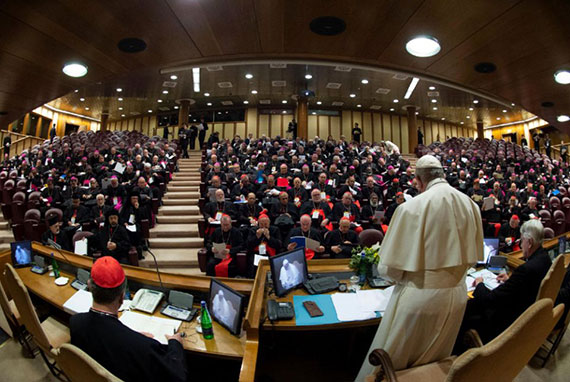
The ad interim Director of the Vatican Press Office, Alessandro Gisotti, issues a statement confirming a meeting that took place in the Vatican  between the organizing committee of the “Protection of Minors in the Church” Meeting and several victims of abuse.”As was announced during the course of the Press Conference on 18 February in the Press Office of the Holy See, this morning the Organizing Committee for the Meeting on “The Protection of Minors in the Church” met a group of representatives of victims of sexual abuse by members of the clergy. There were 12 people, men and women, from different parts of the world who belong to various organizations. The meeting lasted a little bit more than two hours. The members of the Committee are very grateful to the victims who participated for their sincerity, the depth and the strength of their testimonies, which will certainly help them to always better understand the gravity and urgency of the difficulties that they will confront during the course of the Meeting.”

GERMAN POLITICIANS ALARMED BY RISING ANTI-SEMITISM IN FRANCE

Josef Schuster, president of the Central Council of Jews in Germany, said in an interview with the German Welt am Sonntag newspaper he’s concerned about a sharp rise in anti-Semitic attacks in France.” The anti-Semitic incidents in France are disturbing and frightening for the Jewish community in Germany also,” Schuster said. France is not the only EU country experiencing a spike in antiSemitic acts; both Germany and Britain have also reported an uptick last year, reaching a record 1,652 in the UK.

Pope wants bishops conferences to take responsibility for sexual abuse issue

Pope wants bishops to take responsibility for abuse scandal — Pope Francis called the bishops of Chile to the Vatican to “examine the causes and consequences” of the clerical sexual abuse scandal and acknowledge personal responsibility and “the mechanisms that in some cases led to a cover up and serious omissions regarding the victims,” the Vatican said. In a statement May 12, the Vatican press office said 31 Chilean diocesan and auxiliary bishops, along with two retired bishops, will meet with Pope Francis on May 15-17 in one of the small meeting rooms behind the Vatican audience hall. The objective of the meeting is “to discern together, in the presence of God, the responsibility of all and each one in these devastating injuries, as well as to study appropriate and lasting changes that would prevent the repetition of these always reprehensible acts,” the statement said. Cardinal Marc Ouellet, prefect of the Congregation for Bishops, will join the Pope and the Chileans, the Vatican said. The goal is “to re-establish trust in the church through good shepherds who witness with their lives that they have heard the voice of the Good Shepherd and know how to accompany the suffering of the victims and work in a determined and untiring way in the prevention of abuse,” the statement said. The Chilean bishops had said they would be at the Vatican on May 14-17 to discuss with the Pope their handling of clerical sex abuse allegations and, as Pope Francis had said, “to repair the scandal as much as possible and re-establish justice.” Media reports in Chile indicated that Cardinal Francisco Javier Errazuriz Ossa, retired archbishop of Santiago and a member of Pope Francis’ international Council of Cardinals, would not attend the meeting. A statement published by the Chilean bishops’ conference on May 10 said, “We reiterate our unity with Pope Francis in the pain and shame he expressed about the crimes committed against minors and adults in church settings.”

On Sept. 12, the Holy See announced that the Pope had decided to call the summit, which will have an unprecedented format, “to discuss the prevention of abuse of minors and vulnerable adults.”

Pope praises girl who zipped by security to give him letter

Pope Francis has praised the courage of a young girl who broke through police barricades in Abu Dhabi to hand-deliver a letter to him. Francis was being driven around the city’s sports stadium in his Pope mobile before Mass when the child dashed from the crowd so quickly that police couldn’t catch her. “This child has a future!” Francis told reporters en route home. “I liked that. You have to have courage to do that.” He laughed and added: “Dare I say, ‘Her poor husband …’”

Geneva to ban religious symbols on public employees

Geneva residents on February 10 voted for a controversial new “secularism law,” which will among other things ban elected officials and public employees from wearing visible religious symbols.

More than 55% voters in the Swiss canton backed the law, final results showed, despite warnings that it could lead to discrimination, particularly against Muslim women. Some critics think it might violate the constitution.

Geneva Canton, which for centuries has been a centre of religious freedom and tolerance, has been striving to replace a law on the books since 1907.

The new law’s stated ambition is to expand the dialogue between religious groups and the state, and to better define the limits to religious expression in the public sphere.

Supporters say it will help clarify existing principles in the Geneva Constitution to protect the religious freedom of believers and non-believers alike.

The right-leaning cantonal parliament adopted the text last April. It also has the backing of Geneva’s three main religious communities, the Protestant Church, the Catholic Church and the Old Catholic Church.

But the far left, the Greens, feminist organizations, unions and Muslim groups all opposed it, and collected enough signa-tures to force the issue to a public vote.

Chaldean patriarch: reforming rites and traditions to meet to the challenges of modernity

The Chaldean Patriarch, Card Louis Raphael Sako, issued a pastoral letter on the “originality and authenticity” of the “renewal” of the Chaldean Church, which was sent to AsiaNews for wider circulation.

In it, the prelate notes that the Church must “give answers” to the questions and challenges of modernity, the passage of time and prepare for those “that will come in the future.” Hence, “no one should be afraid” to change rites and traditions without losing their original missionary nature.

In his letter, the cardinal warns against fear of “modernity.” To those who criticise changes in rituals, customs and traditions, he asks if they “today wear the garments that were once popular in their villages of origin.”

Practices and traditions are not the same as “ancestors” and this change is physiological because it is an adaptation “to the new society.”

Thus, he goes on to say, we need to “prepare the texts of our liturgy in Arabic, Kurdish, English, French, German,” or the other languages of the Diaspora countries where new Chaldean communities have emerged in the last few decades.

In the new millennium, the US invasion of Iraq and the rise of the Islamic State (IS) group contributed to this exodus, which has bled the communities of their members.

The cardinal’s letter comes at a time of controversies and divisions in Eastern Churches over liturgical reform, with some stubbornly holding onto the dictates of tradition.

To back his argument, Msgr Sako cites the case of the Malabar Church in India, which tran-slated the various rites from the original “Chaldean-Syriac language, like ours” into Malayam and promoted “a reform” so that rites could be “understood by its believers.” “We are a Church, not a museum called to preserve a certain heritage,” the cardinal writes. In fact, for him, there is a danger that the “missionary dimension and the sense of evangelisation” of the Eastern Catholic communities might be lost “because of the geopolitical situation, the pressures and persecutions,” which have led to “closed ethnic Churches: Chaldean, Assyrian, Armenian, Syriac, Coptic and Maronite, each with its own geographical and linguistic affiliation.”

Orban Encourages Mothers in Hungary to Have 4 or More Babies

Faced with a plummeting population, rising labour shortages and widespread emigration, Prime Minister Viktor Orban of Hungary has long taken an unconventional approach to increasing the size and productivity of Hungary’s work force.

He offered university scholarships only to those who promised to stay in Hungary. He gave citizenship to ethnic Hungarians living beyond the borders. And late last year, he increased the amount of overtime employers can demand of workers — to 400 hours a year.

Mr Orban announced one of his most ambitious plans yet: Any Hungarian woman with four or more children will no longer pay income tax.

“We are living in times when fewer and fewer children are being born throughout Europe. People in the West are responding to this with immigration,” Mr Orban said in a speech. “Hungarians see this in a different light. We do not need numbers, but Hungarian children.”

No country in the European Union has a fertility rate high enough to replenish its population without immigration — but Hungary, with about 1.5 children per woman, is among the most sluggish. It also is among the most reluctant to accept foreign workers to help plug the gaps.

Even in the Czech Republic and Poland, where anti-immigrant sentiment also runs high, governments are planning to admit, or have already admitted, workers from across Asia. But Mr.Orban, a far-right leader, has said he does not want the color of Hungarians to be “mixed with those of others.” He led European opposition to refugees during the 2015 migration crisis and has boxed himself into a rhetorical corner that now makes it difficult to change direction.

Church service stops after 96 days as asylum family pardoned

A church service that has been performed continuously for 96 days has come to an end after the Dutch government agreed to pardon a family the pastors were shielding from deportation as part of a wider amnesty.

Sasun Tamrazyan, his wife Anousche and their children Hayarpi, 21, Warduhi, 19, and Seyran, 15, have been holed up in the Bethel church in The Hague since October, relying on a medi-eval law that says immigration authorities cannot enter while a religious service is being perfo-rmed.

The family, who have been in the Netherland for nine years, had claimed their lives would be in danger if they returned to Armenia, where Sasun had been a political activist.

But the Dutch coalition government announced under pressure from campaigners that they would examine the cases of 700 children and their families who are under the threat of deportation. Residency rights were likely to be granted in 630 of the cases, government officials said.

Cardinals at war over ‘fraud of Antichrist’

The Pope’s former doctrinal chief has published a “Manifesto of Faith” in which he warns of the “fraud of Antichrist” being perpetrated by those who fail to teach the faith correctly.

Cardinal Gerhard Müller, prefect of the Congregation for the Doctrine of the Faith from 2012 to 2017, writes that there is “growing confusion about the doctrine of the faith.”

In the face of this, “many bishops, priests, religious and lay people of the Catholic Chur-ch have requested that I make a public testimony about the truth of revelation.”

He says it is the task of the shepherds of the Church to guide Catholics on the path of salvation. “This can only succeed if they know this way and follow it themselves.”

But today, many Christians are no longer even aware of the basic teachings of the faith, so there is a growing danger of missing the path to eternal life, he warns.

Cardinal Müller says Christ is the “point of reference,” rather than the “views of a majority or the spirit of the times.”

He drew a rapid response from the German prelate, Cardi-nal Walter Kasper, who writing on the German site Katholisch, says there is no doubt that the manifesto contains many state-ments of faith that every upright Catholic can whole heartedly affi-rm, but there are also problems.

GERMAN CATHOLICS DEMAND BREAK FROM CHURCH’S TEACHING ON SEX

A group of prominent German Catholics called on February 3 for the ordination of women and ending mandatory priestly celibacy among other changes to Catholic sexual morality. The group of nine, including prominent German priests and theologians, made their demands in an open letter to Cardinal Reinhard Marx, published in the German newspaper Frankfurter Allgemeine Zeitung. The signatories of the letter demand a new assessment of the church’s teaching on homosexuality, permission for the ordination of women and a reordering of church structure, among other changes.