
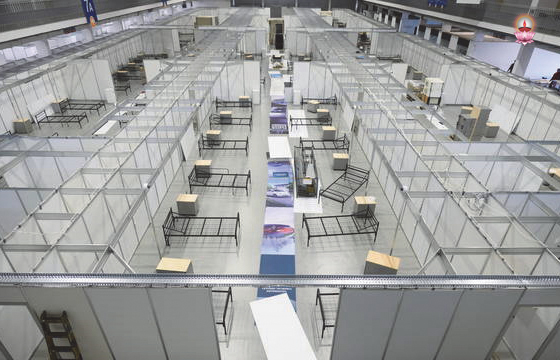
Polish Prime Minister Mateusz Morawiecki has warned Poles against planning travel during the Christmas period, warning that most of the restrictions to keep the epidemic under control will be prolonged, even if you think about the reopening of the shops. “Please don’t plan any trips,” Morawiecki said at a press conference, adding that the government is looking for ways to impose restrictions on movement. Morawiecki suggested that Poles should spend Christmas only with their families and not travel between the country’s cities. Morawiecki also said that theaters, bars and restaurants will remain closed until after Christmas and that schools will continue with distance learning. “The situation is still very serious,” said the premier of Warsaw, expressing concern over the high mortality rate but stressing that the number of new cases has stabilized. The Ministry of Health recorded 574 deaths over 24 hours, bringing the total death toll to 13,288. The number of new infections per day in Poland was 24,213. –ANSA-AFP
Category Archives: International

Christian astronaut takes Bible, communion cups on mission to space station
Astronaut Victor Glover was- n’t trying to get away from God as he blasted to the International Space Station in the SpaceX Crew Dragon’s capsule Resilience on November 15.
As the first African American astronaut to go on a long-term mission, Glover took on board communion cups and the word of God. He plans to utilize the strong internet connection aboard the craft to access faith-based pro-grams, too.
Glover arrived at the ISS with the three other crew members on-board the first commercially developed space vehicle certified by NASA and the Federal Aviation Administration to ferry astronauts up to low-Earth orbit and back again. The crew will stay at the space station until the spring.
“As we’ve grown our family, that’s really when I’ve started to develop a real, true appreciation of my own faith and not just the academic,” he said. The couple has attended two Houston-area congregations: League City Church of Christ and the Southeast Church of Christ in Friendswood. They’ve been going virtually since the COVID-19 pandemic began.

Christian Persecution: A Glaring Blind Spot in Nigeria and Beyond
“Traveling by road into Maiduguri, the capital of Nigeria’s northeast, has become one of the most dangerous journeys on earth.” So begins an alarming and timely Wall Street Journal article about ever-encroaching violence in Nigeria, Africa’s largest country and most powerful financial centre. Writer Joe Parkinson describes four primary highways that lead into that northern Nigerian city, once known as “Home of Peace.” Along those roads some 200 people have been murdered in the past six months. Since its happier days, today Maiduguri is better known as the birthplace of Boko Haram, the brutal Islamist terrorist group. “The attacks are conducted by militants fighting for Boko Haram and a splinter group loyal to Islamic State,” Parkinson explains. “With each passing month they become more brazen, targeting civilians, aid workers, soldiers and even the state’s most powerful politicians.”

Multiracial churches on the rise, Catholic churches lead in diversity: survey
American Churches have grown in diversity with Catholic Churches leading as the most diverse, a new study by Baylor University shows.
The number of churches where less than 80% of people belonged to one race has nearly tripled since 1998, from 6% to 16%. The study counts churches in this category as “multiracial.”
Baylor University Professor Kevin Dougherty ran the study along with professors Michael Emerson and Mark Chaves. To find the information, the group asked 1,262 churches questions about race from 2018 to 2019. The study is the fourth in a series of studies which began in 1998. It’s unclear whether church makeup is changing society or whether some other change is changing church makeup.
“There’s a long history of research that shows when you bring people together to form relation-ships across racial lines, they start to think differently about race. Racism disappears,” Dougherty told The Christian Post. “But for most people, the reason they choose a multiracial place of worship is because they already have positive attitudes about other racial groups.”
Since 1998, Catholic Churches have always been the most diverse, the study suggests. But Pentecostal, evangelical, mainline Protestant and black Protestant denominations have all been catching up.
2 in 3 Americans thankful to God; most thankful for family: Survey
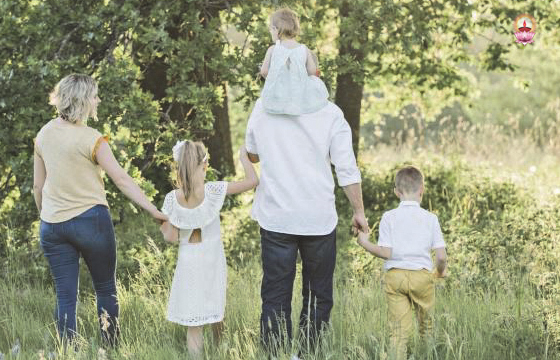
Ahead of Thanksgiving Day, which will be celebrated amid the COVID-19 pandemic and following a divisive election, a new survey shows that the majority of Americans still have a reason to be thankful.
The poll from Nashville-based LifeWay Research shows that more than 84% of American adults say they are thankful for their family, 69% are thankful for health, 63% for their friends and 63% of Americans are thankful for memories.
“In a year that has been difficult for most, Americans still express a lot of thanks,” the executive director of LifeWay Research, Scott McConnell, said. “This year of loss and division does not mean people have an absence of good things for which to be grateful.”
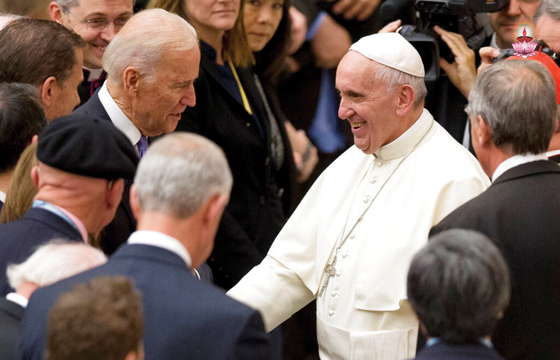
Joe Biden will be the second Catholic president Here’s what you need to know about his faith
The morning of Election Day, Joseph R. Biden Jr. prayed during Mass at the Catholic parish near his home in Delaware. Late that night, when it became clear that no winner would be determined, Mr Biden spoke to supporters. He urged patience, told them that he believed he would be elected president and asked them to “keep the faith.” The president-elect kept the faith, and major news outlets have projected Mr. Biden has captured enough electoral votes to win the presidency. He will be just the second Catholic to hold the office.
In a 2015 interview with America’s editor in chief, Matt Malone, S.J., Mr Biden called his faith a “gift,” saying his parents inculcated in him Catholic values.
“Jesus Christ is the human embodiment of what God wanted us to do,” Mr Biden said. “Everything Jesus did was sort of consistent with what generically we were supposed to do: treat people with dignity.”
In that interview, Mr Biden spoke about his meeting with Pope Francis in 2013. “He’s the embodiment of Catholic social doctrine that I was raised with,” the former vice president said. “The idea that everyone’s entitled to dignity, that the poor should be given special preference, that you have an obligation to reach out and be inclusive.” Mr. Biden traces his Catholic faith back to Catholic schools in Delaware and Pennsylvania. He wrote in his memoir, Promises to Keep, that during a visit to a Catholic grade school, a child asked Mr Biden if he wanted to be president, and he replied that he was happy being a senator. But a Catholic sister corrected Mr Biden. “You know that’s not true, Joey Biden,” she said, before showing him an essay he had written as a child saying he wanted to be president. He wears a rosary around his wrist, a gift his son, Hunter, gave to Mr Biden’s late son, Beau. Mr Biden has said his faith has helped him cope with personal tragedy, including the death of his wife and daughter in a 1972 car crash and then again in 2015, when his son Beau died from cancer. Mr Biden had a health scare himself in 1988, shortly after he dropped out of the presidential race. He was admitted to Saint Francis Hospital in Wilmington. With his family gathered around, a priest visited to administer the sacrament of anointing. Mr Biden healed following surgery, and for the next two decades, he returned to work in the Senate.
“He’s the embodiment of Catholic social doctrine that I was raised with,” the former vice president said. “The idea that everyone’s entitled to dignity.” Later, in 2008, Mr Biden’s political fortunes changed when then-Senator Barack Obama chose him as his running mate. According to Mr Obama’s chief strategist, David Axelrod, Mr Obama chose Mr Biden, in part, because “he came from a working-class Catholic family in a pivotal part of the country and still spoke of that experience.”
Victims in McCarrick report show fear, courage, anger, need for action
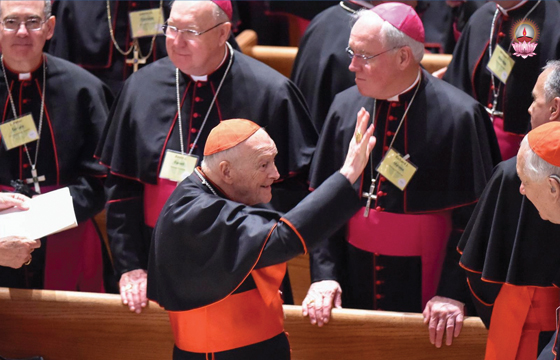
The Vatican Secretariat of State’s report on Theodore E. McCarrick provides a glimpse into how a number of witnesses and victims of the former cardinal’s abuse sought numerous ways to alert church officials and were disturbingly aware their allegations might trigger repercussions.
Over its 460 pages, the report also reveals how much difference 30 years can make when it comes to flagging misconduct and abuse. The report begins with a New York mother’s account of writing to every U.S. cardinal and the papal representative in the mid-1980s detailing McCarrick’s “dangerous” behaviour toward her underage sons. Having left no address or legible name, her red-flag warnings went unheeded.
Decades later, in 2017, when the Archdiocese of New York received an allegation of the sexual abuse of minor by McCarrick in the early 1970s, the report showed how the archdiocese’s now mandatory reporting system and procedures resulted in McCarrick’s eventual dismissal first from the College of Cardinals and, later, from the priesthood.
But for decades in between, the victims and witnesses described in the report recount how they struggled to figure out if and how they should or could make their claims in essentially a no-man’s land for accusations.
Haphazardly handled, ignored or dismissed allegations meant spotty paper trails, ineffective investigations that failed to find “hard” credible evidence and a climate of incessant gossip and rumors about McCarrick’s proclivities that ended up being leveraged by some to paint him as “a victim” of envy and enemies.
A New York woman, called “Mother 1” in the report, describes how McCarrick groomed her family into trusting him and feeling special by receiving his kind and generous attention during the 1970s and ’80s.
But she began to see the then-bishop as a threat when she caught him massaging her sons’ inner thighs in front of her husband, who seemed, in her words, “oblivious to Ted’s behaviour.”
While she felt they needed to get him “out of our lives,” her husband “refused to understand,” and she proceeded to witness ongoing inappropriate touching and massaging by McCarrick with her oldest son.
–CNS
Pope toughens rules on new religious orders
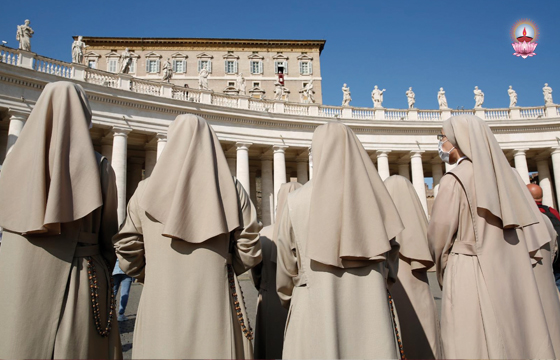
Pope Francis has ruled that new religious orders must receive Vatican approval before being established. It is a significant move that is likely to prevent the hasty establishment of small groups of religious and seeks to put an end to the sexual abuse scandals that have bedevilled such institutes in recent decades.
Francis has amended Canon Law meaning that local bishops will now need written permission from the Holy See before approving the setting up of communities of religious in their diocese. It also signals that bishops will be required to undertake a more credible and rigorous discernment than they have in the past before establishing congregations.
A proliferation of new “institutes of consecrated life or societies of apostolic life” have been established during the latter part of the 20th century, although many of them similar to one another. In an alarming number of cases, the founders of new orders have sexually and spiritually abused their members.
The Vatican has investigated a range of problems inside newly established congregations. These include cults of personality developing around the purportedly orthodox or charismatic founders; how members are formed; an excessive focus on traditionalist liturgies out of sync with the local church; authoritarian leadership styles; psychological manipulation oft those inside the groups and financial mismanagement.
“The faithful have the right to be advised by their pastors about the authenticity of the charisms and about the trustworthiness of those who present themselves as founders,” the Pope explained in the ruling. “It is the responsibility of the Apostolic See to accompany the Pastors in the process of discernment leading to the ecclesial recognition of a new institute or a new society.”
In a sign the Vatican is taking the issue very seriously, Archbishop José Rodríguez Caraballo, the secretary of the Holy See’s congregation for religious, recently wrote the foreword for a new book published this year Risques et dérives de la vie religieu-se (Risks and deviations of Religious Life), which examines sexual and spiritual abuses and how to combat them. The book is written by Dysmas de Lassus, the minister general of the Carthusian Order who is based at the historic Grande Chartreuse monastery in the French Alps. Carthusians, who follow a strict rule of silence, do not normally give their names publicly to what they write but in this case, de Lassus has made an exception.
Pope warns Spanish prime minister of rise of nationalism, ideology
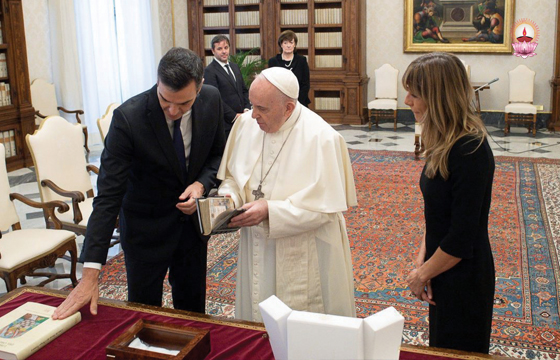
The rise of nationalism and the ideological divide that springs from it could create the same circumstances that led to the rise of the Nazi party in Germany and World War II, Pope Francis warned.
In a rare move, Pope Francis asked for a microphone and gave an off-the-cuff speech to Spanish Prime Minister Pedro Sanchez, who was accompanied by his wife, Maria Begona Gomez, and a delegation of officials on Oct. 24.
Citing a book by Italian philosopher Siegmund Ginzberg titled “Syndrome 1933,” the Pope said he agreed with its assessment that the ideological shift in today’s European political climate risks something similar to what occurred in Germany after the fall of the Weimar Republic, giving rise to the ideology of National Socialism, more commonly known as Nazism.
Ideologies “sectarianize, ideologies deconstruct the homeland, they don’t build it,” he said. And Ginzberg “very delicately, makes a comparison of what is happening in Europe. He says: ‘Be careful, we are repeating a similar path.’”
In his roughly eight-minute address to Sanchez and the Spanish delegation, the Pope recalled St Paul VI’s recognition of politics as “one of the highest forms of charity.” “Politics is not only an art, but for Christians it is an act of charity, it ennobles and often leads to the sacrifice of one’s life, one’s privacy, so many things, for the good of others, and this is because the politician has in his hands a very difficult mission,” he said.
The Pope’s comments came at a time of political division in Spain when lawmakers overwhelmingly rejected a vote of no-confidence on Oct. 22 brought against Sanchez, a member of Spain’s Socialist party, by members of the far-right Vox party.
Nice Jihad: Bishop Blames Europe, Cardinal Names Islam
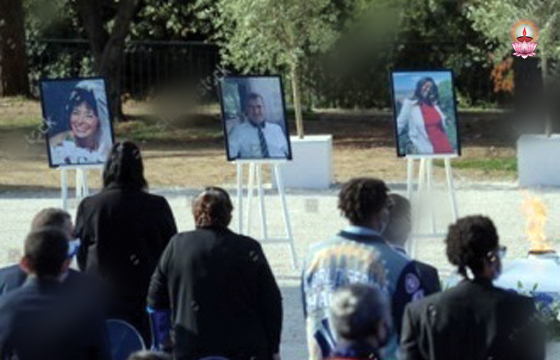
A Portuguese bishop is blaming European prejudices for the slaughter and beheading of three innocent Catholics by an illegal Muslim migrant in Nice’s Notre Dame Basilica.
“The attack on the cathedral in Nice is not Islam’s fight against Christianity: It is the result of the prejudices of those Europeans who not only do not foster intercultural and interreligious dialogue but are always at the ready to accuse religions,” Bp Manuel Linda of Porto tweeted on November 6.
Calling upon the West to fight against jihadi forces with “force and determination,” the French-speaking Guinean prelate warned that Islam would “not stop its war” against Europe.
“Unfortunately, we Africans know this too well. The barbarians are always the enemies of peace. The West, today France, must understand this. Let us pray,” tweeted Sarah, prefect of the Vatican Congregation for Divine Worship and the Discipline of the Sacraments.