
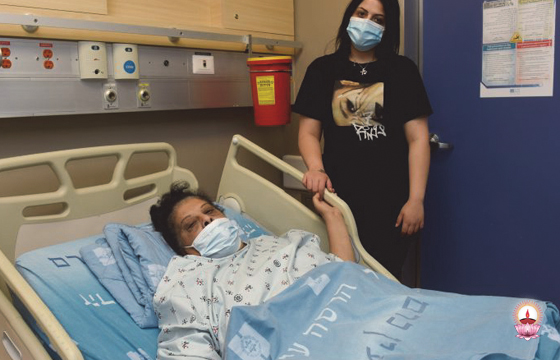
Arab Catholic Randa Aweis, 58, recovers from a kidney transplant with her daughter Niveen, 26, in Hadassah Medical Centre in Jerusalem, May 21, 2021. Aweis received a donor kidney from an Israeli Jew, Yigal Yehoshua, 56, who died after being hit with stones during riots in Lod, Israel.
For nine years, Randa Aweis battled kidney disease, urgently in need of a transplant.
In mid-May, a donor was found for the 58-year-old mother of six, a Catholic Palestinian who lives in Jerusalem.
The circumstances were unusually painful because the donor — Yigal Yehoshua — a 56-year-old Jewish Israeli man from the mixed city of Lod who worked for tolerance and co-existence, was stoned to death by an Arab mob during violence by both Jews and Arabs in the city in mid-May. Arab and Jewish gangs rioted in mixed cities throughout Israel following the May 10 outbreak of violence between Israel Hamas May 10.
“Yigal will go straight to heaven, to a better place, and he will always be with me,” Aweis said from her hospital bed at Hadassah Medical Center, where the transplant was performed by Dr. Abed Khalaileh, director of Hadassah’s Kidney Transplan-tation Service, who is Muslim. “Here we must all, Christians, Muslims and Jews, strive for peace. I don’t distinguish bet-ween Christian, Muslim or Jew — we are all human beings.”
Category Archives: International
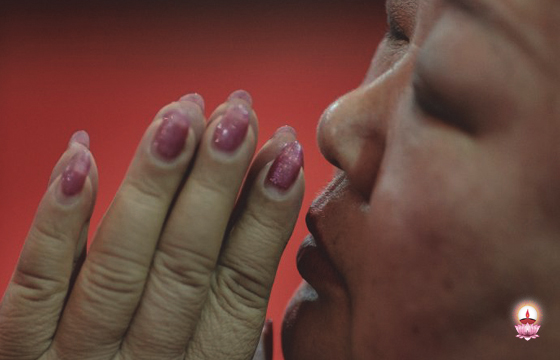
Clergy arrested as week of prayer for China begins
Days before the week of prayer for Catholics in China began on May 23 and seminarians in the country were arrested for holding Sunday, several services without the permission of the country’s Communist authorities.
In 2007, then-Pope Benedict XVI published a lengthy letter to Catholics in China in which he designated May 24, the feast of Our Lady Help of Christians, as an annual global day of prayer for the Catholic Church in China.
Earlier this year, Cardinal Charles Bo of Yangon, Myanmar, President of the Federation of Asian Bishops’ Conferences (FABC) asked that the entire week of May 23-30 be observed as a time of prayer for China, saying “We should ask Our Lady of Sheshan to protect all humanity and therefore the dignity of each and every person in China.”
“It is right that we should pray not only for the church but for all persons in the People’s Republic of China,” he said, voicing hope that China “continues to rise as a global power” and becomes “a force for good and a protector of the rights of the most vulnerable and marginalized in the world.”
Pope Francis in his May 23 Regina Coeli address gave Chinese Catholics a shout-out, congratulating them for the feast of Our Lady Help of Christians, who he said “is invoked assiduously” by Chinese Catholic families.

More Protestant churches shut as members leave: study
With fewer than 50% of Americans holding formal memberships in churches in 80 years, more Protestant church-es are closing than opening nationwide, and further decline appears “inevitable,” new data show.
Estimates made by the Nashville-based Lifeway Research, show that in 2019, well before many churches were forced to close in 2020 due to the coronavirus pandemic, approximately 3,000 Protestant churches were started in the US, but 4,500 Protestant churches closed. The findings came from an analysis of congregation data collected from 34 denominations and groups representing some 60% of Protestant churches in the U.S.
A previous analysis done in 2014 showed a net gain in churches that year when an estimated 4,000 Protestant churches were planted and 3,700 closed.
Scott McConnell, executive director of Lifeway Research, suggested in a statement that one reason for the decline in church plants is because denominations were more focused on keeping existing churches afloat.
“Over the last decade, most denominations have increased the attention they are giving to revive existing congregations that are struggling,” he said. “This has been more than a fad. This has been a response to a real, growing need to revitalize unhealthy congregations.” Earlier this year, a Gallup analysis showed that in 1937, when they first measured formal membership in houses of worship, some 70% of Americans had formal church membership and that measure remained steady for the next 60 years until it began a steady decline in 1998. In 2020, formal membership in houses of worship stood at 49%.
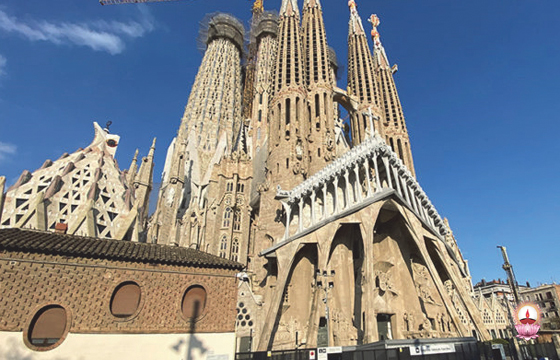
Key Spanish archdiocese to combine parishes amid falling numbers
The Barcelona Archdiocese will combine most parishes into larger pastoral communities, amid falling church attendance and secularization. A statement on the archdiocesan website said most Spanish dioceses were facing the same process. It said three to six parishes would be grouped together, resulting in 48 pastoral communities.
“The intention of an eventual diocesan reorganization is better distribution of pastoral resources, to obtain maximum pastoral efficiency and adequate support for the resulting pastoral units,” said the May 18 statement. “The aim is to reinforce common work and synodality among priests, laity, religious and deacons, when it is more difficult today for parishes to offer a full range of services.”
News of the reorganization comes amid continuing disputes over plans by the Spanish government to make the Catholic Church — whose members make up 61 percent of Spain’s 47 million inhabitants — relinquish what Spain says are improperly acquired assets.
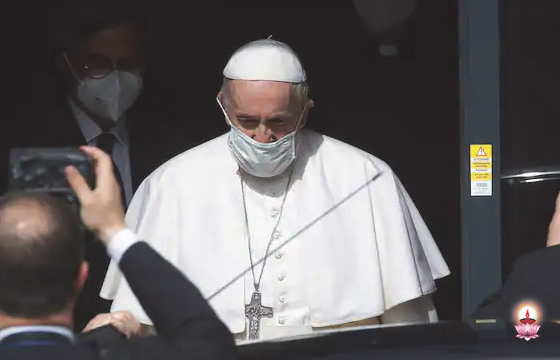
Pope moves youth seminary out of Vatican amid abuse trial
Pope Francis has decided to move a youth seminary outside Vatican City, taking action before the Vatican’s criminal tribunal renders a verdict in a sex abuse trial involving a former seminarian and an ex-rector. The Vatican made no mention of the ongoing trial in its announcement that the St Pius X pre-seminary would relocate somewhere in Rome starting in September. The facility serves as a residence for altar boys ages 12-18 who serve at papal Masses in St Peter’s Basilica.
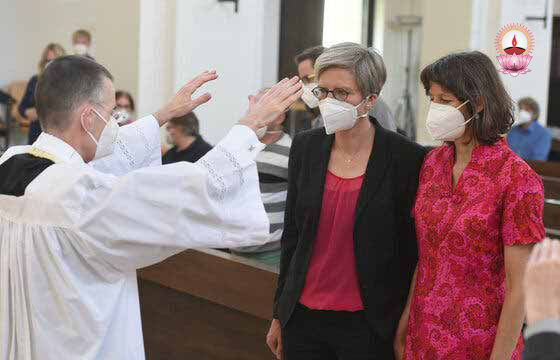
German Catholic Priests Defy Rome to Offer Blessings to Gay Couples
More than 100 Roman Catholic parishes in Germany offered blessings to gay couples on May 10 in defiance of church teaching and their own bishops.
The call for nationwide blessings came in response to a decree issued by the Vatican on March 15, reinforcing the church’s prohibition of priests asking for God’s benevolence for gay couples, stating that God “does not and cannot bless sin.”
A group of 16 German priests and volunteers organized a petition that within days collected more than 2,000 signatures. Encouraged by the response, they decided to take their action one step further and declare May 10 — chosen because of its association with Noah, who in the Bible is recognized by God with a rainbow, a symbol that has more recently been adopted by the L.G.B.T.Q. community — as a day to hold blessing ceremonies for any and all couples, but especially those in same-sex unions.
“In view of the refusal of the Congregation for the Doctrine of the Faith to bless homosexual partnerships, we raise our voices and say: We will continue to accompany people who enter into a binding partnership in the future and bless their relationship,” the group said in a state-ment. “We will not refuse a blessing ceremony.”
The Vatican had no comment on Monday, but the head of the conference of Roman Catholic bishops in Germany, Georg Bätzing, who is also the bishop of Limburg, rejected using public blessing ceremonies as what he called “instruments for symbolic actions on church policy or for protests.”
“It is part of the pastoral ministry of the church to treat all of these people fairly in their respective concrete situations on their life’s journey and to accompany them pastorally,” Bishop Bätzing said in a statement, speaking for the country’s bishops. “In this context, however, I do not consider public actions such as those planned for 10 May to be helpful or a way forward.”
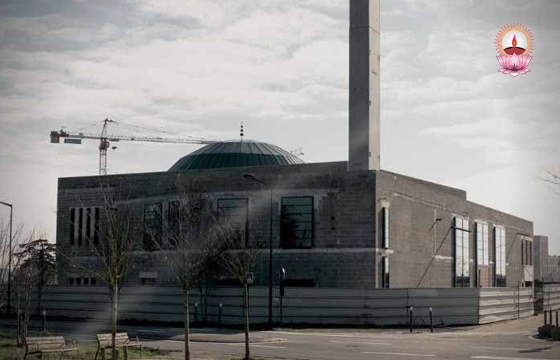
French Bishops Fund New Mosque
Debate has emerged in France due to news about the diocese of Tours helping fund a new Muslim worship center. According to La Nouvelle République, Salah Merabti, president of the Muslim community of Indreet-Loire — which is about 150 miles southwest of Paris — recently thanked the local Catholic diocese for its contribution to the mosque, which is just a part of a brand new community center.
He told the paper that his co-religionists received 150,000 euros from Coca-Cola Algeria, as well as funding from local elected officials, the Jewish community and the Catholic diocese. “This is comforting,” he said. In 2019, as many as 9,000 Muslims showed up at the construction site to celebrate the end of the Ramadan fasting period. In 2020, COVID restrictions kept them away.
Following the revelation, Abp. Vincent Jordy justified the contribution by saying that it was merely a symbolic gesture in gratitude for a contribution Muslims allegedly made towards the visit of St John Paul II in 1996. In a signed statement on the archdiocesan website, Abp. Jordy dodged some of the blame. He declared:
An article published on April 13 in La Nouvelle République, titled “The mosque of Tours awaits its roof, its dome and its donations,” evokes the financial situation of this site. In this regard, it is emphasized that various contributors are participating in this project, including the diocese of Tours. Questions that have reached us about this article lead us to provide the following clarifications.

German Catholic group calls on bishops to unite with Rome
A German Catholic group appealed on May 8 to the country’s bishops to unite with Rome amid a day of protest at the Vatican’s “no” to same-sex blessings. The initiative “Maria 1.0” called on the bishops to stop the blessing celebrations for same-sex partnerships planned by some priests for May 10.
In a May 8 statement, Clara Steinbrecher, leader of the group, said: “The planned blessing celebrations are a targeted pro-vocation in the direction of Pope Francis and should therefore be omitted by the priests.”
CNA Deutsch, CNA’s German-language news partner, said that she urged priests and bishops to “accompany people in all life situations pastorally and compassionately” while preserving unity with Rome.
Maria 1.0 is inviting “all Catholics and people of good-will” to say a decade of the rosary on May 10, thus expressing their bond with the Virgin Mary and the whole Church. “We call on people to ask the Blessed Mother Mary to intercede with Jesus Christ so that he may keep the bishops and priests in unity with the pope and the whole Church,” Steinbrecher said.
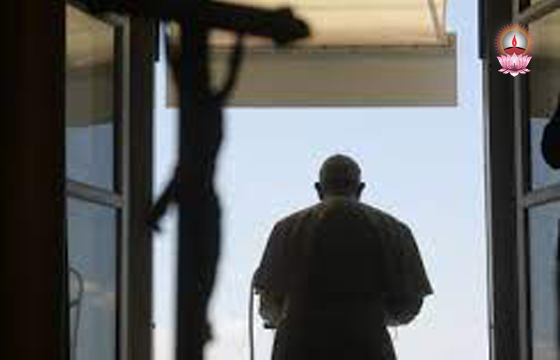
New Vatican anti-corruption law prohibits employees from using tax havens
Pope Francis has signed a new anti-corruption law for the Vatican, which prohibits employees from using tax havens investing in companies that go against Church teaching.
“Faithfulness in things of little account is related, according to Scripture, to faithfulness in the important ones,” begins the motu proprio on anti-corruption for members of Vatican management signed by Francis April 26. “Just as being dishonest in things of little importance is related to being dishonest in important matters.”
The Holy See adheres to the United Nations Merida Convention against Corruption, and is therefore compelled to conform to the best practices for preventing and combating corruption. To that end, employees at all managerial levels of the Vatican – from cardinals to lay executive personnel – will be obliged to sign, every two years, a declaration in which they attest that they have not benefitted from any special amnesty or pardon, nor received convictions for crimes, either in the Vatican City State or abroad.
The declaration also demands the employees not to be shareholders or have interests in companies that operate for purposes or in sectors contrary to the Catholic Church’s social teaching. This includes the weapons industry, pornography, or pharmaceutical companies that produce products related to artificial contraception and abortion.
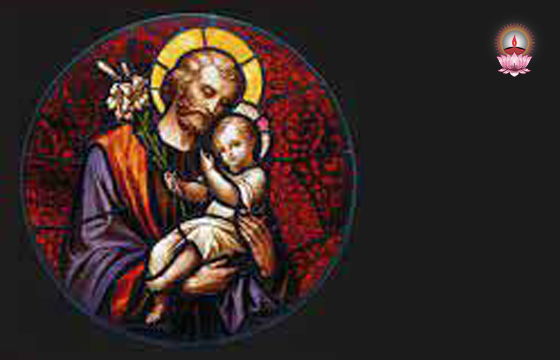
Vatican adds seven invocations to Litany of St. Joseph
The Vatican’s divine worship office announced May 1 the addition of seven new invocations to the Litany of St Joseph. The seven invocations, in Latin, are Custos Redemptoris, Serve Christi, Minister salutis, Fulcimen in difficultatibus, Patrone exsulum, Patrone affli-ctorum, and Patrone pauperum. The Congregation for Divine Worship and the Discipline of the Sacraments wrote a letter to the presidents of bishops’ conferences May 1, the feast of St Joseph the Worker, explaining the inclusion of the new invocations.