
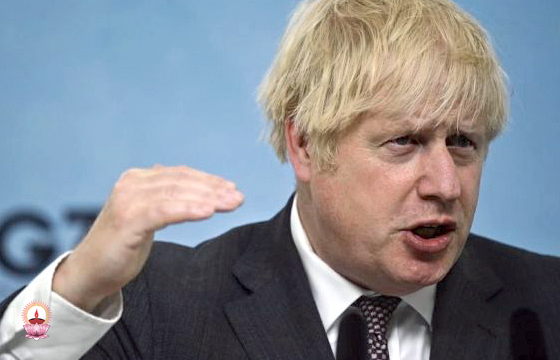
In short exchange with a journalist during the G7 summit in Cornwall, British Prime Minister Boris Johnson refused to comment on whether or not he is now a practicing Catholic.
ITV political editor Robert Peston noted that Johnson got married in Westminster Cathedral on May 29, and then asked him, “Are you now a practicing Roman Catholic?”
Johnson replied, “I don’t dis-cuss these deep issues. Certainly not with you.”
Johnson was the first prime minster to get married in office for 199 years, and his unannounced wedding to Carrie Symonds caused some to question how he was married in a Catholic ceremony, since Johnson was married twice before.
The answer was that Johnson was baptized Catholic – he left the Church and became an Anglican while in school – and Church law stipulates that his previous two marriages weren’t recognized, since they had not been solemnized in the Catholic Church.
Symonds is a practicing Catholic and has not been married before.
Writing on the ITV website, Peston said he was “struggling to make sense of the prime minister’s answer” to his question about Johnson’s religion.
“He is aware that – for better or worse (worse for a long time) – this has been a pertinent quest-ion for chief and prime ministers since Henry Vlll,” Peston wrote. “More broadly, the professed faith or none of a leader matters to many voters.”
Category Archives: International

A Marvellous encounter: Pope Francis meets Spiderman
At the end of his weekly June 23 audience, Pope Francis and Spider-Man shook hands in Rome, with the superhero handing the pontiff a mask.
Although the pope often will graciously put on a hat when it is offered to him, he didn’t try on the mask.
The moment had been building up ever since TV cameras captured a man dressed in a Spider-Man costume in the Cortile di San Damaso, where the papal audiences are being held to prevent big crowds, in light of the COVID-19 pandemic. The picture of the two went viral, with some people in social media adding the line, “with great power comes great responsibility,” used in the comics and movies by the character’s Uncle Ben.
Pope orders visitation of Vatican’s Congregation for Clergy
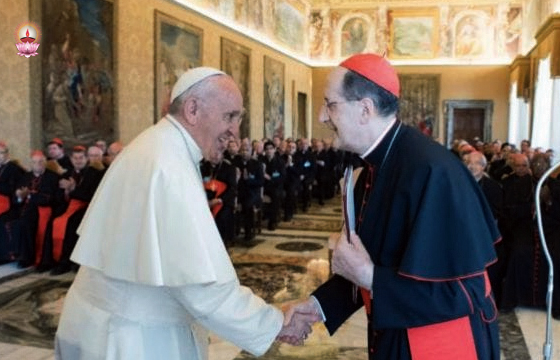
Pope Francis earlier this month asked an Italian bishop and expert in canon law to conduct visitation of the curial Congregation for Clergy, much like the one that recently concluded of the Vatican’s liturgy department.
In a letter to diocesan priests widely reported on by Italian news outlets, including Italian newspapers La Stampa and L’Unione Monregalese and the official online news outlet of the Italian bishops, SIR, Bishop Egidio Miragoli of Mondovì said he had been tasked with the job. Miragoli, who holds a doctorate in canon law from Rome’s Pontifical Gregorian University, was appointed to lead the Diocese of Mondovì by Pope Francis in September 2017.
In his letter, sent out the morning of June 7 to all priests in his diocese, Miragoli said he was approached by Pope Francis, who wanted “to ask me for a favour,” during the Italian bishops’ recent plenary assembly late last month.
On that occasion, he said, the pope asked him “to make a visitation, in his name, to the Congregation for Clergy.” On June 3, the two had a private meeting at the pope’s residence in the Vatican’s Santa Marta guesthouse where the pope “explained his expectations to me better.”
“Needless to say, the request took me by surprise, and of course I gave my availa-bility,” Miragoli said, explaining that he will begin meeting with individual staff members Wednesday, June 9, and that the visitation will likely take up the entire month of June, “albeit not continually.” Miragoli assured his priests that commitments already on the calendar, including a swath of confirmations, will be unchanged.
Italian nun slain by 3 teen girls in Satanic ritual beatified as martyr
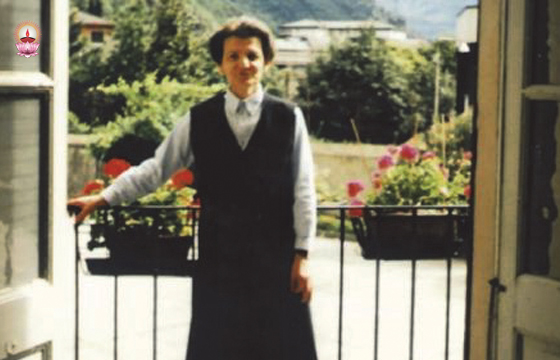
An Italian nun who was stabbed 19 times more than two decades ago by three teenage girls apparently fascinated by Satan was honoured on June 6 with beatification as a martyr of the Catholic Church. Hours before the beatification ceremony in northern Italy, Pope Francis praised Sister Maria Laura Mainetti and described her killers as “prisoners of evil.” Beatification is the last formal step in the Catholic Church before possible sainthood. Italian news reports about the June 6, 2000 slaying in the town of Chiavenna said the defendants during interrogation recounted that the nun asked God to forgive her attackers even as they assaulted her.
After serving sentences ranging from 8 1/2 to 12 years and four months, the convicted attackers were released from prison. Two were age 16 and the other was 17 when the Catholic nun was slain. They were prosecuted as minors. Addressing the faithful in St. Peter’s Square during his traditional Sunday remarks, Francis spoke of the beatification, saying Mainetti, who belonged to the religious congre-gation of the Daughters of the Cross, was slain “by three girls influenced by a satanic sect. Cruelty.”
Pope Francis refuses resignation of German cardinal, commends his courage
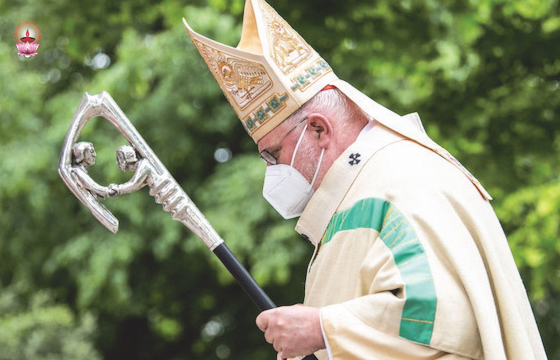
Although agreeing with him that the clerical abuse crisis is a “catastrophe,” Pope Francis rejected the resignation presented to him by German Cardinal Reinhard Marx as archbishop of the archdiocese of Munich.
“You tell me that you are going through a moment of crisis, and not only you but also the Church in Germany is going through it,” Francis wrote in a letter dated June 10. “The whole Church is in crisis because of the abuse matter; moreover, the Church today cannot take a step forward without addressing this crisis.” The “ostrich policy” of hiding the head in the sand leads nowhere, the pope argues, and the only way to address the crisis is to address it “from our paschal faith.”
Marx, 67, had offered his resignation to Pope Francis on May 21 despite being eight years shy of the mandatory retirement age of 75. In his letter, the prelate said that he wanted to take his share of responsibility for the “catastrophe of sexual abuse” by representatives of the Catholic Church.
The German cardinal, one of the most influential leaders in the church, said he had not expected the Pope to respond so quickly to his offer to step down. He said: “I also had not expected his decision that I should continue on as archbishop of Munich and Freising.”

Catholic group founding conservative university in Warsaw
An increasingly influential Polish Catholic legal institute inaugurated a university in Warsaw that aims to educate a new generation of conservative lawyers in central Europe who it hopes will also shape wider European culture.
The institute, Ordo Iuris, works to promote conservative causes, including restrictions on abortion and opposition to same-sex legal unions as its seeks to support traditional family stru-ctures. It successfully lobbied for the recent restriction on abortion in Poland and is also urging countries not to ratify the Istanbul Convention, an international treaty against domestic violence, due to objections over how the treaty depicts gender relations in the family.
Jerzy Kwasniewski, a War-saw lawyer who heads Ordo Iuris, said that the university, Collegium Intermarium, is meant to be a space of free academic inquiry at a time of censorship in traditional academic settings that overwhelmingly targets and silences conservative thinkers.
Kwasniewski also described the college as a counterweight to existing institutions, including the Central European University, which was founded by the liberal Hungarian-American investor George Soros and which recently relocated from Budapest to Vienna under pressure from Hungary’s nationalist conservative government.
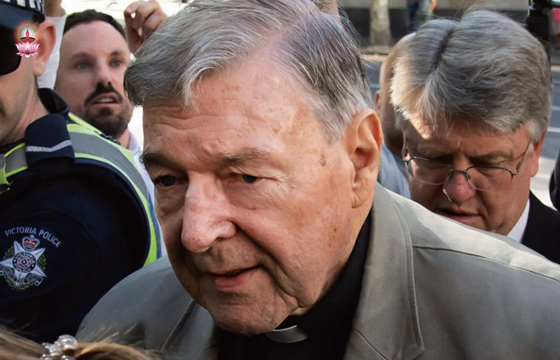
12 Australian media companies fined for breaking Pell order
A judge on June 4 ordered a dozen Australian media compa-nies to pay fines from 1,000 Australian dollars ($766) to AU$450,000 ($345,000) for breaching a gag order by publishing references to Cardinal George Pell’s since-overturned convictions in 2018 for child sexual abuse.
Dozens of companies, repor-ters and editors were initially charged with contempt and breaching a suppression order over their coverage of the convictions, which were banned from publication in Australia until February 2019.
Such suppression orders are common in the Australian and British judicial systems. But the enormous international interest in an Australian criminal trial with global ramifications high-lighted the difficulty in enforcing such orders in the digital age. The media companies pleaded guilty in February to 21 charges of contempt in a plea deal in the Victoria state Supreme Court.
Justice John Dixon said on June 4 the guilty pleas did not demonstrate remorse but were entered to protect individual editors, reporters and broadcast presenters from convictions. The individuals had faced potential prison sentences.
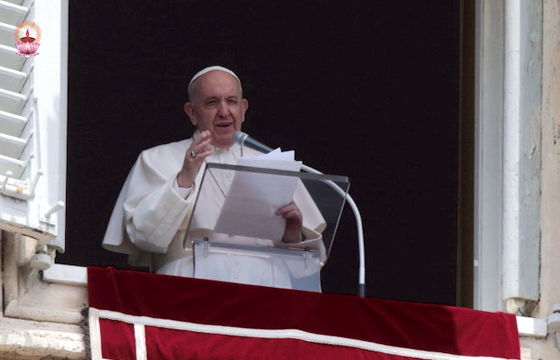
Pope orders sweeping change of abuse law
Pope Francis has ordered a sweeping revision of the Church’s Canon Law, toughening up regulations on abuse which now include lay people who commit offences while in office.
The changes were made after a 14-year process of study of the Church’s laws, and is the most significant updating of Canon Law since the 1983 code was published. The revisions concern book VI of the code, which covers penal law, and are significant as
Canon Law is the tool which regulates
Church discipline.
The revisions make clear that abuse can be committed by a cleric against an adult, and not just a minor, and states that “any one of the faithful who enjoys a dignity or performs an office or function in the Church” abuse . Any priest, it says, who abuses his authority to force someone to engage in sexual acts can be removed from the clerical state.
Furthermore, the new norms criminalise the grooming of minors or those with “imperfect use of reason” by priests, which includes exposing a victim to pornography, a method long used by abusers.
As a result of the revisions, bishops and other church leaders who display “culpable negligence” of abuse can be removed from office. In a letter introducing the changes, the Pope reminded bishops they are responsible for following the law, and the updating of the code was designed to reduce the number of occasions where penalties for abuse were left to the “discretion” of some superiors.
Significantly, the abuse of minors was placed under the section “Offences Against Human Life, Dignity and Liberty,” instead of the previous title “Crimes Against Special Obligations.” The Bishops of England and Wales had this year requested this change in a letter to the office tasked with undertaking the revision of the code. They had requested a different title to placing abuse under “crimes against the obligations of celibacy on the part of clerics.” At the time they were told the change would be made.
The Pontifical Council for Legislative Texts has overseen the latest changes with Archbishop Filippo Iannone, explaining at a Vatican press briefing on Tuesday 1 June that there had been “a climate of excessive slack in the interpretation of penal law,” where mercy was placed ahead of justice.
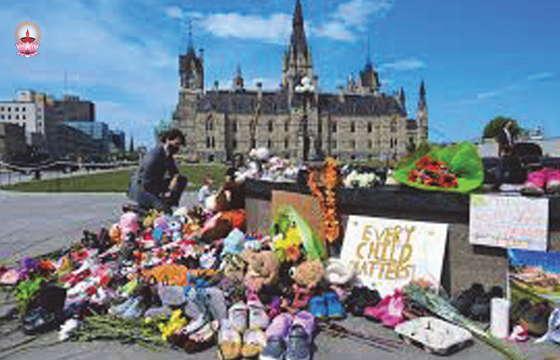
Pope acknowledges ‘pain’ for boarding school discovery, no apology
Pope Francis expressed closeness to all Canadian people traumatized by the shocking discovery of the remains of 215 children in the Kamloops Indian Residential School, Canada’s largest indigenous boarding school.
Though he spoke of pain and suffering, the pontiff avoided apologizing.
“I follow with sorrow the news coming from Canada,” Francis said at the end of his Sunday Angelus prayer from the balcony in the Apostolic Palace overlooking St. Peter’s Square. “I join the Canadian bishops and the entire Catholic Church in Canada in expressing my sympathy to the Canadian people, who have been traumatized by the shocking news.”
The pontiff said that the “sad discovery” further heightens “our awareness of the pain and suffering of the past,” urging Canada’s political and religious authorities to continue to work together with determination to shed light on this event and to “commit themselves humbly to a path of reconciliation and healing.”
Francis also said that the difficult times posed by the discovery of the remains in the Canadian State of British Columbia represent a strong call to “turn away from the colonizing model,” which also applies to what he called today’s “ideological colonization.”
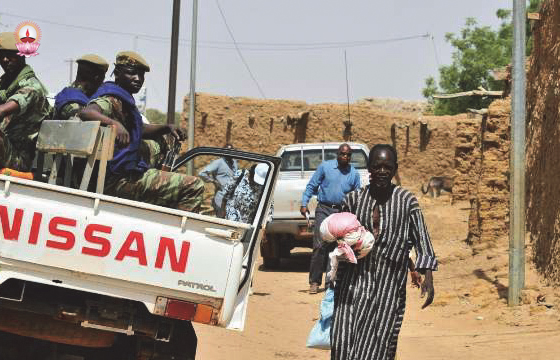
Burkina Faso bishop deplores village attack that left 160 dead
A Catholic bishop in Burkina Faso has condemned an Islamist attack on a north-eastern village which left at least 160 people dead and urged residents to “keep faith and stay united.”
“They executed them, purely and simply, and then burned the market, houses and shops, and the vehicles, lorries and transport parked outside,” Bishop Laurent Dabire of Dori said, decrying the June 5 attack on Solhan, a village in his diocese.
Although no group claimed responsibility, authorities blamed Islamists for the attack, which also left 40 people injured. It is believed to be the worst violent incident since the start of an insurgency in 2015.
In a Vatican Radio interview June 7, Bishop Dabire, president of the bishops’ conference of Burkina Faso and Niger, said he believed the attack was retaliation for local involvement in a government-backed civil defence militia, set up in 2020 in the gold-mining area.
The early-morning attack fuelled a “sense of powerlessness,” Bishop Dabire said.
“People would like to do something, but what can they do, when faced with an invisible enemy, unknown and well armed?” the bishop asked. “We must not lose confidence in life, keeping faith firmly in hope, and staying united in face of the violence falling on us, in order to explore all solutions, including dialogue.”