

Vladimir Putin’s campaign of violence in Ukraine has brought to the fore questions about his longstanding religious connect-ions, prompting scholars and journalists to challenge his well-markete d piety and seemingly deep devotion to Russian Ortho-dox spirituality—the latter of which is often expressed in its deep ties to the post-Soviet Moscow Patriarchate. In the study of religion, it’s long been common to question whether the categories of sincere or authentic religious belief are adequate for analyzing the complex motivations and actions of adherents or believers.
When practitioners are public figures with global geopolitical aims, the classification of true religious subjectivity is often suspended in favour of assuming a kind of charlatanism, or spiritually spurious intentions built to curry favour with faith com-munities. Our goal here isn’t to argue about Putin’s personal faith; rather, we want to reflect on how academic assumptions about individual religious practices and beliefs are often analysed through categories that typically begin and end with western conceptions of what counts as correct or wholehearted spirituality. In other words, we want to question the questioning of Putin’s faith.
Patriarch Kirill isn’t just a willing participant in the trans-national expansion of Russian power, culture, and Christianity-he’s a co-conspirator in this world building project of faith and politics.
Category Archives: International
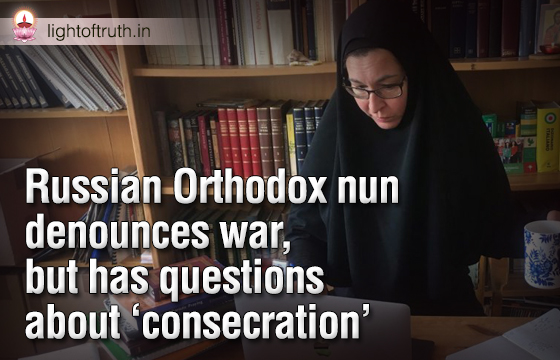
Russian Orthodox nun denounces war, but has questions about ‘consecration’
One of the Orthodox scholars who signed a statement condemning as “heresy” the political vision of Russian Orthodox Patriarch Kirill of Moscow is a U.S.-born Russian Orthodox nun and scholar of Byzantine liturgy.
Sister Vassa Larin, a nun of the Russian Orthodox Church outside Russia, also is host of the popular podcast and video series, “Coffee with Sister Vassa.”
Living and working in Vienna, Sister Vassa also serves on the liturgical and canon law commissions of the Russian Orthodox Church, and now she is helping support a Ukrainian Catholic mother and her two children who fled Russian President Vladimir Putin’s war on Ukraine.
In an interview with Catholic News Service March 18, she denounced the war as “evil” and Patriarch Kirill’s approach to it as a “horrible, horrible thing.”
For decades, the patriarch has been promoting a teaching called “Russkii Mir” (Russian World), which claims a special status for the Russian Orthodox Church and the Russian nation working closely together to govern politically and spiritually not only Russia, but all Russian speakers and the people they believe are closely related to them: Ukrainians and Belarussians.
“It is not a Christian thing,” Sister Vassa said, even if Patriarch Kirill and President Putin try to cloak it in Christian language and present themselves as defenders of traditional Christian values.
“What unites us is not being Russian; that’s not the primary thing in the mystery of the church,” she said. “The church is a mystery of unity, a sacrament of unity, based on the oneness of the Body of Christ. It’s not based on ethnicity.”
While she describes herself as “a big Pope Francis fan,” Sister Vassa said that as an Orthodox Christian, she does have some questions about his plan to consecrate Russia and Ukraine to the “Immaculate Heart of Mary” on March 25.
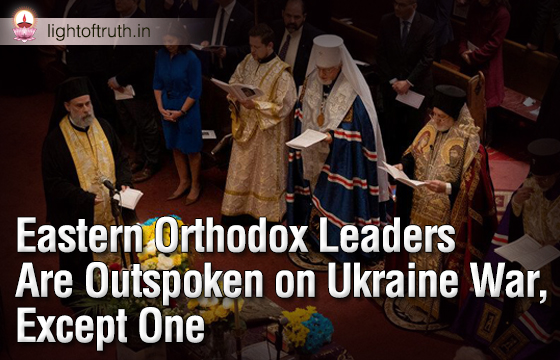
Eastern Orthodox Leaders Are Outspoken on Ukraine War, Except One
Last week, more than a dozen religious and political leaders sat on the dais of the Ukrainian Orthodox Cathedral of Saint Volodymyr on the Upper West Side, listening to solemn prayers and fiery speeches denouncing Russia and extolling Ukrainian resistance to the invasion that began two weeks earlier.
They gave speeches, one by one: the leaders of the Ukrainian, Greek and American Orthodox churches; a prominent rabbi; the leader of the Roman Catholic Archdiocese of New York; even Gov. Kathy Hoch-ul of New York.
But one group was missing from this interfaith tableau: the Russian Orthodox Church, whose leader, Patriarch Kirill of Moscow and All Russia, is an ally of President Vladimir V. Putin. Organizers said Russian Orthodox leaders in New York had been invited but did not reply.
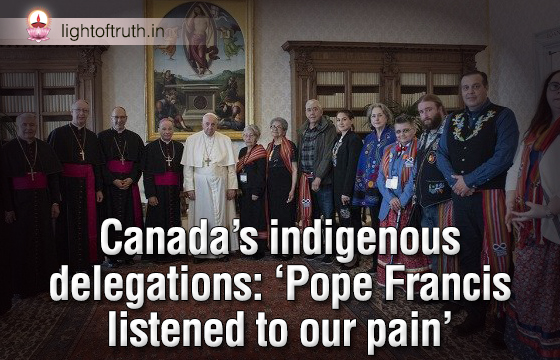
Canada’s indigenous delegations: ‘Pope Francis listened to our pain’
Following Pope Francis’ two audiences with delegations of Canada’s Métis and Inuit peoples, members of the Métis Nation say the Pope sought to listen to the stories of survivors of residential schools.
“Truth, justice, healing, reconciliation.”
Those words express the goals which delegations from several of Canada’s indigenous peoples came to share with Pope Francis in the last week of March, in an effort to heal the pain caused by residential schools.
Two delegations met with the Pope on March 28 in successive audiences—one from the Métis Nation and another from the Inuit People. They were accompanied by several Bishops from the Canadian Catholic Bishops’ Conference, with each delegation meeting with the Pope for roughly an hour.
The Director of the Holy See Press Office, Matteo Bruni, said in a statement that the audiences were focused on giving the Pope the opportunity to “listen and to offer space for the painful stories shared by the survivors.”
In his Angelus address on June 6, 2020, Pope Francis shared with the world his dismay at the dramatic news which had come a few weeks earlier, of the discovery in Canada of a mass grave in the Kamloops Indian Residential School, with more than 200 bodies of indigenous people.
The discovery marked a symbol of a cruel past, which sought, from 1880 to the final decades of the 20th century saw government-funded institutions run by Christian organizations, to educate and convert indigenous youth and assimilate them into mainstream Canadian society, through systematic abuse.
The discovery in June 2020 led Canada’s Bishops to make an apology and set up a series of projects to support survivors. The importance of the process of reconciliation is shown by the Pope’s willingness to receive the delegations in the Vatican on Monday and on 31 March, in view of a future papal visit in Canada, which has been announced by not yet officially confirmed.
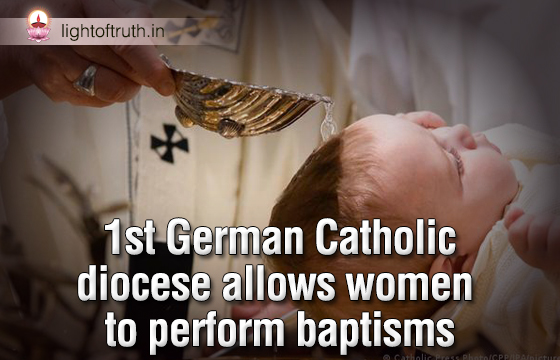
1st German Catholic diocese allows women to perform baptisms
The Diocese of Essen has become the first in Germany to allow women to perform baptisms, citing a lack of priests.
The diocese said in a statement Monday that Bishop Franz-Josef Overbeck tasked 18 lay ministers – 17 of them women – with conferring the sacrament of admission into the Church at a ceremony over the weekend.
Until now only priests and deacons – roles the Catholic Church reserves for men – were allowed to perform baptisms.
“Time and again, the Church has reacted to external circum-stances over the past 2,000 years,” said Theresa Kohlmeyer, who heads the diocese’s department of belief, liturgy and culture. The measure is temporary and will initially last for three years.

Court allows giant statue of Virgin Mary to be built in Brazil
São Paulo State’s Court of Appeals has reversed a 2019 decision that stopped the building of a giant steel statue of the Virgin Mary in Aparecida, the city where Brazil’s major Catholic shrine is located.
Now, the 164-feet stainless steel sculpture portraying Our Lady of Aparecida – taller than Rio de Janeiro’s Christ the Redeemer – which was donated in 2017 by the artist Gilmar Pinna to the municipality as part of the celebration of the 300th anniversary of the apparition, can finally be finished.
The project includes five small religious statues implanted in different parts of the city along with the large hilltop monument.
But the work was interrupted due to a lawsuit filed by the Brazilian Atheists and Agnostics Association (ATEA), which claimed that public funds were being used to pay for religious symbols, which is forbidden by the Brazilian constitution.
However, Pinna said almost all elements that integrated the project had been donated, including the sculpture.

3 million Filipino families experience “involuntary hunger”: Survey
An estimated three million Filipino families, or 11.8% of Filipino families, experienced involuntary hunger in the last quarter of 2021.
A survey done by pollster Social Weather Stations (SWS) shows an 11.8% hunger rate in December 2021, higher than the 10%, or about 2.5 million families, in September 2021.
It is, however, lower than the 16.8% in May 2021 and 13.6% in June 2021.
“The resulting annual average Hunger rate for 2021 is 13.1% versus the record-high 21.1% for 2020. However, this is still above the 9.3% annual average for 2019, before the COVID-19 pandemic,” said the SWS in a statement.
On March 26, the presidential palace acknowledged that the government needs to do “much more” to protect citizens from hunger and poverty.
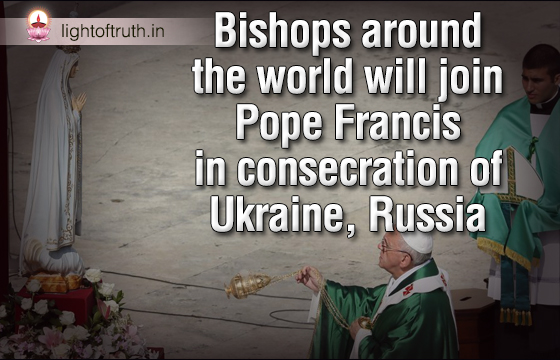
Bishops around the world will join Pope Francis in consecration of Ukraine, Russia
Pope Francis on March 25 consecrated Russia and Ukraine to the Immaculate Heart of Mary, and Catholic bishops from around the world have already announced they answer his request for them to join him in the consecration.
March 25 is the feast of the Annunciation, and a solemnity on the church calendar. The celebration took place in the Vatican’s St. Peter’s Basilica at 5 p.m. local time. Pope emeritus Benedict XVI joined in the consecration. Though some reports speculated he would be in the basilica, Crux has been able to confirm that the retired pontiff won’t be there. Instead, he joined from the Mater Ecclesia monastery where he has lived since leaving office.
On the same day Francis leads the penitential Lenten service, Cardinal Konrad Krajewski, the papal almoner, lead a similar act of consecration at the Shrine of Our Lady of Fatima in Portugal.
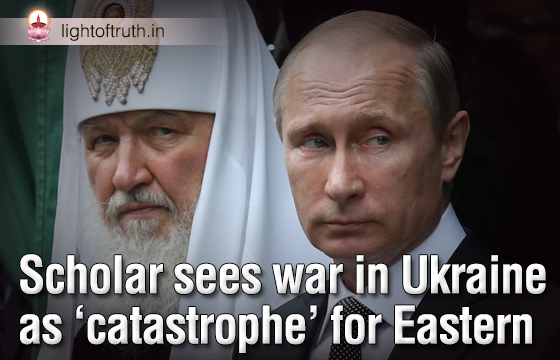
Scholar sees war in Ukraine as ‘catastrophe’ for Eastern
“The war in Ukraine is destroying relations between Christians; it is the great schism of Orthodoxy. There are twice as many practicing Ukrainian Orthodox as there are Russian Orthodox. Most of the dioceses that remained under Moscow jurisdiction after the proclamation of autocephaly in 2018 have decided not to cite Patriarch Kirill’s name in their liturgies anymore. All the other national Orthodox Churches will have to take a more explicit position on what is happening” wrote Stefano Caprio. He continued:
“The war in Ukraine began in 2014 when the Maidan Revolution brought to the fore the opposition between Kyiv and Moscow, a centuries-old confrontation that today has reached its most extreme point.
Whatever the outcome of military operations, peace negotiations and the division of territories, deep and inextricable rancour will remain between the two brotherly peoples, drawing a line between not only Slavs and Europeans, but also between different geopolitical and ideological alignments across the world.
We are all “either Russians or Ukrainians”, “a little Russian and a little Ukrainian”, “neither Russian nor Ukrainian” as this tragedy reshapes the conscious-ness of the men and women of the 21st century, much more than Islamic terrorism in this century’s first 20 years.
This war is destroying relations between Christians much more than all the alternatives and contradictions between East and West, globalizers and sovereigntists, Atlanticists and pacifists, neo-Nazis and theorists of real or alleged conspiracies.
For weeks, religious leaders around the globe had been begging the bearded patriarch to speak out against the Russian invasion of Ukraine. But in weekly sermons that air live on Russian TV, Kirill, 75, has done just the opposite, painting the war as an apocalyptic battle against evil forces that have sought to destroy the God-given unity of Holy Russia.
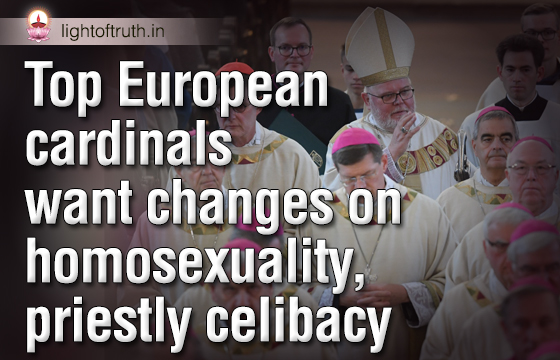
Top European cardinals want changes on homosexuality, priestly celibacy
Over the past week, two leading European cardinals, both of whom enjoy broad favour with Pope Francis, have made public statements calling for a change in the Catholic Church’s current position on the issues of homosexuality and priestly celibacy.
In an interview published in Germany’s Catholic News Agency (KNA) earlier this week, Jesuit Cardinal Jean Claude Hollerich, Archbishop of Luxembourg, voiced his belief that the Church’s position viewing homosexual relationships is wrong.
“I believe that the sociological-scientific foundation of this teaching is no longer correct,” he said, saying the time has come to revise this position, and suggesting that Pope Francis’s own rhetoric on homosexuality could open the door for this change to take place.
Since the beginning of his pontificate, Pope Francis, who has also voiced concern over homosexuality in the priesthood, has taken a softer approach to the issue and has urged the Church to be more welcoming to homosexual individuals and to families with homosexual members.
In 2013, he signalled a new approach to the issue with his famous declaration that if a person “is gay and is searching for the Lord and has good will… Who am I to judge?”
In 2018, he said that the Church has to find a way to help the parents of gays and lesbians so that they “stand by” their children, telling parents with LGBT children, “Do not condemn. Dialogue. Understand. Make space for the son or daughter; make space so they express themselves.”
During an interview in 2019, Francis said he does not think it’s rare for parents to have a homosexual child and said that homosexual tendencies “are not a sin,” insisting that tendencies themselves “are not sin. If you have a tendency to anger, it’s not a sin. Now, if you are angry and hurt people, the sin is there.”
Last year, he met with a group of parents of LGBT children, telling them that God loves their children as they are, and that the Church loves them because they are “children of God.”