

New study reveals that people who spent much of their lives volunteering, giving to charity, or helping others have higher levels of oxytocin
Seniors really are kinder than younger generations thanks to the “love hormone” released in older people’s brains, according to new re-search. People who release more of the neurochemical oxytocin are kinder to others and tend to be more satisfied with their lives, say scientists.
The amount of oxytocin released in the brain increases with age, showing that on average, people are more caring as they get older, researchers say. Experts reveal that these findings are consistent with many religious philosophies, where satisfaction with one’s life is enhanced by helping others.
Oxytocin is a neurochemical widely known for its role in social attachment, inter-personal trust, and generosity. It’s also known as the “love hormone.” “The findings of our study are consistent with many religions and philosophies, where satisfaction with one’s life is enhanced by helping others,” says study first author Dr. Paul J. Zak of Claremont Graduate University in California, in a statement. “Participants in our study who released the most oxytocin were more generous to charity when given the opportunity and performed many other helping behaviours. The change in oxytocin was also positively related to participants’ empathy, religious participation, and gratitude.”
Dr. Zak and his colleagues wanted to understand if the release of oxytocin changed with age, as is found with some other neurochemicals that influence feelings and behaviors.
“We have previously shown a link between how kind and generous people are, known as prosocial behaviours, and the rel-ease of oxytocin,” he adds. “Seniors spend more time volunteering and donate a larger propor-tion of their income to charity than do younger people, so we wanted to see if there was a neurochemical basis for these behaviours.”
Category Archives: International

Burger King in Spain Apologizes, pulls offensive Holy Week ads
The fast-food chain Burger King in Spain has with-drawn and apologized for an offensive ad campaign that sparked outrage among Catholics during Holy Week.
“We apologize to all those who have felt offended by our campaign aimed at promoting our vegetable products during Holy Week. Our intention has never been to offend anyone and the immediate withdrawal of the campaign has already been requested,” Burger King announced Easter Sunday on its official Twitter account.

Kenya’s retired President Mwai Kibaki, a Catholic, dies at age 90
Emilio Stanley Mwai Kibaki, who served as president of Kenya from 2002 to 2012, died April 22. He was 90. President Uhuru Kenyatta declared a national mourning period for Kibaki, a Catholic. Details of his funeral were not announced immediately.
“As we mourn this immeasurable loss, we recall with eternal gratitude President Kibaki’s patriotic journey in the service of his country, which can be traced way back in Kenya’s fight for liberation,” said Kenyatta, describing Kibaki as a gentleman of Kenyan politics, a brilliant debater whose eloquence, wit and charm won the day.

Superiors plenary to focus on synodal experience in religious life
The International Union of Superiors General (UISG) is scheduled to meet in Rome May 2-6 for its 22nd Plenary Assembly which will bring together some 700 religious of 71 different nationalities.
As many as 521 superiors general are expected to attend in person to discuss the theme: “Embracing Vulnerability in the Synodal Journey”.
Ten key speakers will lead reflections on the focus theme of synodality from five perspectives: vulnerability, synodal process, religious life and synodality, peripheries, and calls to transformation.
The event will be presented at 12,00 pm on April 29 at the Press Office of the Holy See by Sister Jolanta Kafka, UISG president, Sister Patricia Murray, executive secretary, Sister Franca Zonta, superior general of the Marianist Sisters, and Sister Roxanne Schares, superior general of the School Sisters of Notre Dame.
A space for listening and research
“There are many ways to make synodality visible: our assembly, with its contents and methods, is an experience of synodality of female religious life and we truly hope to experience a privileged space of listening and research accompanied by the Holy Spirit,” Sister Jolanta explains. “We will discuss how we are contributing to the synodal process of the Church, how we can encourage deep listening in a synodal style, and how to enter into a dynamic of common discernment as a Church by recognizing vulnerability as a typically human feature”.
The UISG was founded in 1965 as a global forum for superiors general of institutions of Catholic women religious. Its members include some 1,900 superiors, whose general houses are distributed in 97 countries around the globe: 25 European countries; 16 Asian countries, 30 American countries, 22 countries in Africa, and 4 countries in Oceania.

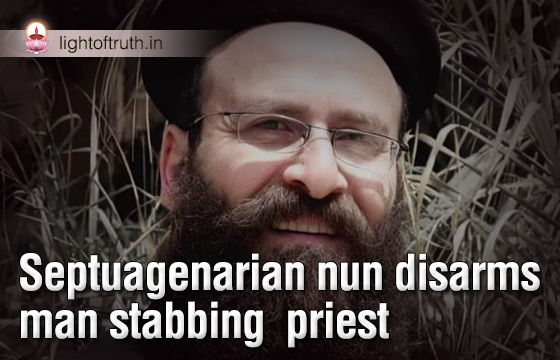
Septuagenarian nun disarms man stabbing priest
A 72-year-old Catholic nun has been praised for her “extra-ordinary courage” after she sought to disarm a man stabbing a priest at a Catholic church in Nice, south-eastern France.
Sister Marie-Claude reportedly intervened after a 31-year-old man entered the Saint-Pierre d’Arene church before Sunday Mass on April 24 and repeatedly stabbed Father Krzysztof Rudziñski.
She received a wound to the forearm and was taken to a hospital along with the 57-year-old priest.
The Diocese of Nice said in an April 24 statement that neither the sister nor the priest suffered life-threatening injuries in the incident, which police said was not related to terrorism.
Local politician Éric Ciotti commended the sister in a post on his Twitter account.
“Extraordinary courage of Sister Marie-Claude who intervened while the attacker continued to stab Father Christophe,” he wrote.
“She snatched the knife from him while being injured on the forearm.”
Father Rudziñski, originally from Suchowola, north-eastern Poland, is believed to have been stabbed up to 20 times, mainly in the chest.
Bishop Piotr Turzyñski, the Polish bishops’ delegate for the pastoral care of Polish immigrants, appealed for prayers for the priest and sister.
Priest dies from stabbing on seaside promenade in Egypt
A knife-wielding man mortally wounded a Coptic priest during an attack at the popular seaside promenade in Alexandria on April 7 evening, Egypt’s interior ministry said.
The ministry said the priest died while being treated for his wounds. It said the suspected attacker had been arrested.
The priest was identified by the Coptic Orthodox Patriarchate of Alexandria as Arsanious Wadid, 56. It said he had served at a local parish,
Sectarian violence is not un-common in Egypt, where an Orthodox Christian minority, the Copts, is believed to be among the world’s oldest Christian communities.
Christians make up more than 10% of Egypt’s mostly Muslim population. Violence between communities occasionally erupts, mainly in rural communities in the south. Islamic extremists have also targeted Christians in the past.
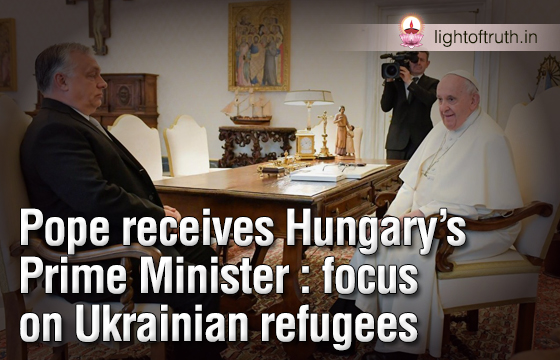
Pope receives Hungary’s P.M. : focus on Ukrainian refugees
Pope Francis spent 40 minutes with Viktor Orbán, Prime Minister of Hungary, whom he received in audience on April 21 morning. The premier arrived at the Vatican shortly before 11 am, accompanied by his wife and entourage, and did not meet with other Vatican authorities due to the private nature of his visit. Orbán is on his first trip abroad since his re-election as head of his government on 3 April. “My first official trip after the elections will take me to the Vatican, to Pope Francis,” Orbán himself revealed on Wednesday via his Facebook account. Pope Francis welcomed the Prime Minister in the Apostolic Library inviting him to take a seat. The conversation between the two leaders took place in the presence of an interpreter, but speaking in English, the Pope blessed Mr. Orbán, his family, and Hungary, a country that is engaged in offering shelter to neighbouring Ukrainians fleeing the war.

26 Million Americans Stopped Reading the Bible Regularly During COVID-19
When researchers for the American Bible Society’s annual State of the Bible report saw this year’s survey statistics, they found it hard to believe the results. The data said roughly 26 million people had mostly or completely stopped reading the Bible in the last year.
“We reviewed our calculations. We double-checked our math and ran the numbers again … and again,” John Plake, lead researcher for the American Bible Society, wrote in the 2022 report. “What we discovered was startling, disheartening, and disruptive.”
In 2021, about 50 percent of Americans said they read the Bible on their own at least three or four times per year. That percentage had stayed more or less steady since 2011.
But in 2022, it dropped 11 points. Now only 39 percent say they read the Bible multiple times per year or more. It is the steepest, sharpest decline on record.
According to the 12th annual State of the Bible report, it wasn’t just the occasional Scripture readers who didn’t pick up their Bibles as much in 2022 either. More than 13 million of the most engaged Bible readers—measured by frequency, feelings of connection to God, and impact on day-to-day decisions—said they read God’s Word less.
Currently, only 10 percent of Americans report daily Bible reading. Before the pandemic, that number was at about 14 percent.
Plake thinks the dramatic change shows how closely Bible reading – even indepen-dent Bible reading – is connected to church attendance. When regular services were interrupted by the pandemic and related health mandates, it impacted not just the corporate bodies of believers but also individuals at home.
“The elephant in the room is COVID-19,” he told CT. “As we’ve been tracking and kind of digging into what really ha-ppened around Scripture engagement in 2022, we realized there were some big issues happening in the United States at the time that we were collecting the data.”
The State of the Bible survey collected data in January 2022 as the omicron variant of the coronavirus was surging.
Most churches remained open, with an additional online option. Only about 3 percent were not meeting in person at all, according to Lifeway Research. But the pandemic took a visible toll on church attendance. Pew Research Center found that nearly a third of regular churchgoers have not returned to church buildings. Some choose to participate online, but others have dropped out completely.

Ukrainian and Russian families to carry cross at pope’s Good Friday Way of the Cross
Ukrainian and Russian families will carry the cross together during the Stations of the Cross led by Pope Francis at Rome’s Colosseum on Good Friday.
The Vatican has published the meditations and prayers for the Pope’s Via Crucis, or Way of the Cross, which will focus this year on the many “crosses” of family life.
The meditations include reflections from a couple without children, a family with a disabled child, a family with an ill grand-parent, a family of migrants, and families suffering due to the Ukraine war.
For the 13th station, “Jesus dies on the Cross,” a Ukrainian family and a Russian family will read a reflection that they wrote together about how their lives were upended by the pain of war. “Why has my land become as dark as Golgotha? We have no tears left. Anger has given way to resignation,” the text of the reflection says.
“Lord, where are you? Speak to us amid the silence of death and division, and teach us to be peacemakers, brothers and sisters, and to rebuild what bombs tried to destroy,” it says. The prayer following the meditation calls Jesus’ pierced side a “wellspring of reconciliation for all peoples” and asks God that “families devastated by tears and blood may believe in the power of forgiveness.”
The two families, whose home countries are at war, will carry a wooden cross together for the 13th station in the Colosseum before passing it to a family of migrants, who will carry the cross for the final station.
On April 15 at 9:15 p.m., Pope Francis will preside over the Stations of the Cross at the Colosseum, a Roman practice dating back to the pontificate of Benedict XIV, who died in 1758.
This is the first time that the pope is returning to the Colosseum on Good Friday since the outbreak of the COVID-19 pandemic. In the past two years, papal liturgies during Holy Week were kept very small due to pandemic restrictions.
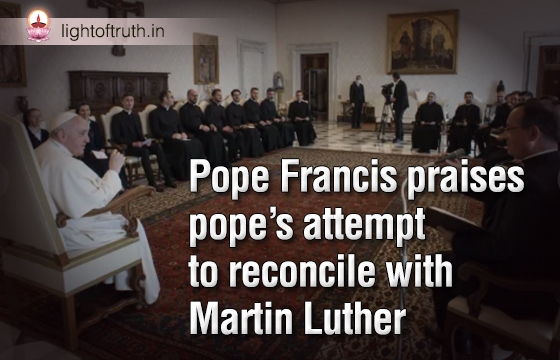
Pope Francis praises pope’s attempt to reconcile with Martin Luther
Pope Francis on April 7 recalled the 500th anniversary of the election of Pope Adrian VI, who sought reconciliation between the Catholic Church and Martin Luther during his short pontificate.
“In his brief pontificate, which lasted only a little more than a year, he sought above all reconciliation in the Church and the world, putting into practice the words of St. Paul, according to which God entrusted precisely to the Apostles the ministry of reconciliation,” Pope Francis said on April 7.
For this reason, Adrian VI sent the nuncio to the Imperial Diets of Nuremberg “to reconcile Luther and his followers with the Church, and expressly asking forgiveness for the sins of the prelates of the Roman Curia,” he stated.
“Courageous,” Francis add-ed. “He would have plenty of work today.”