
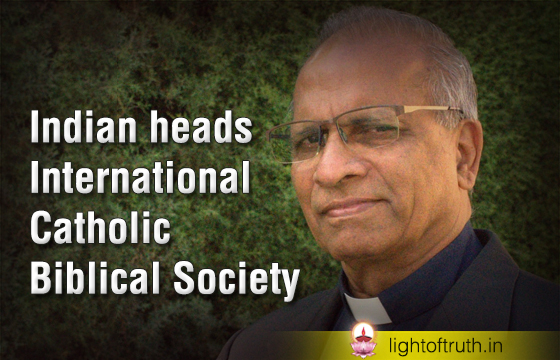
The Society of Paul superior general Father Domenico Solliman has appointed Father Jose Pottayil as the director of the Madrid-based International Catholic Biblical So-ciety that was set up a hundred years ago by Venerable James Alberione, the congregation’s founder. Father Pottayil is the first Asian and Indian to head the society known as SOBICAIN (Società Biblica Cattolica Inter-nazionale). Father Pottayil, a member of the congregation’s India-Great Britain-Ireland province, has served as its general councilor, vicar general, India provincial, director of apostolate and animator of various communities and groups.
Category Archives: From The States
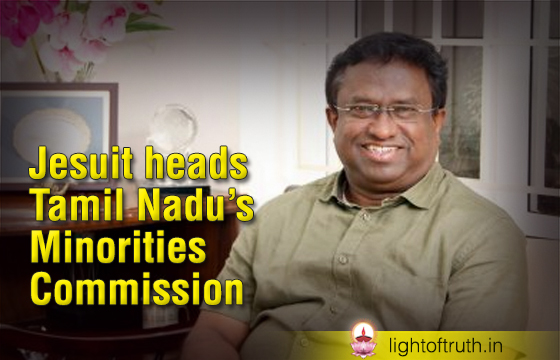
Jesuit heads Tamil Nadu’s Minorities Commission
The southern Indian state of Tamil Nadu has appointed Jesuit Father Joe Arun as the chairperson of its 10 member Minorities Commission. A government notification on July 23 said the appointment is for 3 years. The 59-year-old Jesuit is the secretary for the higher education secretariat of Jesuit Conference of South Asia and Director of the Chennai-based LIBA (Loyola Institute of Business Administration), a 45-year-old business management institute.
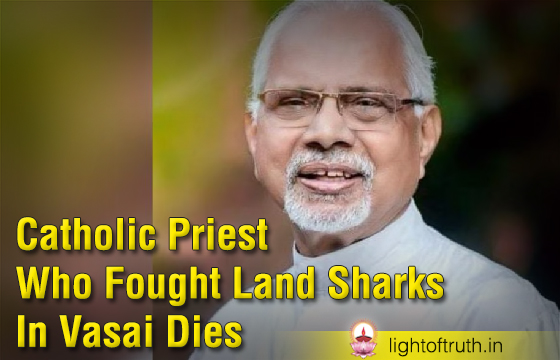
Catholic Priest Who Fought Land Sharks In Vasai Dies
A Catholic priest, who had gone beyond his priestly duties to fight illegal land grabbers and promote peace and communal harmony even at risk to his safety, died July 25 after a prolonged illness. Father Francis D’Britto of the western Indian Vasai diocese was known for his involvement in public movements such as the Harit (green) Vasai initiative to promote environmental sustainability and green practices. The death occurred at his home in Vasai, some 60 km north of Mumbai. He was 81. He was born December 4, 1942, to Marathi-speaking parents, in Girij, a tiny Vasai village. After studies in St. Pius, a Goregaon seminary, he was ordained a priest on December 23rd 1972, for the Bombay arch-diocese. He had also served as the spokesperson for Vasai diocese in the 2000s.
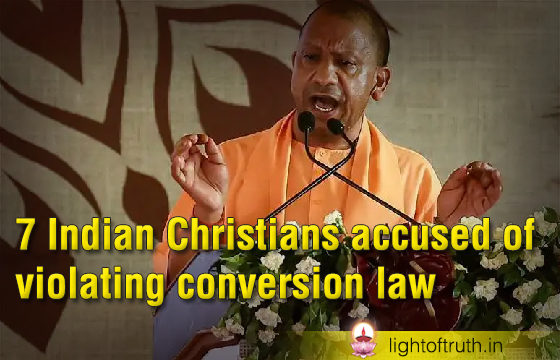
7 Indian Christians accused of violating conversion law
Seven Christians have been accused of violating the stringent anti-conversion law in two separate incidents in the northern Indian Uttar Pradesh state. Police arrested Pastor Ram Udeshy Sahani, Babulal Sahani and Vinod Kumar on July 14 in Maharajanj district. They were charged with converting a man by allegedly offering money and promising miraculous healing, according to a complaint lodged by his wife, Chanda, who was identified by only her first name. The police in Senduria village said the woman alleged in her complaint that her husband, who was identified by a single name, Anil, removed portraits of Hindu gods and goddesses from their home after his conversion. The three Christians were arrested but Babulal Sahani and Vinod Kumar were released on bail on July 16. “The police did not invoke the provisions of the anti-conversion law” against the two, said a lawyer dealing with their case. Four other Christians were accused of converting Hindu villagers in the Moradabad district by a leader of the Hindu group Vishwa Hindu Parishad (VHP or World Hindu Council). Police reportedly arrested two among them and were on the lookout for the two others. VHP local leader Pankaj Singh Pal registered the complaint at the Thakurdwara police station. He accused the Christians of converting Hindus by offering them “fridges, televisions, bicycles, motorcycles and sewing machines among other things” and “a cash reward of 25,000 rupees [about $300].” Pal alleged that those ready to become pastors were offered a monthly remuneration of 35,000 rupees and household expenses. The VHP leader further alleged that some 50-60 persons were already converted to Christianity and this had agitated the local Hindus. “Both cases were baseless and aimed at giving a negative image to Christians,” said Father Mathew from the Indian Missionary Society in Varanasi. Uttar Pradesh is India’s largest and most populous state. It is ruled by Prime Minister Narendra Modi’s right-wing Bharatiya Janata Party. The state enacted a stringent law, the Uttar Pradesh Prohibition of Unlawful Conversion of Reli-gion Act, in 2021. “Anti-conversion cases are part of the right-wing conspiracy against Christians,” Father Anand Mathew of the Indian Missionary Society told. The priest said that the police and media in the state were being used to target the tiny Christian community in the state. Some 24 Christians were already put behind bars in Uttar Pra-desh for violating the anti-conversion law after the general election results were announced on June 4. Only six persons “had got bail,” said a Church leader helping them with legal matters. Christians make up a mere 0.18% of Uttar Pradesh’s more than 200 million people, most of them Hindus. However, the state tops in cases of violence against Christians in the country, according to published records.

Catholic diocese moves court to quash Indian state’s order
A Catholic diocese has approached the top court of a central Indian state over a government order asking two of its schools to reimburse close 180 million rupees (some US$2.2 million) after accusing them of collecting exorbitant fees from students. The Jabalpur diocese in Madhya Pradesh approached the State High Court on July 16 “seeking a direction to quash the order from the [Jabalpur] district education officer,” said Father Davis George, diocesan vicar-general. The order is untenable and there is “no truth in it,” Father George told. The priest denied the Madhya Pradesh state education department’s claim that two diocesan schools, named after St. Aloysius, collected exorbitant student fees. The Catholic schools were told to reimburse nearly US$2.2 million after the management was accused of overcharging students in the past six years. The July 9 order named 10 private schools including four run by the Church of North India (CNI). The Protestant-run schools were also told to repay close to US$2.1 million. Madhya Pradesh has the highest number of tribal people in India. Christian schools are the most sought-after in Jabalpur, known as the cultural capital of Madhya Pradesh. This is the first time Christians are being told to reimburse the fees collected from students. The CNI’s Jabalpur diocese is also contemplating filing an appeal in court. “We are in consultation with lawyers,” said a CNI member who did not want to be named. The state is ruled by the pro-Hindu Bharatiya Janta Party (BJP) of Prime Minister Narendra Modi. The BJP is against missionary activities that benefit the tribal people and other poor sections of society, said a Church official. “We are targeted for providing quality education at an affordable rate,” he told on July 16.
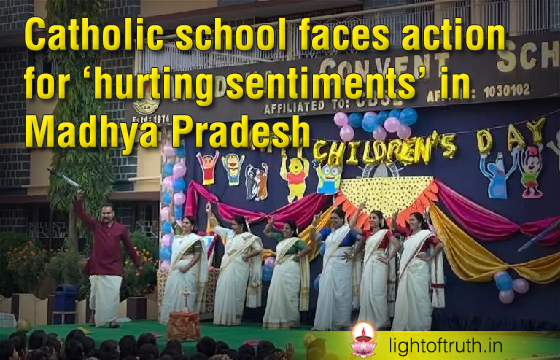
Catholic school faces action for ‘hurting sentiments’ in Madhya Pradesh
Police in a central Indian state have begun investigating complaints that a Catholic school has been hurting the religious sentiments of its students by insisting on reciting prayers in English. “A case is registered against us for following the medium of instruction [English] in our school,” said Sister Rashmi Kuzhyil, vice principal of Vandana Convent School at Guna in Madhya Pradesh state. The school management and its principal Sister Catherine Vattoly are the prime accused in the complaint filed by the Akhila Bharatiya Vidyarthi Parishad (ABVP or All India Students’ Council), the student body of the ruling pro-Hindu Bharatiya Janata Party (BJP). “It is a fabricated case,” Kuzhiyil told on July 23.
The English-medium school has 3,700 students and has been run by the Sisters of St. Elizabeth congregation for the past 50 years. It falls under the Sagar diocese and is a much sought-after school for Guna city residents. Kuzhiyil said that during the assembly on July 15, Vattoly found the students reciting prayers in Hindi instead of English. She stopped them and instructed them to follow the school’s medium of instruction and recite prayers in English. On July 22, around 50 activists from ABVP forcibly entered the school premises and began to shout slogans against the principal and school management. They also sought the immediate removal of Vattoly, alleging she “hurt the religious sentiments of Hindu students.” A few students later joined the protesters. “A police official informed us about the complaint, but we are yet to get its copy,” Kuzhiyil said. A district education official and others visited the school on July 23 and recorded statements from the students and staff members. “Unfortunately, a five-decade-old school is dragged into un-necessary controversy,” said Bishp James Athikalam.

Indian Christians seek police protection
Christians in a northern Indian state have sought police protection after right-wing Hindu groups allegedly threatened to accuse them of breaching a stringent anti-conversion law. In a petition submitted to the top policeman in Maharajganj district in northern Uttar Pradesh, Christians say their lives have been threatened. “We were forced to seek police protection as Bajarang Dal (Brigade of Lord Hanuman) activists continue to unleash violence against us by barging into our prayer meetings,” said Ram Lakhan, a petition signatory. Some 50 others who follow the teachings of Christ, but who have not converted to Christianity, also signed the petition submitted to the superintendent of police on July 23. They have accused Vivek Shrivastava, district president of the Bajarang Dal, and his associates of unleashing a reign of terror against Christians. They also claimed to possess video footage to back the allegations. Right-wing activists have assaulted Christians and followers of Christ, molested women, and damaged copies of the Bible, they said in the petition. Activists also allegedly threatened “to beat Christians one by one if they hold prayer meetings in the church or at their houses.” Uttar Pradesh is among 11 states in India where a draconian anti-conversion law is in force that criminalizes religious conversion from Hinduism to Christianity or Islam. Christians make up less than 1 percent of more than 200 million people in Uttar Pradesh. Most of the population are Hindus. India’s largest and most populous state is ruled by Prime Minister Narendra Modi’s Bharatiya Janata Party (BJP) and right-wing Hindu groups like the Bajarang Dal and Vishva Hindu Parishad (World Hindu Council). Uttar Pradesh ranks second in violence against Christians. The northern state witnessed 92 such incidents in the first half of this year out of 361 incidents reported across the country, according to the United Christian Forum, an ecumenical body that tracks atrocities against Christians in India.
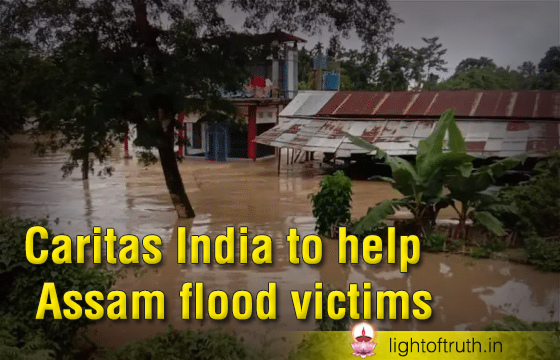
Caritas India to help Assam flood victims
Caritas India, the social service wing of the Catholic Church in the country, has geared up for rescue and relief work in Assam state in the northeast, which has been badly hit by floods. The media reported 46 deaths on July 4 while a report from the Assam State Disaster Manage-ment Authority (ASDMA) said the floods had affected over 1.6 million people in 2,800 villages across 29 districts in the state. Thousands of people were evacuated and sheltered in relief camps as heavy rainfall damaged homes and civic infrastructure. The worst affected districts are Nagaon and Darrang in central Assam and Karimganj in the Barak valley, reports said. The Assam government on July 4 issued an alert in Kamrup district as major rivers, including the Brahmaputra, Digaru and Kollong, were flowing above the danger mark. “Our team is ready. At present, we are assessing the severity of the situation with the help of our NGO network,” Jonas Lakra, zonal program lead of Caritas India in Northeast India told. He said the flood situation was grim and the Caritas team would begin work “as soon as we get the green signal from the government.” At present, government agencies are busy with rescue operations and setting up relief camps. A total of 181 relief camps and 334 relief distribution centers have been set up for the 25,744 displaced people so far. Lakra said the assessment carried out by the NGO network revealed loss and damage to houses, businesses, schools, water, electricity and road infrastructures. “This is also time for paddy cultivation but swathes of agricultural land is inundated. This will mean a huge loss for farmers,” he added. Meanwhile, Assam Chief Minister Himanta Biswa Sarma on July 4 assured the people that the flood situation was “under control.” He, however, added that “everything depends on the weather conditions during the next few days.” The flood-affected people are being provided relief and plans are being drawn up for their rehabilitation along with the repair of damaged infrastructure, the chief minister said.
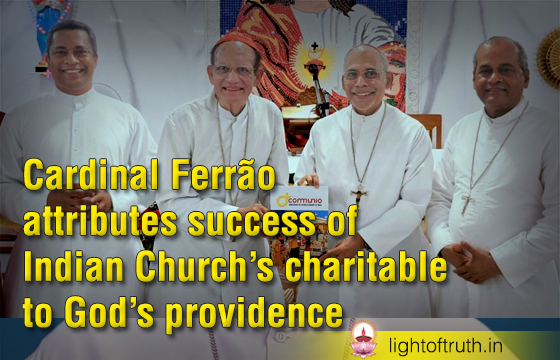
Cardinal Ferrão attributes success of Indian Church’s charitable to God’s providence
The head of the Conference of Catholic Bishops of India (CCBI) attributed the remarkable growth of the charitable initiative ‘Communio’ to divine providence during an event at Sacred Heart Church in Pethapur, Gujarat. “Communio embodies the spirit of solidarity, echoing the early Church’s unity and the power of the Holy Spirit,” said Cardinal Filipe Neri Ferrão.
The gathering celebrated the release of Communio’s report book, which details the organization’s ex-tensive contributions to rural development projects across India, according to a report by Catholic Connect. Communio, established in 2017 by the CCBI, has initiated and supported over 250 projects aimed at improving conditions in rural communities, with 100 projects currently active. The event was attended by ecclesiastical leaders, including Cardinal Oswald Gracias, Archbishop of Bombay, who received the first copy of the report book.
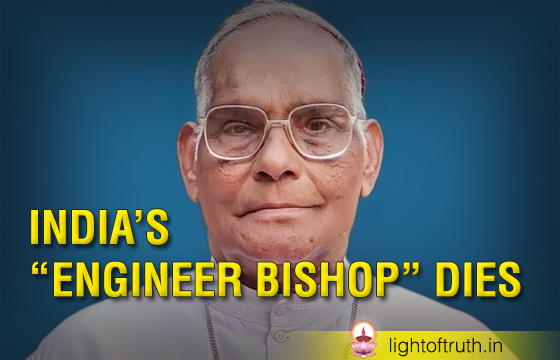
INDIA’S “ENGINEER BISHOP” DIES
Bishop George Mamalassery, who had helped transform a remote and hazardous northeastern Indian region into a modern place, died July 5 due to severe respiratory issues. He was 92. He served the diocese of Tura for 28 years from 1979. The government of Meghalaya had honored Bishop Mamalassery with the Pa Togan Sangma award that was set up in honour of a Garo tribe leader who had fought the British in the late 19th century. The University of Science and Technology, Meghalaya, conferred him an honorary doctorate in 2019 for his contributions to education, healthcare, and socio-economic development. Mourning the death, the Catholic Bishops’ Conference of India hailed Bishop Mamalassery as a prelate with “unparalleled commitment” a man of visionary leadership” who helped transform the northeastern Indian region’s socioeconomic and educational landscape. “His compassionate efforts during the 1971 Bangladesh Liberation War and the founding of Holy Cross Hospital are testament to his enduring legacy,” the statement added. Bishop Mamalassery was born on April 23, 1932, at Kalathoor in the southern Indian state of Kerala, as the youngest of three children to Kurian and Elizabeth Mamalassery.