Category Archives: From The States

Bishops plan guidelines to deal with sexual harassment

The Catholic Bishops’ Conference of India (CBCI) is to soon release a set of guidelines to prevent and deal with sexual harassment, esp-ecially of women, in Church-run institutions. The document titled “CBCI Guidelines to Deal with Sexual Harassment at Workplace” will be released on Sept 14 at a press conference at the CBCI Centre in New Delhi.

“The Church, while wanting to ensure the protection and respect for women at workplace and without in any way under-estimating the seriousness of sexual harassment of women at workplace, wants to address all forms of sexual harassment at work place,” said the Council for Women of the CBCI, in a statement on Sept 11. The statement signed by council chairperson, Bishop Jacob Mar Barnabas of Gurgaon and secretary, Sr Talisha Nadu-kudiyil SD, explained that document will be “gender in-clusive and has been formula-ted to create a safe, healthy and loving environment that enables its employees to work without the fear of prejudice, bias and sexual harassment and creates a mechanism for pre-vention of any form of harass-ment.”

Catholic priest in Delhi advocates cremation for Christians

An acute lack of space has forced Christian ceme-teries in New Delhi to reuse graves after five years, with a Catholic priest advocating that Christians opt for crema-tion. The Indian Christian Cemetery Committee that manages two cemeteries for various Christian deno-minations in New Delhi, announced that from Sept. 1 burial plots to families of the deceased will be given only for five years.

Reverend Samson R. Nath, the committee chairman said this was because “very soon we will have no space to bury our dead.”

He said requests to the Delhi government for more land for use as cemeteries have not been successful.

“Asking people to opt for cremation will be the last resort when we will have no other choice. It is a very sensitive issue,” said Reve-rend Nath, a Methodist. The lack of space for Christian and Muslim graveyards has been a growing concern in Delhi and other Indian cities, the Delhi high court in July observed. As the population increased, the death rate also increased but cemetery land remained the same.

Alphons joins Modi ministry, BJP veterans in Kerala left out

Prime Minister Narendra Modi’s decision on September 3 to induct former bureaucrat K.J. Alphons into his council of ministers has left the BJP’s long-standing leaders out in the cold. Not surprisingly, the state head office of the Bharatiya Janata Party here looked deserted when Alphons took oath even though Kerala was getting its first representation in the three-year-old Modi government.

But there was celebration in Alphons’ hometown Manimala in Kottayam district.

PM Modi doing what good Christian is supposed to do: Alphons KJ

Newly inducted Union minister Alphons Kannanthanam said Prime Minister Narendra Modi is doing what a good Christian is supposed to do. Addressing a public rece-ption on Sept 10 at Muvattupuzha near Kochi, the Minister of State for Tourism said, “People ask why I, a Christian, joined BJP. My answer to them is that Modi is doing what a good Christian is supposed to do. I would do whatever possible to realise the PM’s dream of creating a new India where all Indians can live with dignity.”

CSI pulls out of Kerala Council of Churches

The Church of South India (CSI) has decided to pull out from the Kerala Council of Churches (KCC), an ecumenical forum of non-Catholic Protestant Churches in Kerala, in protest against the KCC decision to provide membership to the Believers Church. The second largest Christian denomination after the Catholic Church, CSI is the largest Protestant denomination in India. The CSI Moderator, Bishop Thomas K. Oommen, said the CSI could never accept inclusion of the Believers Church in the KCC strictly on moral and ethical grounds.

Believer’s Church is the country’s top foreign-funded NGO. Its head K.P. Yohannan, who is also founder of Gospel for Asia, is facing a lawsuit in the US for fraud and misuse of charitable donations.

Bishop Oommen told The Hindu that the regional forum of the CSI Synod members had unanimously decided to disassociate with the KCC and its programmes. The latest development has to be viewed in the backdrop of the controversy over the episcopacy claims of the Believers Church that its head, K.P. Yohannan, was consecrated by then CSI Moderator Bishop K.J. Samuel in 2003.

The CSI has outright rejected this claim of the Believers Church, saying that the former has never done such a thing at any point of time.

According to Bishop Oommen, the CSI had never consecrated Yohannan and whatever news spread in this regard were baseless.

“The CSI never considers the Believers Church as an episcopal church or accept its leader, K.P. Yohannan, a bishop. As per the CSI view, K.P. Yohannan is a layman and the KCC decision, overlooking the CSI objection, was unfortunate,” he said. He said the bishop was the constitutional head of CSI. As per the constitution of the Church, the Synod executive has to authorise the Moderator to consecrate a clergy as a bishop. The CSI Synod executive never authorised the Moderator to consecrate K.P. Yohannan as a bishop, he said.

Christians protest Baptist-Catholic row in Manipur village

Christians in India are pro-testing the “inhuman behavi-our” of some villa-gers from north-eastern Manipur State for refusing the burial of a woman who left the Baptist Church to become a Catholic.

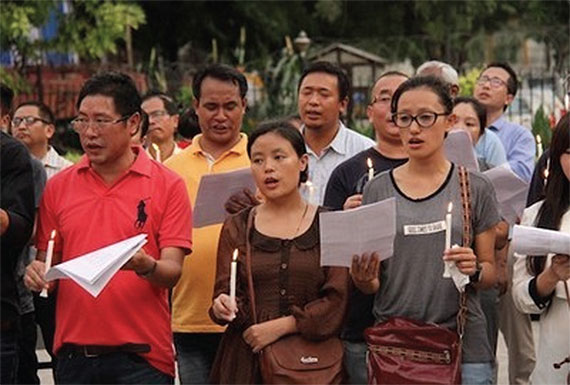
More than 200 Christians from various denominations gathered in front of the Catholic Sacred Heart Cathedral in New Delhi Aug. 17, holding candles, singing hymns and praying. They condemned the incident in a statement and sought help from the government to bury the woman who died Aug. 7. Leingangching villagers in Manipur state denied permission to bury the woman because the village council had excommunicated her family about seven years ago for leaving the Baptist Church and becoming Catholic.

Rita Haorei, the deceased is still not buried, according to Father Vialo Francis of Imphal Archdiocese, based in Manipur.

Fr Francis told ucanews. com that the predominantly Baptist village refused permission to five families, including that of Haorei, to become Catholic saying the village constitution holds that it “shall be a Baptist village.”

Manipur is a Christian strong-hold State. More than 40 percent of its 2.73 million people are Christians, mostly Baptists. Some pockets are almost entirely Christian. The Ukhrul district where Haorei hails from is 95% Christian.

Petition State Governor of India to Drop New Anti-Conversion Measure

The Governor of the State of Jharkhand in India has a big decision to make regarding the thousands of Christians and other religious minorities residing in her state.

Jharkhand Governor Drau-padi Murmu must decide on an anti-conversion Bill passed by the State Assembly earlier.

If Murmu allows the Bill to become law, she risks putting in harm’s way Christians and other religious minorities living in Jharkhand.

Only five states in India now have such laws. But of those five states, two are among the top three states in India where violence against Christians is highest.

Anti-conversion laws are supposed to stop people con-verting from Hinduism to Christianity. But, what they really do is infringe on the right of an Indian citizen to practise their religion as they see fit…and, to a right to privacy – both of which are guaranteed by India’s federal Constitution.

And, India’s federal Penal Code, Section 295(A), already deals with the issue of sectarian harmony, and the use of coercion and, or, “allurements” to entice people to convert from Hinduism to Christianity. These laws command stiff penalties, ranging from fines to imprison-ment.

SC quashes HC order on repair of shrines damaged in 2002 riots

The Supreme Court on August 29 set aside the Gujarat High Court’s 2012 verdict asking the state government to grant compensation for restoration of religious places damaged during the 2002 post-Godhra riots.

The court accepted the scheme formulated by the state government to provide “ex gratia assistance” of up to Rs 50,000 to all religious places, including mosques and temples, which were damaged or destroyed during the communal riots, on par with the relief granted for destruction of houses.

No confirmed ‘Love Jihad’ incidents in Kerala: DGP as Supreme Court asks to probe “love jihad”

The Supreme Court has asked the National Investigation Agency to probe what has come to be dubbed “love jihad.”

This was done after the top probe agency told the apex court on August 16 that there was evidence to suggest that some extremist outfits linked to a banned group were involved in converting Hindu girls to Islam and their gradual radicalization toward the Islamic State’s ideology.

The bench of Chief Justice J.S. Khehar and Justice D.Y. Chandrachud took on record a sealed report of the central agency’s preliminary findings, reports telegraphindia.com.

State police chief Loknath Behera has said that there is no confirmed case of ‘Love Jihad’ reported in Kerala.

The report, which appeared in a section of the media saying the state police chief has confirmed that ‘Love Jihad’ is there in state, is wrong, the DGP said in a statement issued on August 26, 2017.

“I only said that we are keeping an eye on the allegations from various quarters that there is radicalization through conversion using various means taking place in Kerala. The Supreme Court has ordered an inquiry into such an allegation in one case (Hadiya case). So it is our duty to find out whether that is correct or not,” he said.

Jharkhand, new anti-conversion law Cardinal Toppo: There are no forced conversions

The government of Jharkhand (in the northeast of the country) last night approved a law prohibiting conversions brought about by force or coercion. The government spokesman explained that “anyone who violates this law may be sentenced to three years in prison and 50,000 rupees [over 600 euros] fine, or both.”

The law provides for more severe penalties for forced conversion of underage girls and tribal women (scheduled tribes). In this case, the culprit can be sentenced to four years in jail and /or a fine of 100,000 rupees. The law, approved by the govern-ment, has to be approved by the local parliament, on August 8. If it passes, Jharkhand will be the seventh state in India with a law against forced or coerced conversions. Such laws already exist in Madhya Pradesh, Chhattisgarh, Odisha, Gujarat, Maharashtra, and Himachal Pradesh. Speaking to AsiaNews, Card. Telesphore Toppo, Archbishop of Ranchi and of tribal ethnicity, states: “This law is not to prohibit conversions, but it is against forced conversions. Forced conversions do not exist. We are free people with a free will and a free conscience and intelligence. No one can force another to convert.”

Commenting earlier to journalists, he had expressed sadness at the government’s decision. “For decades, we have held many schools and colleges, clinics and hospitals across the state, serving the poor, the oppressed, and the abandoned. None of the millions of people we have ever served have been converted to Christianity.”

Although the law only wants to prevent forced conversions or illicit conversions, Hindu nationalists fear of any kind of conversion. According to the Times of India, the Jharkhand government’s decision came after the census data was presented in 2011. On a total population of 35 million, 27% is tribal; Christians are 4.3% and Muslims 14.53. Data show that over the past 10 years, the Hindu population has grown by 21%; Christians of 29.7%, Muslims by 28.4%.