Category Archives: From The States

Campaign for jailed Christians achieves milestone

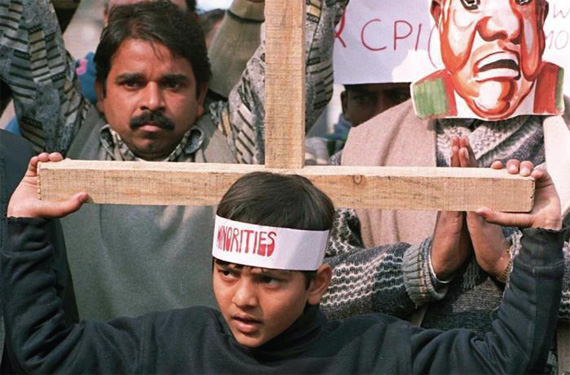
An online signature campaign demanding the release of seven innocent Christians, jailed in connection to anti-Christian riots in Odisha, crossed the milestone of 50,000 signatures on July 11. Journalist author Anto Akkara, who has been spearheading the campaign in a press statement on July 12, called for more signatures for the release of the seven – six of them illiterates including a mentally challenged.

The seven Christians – Bhaskar Sunamajhi, Bijay Kumar Sanseth, Budhadeb Nayak, Durjo Sunamajhi, Gornath Chalenseth, Munda Badamajhi and Sanathan Badamajhi—have been jailed accused of murdering of Swami Laxmanananda Saraswati on Aug. 23, 2008.

The murder sparked a six-week long anti-Christian violence, resulting in the death of some 100 Christians. Frenzied groups raided and torched some 300 churches and 6,000 Christian houses.

Latin-rite bishops reflect on ‘mission of the Church’

Twenty-five Catholic bishops from all over India came together in the country’s commercial capital, Mumbai, in early July to take a closer look at the Church’s core mission in the country, AsiaNews reported.

They prayed and reflected on how best the Church can seek out, touch and heal the wounds of Jesus in suffering humanity.

The July 2-7 “Bishops’ Joint Reflection Programme” was the initiative of Conference of Catholic Bishops’ of India (CCBI), the official body of the country’s Latin-rite bishops, one of the three rites that make up the Catholic Bishops’ Conference of India, the nation’s apex Catholic bishops’ body.

Cardinal Oswald Gracias, Archbishop of Bombay and president of both CBCI and CCBI, explained to AsiaNews that the purpose of the program was “to reflect on the mission of the Church and how we can touch the wounds of Jesus.” “St Thomas the Apostle, whose liturgical memorial recurred on July 3, wanted to touch the wounds of Jesus with his own hands,” Cardinal Gracias explained.

Syro-Malabar expansion not colonization, but evangelization: Archbishop 

A Syro-Malabar archbishop, who heads a diocese in northern India, wants his Oriental Church to become global by breaking free the barriers of Kerala, its base in southern India.

“What we need is globalization and not colonization of the Church,” Archbishop Kuriakose Bharanikulangara of Faridabad said on July 1 in an apparent response to fears expressed in certain circles over the Oriental rite gaining pan India jurisdiction.

The Syro-Malabar Church’s recent all India expansion, the archbishop said, should be seen more as an opportunity for greater evangelization than colonial conquest or territorial expansion.

The Universal Church today needs more “mission power” than “muscle power,” explained the first prelate of Faridabad diocese erected on March 6, 2012, primarily for the Syro-Malabar Catholics settled in the national capital and surrounding regions.

The archbishop, a former Vatican diplomat, expressed these views in a pastoral letter that was read on July 1 in all 36 parishes and 15 mission stations under the diocese that covers the National Capital Region and the states of Haryana, Himachal Pradesh, Jammu and Kashmir, Punjab and Rajasthan.

The prelate repeated them at the opening of the new academic year of catechism and faith formation program in the diocese held on the same day. More than 500 catechism teachers of the diocese attended the program at St Francis Assisi Forane Church in Dilshad Garden, a suburb in eastern India.

Fr Paul Saldanha becomes new bishop of Mangalore

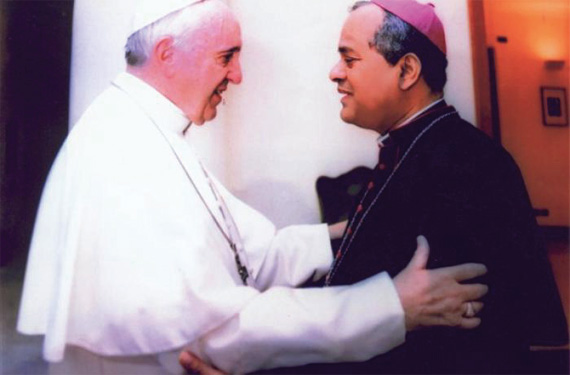
Pope Francis has accepted the resignation of Bishop Aloysius Paul D’Souza of Mangalore and has appointed Fr Peter Paul

Saldanha (54) the new Bishop of Mangalore. The bisop-elect, a priest of Mangalore, is now Professor at the Pontifical Urbanian University in Rome.

This ecclesiastical provision was made public in Rome and Mangalore on July 3. Rev. Fr Peter Paul Saldanha was born in Kinnigoli, Diocese of Mangalore, on 27 April, 1964.

Coadjutor for Patna, administrator for Palayamkottai appointed 

Pope Francis on June 29 transferred Bishop Sebastian Kallupura of Buxar to Patna archdiocese as the coadjutor. Both the dioceses are in Bihar, eastern India.

On the same day, the pontiff accepted the resignation of Bishop Jude Gerald Paulraj A of Palayamkottai, Tamil Nadu, and appointed Archbishop Antony Pappusamy of Madurai as the diocese’s apostolic administrator.

Bishop Kallupura has been the Buxar bishop since June 21, 2009. Earlier, he had served Patna arch-diocese as pastor in various parishes.

Pope appoints apostolic administrator for Syro-Malabar major archdiocese

While Cardinal George Alencherry still retains the title of major archbishop of the Syro-Malabar Archdiocese of Ernakulam-Angamaly, Pope Francis named an apostolic administrator to run the Indian archdiocese.

The Pope appointed 71-year-old Bishop Jacob Manathodath of Palghat to be the apostolic administrator “sede plena,” or effective head, of the archdiocese, said a Vatican press release on June 22.

“It shows a grave situation of ethical violations and the inability of the synod to effectively settle the issue,” he told ucanews.com.

In 2011, Alencherry, now 75, was selected by the Syro-Malabar Catholic Church’s decision-making Synod and confirmed by the Pope to be major archbishop and head of the Eastern Church. Pope Benedict XVI elevated him to the College of Cardinals in 2012.

Ucanews.com reported a letter from Cardinal Leonardo Sandri, prefect of the Vatican’s Congregation for Eastern Churches, said, “There remains the grave and worrying” situation of division between priests, auxiliary bishops and Cardinal George Alencherry.

India’s Mizoram snubs Yoga Day as ‘anti-Christian’

World Yoga Day proved a big hit across India on June 21 as Prime Minister Narendra Modi urged the nation to revel in and promote its culture but it was largely ignored in Christian-dominated Mizoram State. While many Catholics in other parts of the country joined the mass group exercises organized that on June 21, some religious groups in the north-eastern state dubbed the event “anti-Christian,” according to local media.

“Ours is a Christian state. We cannot accept yoga because we see it as a part of Hinduism,” said Vanlalruata, president of the People’s Representation for Identity and Status of Mizoram (Prism), a newly floated political party. “We refuse to practise yoga and we will keep opposing this celebration in our state,” he added.

Arunachal chief minister promises to repeal anti-conversion law 

Arunachal Pradesh Chief Minister Pema Khandu on June 28 announced that his government would repeal the anti-conversion law the north-eastern Indian state passed 40 years ago.

“The anti-conversion law could undermine secularism and is probably targeted towards Christians,” said Khandu while assuring he would introduce steps to repeal the draconian law in the next assembly session to prevent its misuse in future by irresponsible officials.

Khandu was speaking at the tenth death anniversary of Prem Bhai, a Benedictine missionary who is considered the “Saint Paul” of Arunachal Pradesh. He endured repeated arrest, imprisonment, beatings and wore disguises to evangelize in the north-eastern state. Born Henry Gaikwad in the western Indian State of Maharashtra, the missionary was popularly known as Prem Bhai (loving brother). He died on June 28, 2008, in Colombo, Sri Lanka, following a heart attack the previous day. He was 45 at the time of his death. He was buried in Banderdewa, a village near the Arunachal Pradesh capital of Itanagar.

The chief minister said although he had not heard of Prem Bhai earlier, the testimonies of many about the Christian missionary’s efforts to promote communal harmony, peace and love among the people of Arunachal Pradesh have impressed him.

Khandu, 38, expressed concern about the persecution Christians faced because of the infamous law against conversion in Arunachal Pradesh, especially when the state was a territory directly ruled by the federal government. The Arunachal Pradesh Freedom of Religion Act or the Anti-Conversion Law was passed by the state Assembly in 1978. It says no person should convert or attempt to convert, either directly or otherwise, any person from one religious faith to any other religious faith by the use of force or by inducement or by any fraudulent means nor should any person abet any such conversion.

The chief minister expressed surprise that the discriminatory law against Christians had not been repealed, even though it was not being enforced. He said that in the future there could be a chief minister, chief secretary or director general of police who could have malicious intent, to misuse the Act. “Any misuse of the law leading to torture of people could trigger large-scale violence in the state and could break Arunachal into pieces,” the chief minister warned.

Jharkhand’s move to weaken land rights meets opposition

The amendment allows the state government to alter a five-year-old federal law that aims to protect the rights of farmers and indigenous people when acquiring their land for state development purposes. Protests and sit-in-demonstrations have been held in several locations around the state following media reports that President Ram Nath Kovind had agreed to the amendments. “The approach of the current government is more pro-rich rather than strengthening the poor,” said Auxiliary Bishop Telespore Bilung of Ranchi, who like other Christian leaders, believes the move dilutes a stricter federal law. The amendment allows the state government to alter a five-year-old federal law that aims to protect the rights of farmers and indigenous people when acquiring their land for state development purposes.

Nearly 20 opposition parties, including Congress and Jharkhand Mukti Morcha (Jharkhand Liberation Front), have demanded the state scrap the amendments and conducted a sit-in protest in front of the Ranchi residence of state governor Draupadi Murmu, the representative of the Indian president on June 25. Protesters also gathered outside district headquarters across the state. If the government fails to scrap the move, the opposition plans to hold a state-wide shutdown on July 5. Meanwhile the ruling pro-Hindu Bharatiya Janata Party has been conducting its own campaigns and demonstrations to garner support for the changed federal law.

Church hails big fall in India’s childbirth deaths

Church leaders have welcomed a big reduction in India’s maternal mortality rate, with nearly 12,000 fewer women dying during childbirth in 2016.

They said the improvement was the result of a joint effort by government and private health workers.  India’s maternal mortality rate (MMR) registered a 22% reduction in three years. The rate declined to 130 deaths per 100,000 births in 2014-16 from 167 deaths in 2011-13, according to data released by the Registrar General of India on June 6. This meant India saved the lives of nearly 12,000 pregnant women in 2016, UNICEF said in a statement analyzing the data.

“India has shown impressive progress in reducing maternal deaths, with nearly 1,000 fewer women now dying of pregnancy related complications each month in India as compared to 2013,” UNICEF’s India representative Yasmin Ali Haque said.

The result is “very encouraging for us all because the church is at the forefront of the health sector in the country,” said Father Mathew Peru-mpil, secretary of the health office of the Indian Catholic Bishops’ Conference.

He said one reason for the achievement was that people were made aware about facilities by the government and privately run health centres.

The government has introduced several schemes to provide free medicine and health checks for pregnant women in state facilities. Federal schemes are also available to ensure healthy food for pregnant women and newly born babies and their mothers. The World Health Organization (WHO) said the government’s efforts to improve access to high-quality maternal services and increased emphasis on women’s education are some of the reasons behind India’s ground-breaking progress.