Category Archives: From The States

Mass readings from Gita, Quran: Jesuit priest apologizes

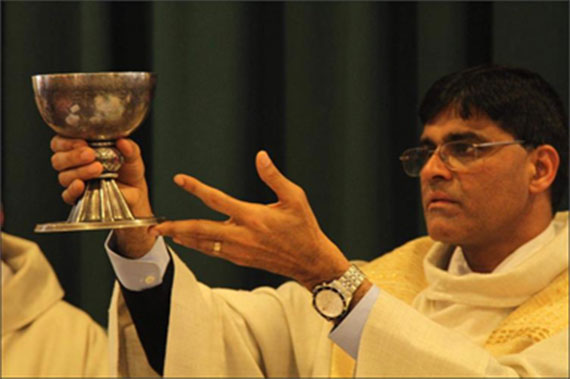
A Jesuit parish priest in Mumbai has apologized for including verses from other religious scriptures in Mass readings after some Catholics protested calling him Anti-Christ. “I realize that the verses were not appropriate as part of the readings of the Mass and I apologize for this. However, to attribute this to the Antichrist is very shocking,” said Father Frazer Mascarenhas, pastor of St Peter’s Church in Bandra, a western suburb of India’s commercial capital, on August 21.

Father Mascarenhas issued a statement explaining his action. “St Peter’s has been making efforts to build human communities in our neighbourhood, as encouraged by the archdiocese. In this context, on the dual feast of the Assumption, and Independence Day, at the traditional Indian liturgy we hold at the 10 am mass, I took the theme, ‘Giving Jesus to the world as Mary did.’”

Indian Catholic Bishops facilitate Indigenous youth achievers

The Catholic Bishops Conference of India (CBCI) Office for Tribals recognized 15 tribal youth for their hard work, brilliance and enthusiasm in achieving standards of excellence.

In a first of its kind, the CBCI Office for Tribals organized an event to congratulate, encourage and felicitate them for their achievements.

At a function held at the CBCI Centre, New Delhi, on August 10, on the occasion of 24th International Day of the World’s Indigenous Peoples, tribal youth from different streams such as music, singing, acting, scholarship, airplane pilot, bodybuilding, writers, and publishers were acclaimed.

Bp Theodore Mascarenhas, secretary general of CBCI, who was the chief guest felicitated the young tribals with a rose flower, a memento and a Certificate of Excellence. “You are not simply the pride of your tribal communities but the pride of whole humanity because you have had the courage and the perseverance to break through barriers and shine forth,” the bishop told the youth.

The prelate reminded them that it was important that the tribals preserve their land, culture, language and unity. Otherwise, they will be swamped out of their existence.

Filipino nun returns home after serving India for 41 years

A Filipina nun, who served India for 41 years, has returned to her native country. Sister Linda Gomez of Daughters of the Charity, a congregation founded by St Vincent De Paul, worked among the poor mostly in Odisha, eastern India, has returned to the Philippines. Sister Martha Pradhan, who heads the congregation’s North India province, in a ceremony in Berhampur on August 25, thanked Sister Gomez for her service to the Church and society in India. Sister Gomez worked also among the poor in West Bengal and other parts of the country. She was among the first to volunteer to work among the victims of the Orissa Super Cyclone 1994, Sister Pradhan recalled.

Activists protest death of children “rescued” from Teresa home

Human right activists gathered at a busy junction in Ranchi on August 21 to protest the death of two infants who were “rescued” from a Missionaries of Charity centre by a Jharkhand government department.

“The two children died of dehydration within six weeks of them being forcibly removed from the Missionaries of Charity centre,” Gopinath Ghosh, an activist associated with “Jan Awaz” (people’s voice), told Matters India on August 22. Jan Awaz, an umbrella body for various human rights groups working in the eastern Indian state, organized the protest march at Albert Ekka Chawk.

The children, just six months old, died on August 19 at a centre managed by Sahayog Village, an NGO favoured by the Child Welfare Committee (CWC), a Jharkhand government’s department, at Khunti district.

The two infants were among 22 children the CWC took away on July 6 from Nirmala Shishu Bhavan (Immaculate home for children), managed by the Mother Teresa nuns at Hinoo, a Ranchi suburb. Out of them, 12 children belonged to Khunti, some 35 km south of Ranchi.

Bishops’ event focuses on how to beat India’s divisive politics

A Catholic Church-organized program in New Delhi has called on Indian politicians to cease being divisive and using religion as a way of attracting votes. Prominent opposition leader Mamta Banerjee was among several speakers voicing concerns over the divisions in Indian society during an assembly organized by the Indian Catholic bishops’ conference on July 31. “Some people are trying to divide the country in the name of religion, caste and creed. But we can’t sit here as mute spectators,” Banerjee, chief of Trinamool (grassroots) Congress party, told the gathering of 1,000 people. “Time has come for us unite and raise our voices,” she said. With the theme of “Love your neighbour,” the assembly was held as leaders of India’s ruling Bharatiya Janata Party (BJP) press their pro-Hindu ideology ahead of general elections early next year.

Banerjee, who is also the chief minister of West Bengal State, said the theme of the gathering was rightly chosen because “some communal forces are trying to dictate what we should eat, dress and how we should practice our faith.” She was alluding to cases of harassment and violence committed against Christians and Muslims by hard-line Hindu groups ever since Prime Minister Narendra Modi came to power leading the BJP in 2014.

Leaders like Banerjee accuse BJP governments in New Delhi and most northern Indian states of supporting Hindu groups who attack religious minorities in an effort to project the party as a pro-Hindu champion.

Indian tribals urged to resist exploitation

About 2,000 people who gathered to mark International Day of the World’s Indigenous Peoples were asked to fight to protect their identity and culture in the face of increasing challenges in India.

Leaders who addressed the gathering in New Delhi on Aug. 9 presented data and incidents to show how exploitation of tribal people has increased since the pro-Hindu Bharatiya Janata Party (BJP) came to power at federal level and in several states in 2014.

“Atrocities on tribals are nothing new but now tribals are branded as anti-national and the government will always harass them,” Jesuit Father Vincent Ekka, a tribal rights activist, told participants.

He said the Indian constitution provided for tribal people to enjoy self-administration in certain areas “but local administrative executives are not following it and have taken an attitude of my way or the highway.” Father Ekka heads the department of tribal studies at the Jesuit-run Indian Social Institute, which organized the meeting of tribal people and leaders across India to mark the international day, which had the theme “Indigenous peoples’ migration and movement.” Tribal leaders recalled how governments had made laws to take over and control tribal land and forests while chanting development mantras but acting on behalf of multinational companies and miners. Many tribal people were forced to migrate to cities.

“The main reasons for migration are mining, power projects and industries,” said Lakhiram Murmu, a professor at the All India Institute of Medical Sciences.

The 2011 census showed the total number of internal migrants in India was a staggering 139 million. Murmu, a tribal and senior surgeon, said that “when we speak about migration, it will be mostly our own people who are affected and we have to find the solution for that by creating jobs.” India has about 104 million tribal people who form 8% of the population. However, 30% of India’s 27 million Christians come from tribal communities, especially in northern and eastern states.

Religious bias seen in India revising citizenship claims

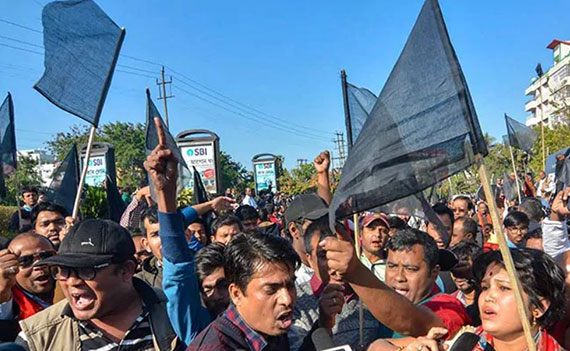
Religious bias is suspected in an Indian government move that could result in millions of people who migrated from Bangladesh five decades ago losing their citizenship rights.

India’s National Register of Citizens (NCR) on July 30 published a list accepting as Indian citizens those who migrated from neighbouring Bangladesh before March 25, 1971, a day before the Muslim nation declared independence.

The list prepared for people living in Assam State bordering Bangladesh left at least four million people uncounted, making them stateless.

“The issue is of international importance as it affects relations with neighbouring countries including Bangladesh,” senior politician and opposition Congress leader Anand Sharma told media in Delhi hours after the list was published.

Guilty should face consequences: Catholicos

The Church has taken a consistent stance in the alleged sex scandal involving a few of its priests, said the supreme head of the Malankara Orthodox Syrian Church. Addressing the Church managing committee, the highest executive body of the Church that met in Kottayam on August 9, Catholicos and Malankara Metropolitan Baselios Mar Thoma Paulose II, said the Church had always maintained that those who were found guilty in the case should face the consequences, but the innocent shall not be punished.

He also came down on those who took the opportunity to insult the entire priestly class and denigrate sacraments such as confession. He said those who took such positions had not done it with the right intention.

The Catholicos said the Church was engaged in an effort to bring peace in the Malankara Church even as it strove to maintain its identity as an ancient Indian Church.

Serra Bangalore Annual Scripture Quiz 2018

The Serra Club of Bangalore comprising of a group of lay Catholics promote, foster and encourage vocations to the Priesthood and Consecrated life. They held their 14th Annual Scripture Quiz on Saturday, August 4, 2018 at the Catholic Club, Bangalore, who also co-sponsored the event.

This year’s theme for the quiz was ‘Evangelization’ and focused on the Gospel according to St Mark and on St Paul’s letters 1 and 2 to the Corinthians.

Goa still a ‘battery’ of Catholicism for Asia

Goa, a former Portuguese colony that now ranks as having one of the most famous beaches in India, is continuing to promote Christianity in Asia as part of its colonial legacy, according to former Archbishop Raul Gonsalves.

The 91-year-old retiree believes Jesuit missionaries, who have been based in his homeland on the subcontinent’s southwest coast since the 16th century, are still having a ripple effect across the entire continent, despite alleged attempts to “ethnically cleanse” the area of Catholics in the past. Archbishop Gonsalves said Goa has produced bishops for a number of countries due to the strong sense of faith instilled in so many families in the region.

This tiny Indian state, covered by the dioceses of Goa and Daman, has churned out some 60 bishops and cardinals for India, Pakistan and Africa, according to Father Joaquim Loiola Pereira, secretary to the current Archbishop of Goa Filipe Neri Ferrao.

Goa Diocese was created in 1533, 23 years after the Portuguese conquered the state by defeating its then Muslim ruler Ismail Adil Shah.

About 500,000 of Goa’s 1.8-million population identify as Catholic while in nearby Kerala about 5 million of its 36 million people are Catholics, and another 1 million are from other Christian denominations.