
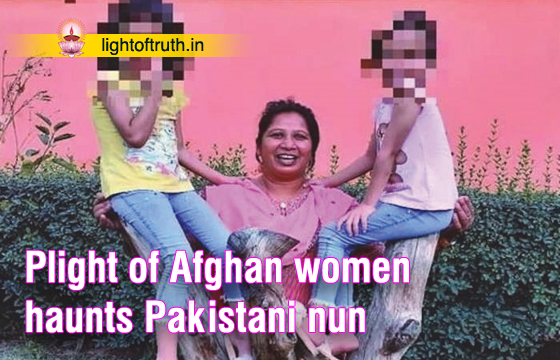
A Pakistan-born Catholic nun who worked in Afghanistan until the Taliban takeover says the plight and lack of freedom of women in the country still trou-ble her. Women are considered inconsequential in Afghanistan, said Sister Shahnaz Bhatti from the Sisters of Charity of St. Jeanne-Antide Thouret, who fled the troubled Central Asian country following the Taliban victory on Aug. 15.
Young women are forced against their will to marry men selected by the patriarch of the family, said Sister Bhatti, who served in Afghanistan as part of the pontifical mission set up by Pope John Paul II in May 2002.
“The most trying thing was not being able to move about freely because, as women, we always had to be accompanied by a man,” Sister Bhatti said in an interview with papal charity Aid to the Church in Need (ACN) on Sept. 22.
The congregation, founded by St. Jeanne-Antide Thouret in 1797 in France, ran a school for children with intellectual disa-bilities and Down’s syndrome in the capital Kabul. Sister Bhatti served in the school along with Sister Teresia of the Sisters of Maria Bambina (Sisters of Holy Child Mary) and Sister Irene of the Missionary Sisters of Consolata.
“It was my job to complete all the necessary paperwork at the banks or other government agencies, but I always had to be accompanied by a local man,” she added.
Women religious had to dress like the local women and were constantly being monitored, Sister Bhatti said, recalling her experience in Afghanistan, where US-led forces were engaged in a 20-year war and humanitarian assistance.
Afghans consider all foreigners to be Christians, she added.
Category Archives: Asian
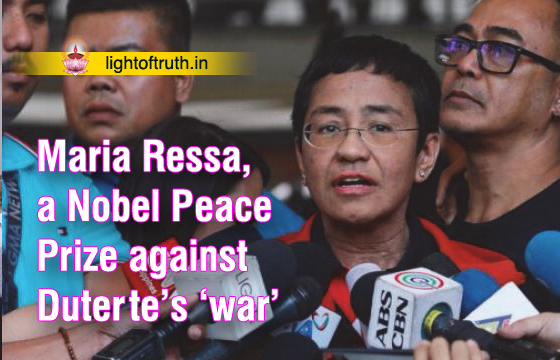
Maria Ressa, a Nobel Peace Prize against Duterte’s ‘war’
The Nobel Peace Prize was awarded to Philippine journalist Maria Ressa, founder of the news website Rappler, and Russian journalist Dmitry Muratov.
In announcing the award, the Nobel committee chair, Berit Reiss-Andersen, said: “Free, independent and fact-based journalism serves to protect against abuse of power, lies and war propaganda.
“Without freedom of expression and freedom of the press, it will be difficult to successfully promote fraternity between nations, disarmament and a better world order to succeed in our time,” she added.
Maria Ressa, the first Filipino to receive a Nobel Peace Prize. She founded Rappler in 2012, an online news website that “has focused critical attention on [President Rodrigo] Duterte regime’s controversial, murderous anti-drug campaign,” the committee writes.
What is more, Ressa and Rappler ”have also documented how social media is being used to spread fake news, harass opponents and manipulate public discourse,” it added.
In recent years, the journalist has been the target of a series of attacks. For her cover of Duterte’s ruthless “war on drugs”, she ended up in jail twice.
Her tenth arrest warrant for cyber libel in less than two years shows “definitely a pattern of harassment,” Ressa, a former CNN correspondent, laments.
Despite the risks, Maria Ressa, whose book “How to stand up to a dictator” will be released in April 2022, has decided to stay in her country.
“I don’t think this is me, I think this is Rappler. I have – we have – all along said this since 2016, that that we are fighting for facts,” the journalist said upon hearing about the award.
If the news becomes debatable, she warns “then journalism becomes activism”, a “battle for facts”. For her, “the Nobel peace prize committee realised that a world without facts means a world without truth and trust.”
The Philippines is ranked the seventh most dangerous country in the world for journalists. As a sign of things to come, when he took office in 2016, President Duterte said that “Freedom of expression cannot help you if you have done something wrong.”

Forced conversions a religious duty in Pakistan
Pir Abdul Haq, alias Mian Mithu, specializes in marrying off Hindu women to Muslim men in Pakistan and converting them to Islam simultaneously. His certificates preceded court verdicts before the partition of British India. “Even at that time, my father was jailed for four months when the local Hindus protested. The British gave us a logbook to keep a record of newly converted Muslim girls or any person and share its receipt,” he said at a Sept. 15 press briefing.
“I don’t return Hindu girls even if their community offers money. My faith is bigger than millions. I even refused Asif Ali Zardari [former president of Pakistan] on this issue. Do whatever you want, I told his minister. Allah will help me. I am performing his duty. I live and die for Islam.
“Girls, most of them housemaids, often come to us. Urgent marriages are organized so that they can live with a mehram [male guardian]. We keep the couple until the husband gets a job. I guarantee them protection at the seminary. Many courts forcefully return girls to Hindus. Those who protest these conversions have an agenda to defame Pakistan.”
Another speaker accused the Catholic bishops’ National Commission for Justice and Peace (NCJP) of getting foreign funding and raising an outcry. Their annual monitor is based on media reports of alleged victims of forced conversions, he said.
Mithu, 85, is the custodian of Dargah Bharchundi Sharif seminary, one of two major hubs in Sindh province for converting religious minorities to Islam. The former member of the National Assembly was a candidate of Zardari’s Pakistan People’s Party at the 2008 general election. In 2017, his photos with Prime Minister Imran Khan went viral on social media. He also leads mobs over blasphemy allegations.
“Women of this country, especially non-Muslim women, and especially underage girls, don’t stand a chance,” author Maria Rashid said in a recent tweet sharing photos of Mithu with Khan and Gen. Qamar Javed Bajwa.
The Council of Islamic Ideology invited him to discuss forced conversions during a session. The Ministry of Religious Affairs and Interfaith Harmony later rejected a bill that proposed regulations on conversions to Islam. On Sept. 24, Lahore High Court ruled that Muslim jurists regard the mental capacity of a child as of crucial importance for conversion to Islam. The age of discernment is generally reckoned as the age when one attains puberty, said Justice Tariq Nadeem while dismissing a petition filed by Gulzar Masih, a rickshaw driver from Faisalabad seeking recovery of his daughter Chashman Kanwal.
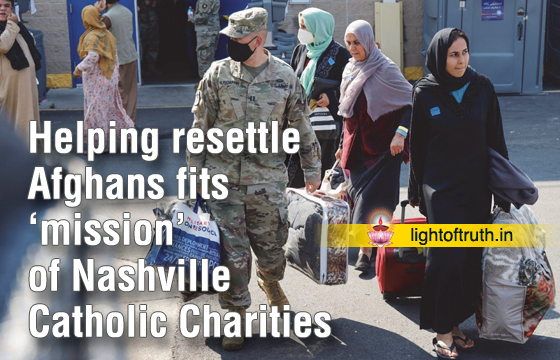
Helping resettle Afghans fits ‘mission’ of Nashville Catholic Charities
Over the course of the next six months, Catholic Charities in the Diocese of Nashville will help resettle 150 Afghans into local communities as part of the effort to help them escape Taliban rule under the U.S. State Department’s Afghan Placement Assistance Program.
“We serve people because we can address their needs, and addressing the humanitarian needs of refugees has been part of the mission of Catholic Charities in the Diocese of Nashville since its founding in the early 1960s,” said Rick Musacchio, diocesan director of communications. “Catholic Charities works in collaboration with federal partners to make the re-settlement process manageable and not overwhelming for local communities,” he added.
Kellye Branson, director of Refugee and Immigration Ser-vices, is heading the effort on behalf of Catholic Charities. “We had a really quick turnaround to think about it. We were asked how many we could accommodate,” Branson said.
“To get everybody’s thoughts about what might be possible,” she reached out to several entities, she said, including the Nashville mayor’s office, metro-area schools, health officials, the Tennessee Office for Refugees, the Nashville International Center for Empowerment and other local organizations that serve refugees.
“I looked at how many refugees we were projected to get over the next year, how many refugees we’ve served in the past and 150 was where we landed as a number that we felt comfortable accepting over the next six months, that we could garner enough support for, and that we could manage when it came to providing services,” she told. the Tennessee Register, Nashville’s diocesan newspaper.

Pakistani clerics oppose anti-forced conversion bill
Muslim clerics in Pakistan are voicing opposition to a draft bill that would only allow “mature people” to change their religion. The top trend on Twitter in Pakistan on Sept.15 was “#Islam mukhalif bill na manzoor [reject anti-Islam bill],” as a debate on the bill aimed at stopping forced religious conversions raged in the media.
Opponents of the bill seemed to direct their ire at Naveed Amir Jeeva, a Christian legislator who has been pushing the Prohibition of Forced Religious Conversion Bill, pending with the Standing Committee on Religious Affairs and Interfaith Harmony, since 2019. Some even shared the Pakistani politician’s profile on social media, spewing hate and condemnation.
Human rights and minority groups have been demanding the government resurrect and pass the bill that would criminalize the kidnapping, forced religious conversion to Islam and subsequently forced marriage of underage girls in Pakistan.
A parliamentary committee to protect minorities from forced conversions recommended in February that only a “mature person” (adult) may be allowed to change religion after appearing before an additional sessions judge.
The committee suggested that the judge set a date for an inter-view within seven days of receipt of the conversion application. An additional clause empowered the judge with the option to grant the person 90 days to undertake a comparative study of the religions concerned before return to his office with a final decision.

Indian Catholics help Myanmar Christian refugees
The Catholic Church in India’s Mizoram state has joined other Christian denominations and youth associations in assisting Christian refugees fleeing unrest in Myanmar.
According to media reports, over the past six months thousands of Christians from Myanmar have sought refuge in Christian-dominated Mizoram after the military junta intensified its crackdown on rebels in Chin state bordering India.
“At present there are around 15,000 refugees from Myanmar living in Mizoram, mostly in Champhai on the Indo-Myanmar border, a strategically important location,” Bishop Stephen Rotluanga of Aizawl told.
“The Church is engaged in humanitarian work along with several other denominations, Caritas India, Catholic Relief Services, the Young Mizo Association and NGOs. Our top priorities are to give them shelter, medicines and food and we have successfully executed our program along with the help of our partners.
“There is no problem for us to help the refugees because people from Myanmar
have been coming back and forth to Mizo-ram for decades. Many have relatives on both sides of the border, hence people can understand their suffering and welcomed them with open arms.
“Many refugees are staying with their relatives and others are in relief camps managed by churches and NGOs. The Young Mizo Association is very active and helping all the agencies to fulfil the requirements.”
Bishop Rotluanga said the state government has encouraged and appreciated the relief work and Mizoram’s chief minister had even asked the prime minister to help with emergency relief funds.
“There are several issues that have to be tackled with love and care as the refugees are in shock and are in trauma leaving their country. Many have lost their near and dear ones. Most of them are Christians at our camp but there are also a few Muslims,” he said.
“We are expecting more refugees in our state after fresh conflict flared up. We already have around 11,500 refugees in our state at present,” said C. Lalrosanga, a member of the lower house of parliament.
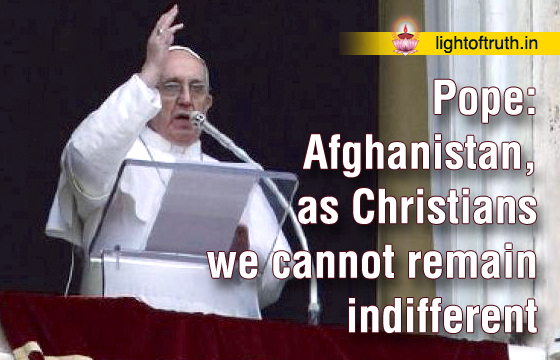
Pope: Afghanistan, as Christians we cannot remain indifferent
The Pope is calling for “intensified prayer and fasting” for Afghanistan, which he follows with “great concern”. “As Christians,” he said at the Angelus, “in historical moments like these we cannot remain indifferent.”
Francis expressed his sympathy “for those who mourn for the victims of the suicide attacks,” asking that “we continue to assist those in need and pray that dialogue and solidarity may lead to peaceful and fraternal coexistence,” and calling for help to be given especially to women and children.
Earlier, before the recitation of the Marian prayer, to some thousands of people present in St Peter’s Square, commenting on the passage of the Gospel in which Jesus says that “there is nothing outside man that, entering into him, can make him impure”, while it is “from within, from the heart” that evil things are born, Francis urged people to “learn to blame oneself” for evil.
“Often,” he said, “we think that evil comes above all from outside: from the behaviour of others, from those who think badly of us, from society. How often we blame others, society, the world, for everything that happens to us! It is always the fault of others, of people, of those who govern, of bad luck. It seems that problems always come from outside. And we spend our time laying blame; but this is a waste of time. You become angry, bitter, and keep God out of your heart. Like those people in the Gospel, who complain, are scandalised, polemical and do not welcome Jesus. One cannot – he warned – be truly religious in complaining: complaining poisons, brings anger, resentment and sadness that close the doors to God”.
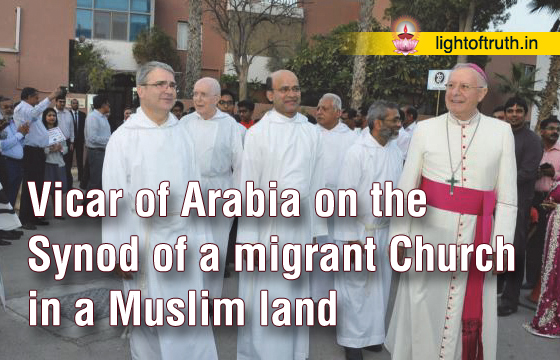
Vicar of Arabia on the Synod of a migrant Church in a Muslim land
Bp Paul Hinder, Apostolic Vicar of southern Arabia (United Arab Emirates, Oman and Yemen) and Apostolic Administrator of the vacant seat of northern Arabia (Kuwait, Saudi Arabia, Qatar and Bahrain) issued a pastoral letter ahead of the 2023 Synod.
In it, he writes: “As a Church of migrants amidst a Muslim society, comprising the faithful of different nationalities and traditions, our witness stands unique and important within the universal Church.”
Titled “Let us go with you, for we have heard that God is with you” (Zechariah 8:23), the letter underscores the importance of a shared synodal journey of a Church that is one of a kind, made up of migrants in a Muslim majority region.
The prelate encourages “the active participation of all the faithful” in the synodal process in the vicariates of northern and southern Arabia, which will officially open on 15 October at St Joseph Cathedral in Abu Dhabi, a few days after Pope Francis leads services in the Vatican (9-10 October).
The Synod is divided in three phases, between October 2021 and October 2023. The first diocesan phase aims at listening to the people of God, while the second and third phases will focus on the continental and universal Church, so that the People of God can journey together in each, with the Synod as much a process as an event.
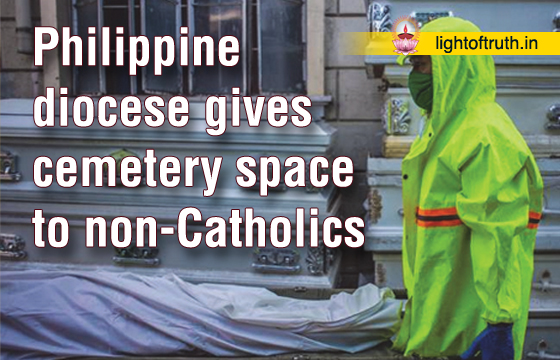
Philippine diocese gives cemetery space to non-Catholics
An archdiocese in the Philippines has begun allowing non-Catholics to be buried in Catholic cemeteries due to the scarcity of vacant burial lots brought about by the Covid-19 pandemic.
Cebu province in the central Philippines has recorded 38,088 Covid cases including 1,193 deaths, according to the latest government figures. The island is also recording a daily average of 10-15 deaths per day, which is affecting the availability of burial plots in cemeteries.
As such, charity demands that clergymen allow non-Catholics to be buried in Catholic-owned cemeteries during the pandemic, Archbishop Jose Palma of Cebu said in a Sept. 2 pastoral letter. “In cases of non-Catholics who have died from Covid, and for whom there are no more vacant burial slots in their own respective cemeteries, I take it as an act of charity to allow their burial in Roman Catholic cemeteries during this time of pandemic,” he wrote.
Catholic cemeteries are usually reserved only for members of the Church.
The bishop said the decision was an “act of goodwill” that would last as long as necessary.
Archbishop Palma urged authorities to open more cemeteries to accommodate those who have died of Covid-19.
Non-Catholics expressed appreciation for the gesture.

Vocations to priesthood and consecrated life
78 new priests were ordained, and about 250 men and women religious professed their perpetual vows during the summer of 2021: these vocations are good news and a sign of hope for the Church of Vietnam, in the midst of a difficult time for the nation, marked by the fourth wave of Covid-19. In the diocesan territories affected by the virus, classified as “green areas”, the local communities were able to celebrate solemn masses, in simplicity and often outdoors; in South Vietnam, where the Corona virus infection with the Delta variant is more widespread (the so-called “red zones”), the liturgies of priestly ordination and religious profession have been postponed for now. Those celebrated in the permitted areas took place following strict precautionary anti-Covid protocols, inside seminaries or convents with only the candidates present, and with a limited number of faithful. With-out the massive crowds, without the feasts organized in the past, the new priests and religious lived their ordination in profound intimacy with God, aware of their important ministry.