
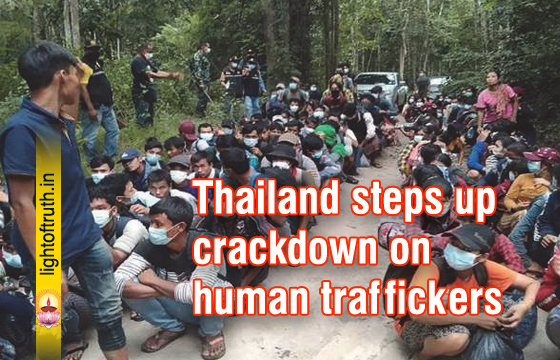
Thai authorities are stepping up their campaign against human traffickers who continue smuggl-ing large numbers of migrants from neighbouring countries.
They are issuing arrest wa-rrants for people smugglers whose assets will be seized if they are convicted of human trafficking, money laundering and other crimes, according to Labour Minister Suchart Chom-klin.
In addition, the Ministry of Labour is seeking to make it easier for migrant workers to enter Thailand legally in order to discourage migrants from relying on people smugglers for entry.
“Migrant workers should not have to wait longer than three weeks before they can enter the country legally under new me-morandums of understanding [between Thailand and its neighbours],” Suchart said at a press conference this week.
Under these pacts with Myan-mar, Laos and Cambodia, up to 80,000 migrant workers from these nations will be allowed to work in Thailand in the first phase, especially in sectors such as construction and food processing that are experiencing severe labor shortages.
At the same time, however, large numbers of migrants continue streaming illegally into Thailand through porous national borders despite stepped-up border patrol measures.
Last week alone, nearly 3,000 illegal crossings were detected, though many more are likely to have managed to stay undetected.
The migrants told police that had each paid either 25,000 baht (US$760) or 26,000 baht to job brokers before entering Thailand with the help of smugglers.
Category Archives: Asian

Catacombs to remind Korean Catholics of early persecution
The Archdiocese of Gwangju in South Korea has installed 14 catacomb murals in a Catholic cemetery to help the faithful pray and meditate as well as to learn about the early days of the Church and the persecution of Christians.
Archbishop Hyginus Kim Hee-joong of Gwangju blessed the murals on the wall behind Catholic Park Cemetery in Damyang county of Gwangju on All Souls’ Day on Nov. 2.
The murals on tiles are based on scenes from the Bible, seven each from the Old and New Testaments. Scenes from the Old Testament include Noah’s ark, the Exodus and the story of Jonah. In the New Testament, there are the parable of the lost sheep, the miracle of the five fish and the resurrection of Lazarus.
The initiative for catacomb murals is the brainchild of Archbishop Kim, who took photos of catacombs in Rome when he studied and obtained a doctoral degree in church history from the Pontifical Gregorian University from 1976-86.
His photos have been improved by a team of professionals and transferred to a tiles format.
Father Andrew Heo Woo-yeong, director of the cemetery, said the murals will help the faithful know about Christians of the early Church and how they gathered secretly to avoid persecution from rulers.
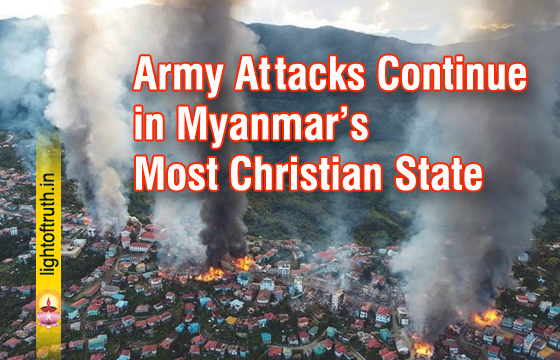
Army Attacks Continue in Myanmar’s Most Christian State
More than 160 buildings in a town in north-western Myanmar, including at least two churches, have been destroyed by fires caused by shelling by government troops, local media and activists reported Saturday.
The destruction of parts of the town of Thantlang in Chin state appeared to be another escalation in the ongoing struggle between Myanmar’s military-installed government and forces opposed to it. The army seized power in February from the elected government of Aung San Suu Kyi, but has failed to quell the widespread resistance.
The Chin state is a heavily Christian area in the otherwise majority-Buddhist country. Over 90 percent of the ethnic Chin people identify as Christian, many of them Baptists after the history of Baptist missionaries in the region.
A government spokesman denied “nonsense allegations being reported in the country-destroying media,” and blamed insurgents for instigating the fighting and setting the fires.
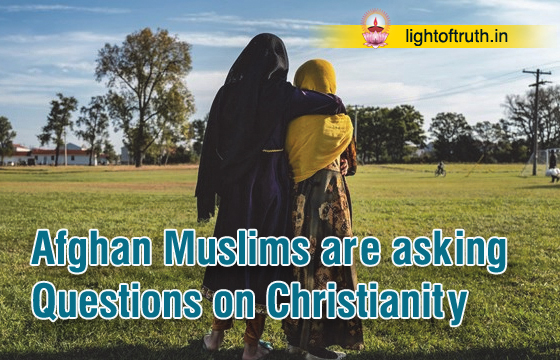
Afghan Muslims Are Asking Questions on Christianity
Mike Christian and his wife lead a small congregation called the Afghan-American Church of the Bay Area. But their main ministry is not gathering with a dozen or so Afghan believers during the week. It is engaging with the tens of thousands of Afghan seekers from around the world who reach out through messaging apps, social media, and online outlets.
Mike, who was born in Afghanistan and worked alongside the US military there, adopted the name “Mike Christian” after his conversion. It was a signal to fellow Afghans that they could speak with him if they were curious about Christianity. His popular Facebook page shares Bible verses and Christian messages in Dari alongside an invitation to get in touch.
The recent Taliban takeover has created a unique opportunity for some Afghan Muslims to rethink their faith, just as a massive influx of Afghan evacuees are fleeing to the United States for resettlement. It ’s the younger generation, and especially the women, Mike says, who are most dis-enchanted with Islam, and most open to learning about the God of Christianity.
“We receive tons of text messages, emails, WhatsApp, and phone calls from Afghanistan,” Mike told in an interview. “They ’re saying, ‘We don ’t like Islam. We don ’t want that kind of religion. We want to become a Christian. Please help us. Show us how we become a follower of Jesus.’”
“I just keep praying,” he says, “‘Lord, you have the power to change Afghan people—to join your church, to seek you and believe in you, to pray and repent.’’”
The couple fields hundreds of questions a day from curious Afghans, describing the good news to them and connecting new believers to nearby house churches. But they are also part of the global network of believers with Afghan connections, helping create resources for churches to better serve their Afghan neighbors—both here and abroad.
“I’m engaged with 30,000 Afghans now,” said Mike. “I don ’t remember the Lord tell-ing me to stop. The Lord ’s mission is never stopped, so let ’s keep going.”
When Mike was working with the military during the War in Afghanistan, he found himself in a dark place and struggling after a deadly mission. He had a series of dreams about Jesus, who called him by name to share the gospel with his people. After joining the underground house church movement, Mike endured intense persecution, multiple imprisonments, and brutal torture for his evangelism efforts before he was able to escape Afghanistan and make his way to the United States.
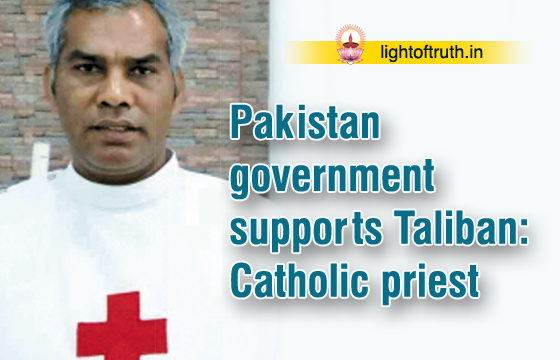
Pakistan government supports Taliban: Catholic priest
The government in Pakistan celebrated the Taliban’s rise to power in Afghanistan, a senior priest has said, stressing that “the brotherhood of the two countries” means they are prejudiced against Christians and other non-Muslims.
Speaking to Aid to the Church in Need (ACN), Father Mushtaq Anjum, the only Pakistani priest of the Order of St Camillus, explained that, following the Taliban’s victory, Christians are under serious threat.
He said: “The threat against them (Christians) has increased, since our government supports the victory of the Taliban in Afghanistan. Both Afghanistan and Pakistan consider the United States as an enemy. There is a deep-seated hatred of western countries where Christians compose a sizeable proportion of the population.
“The brotherhood of the countries is based on Surah Al-Ma’idah 5:51 of the Qur’an, which warns believers against becoming allies of Jews and Christians. It is largely because of the Taliban that religious minorities in Pakistan and Afghanistan live a subdued life.”
Pakistan’s Ministry of Reli-gious Affairs and Interfaith Harmony last month rejected a bill which sought to prohibit forced conversion of any indi-vidual of a religious minority, particularly underage girls, on the grounds that it “clashes with Islamic Shari’a.”
Father Anjum said: “We have always complained of mob rule and about the controversial blasphemy law which has been grossly abused, with many people making false accusations to settle personal scores, to obtain the victim’s property, or to attack the person’s faith. We have always demanded that the majo-rity of Muslims should respect and accept religious diversity in Pakistan…
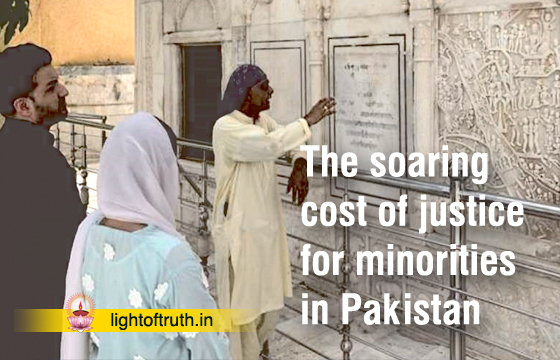
The soaring cost of justice for minorities in Pakistan
Costs and lack of helpful resources are the most prominent barriers for religious minorities in accessing justice in Pakistan, according to a survey by a legal group.
“Religious minorities were less confident about attaining a fair trial compared to their Mu-slim counterparts. They foremost identified themselves as not aff-luent and powerful, and therefore not possessing the law to seek protection within its ambit, nor the law taking ownership of them. Consequently, they seldom approach the judicial system to seek justice,” found the Legal Needs Assessment Survey laun-ched on Oct. 20 in Islamabad.
“They repeatedly referenced poverty, and not religious dis-crimination, as their biggest problem. They identified their minority status as exacerbates of their poverty. Instead, a dearth of opportunities, corruption and administrative incompetence were the primary suspects.
“These problems are a direct result of poverty and dire living conditions. Structural discrimi-nation, including absence of employment opportunities and lack of provision of legal identities, creates and traps these communities in a problem loop by limiting avenues for awareness and information and thus altering legal behaviours.
“The majority of our res-pondents were unaware that their problems are legal issues with a predetermined solution. Majority versus minority rhetoric has made our respondents believe that this country is for Muslims and so is the law. The discrimi-nation faced by these marginali-zed communities is not only external but is also fuelled by ca-steism and socioeconomic dispa-rity within these communities.”
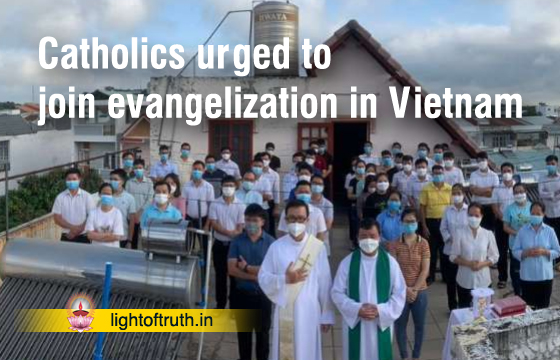
Catholics urged to join evangelization in Vietnam
Catholics in Vietnam are urged to celebrate the coming World Mission Sunday by praying the Our Father and reaching out to people in need. Bishop Matheus Nguyen Van Khoi of Qui Nhon said October is chosen as the Mission Month, starting with the feast of St. Therese of the Child Jesus, patroness of mission lands, including Vietnam. Bishop Khoi said the height of Mission Month is World Mission Sunday falling on Oct. 24 this year. The entire Church unites in prayer and sacrifices for the work of evangelization worldwide and locally.
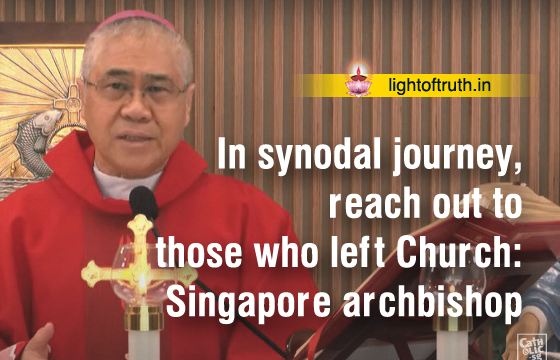
In synodal journey, reach out to those who left Church: Singapore archbishop
For too long, the Church hierarchy has held consultations between bishops and priests, and between Bishops and the pope, without involving the laity seriously. However, unless the hierarchy identifies with the pains of the people, it would not be able to come up with solutions that are effective, practical and uplifting.
Archbishop William Goh of Singapore made this point during his homily at an online Mass on October 17 to launch the synodal process in the Southeast Asian archdiocese. This process of Church consultation, launched simultaneously by dioceses around the world, is part of a two-year process leading to the Synod of Bishops in Rome in 2023. The event has the theme: “For a Synodal Church: Communion, Participation, and Mission.”
“The Church is not just simply constituted of the hierarchy,” stressed Archbishop Goh in his homily. “The Church is the People of God including the bishops and the priests. And so it is very important that this synodal process must begin by including everyone.”
He noted that many Catholics had left the Church “because they feel that the Church lacks compassion, the Church did not listen to them,” he said. “They have been hurt, they are angry.”
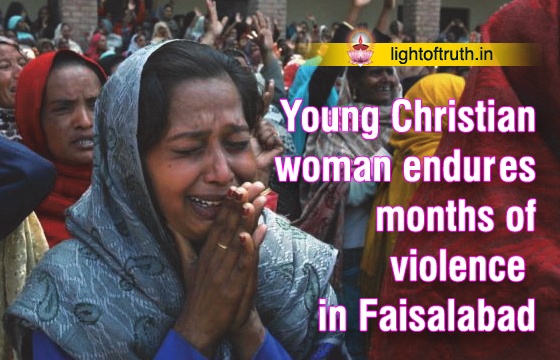
Young Christian woman endures months of violence in Faisalabad
After months of threats and attempted kidnappings, Arushma Ejaz, a young woman from Rabbani Colony, turned to Human Rights Focus Pakistan (HRFP) late last month for help after her complaints to the police proved useless. A man named Ghulam Jelani has been stalking her for a while, going so far as to try to kidnap her back in mid-July in order to convert her to Islam and force her to marry him.
To this end, Jelani broke into Arushma’s home, armed, forced to leave only after neighbours intervened. In this incident, the police arrived too late.
In the following days, Jelani continued to follow the young woman in an attempt to kidnap her.
He threatened to kill the young woman’s brothers if she refused to marry him, and then attempted to intimidate her family by saying that he would accuse them of violating the blasphemy law.
At this point, Arushma’s mother contacted HRFP, which immediately brought the case to the Faisalabad District Court. However, the human rights organisation was able to file a First Information Report with police only on 2 September.
Under maximum security, Arushma and her mother testified before the court 10 days later.
For HRFP President Naveed Walter, “kidnappings, forced conversions and forced marriages are not yet considered a serious matter by the state. The government sometimes talks about high-profile single issues, but never addresses the underlying causes, much less tries to eliminate them.”
A big problem continues to be police reluctance to get involved in such cases. In Jelani’s, he was held in custody for a while, then released without trial.
“From the first call to the police to actual action, 47 days passed,” Walter pointed out.
The HRFP told that it was concerned by how free and fair trials involving girls from religious minorities are, given the fact that “often political and religious figures publicly support the culprits.”
“Muslims who convert [to other religions] would be called murtads (apostates), so that only non-Muslims can convert,” the organisation added.
For the HRFP, the authorities must stop “protecting kidnappers and rapists who hide behind forced conversions and marriages to save themselves from punishment.”
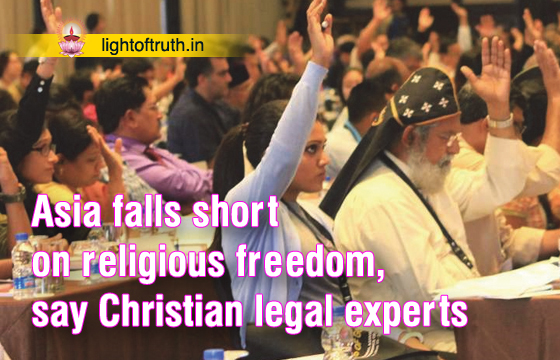
Asia falls short on religious freedom, say Christian legal experts
Asian nations are failing to effectively interpret and imple-ment freedom of religion and belief for their citizens despite having constitutional provisions and guarantees, Christian legal experts said during a regional consultation.
“Although a majority of Asian countries have strong constitutional provisions and guarantees to secure their citi-zens’ freedom of religion and belief, there are severe short-comings in interpretation and implementation, or in upholding such principles in practice,” observed two legal experts during the Asia Regional Consultation on “Freedom of Religion, Rights of Religious Minorities and Constitutional Guarantees in Asia” organized by the Christian Conference of Asia (CCA).
The five-day consultation from Oct. 3-5 drew 50 partici-pants from various Asian nations.
“In order for freedom of religion and belief to be secure, enhanced and applicable to all human beings, we must comply with constitutional provisions and be consistent with international declarations,” said Eugene Yapp, senior fellow of the Religious Freedom Institute’s Southeast Asia team. “If constitutional guarantees are to be meaningful, there is a need for more context-ualized or localized approaches based on ground realities – such as cultural particularities and contingencies of a local nature.”
Yapp, former secretary-gen-eral of the Evangelical Alliance of Malaysia, also emphasized the role of churches and missionaries in Asia, stating that churches must seek concrete expression for the flourishing of “diversity of cultures in social engagement and creative dialogue for the well-being of everyone for the common good.”