

The Philippine government has banned traditional firework celebrations over Christmas and New Year for a second straight year due to Covid-19 and safety fears.
The ban was based on the recommendation of the Health Department to avoid firework-related accidents during a time when medical services were being stretched because of the pandemic, national police chief General Dionardo Carlos said on Dec. 7.
Although the number of daily infections has dropped in the Philippines in recent weeks, authorities say they are mindful of the threat posed by the Omicron coronavirus variant despite there being no recorded cases there yet.
Those caught flouting the ban will face criminal and civil charges, Carlos said.
“The police fully support the Department of Health in pro-moting safety while celebrating the holiday season despite fire-work displays being a cultural tradition Filipinos are accusto-med to during personal and reli-gious events, especially during the New Year,” he added.
In 2020, the Health Depart-ment reported an 85 percent decrease in firework – related injuries thanks to the ban. There were also no fires linked to them either, according to the Fire Department.
“The country benefited from not using fireworks to celebrate Christmas. Nobody was hurt last year. No house was burned,” the police chief said.
Category Archives: Asian
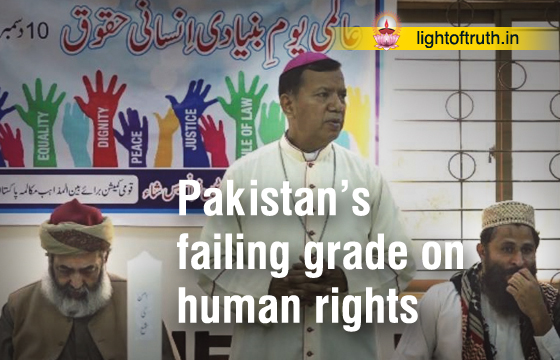
Pakistan’s failing grade on human rights
It only takes the events of one week to summarize the situation of human rights in Pakistan. “I went to speak and perform in Government College University Chiniot but I was not allowed on campus. I was told that intelligence agencies called Dr. Shahid Kamal (the vice-chancellor) and blocked my entry,” said Taimur Rahman, an associate professor at Lahore University of Management Scien-ces, in a Facebook post on December. 8.
“I have committed no crime. My only ‘crime’ is that I’m a progressive who stands on the side of the poor and downtro-dden. Please share my video to express solidarity and record your protest against this inex-plicable censorship of progre-ssive thought,” he appealed to netizens in a post viewed by more than 3,000 people.
The same afternoon, videos of several women being assault-ed, stripped and filmed in a market in Faisalabad, also in Punjab province, surfaced on social media. Their ordeal went on for an hour with none of the spectators attempting to inter-vene. The incident comes amid 16 Days of Activism against Gender-Based Violence, an annual international campaign that kicks off on November 25, the International Day for the Elimination of Violence against Women, and runs until Dec. 10, Human Rights Day.
Many netizens justified the action after the emergence of a new video showing the women stealing from a shop.

Nepal sentences pastor to two years for conversion
A court in Nepal has sentenced a Christian pastor to two years in jail and a fine of 20,000 rupees (US$166) for violating the Himalayan country’s repre-ssive anti-conversion law.
The sentence from the court in Dolpa district in Pokhara region of western Nepal on Nov. 30 came about a week after it found Pastor Keshav Raj Acharya from Abundant Harvest Church guilty of proselytization on Nov. 22, according to US-based International Christian Concern (ICC).
The evangelical pastor was first arrested on March 23 by police in Kaski district after a YouTube video of him went viral on social media. In the video he said that Covid-19 could be healed through Christian prayer.
“Hey, corona — you go and die. May all your deeds be destroyed by the power of the Lord Jesus. I rebuke you, corona, in the name of Lord Jesus Christ. By the power or the ruler of this Creation, I rebuke you … By the power in the name of Lord Jesus Christ, corona, go away and die,” he reportedly said in the video. Pastor Acharya denied uploading the video on the internet. He was released on bail about a month later.
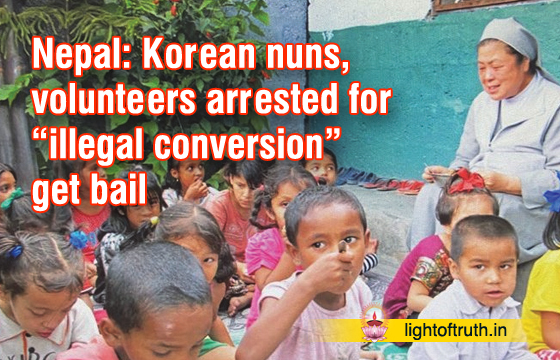
Nepal: Korean nuns, volunteers arrested for “illegal conversion” get bail
A High Court in Nepal on November 18 granted bail to two Catholic nuns and two volunteers from South Korea, who were arrested for “illegal conversion” in Nepal slums.
“Thank God for praying for Korean Sisters and volunteers. They got bail finally, thank you all for praying,” says a note from Father Silas Bogati, the vicar general of Nepal, posted on the “Couples for Christ – Nepal” WhatsApp group.
Sisters Gemma Lucia Kim and Martha Park Byongsuk, members of the Sisters of St Paul of Chartres Congregation, and two volunteers wee arrested September 14 after being accused of converting Hindus by coercion and allurement. The Koreans were kept in a jail at Pokhara, the nuns’ base in Nepal some 200 km northwest of Kathmandu, the national capital.
The High Court granted the bail after the district court in Pokhara rejected the nuns’ application. The bail was given at around 4 pm (local time). The nuns are expected to be released November 19 after the bail is paid and formalities are done at the lower court, a source in Kathmandu told Matters India.
The nuns will have to appear for hearing in case at the lower district court at a given date.
Nepal’s Catholic Church, which has been praying for the nuns and their companions, was relieved and happy, the source added.
The two nuns have been managing “St. Paul’s Happy Home,” a center in Pokhara that provides accommodation, food, education, medical services and skills training to about 120 slum children at Bus-Park. The home is named St. Paul’s in honor of their congregation’s patron.
During the Covid-19 pandemic, the nuns distributed food rations to the poor, but some people accused them of alluring them to become Catholics by giving low-quality food.
Bishop Paul Simick, the Apostolic Vicar of Nepal, has told Aid to the Church in Need that the nuns’ arrest and denial of bail has shocked the Nepalese Catholic community. The allegations against the nuns “are utterly baseless and unjust,” he asserted.
The prelate clarified that Catholics do not indulge in forceful conversion and “the Korean sisters are known for doing exclusively social work.”
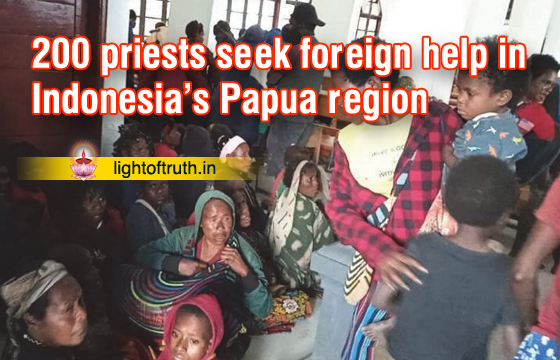
200 priests seek foreign help in Indonesia’s Papua region
Nearly 200 Catholic priests in Papua have called on the international community, includ-ing the United Nations, to play a more active role in bringing peace to Indonesia’s violence-plagued easternmost region.
In addition to diocesan priests, Franciscan, Augustinian, Jesuit and Missionaries of the Sacred Heart clerics were among 194 priests who said their call was part of an effort to be “pro-actively involved in the fight for justice, truth and peace” in Papua.
The region is caught in the grip of an insurgency being waged by separatist rebels against security forces in which innocent civilians are caught in the middle, they said in a statement.
The priests asked other countries to join them in urging rebels of the National Liberation Army of the Free Papua Organi-zation and security forces to call and observe an immediate cease-fire.
“We also firmly support inviting the UN high commissi-oner for human rights to come, see and hear the actual human rights conditions in Papua,” they said.
They also called on the go-vernment and agencies providing funds for development in Papua to review certain policies being conducted such as increasing troop deployments, which trigg-ers more violence and increased state oppression.
“There are even those in government who accuse priests who talk about human rights issues of being among the separa-tists,” they said.
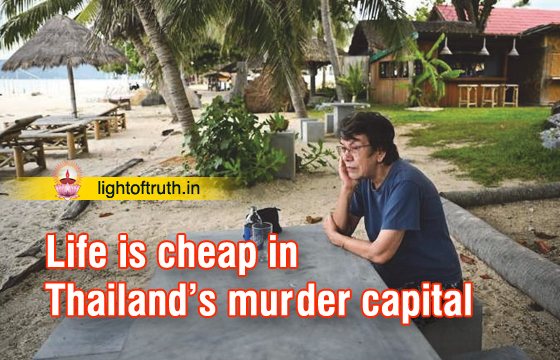
Life is cheap in Thailand’s murder capital
Violent crime targeted by disgruntled locals at family members and acquaintances has been claiming victim after victim in southern Thai provinces notorious for hair-trigger tempers and rampant gun violence.
In one recent incident in the southern province of Nakhon Si Thammarat, which has been dubbed “the murder capital of Thailand,” the assistant head of a village shot dead his two-year-old daughter on Nov. 16 during a heated, drunken quarrel with his 27-year-old wife.
The man, who took umbrage at his wife for berating him for getting visibly drunk at home, reached for his gun and took a shot at his wife but missed. He then shot his daughter, killing the toddler instantly.
The villager then tried to commit suicide by shooting himself in the head but survived with a severe head wound, according to police.
The day before, a 60-year-old man in the southern province of Songkhla, which borders Nakhon Si Thammarat, shot his 88-year-old father dead following a quarrel in an incident that was recorded on a home surveillance camera. The man tried to flee but was arrested by police.
Gun violence has long been a serious problem in Thailand, especially in the South, with a per capita murder rate that is higher than that in the United States, according to experts.
In Nakhon Si Thammarat, which has a population of some 1.5 million, scores of locals have been shot dead this year alone and many more are likely to die before the year is out.
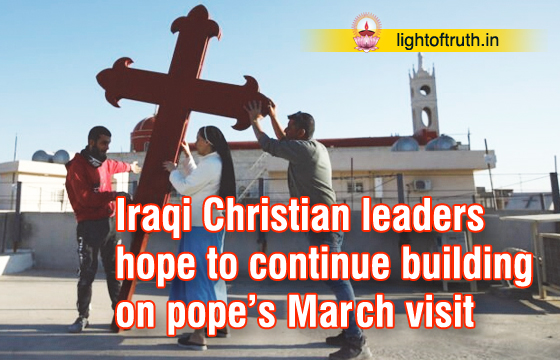
Iraqi Christian leaders hope to continue building on pope’s March visit
Nahla and Valentina like to stop and pray at Mar Elia Chaldean Catholic Church in the centre of this small majority Christian community. The grounds of the church once shelt-ered several hundred Christians who were forced to flee their homes in 2014 when Islamic State militants attacked Mosul and surrounding villages some 50 miles away.
The tents and caravans that dominated the property are gone, but the women say many Christian families remain unable to return home.
“Although we are from Ankawa, there are still many displaced in our midst from Mosul, Qaraqosh, and other towns, but they are now in apartments, having to pay rent and wondering if they will ever be able to go back,” Nahla told the Catholic News Service after lighting a candle near the saint’s statue.
“The pope gave us a lot of hope with his visit in March. It was wonderful to see our churches united in welcoming him and enjoying the many Masses, but in practical ways, we don’t feel much has changed in the circumsta-nces,” she said. “Being separated is so difficult.”
Chaldean Catholic Abp Bashar Warda of Irbil and other church officials acknowledge the pain that many still feel, but Abp Warda said the papal visit helped to inspire and recharge Iraq, which has struggled to regain a firm footing after years of conflict and sectarian violence.
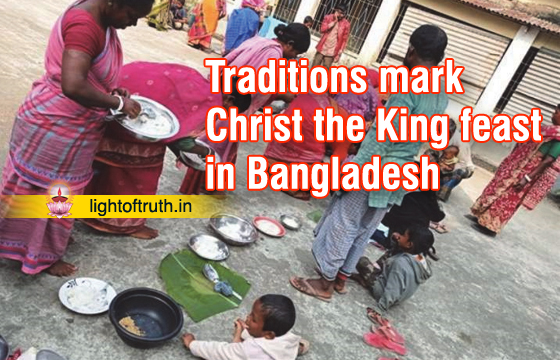
Traditions mark Christ the King feast in Bangladesh
Catholic Surobhi Minj never misses a Sunday Mass. And, the November Sunday of the feast of Christ the King has become a harvest festival for her community in Bangladesh.
On the Solemnity of Our Lord Jesus Christ, King of the Universe on November 21 Surobhi and family members wore new clothes to go to the church. They carried with them 15-kilogram rice from the latest harvest and offered it to Christ the King.
Surobhi also carried a cake she baked from the newly harvested paddy and shared it with everyone including the priest and nuns after the priest blessed the harvest offerings.
Local Catholics like Surobhi offer a share of their farm produce during the feast, making it a sort of harvest festival for indigenous Catholics across Bangladesh.
Surobhi planted paddy in her 0.251 hectors of land. “We harvested and stored it in the house. I am yet to measure this year’s yield but it’s better than previous years. I devoted a little to God because, without His grace and blessings, we cannot consume this crop at home,” the 34-year-old Oraon indigenous farmer said.
The premises of her Saint Anthony’s parish Church in Rajshahi Diocese were flooded with a variety of fresh crops on Sunday morning.
Like Minj, several Catholics in the parish had come to offer their harvests to Christ the King. Some even sold a part of the yield to gift new clothes to the priest.
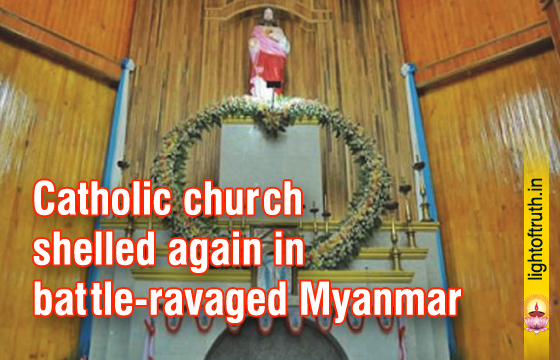
Catholic church shelled again in battle-ravaged Myanmar
Religious buildings including Catholic churches and convents continue to be the primary target of Myanmar’s military, which is reinforcing its troops to crush local militias.
Sacred Heart of Jesus Cathedral in Pekhon town, which belongs to the Diocese of Pekhon in Shan state, was hit by military artillery on Nov. 9.
There were no reported casualties despite the windows and pews being damaged, according to church sources.
The cathedral was also struck by artillery fire in June. The attack came three days after a convent in the same township was hit by military shelling on Nov. 6.
No casualties were reported at the convent of the Sisters of Zetaman, which is situated in Jeroblous Marian shrine in Pekhon township. Fighting between the military and the combined forces of the Karenni army and Karenni People’s Defense Force has intensified since Nov. 2.
More than 10,000 people from Pekhon township have been newly displaced due to the fighting and indiscriminate attacks with heavy weaponry by the military, according to aid workers.
A Catholic social worker said his family were forced to flee from their homes in Pekhon town as artillery shelling fell on his neighbours.
“It was intense fighting, so the majority of people have fled from their homes to safe areas,” he told.
He said the fighting has impacted their response to displaced people as church social workers have also fled their homes and taken refuge in safe areas.
Pekhon Diocese is one of the worst-affected areas along with Loikaw Diocese in Kayah state due to the escalating conflict since May.
More than 100,000 civilians have been forced to seek refuge in churches, convents and makeshift camps even while the military is targeting priests and pastors, bombing and vandalizing churches in the predominantly Christian region of Kayah and Chin states.
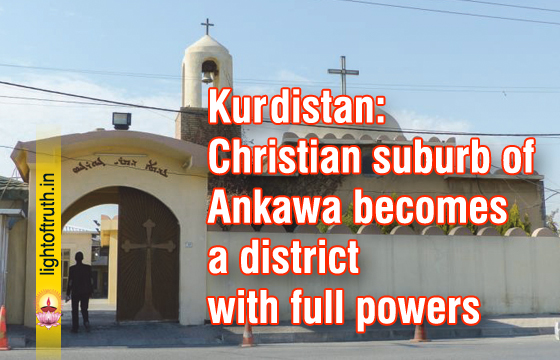
Kurdistan: Christian suburb of Ankawa becomes a district with full powers
Ankawa, the Christian suburb of Erbil, the capital of Iraqi Kurdistan, has been designated a district. In the past it welcomed thousands of Christian families who fled from Mosul and the Nineveh plain following the rise of the Islamic State group.
Kurdistan Region Prime Minister Masrour Barzani made the announcement on Monday during a visit to the area.
Archbishop Bashar Matti Warda of Erbil welcomed this major recognition. It is a “very important decision for Ankawa,” said the prelate, a “strategic” move to maintain the Christian presence in the region and an incentive for Christians to remain and invest in their community.
The decision to increase the degree of autonomy and repre-sentativeness of what was just once a (Christian) suburb is shared by the Kurdistan Interior Ministry, the governor of Erbil and the local provincial council.
With the new status, Ankawa passes under the “administrative control” of its Christian reside-nts, most of whom fled perse-cution from Iraq’s Nineveh plain and Syria, and will become “the biggest district of Christians in the Middle East.”
From sub-district to full-fledged district, residents will be able to elect officials and repre-sentatives, run their admini-strators, be in charge of security and benefit, unlike the past, from a mayor with “direct authority”.
For Kurdish leaders, who took in Christians during the rise of the Islamic State, the goal is to show the international commu-nity that the region is safe for Christians (and non-Christians), thus attracting investments and opportunities for economic development.