
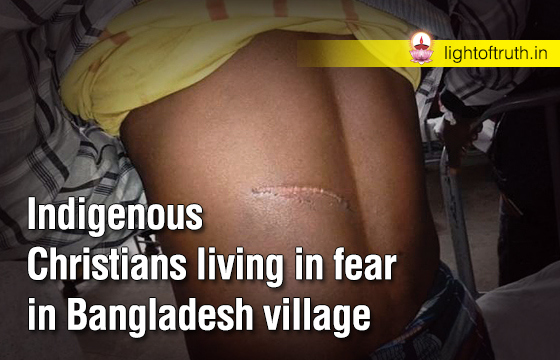
Indigenous Christians are living in fear after violence by land grabbers from the Muslim-majority community in Bangladesh’s Rajshahi district.
At least 10 Christians were beaten while two of them landed in hospital in critical condition in Badhair village in the Tanore area of the northern district in the past week.
The village is home to more than 200 indigenous people, mostly Christians. They are now scared to step out of their homes. The men fear going to the market while children are not being sent to school, say locals.
The cause for the attacks is 12,500 square meters of khas land (government-owned fallow land) on which 23 indigenous families have been settled for years. Some influential people want to remove them and occupy the land themselves.
Biplob Tudu, 40, an indigenous Santal who was taken to Tanor subdistrict hospital in critical condition, said he was attacked while returning home from the market in a three-wheeled vehicle on Jan. 3.
“I was accosted by a mob of around 10 Muslims who pulled me out of the three-wheeler and beat me with rods. They broke my bones,” Tudu, a Seventh-day Adventist Christian, told.
Category Archives: Asian
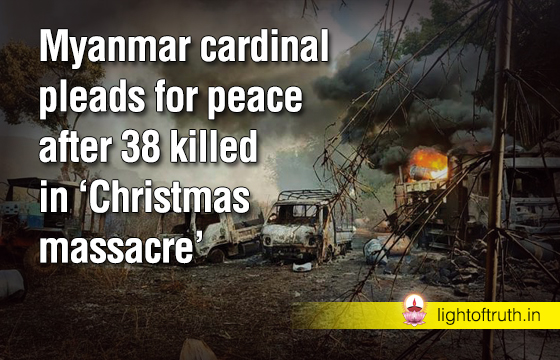
Myanmar cardinal pleads for peace after 38 killed in ‘Christmas massacre’
After nearly 40 people were killed in a brutal attack in east-ern Myanmar right before Christmas, Cardinal Charles Bo of Yangon made an appeal to both government and opposition forces to stop the violence and begin pursuing peaceful dialogue.
The killing of at least 38 civilians in Mo So village, in Myanmar’s Hpruso, Kayah (Karenni) State “is a heart-breaking and horrific atrocity which I condemn fully and unreservedly with all my heart,” Bo said in his Dec. 26 message.
He offered prayers for the victims, their families, and the survivors of “unspeakable and despicable act of inhumane bar-barity.”
“The fact that the bodies of those killed, burned, and mutilated were found on Christmas Day makes this appalling tragedy even more poignant and sickening,” he said, noting that as the rest of the world celebrated the birth of Christ with joy, the people of Mo So village suffered death, shock, and destruction.
At least 38 people, including children, were killed late last week in an attack by Myanmar’s military in a region of the country where fighting has escalated between resistance groups and junta forces.
International UK-based humanitarian group Save the Children said two of its workers who were heading home for the holidays following a humanitarian trip to the area are still missing, after their vehicle was targeted in the attack, which took place in the eastern Burmese state of Kayah, also known as Karenni.
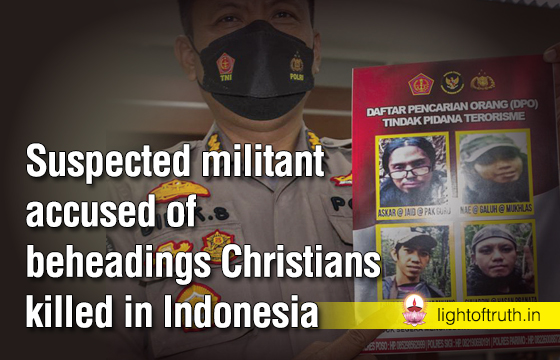
Suspected militant accused of beheadings Christians killed in Indonesia
Indonesian security forces killed a suspected militant accused of beheadings in a shootout Tuesday in a sweeping counterterrorism campaign against extremists in remote mountain jungles, police said. Provincial police chief Rudy Sufahriadi said Ahmad Gazali, 27, also known as Ahmad Panjang, a key member of the East Indonesia Mujahideen network, was fatally shot by a joint team of military and police officers near Uempasa hamlet in Central Sulawesi province’s mountainous Parigi Moutong district. It borders Poso district, an extremist hotbed in the province.

Taliban order Afghan shop owners to behead mannequins
The Taliban have ordered shop owners in western Afghanistan to cut off the heads of mannequins, insisting the human figures violate Islamic law.
A video clip showing men sawing the plastic heads off women figures went viral on social media.
Since returning to power in August, the Taliban have increasingly imposed their harsh interpretation of Islamic law, severely curtailing freedoms, particularly those of women and girls.
“We have ordered the shopkeepers to cut the heads off mannequins as this is against (Islamic) Sharia law,” Aziz Rahman, head of the Ministry for the Promotion of Virtue and Prevention of Vice in the city of Herat, told AFP on Wednesday.
“If they just cover the head or hide the entire mannequin, the angel of Allah will not enter their shop or house and bless them,” he added, after some clothes vendors initially responded by covering the heads of mannequins with plastic bags or headscarves.
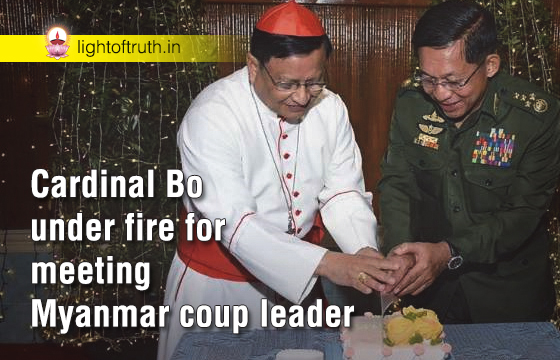
Cardinal Bo under fire for meeting Myanmar coup leader
Cardinal Charles Maung Bo’s meeting with Myanmar coup leader Min Aung Hlaing has sparked outrage among the Catholic community in the predominantly Buddhist nation.
Senior General Min Aung Hlaing visited the archbishop’s house in Yangon on Dec. 23 for a Christmas event hosted by Cardinal Bo and two auxiliary bishops.
The archbishop of Yangon and the general cut a Christmas cake together and the military chief also donated US$11,000 to the cardinal for church funds.
Cardinal Bo said in his short message that peace and peacemaking represent the core message of Christmas.
“I encourage and request all people from all walks of life to make extraordinary efforts to bring peace, unity and development to the country through forgiveness, mutual respect, creating opportunities for the younger generation, sincere dialogue and reconciliation with all our people,” he said.
The cardinal also conveyed the message of Pope Francis, who visited Myanmar in 2017, that he is deeply saddened by the current situation in the country and repeated his appeal to work hard for peace, development and joy.
The meeting between the Catholic leader, who advocates for peace and human rights, and Min Aung Hlaing came amid the military’s relentless assault on civilians including air strikes and shelling in Karen, Chin, Kayah and Kachin states where Christians form the majority.
The Independent Catholics for Justice in Myanmar condemned the meeting, saying it ignored the suffering of the people who have been oppressed and killed and the bombing of churches.
“The meeting is not representing the whole Catholic community in the country as it is against the will of all Catholics,” the group said in a statement.
Catholics including clergy have taken to social media to express their anger, shock and dismay at the meeting.
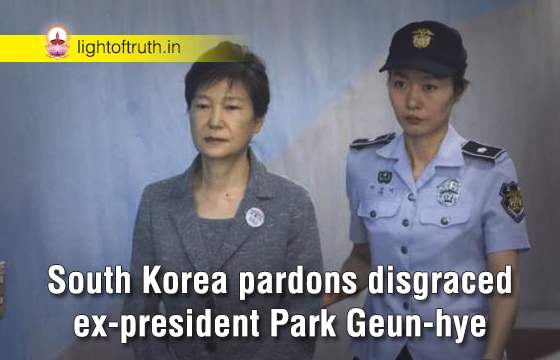
South Korea pardons disgraced ex-president Park Geun-hye
South Korea’s ex-president Park Geun-hye received a pardon today, cutting short a jail term of more than 20 years for corruption with her successor saying he granted it in the interest of national unity.
Park became South Korea’s first female president in 2013, but less than four years later she was impeached and ousted after a graft scandal sparked huge street protests.
The 69-year-old was serving a 20-year prison sentence for bribery and abuse of power, with another two years after that for election law violations.
“Considering the many challenges we face, national unity and humble inclusiveness are more urgent than anything else.”
Moon said Park’s deteriora-ting health after serving almost five years in jail was also a factor in the decision to pardon her. Park has been hospitalized several times this year. She is currently receiving treatment at a facility in the capital Seoul.
The amnesty will take effect on Dec. 31, the Justice Ministry said.
India-Bangladesh ties are no more refugees of the past
The agony and ecstasy associated with the birth of Bangladesh in 1971 still hold the message that religion cannot bind a nation together for long. Sheikh Mujibar Rahman and his Mukti Bahini firmly believed that the Bengalis in the east were different from West Pakistanis and thus Pakistan was splintered and Bangladesh came into being. This development had a more significant and wide-ranging impact than any other comparable event in the recent history of the subcontinent, especially for India, which played a big role in the liberation of Bangladesh.

Celebrating Christmas in Muslim-majority Pakistan
The international community fed by biased news tends to presume that all Muslim-majority nations ban any kind of celebrations, which is false.
Only a few among the 50 or so Muslim majority countries in the world, among them the Kingdom of Saudi Arabia, Somalia, Tajikistan, Brunei, Morocco and Afghanistan, disallow celebrations like Christmas.
Speaking for and from Pakistan, non-Muslim citizens are permitted to take a couple of days off for their festivals.
There are over 5 million Christians in Pakistan, though they make up a small proportion of its 162 million people.
We are lucky because Dec. 25 is a public holiday as it is the birthday of the nation’s founder, Muhammad Ali Jinnah, also referred to as Quaid-e-Azam or the Great Leader.
The student community gets a longer winter break with schools and colleges closing on Dec. 23-24 until Jan. 2-3.

Catholics caution Philippine govt against Chinese aid
Catholics in Bacolod Diocese in the Visayas region have cautioned the Philippine government against accepting China’s aid to help victims of Super Typhoon Rai.
Chinese ambassador Huang Xilian on December 22 offered US$1 million as cash aid and 4,725 tons of rice to the typhoon-hit Southeast Asian country.
Philippine President Rodrigo Duterte accepted the aid and thanked the Chinese government.
The San Lorenzo Ruiz group, comprising representatives from various parishes in the region, said the Philippine government must scrutinize if there were any “strings attached” before accepting Chinese aid.
“The country is in need of money because we are still recovering from the pandemic. Now a natural calamity has hit us. But this does not mean we should put our defenses down while accepting these big donations,” the group said in a Facebook post on Dec. 23.
They further said the Duterte government must exercise caution to avoid falling into a debt trap like fellow developing nation Bangladesh, whose 6.81 percent external debt is now Chinese money.
“Let us be careful because all this could lead us towards a debt trap. These donations may lead to debts later on. Everyone must look at this deal because the million dollars may be a donation but the succeeding millions, if any, would be in the form of debt,” the group added.
The Chinese ambassador said the cash was allocated by the Chinese government for relief and recovery efforts by the Philippine government in badly hit provinces such as the Surigao, Siargao and Dinagat islands in the Visayas region.
Blasphemy laws lead to bloodbath in Pakistan
As factory workers took selfies with the burning corpse of their manager, Farhan Idrees proudly spoke to local media about the alleged blasphemy. “Priyantha Kumara tore a paper from the wall. It was inscribed with the name of Hussain [grandson of Prophet Mohammad]. He threw it in the basket,” said Idrees, who appeared to be in his 20s. “We complained to the foreman and demanded an apology. He tried to run away. We went on strike and gathered people, protested and burned him.”
“Labaik Ya Rasool Allah” chanted the mob surrounding the remains of Kumara spread on road amid stones, bricks and sticks in front of Rajco Industries, a sportswear manufacturing company in Sialkot, Punjab province. Videos of his vandalized car and lynching went viral on social media on December 3.
Tahir Mehmood Ashrafi, Prime Minister Imran Khan’s special representative on religious harmony, disputes their claim.
“This man [Kumara] used to urge people to work efficiently. Our hearts are wounded. These three incidents were reported in the past year. We urgently send ulemas to avoid similar incidents. The United Ulema Board Punjab has reviewed 113 cases and often given relief to the innocent,” he told media.
“Ulema of all sects have condemned the killing. This is a test case. We ask for forgiveness from the people of Sri Lanka and the victim’s family.” Idrees was among more than 100 protesters arrested on charges of murder and terrorism. Both PM Khan and army chief General Qamar Javed Bajwa have strongly condemned the Sialkot incident and announced strict punishment for the suspects.
According to Pastor Iqbal Masih of the Presbyterian Church in Sialkot, local Christians avoided protests about Kumara’s murder. “We are not powerful enough to challenge them. Earlier there were rumors that he had converted to Christianity in a local church five months ago. There were no prayers for him either because he was a Hindu,” he told.