
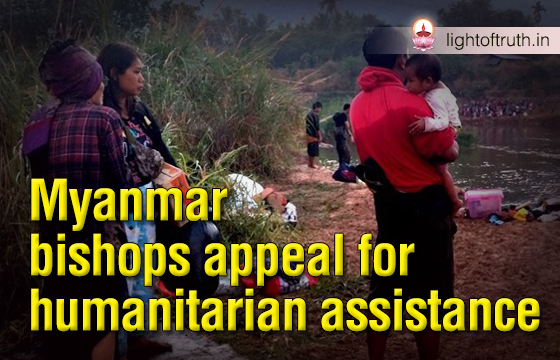
The Catholic Bishops’ Conference of Myanmar has issued a statement last week calling for humanitarian assistance to thou-sands of people who have been displaced by the ongoing conflict in the country.
In a letter of appeal released on Jan. 14, the Church leaders called on “all concerned” to facilitate “humanitarian access to suffering and internally displaced people.” “Human dignity and the right to life can never be compromised,” the Church leaders said in the letter following their general assembly in Yangon last week.
The bishops also called for “respect for life, respect for the sanctity of sanctuary in places of worship, hospitals, and schools.”
The letter also expressed their appreciation to priests, nuns, and catechists who continue to take care of the people “in their flight from dangers of life.”
The bishops called on all Church workers, especially priests, religious men and women, and catechists, to continue the “mission of love and sacrifice for the people irrespective of the faith, race, and place.”
Category Archives: Asian
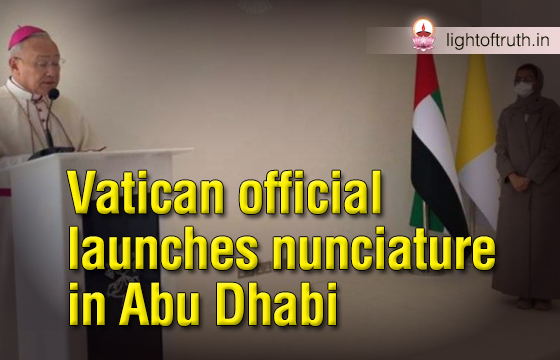
Vatican official launches nunciature in Abu Dhabi
The opening of a new apostolic nunciature in the United Arab Emirates is a testament to fraternity and goodwill between Muslims and Christians, said Archbishop Edgar Peña Parra.
Speaking at the inaugural ceremony in Abu Dhabi Feb. 4, Archbishop Peña, the substitute secretary for general affairs in the Vatican Secretariat of State, said the new nunciature is also “a further sign of the Holy Father’s solicitude and concern for all the people in this land.”
“May this new embassy of the Holy See serve as a place of encounter and dialogue for our bilateral cooperation for many years to come,” the Archbishop said.
Among those present at the inauguration were Sheikh Mohammed bin Zayed Al Nahyan, the crown prince and minister of foreign affairs and international cooperation; Bishop Paul Hinder, apostolic vicar for Southern Arabia; and Msgr. Yoannis Gaid, member of the Higher Committee of Human Fraternity.
The Holy See and the United Arab Emirates established diplomatic relations in 2007, but the nuncio resided in Kuwait. Currently the nunciature is headed by Slovenian Msgr. Kryspin Dubiel, who serves as chargé d’affaires.
The opening of the nunciature coincided with the third anniversary of the day that Pope Francis and Sheikh Ahmad el-Tayeb, grand imam of al-Azhar in Egypt, signed a document on promoting dialogue and “human fraternity” during the Pope’s 2019 apostolic visit to the United Arab Emirates.
The document, Archbishop Peña said, showed that unity between Muslims and Christians is possible through the “shared belief in God the creator of all things” from which “stems the call for believers to live in fraternity with all people regardless of race, religion or creed and to safeguard creation, our common home.”
“Contrary to any distortion or manipulation of religion, the response to this call can be nothing other than choosing the path of dialogue, which leads to better mutual understanding and cooperation,” he said.
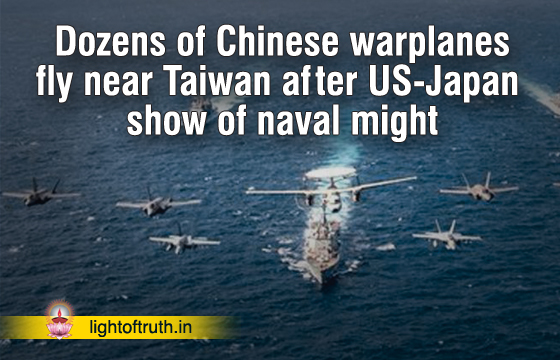
Dozens of Chinese warplanes fly near Taiwan after US-Japan show of naval might
Hong Kong (CNN) China sent 39 war-planes into Taiwan’s air defence identification zone (ADIZ) on January 24, Taiwan’s Defence Ministry said, the largest such incursion this year.
The flights by the People’s Liberation Army aircraft came a day after the United States and Japanese navies put on a massive show of force in the Philippine Sea, putting together a flotilla that included two US Navy aircraft carriers, two US amphibious assault ships and a Japanese helicopter destroyer, essentially a small aircraft carrier.
Two US guided-missile cruisers and five destroyers were also part of the exercise. The Philippine Sea is the area of the Pacific Ocean east of Taiwan, between the self-ruled island and the US territories of Guam and the Northern Mariana Islands. The Navy did not say how close the flotilla was to Taiwan.
Aircraft fly over a US-Japan naval flotilla that included two US aircraft carriers in the Philippine Sea on Saturday.
“Freedom at its finest! Nothing reaffirms our commitment to a #FreeandOpenIndo Pacific like 2 Carrier Strike Groups, 2 Amphibious Ready Groups sailing alongside our close friends from the Japan Maritime Self Defense Force,” Vice Adm. Karl Thomas, commander of the US 7th Fleet based in Japan, said in a tweet.
A US Navy statement said the mass of warships was “conducting training to preserve and protect a free and open Indo-Pacific region.”
Taiwan’s President: Threat from China is growing every day (October, 2021) 07:32
Taiwan and mainland China have been governed separately since the defeated Nationalists retreated to the island at the end of the Chinese civil war more than 70 years ago.
But China’s ruling Chinese Communist Party (CCP) views the self-ruled island as part of its territory — despite having never controlled it.
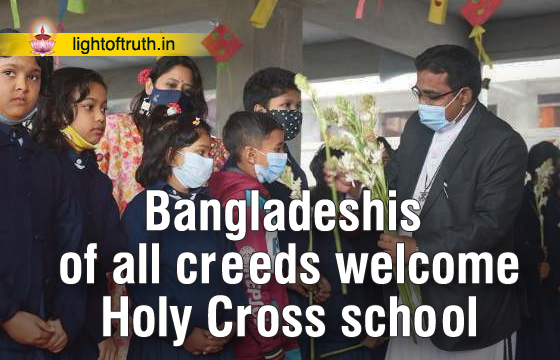
Bangladeshis of all creeds welcome Holy Cross school
A missionary-run school and college in Rajshahi city launched more than 30 years after the establishment of the Catholic diocese is committed to imparting human values as well as offering a solid academic education to Bangladeshi students.
Holy Cross Brothers, well known for their education apostolate, officially started their new ministry in Rajshahi on Jan. 18 with the aim of providing an inclusive education, welcoming new students at Holy Cross School and College in Rajsha-hi Diocese.
The educational institution started its journey with 106 students as the first Catholic missionary-run school and college in Rajshahi metropolitan city. Initially, it is admitting stu-dents at nursery, kindergarten, first, third, fourth and sixth gra-des but it will be gradually up-graded to 12th grade.
“Our first consideration is to ensure that pupils can learn in an open and student-friendly envi-ronment so that they can learn values. We want students to be 100% free from private depend-ence and attend class 100%,” said Brother Placid Rebeiro, principal of the institute.
“Students can learn leader-ship through humanitarian, moral development and extracurricular activities. In a word, we want to ensure an environment in which a fully fledged human child grows up, and we are committed to that.”

Laotian Catholics honour first lay martyr with new church
Catholic faithful in Laos joined clergy and religious to celebrate the dedication of a new church to the first layman from the ethnic Hmong community who was martyred for his faith six decades ago.
The church was dedicated to Blessed Paul Thoj Xyooj at Ban Nam Gnam village in Thulakhom district of Vientiane province, reported Fides new agency.
Born in 1941, Paul Thoj Xyooj was a Laotian teacher and catechist. He was killed by com-munist guerrillas in 1960 along with Italian Oblate missionary Father Mario Borzaga.
Pope Francis proclaimed them martyrs in 2015. Both were beatified on Dec. 11, 2016, along with 15 other martyrs by the pope’s special envoy, Oblate Cardinal Orlando Quevedo, archbishop of Cotabato in the Philippines, in Laotian capital Vientiane.
According to the Oblates of Mary Immaculate (OMI) congre-gation, communist forces killed 17 Catholics between 1954 and 1970: a young Laotian priest, five priests of the Paris Foreign Missions Society (MEP), six OMI priests (an Italian and five French) and five Laotian laymen.
Italian Oblate Father Angelo Pelis, who served in Laos for years as a missionary, told Fides that consecration of the new church was presided over by Cardinal Louis-Marie Ling Mangkhanekhoun, apostolic vicar of Vientiane. Catholic priests and Laotian Catholics also attended the ceremony.
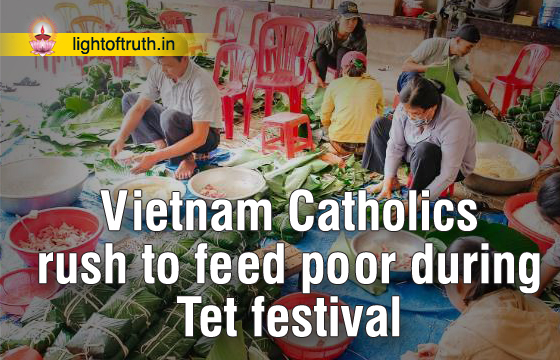
Vietnam Catholics rush to feed poor during Tet festival
Catholics in Vietnam are speeding up provision of basic food to allow people badly affected by Covid-19 to celebrate the coming Lunar New Year holiday. On Jan. 19, Caritas workers and parish council members from the parishes of Nhan Hoa and Xom Moi provided gifts for some 400 families whose members had died or lost jobs because of the pandemic, disabled people and street vendors regardless of their backgrounds. They were given money, rice, cooking oil, fish sauce, sugar, cakes and other items worth 1 million dong (US$45). Those people could not afford to get food for the five-day traditional festival starting Feb. 1.
“We are really appreciative of the generous gift from local Catholics who sympathize with our family,” Mary Vu Thi Loi said, adding that all her family members had suffered Covid-19 and her daughter had been left with partial paralysis.

Singapore Catholic charged with sexual abuse of teenagers
A court in Singapore has charged a former Catholic officer of a church-run school with committing unlawful sexual acts with at least two teenage boys more than a decade ago.
District Judge Terence Tay at the State Courts of Singapore accepted the charges on Jan. 10 but issued a ban against media revealing the identity of the accused, victims and the school involved, local media reports said. Court documents showed that the accused in his 60s had unnatural sex with a boy aged 14-16 some time between 2005 and 2006. He also committed the same act some time between April 2007 and December 2007 with a younger boy aged 14-15.
The accused faces two charges of carnal intercourse against the order of nature under Singapore’s Penal Code. He was also charged with two counts of sexual exploitation of a child or young person under the Children and Young Persons Act.
Under Singaporean Penal Code, a person convicted of each count of carnal intercourse against nature can be jailed for up to 10 years and fined.
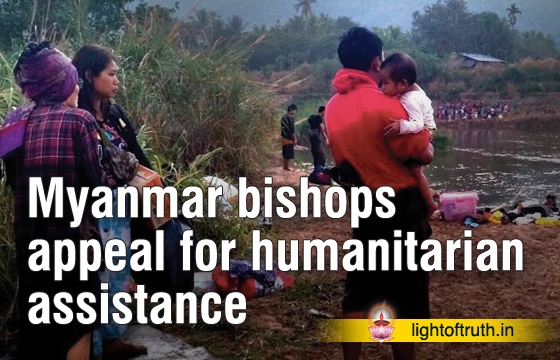
Myanmar bishops appeal for humanitarian assistance
The Catholic Bishops’ Con-ference of Myanmar has issued a statement last week calling for humanitarian assistance to thousands of people who have been displaced by the ongoing conflict in the country.
In a letter of appeal released on January 14, the Church leaders called on “all concerned” to facilitate “humanitarian access to suffering and internally displaced people.”
“Human dignity and the right to life can never be compromised,” the Church leaders said in the letter following their general assembly in Yangon last week.
The bishops also called for “respect for life, respect for the sanctity of sanctuary in places of worship, hospitals, and schools.”
The letter also expressed their appreciation to priests, nuns, and catechists who continue to take care of the people “in their flight from dangers of life.”
The bishops called on all Church workers, especially priests, religious men and women, and catechists, to continue the “mission of love and sacrifice for the people irrespective of the faith, race, and place.”

China forbids foreigners from spreading religious content online
In the U.S. China rivalry that involves a complex mix of diplomacy, trade wars and sanctions, religion has come under increased pressure after the communist regime banned online propagation of religion by foreign nationals, purportedly to make religion more Chinese-oriented.
On Dec. 22, the Chinese government issued a new norm that proscribes all foreign institutions and individuals from spreading religious content online. China cited national security interests for enacting the new law, the first of their kind to monitor online religious affairs, reported ucanews.com.
The new rules, titled Measures for the Administration of Internet Religious Information Services, were made two weeks after Chinese President Xi Jinping attended a national religious work conference. In his address to that conference Dec. 4, Xi stressed making religions Chinese in orientation and developing them in the Chinese context.
The United States, the United Nations and others have criticized China’s repression of 1 million Uyghur Muslims, in Xinjiang province, where China allegedly is holding Uyghurs in detention camps.
Michelle Bachelet, U.N. high commissioner for human rights, has sought to visit Xinjiang for years to verify the prosecution of Uyghur Muslims on religious grounds, but a U.N. spokesman said so far, no such visit had been made possible by the Chinese government.
China denies abuses in Xinjiang and says its policies and detention camps are meant for vocational training and to curb Islamic extremism. The United States cited China’s arbitrary detention and forced sterilizations of Uyghurs — part of treatment the U.S. has called genocide — when it announced a diplomatic boycott of the Beijing Winter Olympics that being in February. The United Kingdom, Australia and Canada joined the diplomatic boycott, which still allows athletes to participate.
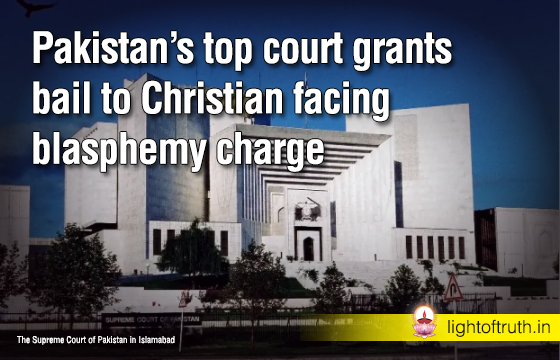
Pakistan’s top court grants bail to Christian facing blasphemy charge
The Supreme Court of Pakistan’s decision to grant bail to a Christian accused of blasphemy should give hope to others facing the charge, according to a prominent lawyer.
Saif ul Malook welcomed the court’s ruling on Jan. 6 that Nadeem Samson should be released on bail.
“It is a very important ruling, the first in the judicial history of Pakistan,” the lawyer said in a video call reported by the Jubilee Campaign, a non-profit promoting human rights.
Samson, identified as a Catholic by the United States Commission on International Religious Freedom (USCIRF), was arrested in 2017 and imprisoned in Lahore, Pakistan’s second-largest city, after a property dispute.
He was charged with insulting the Muslim Prophet Muhammad under Section 295-C of the Pakistan Penal Code.
The 42-year-old’s supporters believe that he was falsely accused of the crime, which is punishable by death in Pakistan, an Islamic republic in South Asia with a population of almost 227 million people.
Malook, who represented Asia Bibi, a Catholic mother acquitted of blasphemy in 2018, petitioned the Supreme Court at a hearing on Jan. 5 to break with the practice of denying bail to people accused of blasphemy.