

Eddie Lo grew up in a religionless Chinese family and never considered practicing a religion despite his schooling under Catholic priests and brothers. But the Covid-19 pandemic and Hong Kong’s democracy struggle helped him change.
The 55-year-old professional karate trainer says “the seed of faith” he received at Hong Kong’s St Antony’s Primary School, run by the Salesians, has matured after four decades.
He is now a catechumen preparing to be baptized Ignatius Lo on Easter Saturday in St. Patrick’s Parish in Lok Fu under Hong Kong Diocese.
Lo is among some 1,550 adults under-going catechumen classes in 52 parishes and territories of the diocese, readying themselves to be baptized this Easter season.
Each year several thousand adults join Hong Kong Diocese. During Easter 2019, before the pandemic hit, some 2,800 adults were baptized. The number of adult baptisms has dwindled since then.
Lo grew up in a traditional family “with Dad and Mum following Confucius thinking but without any religion,” he recalled. He followed no religion until a year ago.
The isolation of the pandemic restrictions and the chaos of Hong Kong’s pro-democracy campaign guided him to the Catholic Church, he says.
As a martial arts trainer, his focus was on physical energy and techniques to control mind and body. But social disruption since 2019 as well as the pandemic made him “think and feel differently, especially with my students.”
Lo recalls that he was “harsh and tough” with his students to help them win competitions and gain recognition.
“But after what happened in Hong Kong, I began to appreciate young people with independent thinking and changed the way I teach them,” he says.
Young university students have been spearheading the pro-democracy movement with thousands taking to the streets protesting what they called their shrinking freedoms. It continued until the Chinese government suppressed protests with a sweeping new security law in June 2020.
As Covid-19 lockdowns and isolation continued, Lo wanted a change. He began to think about the meaning and purpose of life and even tried new things like making bread and practicing iaido, a Japanese martial art. “At the same time, I wanted someone to guide me for the future. I began to think that I needed more mental support and someone to rely on,” he says.
Category Archives: Asian
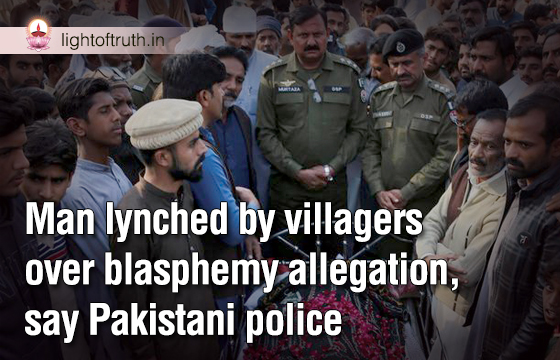
Man lynched by villagers over blasphemy allegation, say Pakistani police
A mob lynched a man because he had allegedly burnt pages of Muslim holy book the Quran in central Pakistan, and dozens of people have been arrested, police and officials said on February 13.
Prime Minister Imran Khan ordered action against the mob and any police who acted an onlookers to the killing.
“The lynching will be dealt with full severity of the law. We have zero tolerance for anyone taking the law into their own hands,” he said in a statement.
A government spokesman said more than 60 people suspected of involvement in the lynching have been arrested, adding that more suspects were being identified through social media videos shot by the villagers in Tulamba, Khanewal district.
The mob gathered at a mosque on Saturday night after the son of its prayer leader announced that he had spotted the man burning pages of the holy book, police official Munawar Hussain told Reuters.
People stand beside the body of a man who, according to police, was lynched by a mob, in Tulamba Village, central Pakistan, on February 13, 2022.
Police arrived to find the man unconscious and tied to a tree, Hussain said, adding that the mob also attacked the police.
“The villagers armed with batons, axes and iron rods killed him and hanged his body from a tree,” Hussain said.
He said that evidence so far gathered by police suggested the dead man, identified as Muhammad Mushtaq, was in his 50s and appeared to have had mental disabilities.

China rewrites Bible with Communist principles: Christian watchdog
A US watchdog has said the Chinese government is currently rewriting the Bible to align it with Communist principles and values. Speaking to Faith Wire, spokesman for Voice of the Martyrs (VOM), Todd Nettleton said the new translation would “really support the Communist Party.”
“This is a project that the Chinese Communist Party (CCP) announced in 2019. At the time, they said it would be about a 10-year process … to release a new translation of the Bible.
“He explained that the Chinese government’s goal is for people to understand their ultimate goal is to be a “good communist.”
In a recent Facebook post, VOM shared an example of several verses in John 8 changed according to the Chinese government. As the biblical story goes, Jesus forgives an adulterous woman despite the Pharisees’ calls to stone her to death. However, in the CCP’s translation, Jesus ends up stoning the woman, admitting he is also a sinner.
John 8:7-11, according to the CCP reads: “Jesus once said to the angry crowd who was trying to stone a woman, who had sinned, ‘He who is without sin among you, let him cast a stone at her.’ When his words came to their ears, they stopped moving forward. When everyone went out, Jesus stoned the woman himself, and said, ‘I am also a sinner.’”
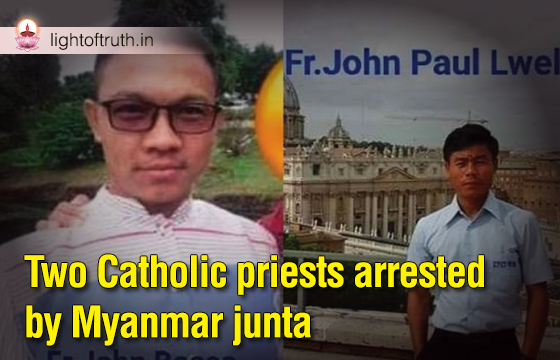
Two Catholic priests arrested by Myanmar junta
Myanmar’s military regime has arrested two Catholic priests who were on their way to help internally displaced persons (IDPs) in Shan state.
Father John Paul Lwel and Father John Bosco, who belong to the St. Therese Little Way Missionary Institute, were arrested by junta soldiers and the Pa-O National Army, an ethnic armed group, at a checkpoint on February 21, said local church sources. Senior clergy from Pekhon Diocese confirmed that the two religious priests have been arrested but said the reason for their arrest was not yet known.
Church officials are trying to contact authorities for the release of the clergy. Two car drivers and a young student were also arrested with the priests.
The arrest of the clergy came even as fighting between the military and people’s defense forces (PDFs) intensified in Mobye township in Pekhon Diocese, where junta forces have deployed airstrikes, armored vehicles and heavy weapons. Thousands of people including Christians have been displaced due to the ongoing fighting.
Pekhon Diocese covers southern Shan state and is one of the worst-affected areas along with Loikaw Diocese in Kayah state due to the escalating conflict between the military and the combined rebel forces of the Karenni Army and newly emerged PDFs since May 2021.
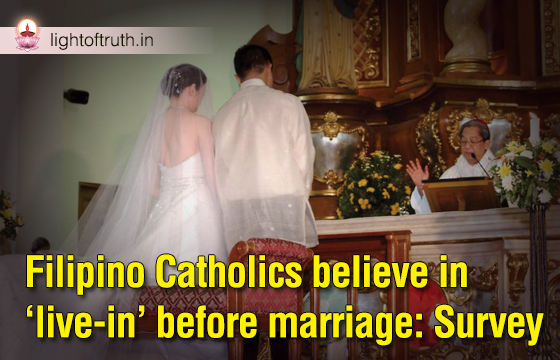
Filipino Catholics believe in ‘live-in’ before marriage: Survey
Filipino Catholics see nothing wrong with couples living together without receiving the sacrament of marriage, showed the result of an online survey done by Church-run Radio Veritas 846.
“This nationwide survey reveals that 40 percent would agree that couples should get married first before living together,” results of the Veritas Truth Survey (VTS) noted.
“On the other hand, 45 per-cent believe that being married is not necessary before living together,” it added.
The remaining 15 percent were undecided over the question “Should couples get married first before living together; and not engage in a common-law partner-ship arrangement?”
Result of the survey also showed that among elderly respondents with ages 61 and older, 61 percent said couples should get married before living together; 33 percent said that being married is not necessary before living together; and six percent were undecided.
For adult (40-60 years old) respondents, 48 percent said couples should be married first before living together; 29 percent said that being married is not necessary before living together, and 23 percent were undecided.
As for young adult (21-39 years old) respondents, 21 per-cent said couples should be married first before living together; 58 percent said that being married is not necessary before living together, and 21 percent were undecided.
Finally, for teen (13-20 years old) respondents, 34 percent said that couples should be married first before living together; 51 percent said that being married is not necessary before living together, and 15 percent were undecided.
Vatican envoy lauds Vietnamese volunteers’ care for Covid patients
The pontifical representative to Vietnam has complimented religious volunteers in a northern diocese on their joining frontline forces in taking care of Covid-19 patients. On Feb. 20, Singapore-based Archbishop Marek Zalewski, the non-resident representative of the Holy See to Vietnam, and Archbishop Joseph Nguyen Nang of Ho Chi Minh City met 400 priests and religious who voluntarily served at field hospitals for Covid-19 patients in the city.
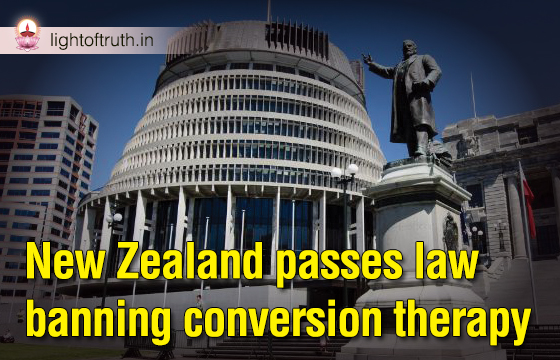
New Zealand passes law banning conversion therapy
New Zealand’s parlia-ment on February 15 near- unanimously passed a legislation that bans practices intended to forcibly change a person’s sexual orientation, gender identity or gender expression, known as conversion therapy.
The bill, which was introduced by the government last year, passed with 112 votes in favour and eight votes opposed.
“This is a great day for New Zealand’s rainbow communities,” Minister of Justice Kris Faafoi said.
“Conversion practices have no place in modern New Zealand.” The government has said practices such as conversion therapy do not work, are widely discredited and cause harm.
The legislation also lays out what is not con-version practice and protects the right to express opinion, belief, religious belief or principle which is not intended to change or suppress a person’s sexual orientation, gender identity or gender expression. The government said it had received nearly 107,000 public submissions on the bill, the highest number of public submissions ever received on any legislation. Under the legislation, it will be an offense to perform conversion practices on a child or young person aged under 18, or on someone with impaired decision-making capacity. Such offenses would be subject to up to three years imprisonment.
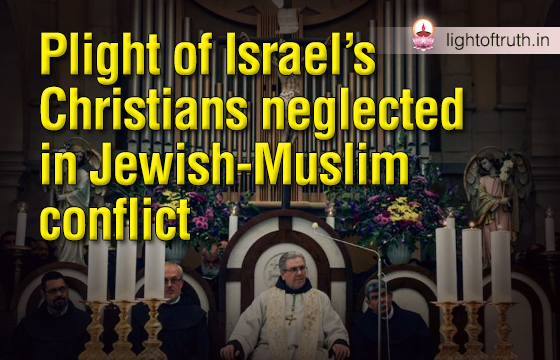
Plight of Israel’s Christians neglected in Jewish-Muslim conflict
Israel’s Christian population is fast dwindling while those of Jews and Muslims continue to grow, giving credence to the fears that a plan to expel Christians is underway in the Jewish state.
The growth rate of Christians in Israel is much slower than those of Jews and Muslims. In 1949, when Israel was recognized as a UN member nation, there were 34,000 Christians. They increased only fivefold in the past 70 years to 180,000 in 2019. But during the same period, Muslims in Israel grew 14 times to number 1.6 million and Jews grew some six times to number 6.69 million in 2019, says a report of the Israeli Statistics Office released last month.
The Druze, another religious minority in the Jewish state, increased almost tenfold from 15,000 to 143,000 in 2019. The report noted that the falling number of Christians is due to the lower growth rate. The Christian growth rate was 1.9 percent, the lowest. The average growth rate was 2.43 for Jewish families and 2.60 for Muslim families, it said.
The lower growth rate of the Christian community in Israel is attributed to the violence due to the Palestine crisis. Often, their plight is overlooked as two main communities — Jews and Muslims — fight each other. As the fringe elements in both communities have become active in the last decade, Christians are caught between the devil and the deep blue sea. The largest Arab Christian population centres are Nazareth (21,400), Haifa (16,500) and Jerusalem (12,900). According to the report, 84 percent of Christians are satisfied with their life in Israel. According to Israel’s Central Bureau of Statistics, 76.7 percent of Christians in Israel are Palestinian Arabs, who mainly live in the northern part of the country with more than 21,000 Christians in Nazareth.
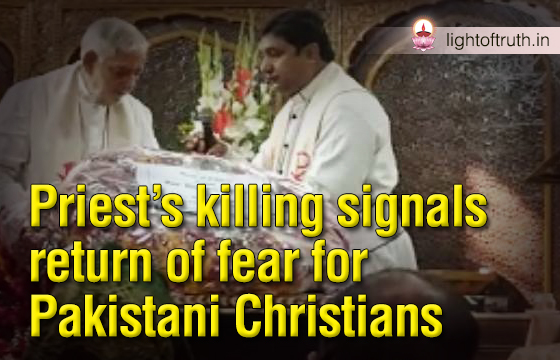
Priest’s killing signals return of fear for Pakistani Christians
The daylight attack by motor-cycle-riding gunmen on two Christian priests, killing one and wounding another, has reignited fears among Pakistan’s beleaguered minority community.
The priests were attacked as they drove home from a Sunday service in the north-western city of Peshawar on Jan. 30,
“We want to convey a positive message. We stand in solidarity with our Christian brothers,” said Tahir Ashrafi, special representative on religious affairs to Prime Minister Imran Khan.
Ashrafi sought to assure Pakistan’s Christians that the prime minister was personally overseeing the matter, calling it “an attack on Pakistan.”
“This isn’t an issue of one community or a pastor. It is an attempt to spread fear and defame the country. Blood in churches, mosques and sacrifices of our soldiers led to peace,” he said at a press conference.
Christian activists slammed Ashrafi’s presser. “This is an eyewash. The nation is tired of condemnations. We demand arrest of the murderers and their punishment,” said Samson Salamat, chairman of Rwadari Tehreek.
Human rights lawyer Nadeem Anthony called it a political stunt. “The cleric is trying to mislead the ongoing investigation. They [the government] are trying to escape the responsibility of protecting the innocent and vulnerable community,” he told.
“It is a pity that the new year started with this heinous hate attack. The country has been hijacked by Islamists who want Islamization in the country and are openly propagating faith-based hatred,” Anthony said.
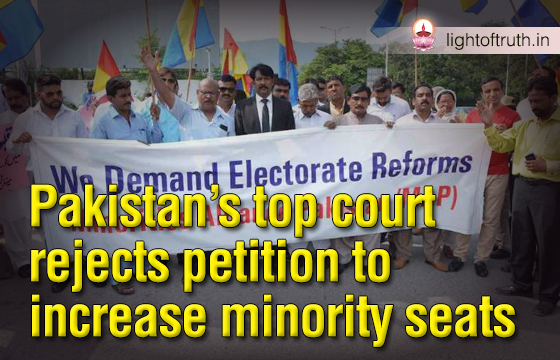
Pakistan’s top court rejects petition to increase minority seats
Pakistan’s top court has dis-missed a plea by a Christian group seeking an increase in the seats reserved for religious minorities in the national and provincial assemblies.
A two-judge bench of the Supreme Court on Feb. 7 rejected the petition on the grounds that the constitutional amendment was required to increase minority representation. The highest court in the country said it cannot issue directions to the parliament on the issue.
“The court was not authorized to issue an order to the parliament to amend the constitution. How could the court decide for enhancing the minorities’ seats in the parliament,” Justice Ijazul Ahsan observed. The petition brought by the Pakistan Interfaith League (PIL) was earlier rejected by Lahore High Court.
Christian human rights activists had long been demanding an increase in seats for religious minorities from 10 to 14 in the 342-seat national assembly. The national parliament currently has four Christian and six Hindu members.
Currently, religious minorities can contest only 33 reserved seats in the provincial assemblies and four seats in the Senate.
Minority voters account for 3.63 million or 3.5% of the 118 million voters in Pakistan, according to official records.