As Sri Lanka continues to sink hopelessly into the worst economic crisis in memory, the country’s Catholic Bishops are calling for unity among politicians to save the nation from becoming a failed state. The country of some 22 million is facing its worst economic nightmare since its independence, with foreign exchange reserves falling abysmally by 70% in the past two years. This has left the country struggling to import essential goods, such as food, fuel, cooking gas and medicine, and is causing power cuts of up to 13 hours a day. The devaluation of its currency has sent inflation soaring to 17.5% in February, the highest so far, hitting the already struggling businesses and exporters but especially the people. “All successive governments to date are responsible in varying degrees for the present state of affairs,” the Catholic Bishops’ Conference in Sri Lanka said in a statement, adding that “the present government as well as those in the opposition … must adopt a conciliatory not a confrontational approach” and they should not “play the blame game.”
“The country is fast approaching the precipice of a failed state that will in its wake inflict irreversible injuries on the people,” the bishops warned, calling on their faithful and Church institutions to come to the aid of the most vulnerable and affected groups.
Category Archives: Asian

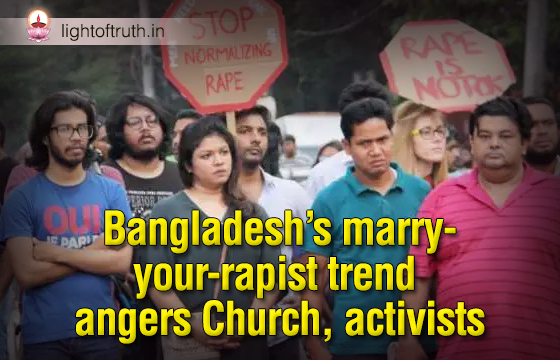
Bangladesh’s marry-your-rapist trend angers Church, activists
A rising trend of rape victims settling for marriage with their rapists has triggered an angry response from female activists in Bangladesh who termed it unethical and unacceptable in a civilized society.
“Instead of punishment, a rapist is being allowed to marry a rape victim. This is absolutely unethical and it undermines women’s rights. If the perpetrators get away this way, then more rape will happen in our society,” said Rita Roselin Costa, convener of the women’s desk at the Catholic Bishops’ Laity Commission.
In Bangladesh, women and minor girls are socially ostracized when they become victims of rape, she said, adding that even if they go for trial, they lose patience for justice due to the lengthy and complex legal system. “And then the criminals take the opportunity, marry the victims and get relieved from the punishment,” she said.
Costa, a social activist and mother of three, was speaking after a court granted bail to a police officer after he married the woman he raped in June 2020. The inspector was jailed and convicted of rape.
On March 23, Judge Mehedi Hasan Talukdar of the Women and Children Repression Prevention Tribunal in Panchagarh district in northern Bangladesh granted bail to police sub-inspector Abdul Jalil after he married his rape victim on the court’s premises.
Jalil, 45, was arrested and imprisoned after the woman filed a case against him on March 25, 2021, alleging she was raped during an investigation into a land dispute she was involved in.
Local media reported the marriage took place on the premises of the district lawyers’ association office within the court in the presence of Jalil’s first wife, who gave consent for the marriage.
The court granted bail after Jalil applied for bail on the condition that he would marry the victim, his lawyer Mehedi Hasan told.
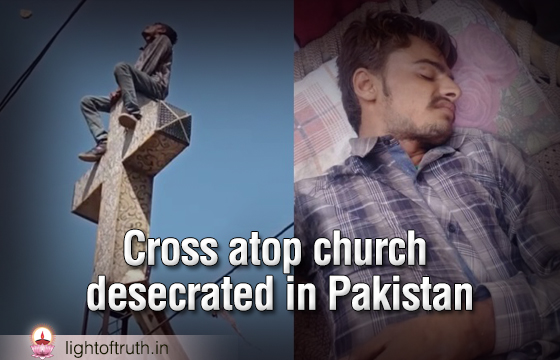
Cross atop church desecrated in Pakistan
A Pakistani Muslim youth who climbed a church roof and sat on the cross chanting “Allahu Akbar” (Allah is great) was arrested and charged with blasphemy by police in Punjab province.
Videos circulating on social media showed Muhammad Bilal mounting the cement cross standing 12 meters from the ground on the rooftop of One in Christ Church in the Hafiz Chowk area of Lahore.
“He climbed the church roof at 10 am from the adjacent lattice factory and first tried to break the cross. Later he sat on the cross and kept chanting ‘Allahu Akbar’ for half an hour,” said M.M. Akash, a local evangelist who called the police helpline.
Bilal was detained by police in Kasur district, 49 kilometres from Lahore, after a first information report (FIR) under section 295-A of the blasphemy law was registered by Akash on March 16.
“As people gathered in the street, Bilal came down. He was arrested but later released by the police after an initial investigation. The same evening we gathered at the police station to register the FIR and gave witnesses [statements] about the blasphemy in front of the super-intendent of police. Bilal was rearrested late at night,” Akash said.
Church authorities have urged the community to remain peaceful. About 400 Christian families are members of the church built in 1985.

Archbishop seeks transparent and free election in Timor-Leste
Timor-Leste, the predominantly Catholic country in Southeast Asia, goes to the polls on March 19 to elect a new president. The influential Catholic Church wants to ensure a “transparent and free” election.
Salesian Archbishop Virgilio do Carmo da Silva of Dili, in an exclusive interview, shared issues affecting the Church in the tiny country of 1.3 million people, 98 percent of them Catholics. Protestants and Muslims share the other 2 percent equally.
The Portuguese brought the Catholic faith to the nation that occupies the eastern half of Timor island in the 16th century. Indonesia occupied it in 1975 after the Portuguese Timor-Leste became a free and democratic nation after decades of struggle for independence after an UN-sponsored referendum at the beginning of the current millennium. But two decades after political freedom, the nation continues to face crippling poverty, corruption, and political uncertainty.
Pope Francis is expected to visit the country soon amid political uncertainty that continues to threaten democratic freedoms and values. The 54-year-old archbishop says the Church — which serves Timor-Leste under three dioceses of Díli, Baucau, and Maliana — keeps reminding politicians of the need to have a free and democratic nation.
Archbishop Da Silva said: “Since it is the celebration of all, we have to avoid all attitudes that will contribute to violence and foster a friendship that will nurture freedom and respect each other during the campaigns.”
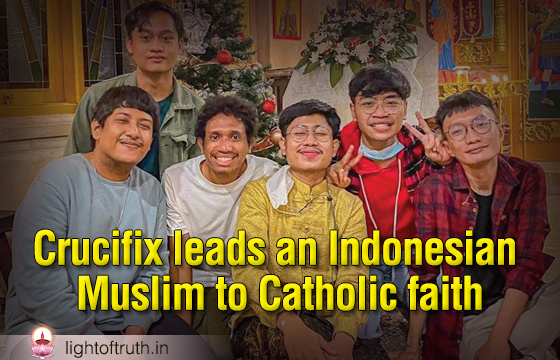
Crucifix leads an Indonesian Muslim to Catholic faith
Vicky Adam Ubaid Akram had a dream that helped him choose the Catholic faith.
In the dream, he walked in an alley that had many houses of worship including mosques, temples and churches on both sides. But his eyes remained fixated on a Catholic church with a cross on top.
He then fell down and woke up from his sleep. “In that falling position, I looked up again and my eyes were still on the crucifix,” he recalled.
Protestant churches normally do not display a crucifix — a cross with an image of Christ’s body on it — but prefer only a simple cross.
Vicky soon began to read more about Catholicism. “The more I knew, the more interested I became,” he said. Jesus’ teaching about the law of love as “the first and foremost law” was deeply touching, he said. “I really like that part, which for me is the key to being a good human being,” he recalled.
Gradually, Vicky began to visit the Catholic church in Ma-lang. The 24-year-old had grown up in a devout Muslim family in Malang in Indonesia’s East Java, a predominantly Muslim province.
Just like his father, Vicky strictly followed Islamic rituals such as praying five times a day. But three years ago he first felt “a spiritual dryness” and lost interest in his family’s religion.
“In 2018 while I was studying in college, I began to feel that I could not find peace when carrying out Islamic religious rituals such as praying,” he said.
He even began to feel that Islam was ineffective in “communicating with God and finding him peace” and began to search for other religions.
That was when Vicky turned toward Christianity, his mother’s former religion. A Protestant Christian, she had converted to Islam to marry his father and ever since followed Islamic precepts strictly.
Islamic customs and traditions were strong in Vicky’s family, just like most families in the province, where 94 percent of its 39 million people are Muslims.
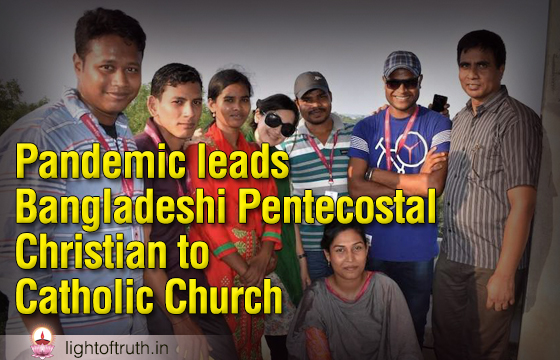
Pandemic leads Bangladeshi Pentecostal Christian to Catholic Church
Kaushik Hembrom lost his job as a computer operator with an insurance company in Bogura city of northern Bangladesh due to the Covid-19 pandemic.
The 35-year-old Pentecostal Christian was forced to return to his native village Dighalchan in neighboring Dinajpur district where he spent more than a year confined to his house without any spiritual assistance.
He would watch his Catholic neighbors attend their parish church and receive pastoral care from priests throughout the protracted lockdown. But he and his family members had no church or prayer meeting to attend in the locality.
Hembrom approached the parish priest of St. Francis of Assisi Church in Dhanjuri under Dinajpur Diocese and expressed his desire to join the Catholic Church.

South Korea’s new president faces host of challenges
Yoon Suk-yeol, a conservative former top prosecutor, was declared winner in South Korea’s presidential polls on March 10, defeating a liberal rival in one of the most closely fought polls in the country’s history.
With more than 98 percent of the ballots counted, Yoon managed to secure 48.6% of votes against his rival Lee Jae-myung’s 47.8%. Both candidates spent months mocking and demonizing each other in a bitter political campaign.
Yoon will take office in May as leader of the world’s 10th-largest economy to serve a single five-year term.
In his first public action, after he became the presidential candidate for the People Power Party last October, he visited Yoido Full Gospel Church in Seoul on a Sunday, sang hymns and prayed with the congregation. Media reports said the move was to attract Christian votes and silence critics who said he followed shamanism.
He was baptized with the name Ambroise in the Catholic Church but he does not practice his faith life in any parish community, according to Church sources.
Christianity has emerged as the largest religion in South Korea and is followed by some 28% of its 51 million people, according to the 2015 national census. A larger group, some 56%, follows no religion at all. Some 15% follow Buddhism, making it the second-largest religion in the country.
In the run-up to the election, Yoon promised to deal sternly with provocations by North Korea and to boost trilateral security ties with Washington and Tokyo.

Myanmar conflict turns 16 parishes into ghost towns
Some 16 parishes in Loikaw Diocese in Myanmar’s Kayah state have been totally abandoned with the escalation of the conflict between military and rebel forces.
The green and mountainous eastern region bordering Thai-land was relatively peaceful for decades but has seen intense fighting since May 2021.
Parish priests, nuns and parishioners from these parishes have fled to safe areas, according to church officials.
Nearly two-thirds of the 90,000 Catholics in Kayah state have been forced to flee their homes, they added.
The junta has unleashed airstrikes and artillery shelling, forcing thousands of people including women, children, the elderly and the infirm to flee their homes to seek refuge in nearby jungles or churches in neighboring villages and towns.
At least seven Catholic churches have been hit by artillery shelling and airstrikes by Myan-mar’s military in Loikaw Diocese, with 16 out of 38 parishes severely affected by the intensifying fighting.
More than 650 houses and other civilian properties including churches, monasteries and schools have been burned or destroyed in Kayah since May 2021, according to reports cited by the UN.
Meanwhile, some parishes in Pekhon Diocese that covers Shan state and border areas of Kayah state have also been affected by the conflict.
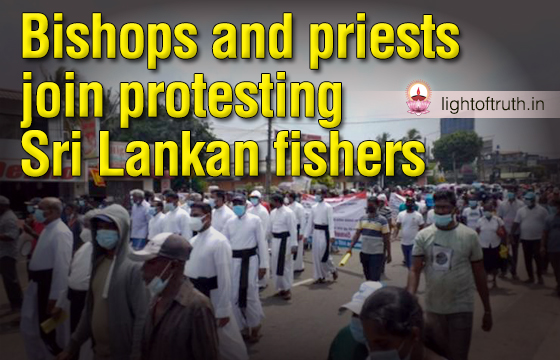
Bishops and priests join protesting Sri Lankan fishers
Bishops and priests joined fisher people in Sri Lanka on March 3 to demand protection of their livelihoods from destructive development projects that were harming the coast and the sea. Sebastian Fernando, a leader of local fishers, said: “The sea bed has been eroding for years. The people are constantly complaining but the authorities have not paid attention to their demand for a permanent solution.”
He said the sand being pump-ed to fill the east and west jetties of Colombo port was having a huge impact on fishing in the country. Seaweed and ornamental fish are greatly affected.
“The disaster-struck X-press Pearl ship also caused great damage to our marine environment but fishermen did not receive fair compensation,” said Fernando, referring to the environmental disaster unleashed by a cargo ship carrying chemicals that caught fire off the coast of Sri Lanka in May 2021.
Several containers have washed ashore from the X-press Pearl and nitrogen oxides have been released into the air and sea in large quantities, exposing the island nation to acid rain in the future, say experts.
Environmentalists have warn-ed that the chemicals inside the containers could enter the sea-water and pose a threat to the marine life system in the short and long term. The Catholic Church in Sri Lanka has repeatedly urged the government to compensate fishing families for their loss of livelihood and restore the environment.

China tightens grip on Hong Kong’s education system
School education, the last bastion of the pro-democracy movement in Hong Kong, is falling asunder like the beads of a broken necklace.
The blood-red flag with five yellow stars flutters in the air on campuses in Hong Kong as it did in mainland China following the Tiananmen Square protest in 1989.
Students in Hong Kong are getting familiarized with patriotism with Chinese characteristics because there are still black sheep in universities and schools whose capitalist hearts have to be won over before they initiate the long march to socialism.
University and high school students made up the majority of protesters in 2019 and teenagers represented almost a fifth of the 10,000 arrests made as part of the crackdown, according to data by Bloomberg.