
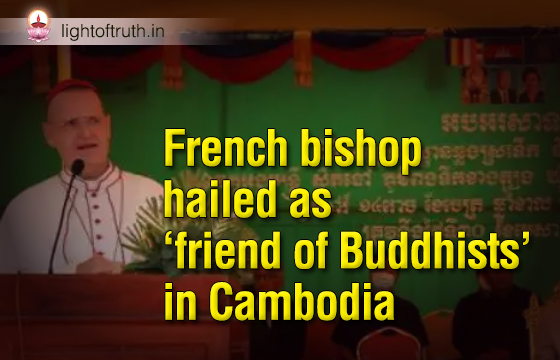
Buddhist leaders in Cambodia have honoured French Bishop Olivier Michel Marie Schmitthaeusler for his years of support and donations to local Buddhists and a popular pagoda.
Bishop Schmitthaeusler, the apostolic vicar of Phnom Penh, received the accolade “a great friend of Buddhists” at an event at Ang Monrei pagoda in Tram Kak district of Takeo province in southern Cambodia on April 30, reported Catholic Cambodia, the communications wing of the local Catholic Church. Seng Somony, secretary and spokesman of the Ministry of Cults and Religions, presided over the ceremony and handed a certificate of honor to Bishop Schmitthaeusler issued by the Mahanikaya Council of Cambodia, the country’s supreme Buddhist council.
Category Archives: Asian
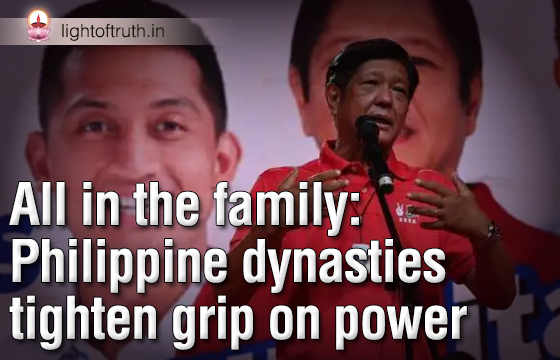
All in the family: Philippine dynasties tighten grip on power
If the son of former Philippine dictator Ferdinand Marcos wins the May 9 presidential election, he will not be the only Marcos currently in power — and will almost certainly not be the last.
Elite families have long ruled the poverty-ravaged nation, holding on to positions of power for generations by dishing out favours, buying votes or resorting to violence.
Analysts say the system has become more pervasive in the decades since a popular uprising deposed Marcos and forced the family into exile. New dynasties have entrenched themselves in politics, smothering electoral competition, stunting economic development and worsening inequality.
“Power begets power — the more they stay in power, the more they accumulate power, the more powerful they get,” said Julio Teehankee, a professor at De La Salle University in Manila.
The archipelago has produced about 319 dynastic families, dating back to when the country was a US colony in the first half of the 20th century, Teehankee said.
“This is all dynastic. I wouldn’t be where I am today if I weren’t a Marcos”
Dozens have withered, but in 2019 members of at least 234 such families won positions in mid-term elections, he said.
They have flourished in a feudal and corrupt democracy where parties are weak, fragmented along clan lines and plagued by defections. Power, however, is not static. Families can win and lose it — and make a comeback. After the fallen dictator died in 1989, the Marcoses returned to their traditional stronghold of Ilocos Norte and began tapping local loyalties to get elected to a succession of higher positions.
Political families held 67% of seats in the House of Representatives, compared with 48 percent in 2004, and 53% of mayoral posts, up from 40%. Among the leading candidates for the 12 Senate seats being contested, at least three already have a relative in the chamber.
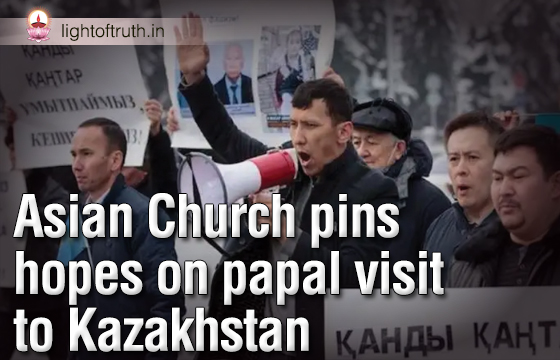
Asian Church pins hopes on papal visit to Kazakhstan
Pope Francis is set to visit Kazakhstan, a Central Asian state close to the epicentre of ethno-religious conflicts where bloody anti-government unrest early this year claimed 240 lives.
According to the office of President Kassym-Jomart Tokayev, Kazakhstan is set to host the 7th Congress of Leaders of World and Traditional Religions in September with Pope Francis as a star guest.
Bishops’ Conference of Kazakhstan president Bishop Jose Luis Mumbiela said the Church was “grateful” to the president of Kazakhstan for inviting Pope Francis 20 years after the visit of Pope St. John Paul II.
The papal visit will be a “breath of hope and strength,” said Father Guido Trezzani, director of Caritas Kazakhstan in the predominantly Muslim nation of 15 million.
While Muslims constitute 70 percent of the population, Christians, mostly Orthodox, number about 30%. However, Catholics are a tiny minority of hardly 2% of the population.
The papal visit to the country of some 300,000 Catholics is considered a major boost for the Kazakhstan Church. The country has a huge landmass of some 3 million square kilometers, making it the ninth-largest nation in the world.
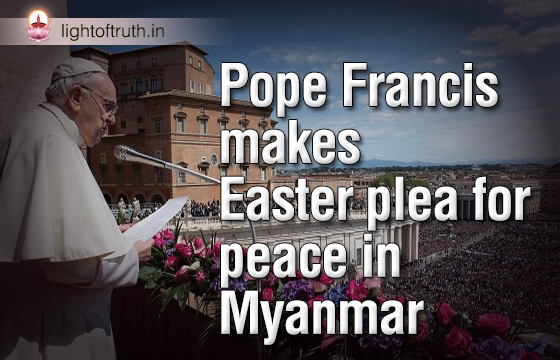
Pope Francis makes Easter plea for peace in Myanmar
Pope Francis has again plead-ed for peace and reconciliation in conflict-torn Myanmar where millions of people including Christians have been oppressed by the brutal military junta.
During his Easter plea for peace around the world, he cited the Southeast Asian nation where violence has persisted for more than a year after the military ousted the civilian government.
“I pray that God grants re-conciliation for Myanmar, where a dramatic scenario of hatred and violence persists,” he said. “We need the crucified and risen Lord so that we can believe in the victory of love, and hope for reconciliation.”
His attention to the people of Myanmar comes as the world is focused on the war in Ukraine.
Pope Francis has spoken several times about the crisis in Myanmar, which he regards with much affection after visiting the country in November 2017.
He has repeatedly called for military leaders to stop the violence, release all detained people and pursue dialogue to seek peace and reconciliation.
“Let our families be healed, let our nation be healed, let our world be healed. We greet the families that are coming out of many challenges”
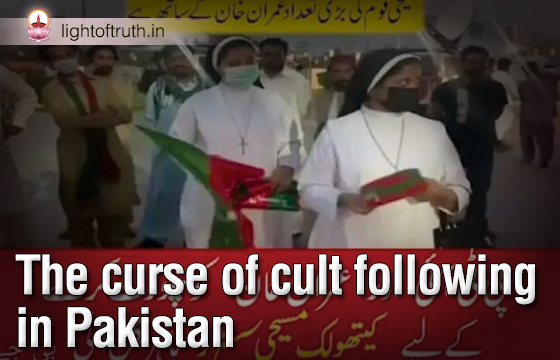
The curse of cult following in Pakistan
Ever since losing a vote of confidence moved by a united opposition this month, Pakistan’s former prime minister Imran Khan has divided the nation with his aggressive campaign — on the ground and online.
You either agree with him or risk being called a traitor to the country, a thief or lifafa (a journalist accepting bribes). The space keeps shrinking for free thinkers. However, nothing compares to the controversial content posted by his followers last week.
“Peace be upon him,” stated a Khan sticker on the back wind-shield of a car whose photo was shared on Facebook.
The Islamic honorific, commonly used by Sunni Muslims, follows specifically after uttering the name of the Prophet Muhammad.
One can easily dismiss the image as being photoshopped. Well, guess again after reading the comments from diehard followers of Khan’s Tehreek-e-Insaf (PTI) party.
“Peace be upon you, brother. Peace be upon everyone. It’s a prayer for safety, everyone should give it to each other,” stated Mohammad Bahoo Sarwar, president of Bahoo Films Corporation. All hail the cricketer hero who led the national team to its first and only World Cup win on March 25, 1992. A cult of personality was born that day.
Sadly, most people in the Islamic republic are neither as liberal nor moderate as Sarwar thinks. Media outlets in Pakistan follow a strict editorial policy of using this expression whenever mentioning the Prophet Muhammad. Religious minorities can be easily accused of blasphemy for using the same title with their names.
C. Raja Mohan, a contributing editor on international affairs for The Indian Express, even compared Khan to the Biblical character Samson determined to bring down the house of Pakistan, dominated until now by the army.
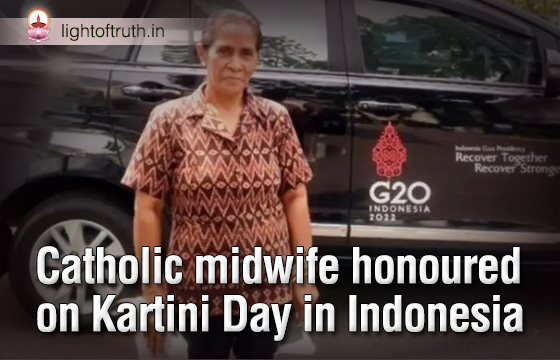
Catholic midwife honoured on Kartini Day in Indonesia
A Catholic midwife who has served a remote Indonesian province for more than three decades was among 10 women honoured by the government during its 144th Kartini Day celebrations.
Yovita Mariati, a midwife from Sikka district in East Nusa Tenggara province, received the award at the state palace in Jakarta on April 21.
Indonesians celebrate the day annually to commemorate the birth of their national heroine Raden Ajeng Kartini, hailed as a symbol of women’s empowerment for promoting gender equity and women’s rights during the Dutch colonial era.
Mariati has served new mothers and children as a midwife in Sikka district’s Nangalimang villages for the past 34 years.
The 54-year-old is a mother of four children who was widowed in 1999. She doesn’t get paid for her work and survives by selling hand-woven fabrics.
But that hasn’t stopped her from working for and advocating medical interventions to prevent diseases such as dengue fever, malaria and tuberculosis in the villages.
“I am crying and touched because it turns out that someone cares about what I have been doing all this time. I never thought that one day I would be rewarded like this”
An emotional Mariati, who received the award from First Lady Iriana Widodo, said: “I am crying and touched because it turns out that someone cares about what I have been doing all this time. I never thought that one day I would be rewarded like this.” She said she had only tried to do what she could for her fellow humans based on her high school education and the training and experience she had gained while being on the job.
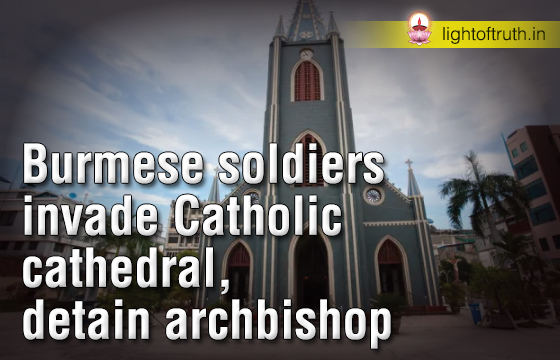
Burmese soldiers invade Catholic cathedral, detain archbishop
Approximately 40 Burmese soldiers forcibly took control of a Catholic cathedral in Mandalay prior to a Lenten prayer service on April 8 and detained an Archbishop and dozens of other worshippers, including a correspondent for CNA.
The soldiers entered Sacred Heart Cathedral at 2:30 p.m. local time April 8 and refused to allow worshipers to leave. Soldiers also occupied other buildings on the compound.
Abp Marco Tin Win and employees of the Archdiocese of Mandalay were similarly herded into the building and forced to sit in the pews along with the worshipers.
A correspondent for CNA was present and was detained for about three hours, then allowed to leave. The others detained were released several hours later.
“I was so afraid,” one elderly Sacred Heart Cathedral parishioner, who did not give her name for safety reasons, told. “The military was always crazy but they never acted like this before. We ran home as soon as we were allowed out of the church.”
“The soldiers kept demanding to know where the gold and money and weapons were hidden,” explained her nephew, who also asked for anonymity. “I told them there was none. Any money collected is for the relief of poor families.”
As soon as the soldiers entered the cathedral, alerts were sent out to the entire Catholic community to stay away from the compound.
Upon hearing of the intrusion, Monsignor Dominic Jyo Du, vicar general of the arch-diocese, confronted the soldiers and their officers inquiring as to their presence. The soldiers rushed him into the cathedral along with the archbishop.
About 30 of the soldiers moved away pews to make room for themselves and slept in the cathedral overnight. They were still inside the cathedral early Saturday morning.
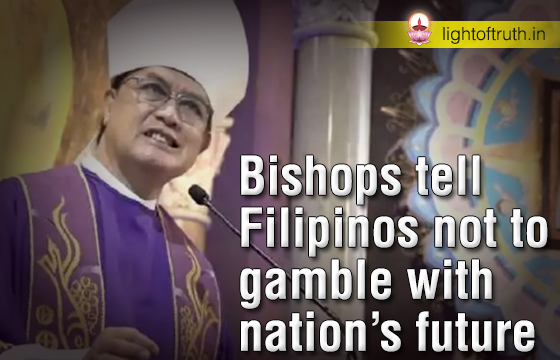
Bishops tell Filipinos not to gamble with nation’s future
Philippine Bishops have urged voters not to gamble with the country’s future in national elections in May by voting for corrupt and incompetent candidates.
Their call came as senior Catholic officials, together with religious congregations and lay-people, gathered in Manila on April 6 for a solidarity Mass on the Catholic Church’s role in the polls.
The “Solidarity Mass for Moral Choice,” held at the National Shrine of the Our Lady of Perpetual Help in Baclaran, Manila, was presided over by Manila Archbishop Cardinal Jose Advincula and members of the Catholic Bishops’ Conference of the Philippines.
The prelates said the aim of the Mass was to have one heart and mind as priests, religious and laypeople on the Catholic Church’s role in politics.
“If faith cannot guide us in our role in politics, then perhaps we have not done enough in our duty. It is easier to just name a candidate to vote for rather than to teach our people how they should vote,” Bishop Pablo Virgilio David, president of the bishops’ conference, said in his homily.
He said that there is no division between faith and politics, especially when issues in politics are moral in nature such as truth and falsehood.
“Truth is like lime pressed on one’s wounds. It hurts but it keeps us awake. But sometimes, if the truth hurts and causes us inconvenience, we choose to be blind and deaf … we choose to be neutral”
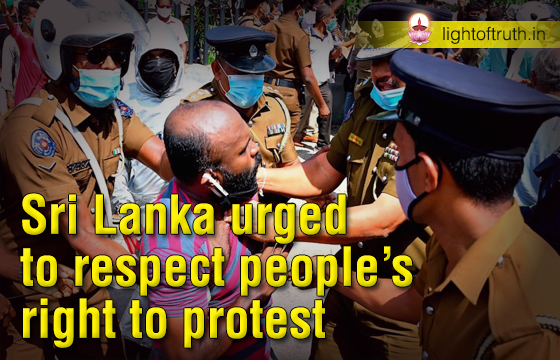
Sri Lanka urged to respect people’s right to protest
A global civil society alliance has expressed serious concern over Sri Lanka’s clampdown on civic space and urged the government to release those detained arbitrarily and investigate and punish abuses by security forces.
“We urge the government to refrain from deploying violence against protesters and instead respect and protect people’s rights to peaceful protest,” said Josef Benedict, Asia Pacific researcher of CIVICUS, in a statement on April 5.
He called the restrictions on access to the internet and social media platforms and the arrest of Thisara Anuruddha Bandara, a youth activist, for promoting the #GoHomeGota social media campaign against the president “a clear violation of the right to freedom of expression and information guaranteed by the constitution and under international human rights law.”
Benedict urged authorities to drop all charges against Bandara immediately.
“CIVICUS has documented how the Gotabaya Rajapaksa administration has led an assault on civic space and fundamental freedoms since the president assumed power more than two years ago,” the statement said.
In March, UN High Commissioner for Human Rights Michelle Bachelet had similarly reported to the Human Rights Council that “the government’s response to criticism has constricted democratic and civic space.”
The protests and escalating economic crisis have led to the resignations of 26 ministers in the current cabinet, leaving only the president and his brother, Mahinda Rajapaksa, the prime minister, to manage affairs.
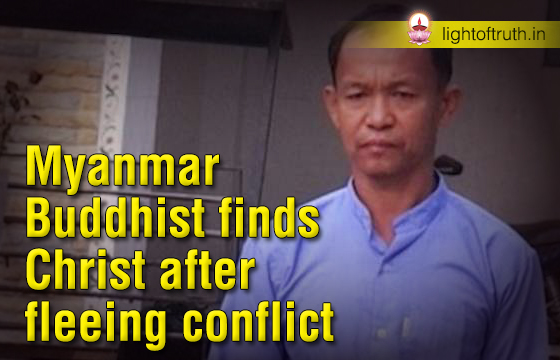
Myanmar Buddhist finds Christ after fleeing conflict
When Buddhist San Shwe Mya’s uncle, a Christian, tried to speak about Jesus Christ, he was annoyed and paid little attention.
“I told my uncle he couldn’t persuade me to convert to Christianity as I had no interest in it,” San Shwe recalled.
Living in a remote village in western Myanmar’s Rakhine state, work was the first priority for the 43-year-old father of three children. “We have to rely on ourselves for our livelihood, so work was the only thing on my mind,” he said.
San Shwe belongs to the ethnic Chin tribe and grew up in a Buddhist neighbourhood in a village in Minbya town. He followed his parents’ Buddhist religion.
His Buddhist-majority village has a few Christians including some Catholics. He could see how the Christians faced daily challenges while practicing their faith. “But I had no idea about Catholicism or Christianity,” he recalled.
San Shwe remembered some radical monks and laypeople warning Christians and not allowing them to use loudspeakers during celebrations such as Christmas.
“I wasn’t involved with the group who opposed Christian celebrations but I witnessed the challenge of being a Christian in a predominantly Buddhist com-munity,” he told.
His native village was remote but it was close to where intense fighting between the military and the Arakan Army had been going on since December 2018.
More than 90,000 people had been displaced due to the conflict in Rakhine that also spilled into neighboring Chin state, home of many Christians, mostly ethnic Chin.
The violence forced even San Shwe to leave for Yangon, Myanmar’s commercial hub, looking for employment and, more importantly, education for his children.