
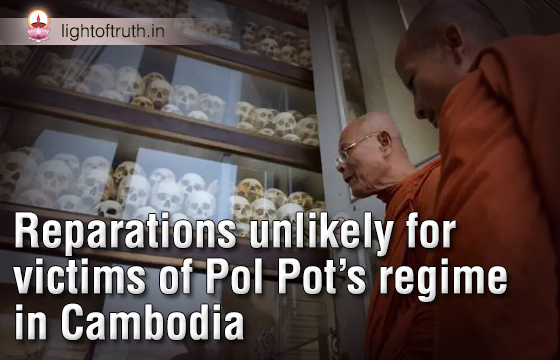
Hopes of financial compensation for survivors of Pol Pot’s brutal regime that ruled Cambodia with an iron fist between 1975 and early 1979 are becoming less likely as the Khmer Rouge Tribunal continues to wind down.
The Extraordinary Chambers in the Courts of Cambodia (ECCC), which was sworn in 16 years ago and charged with prosecuting senior leaders of the regime for unleashing one of the worst mass killings in the 20th century, could secure only three guilty verdicts for crimes against humanity and genocide.
“Compensation could only work with a complete acknowledgement of responsibility,” said Ou Virak, president of the Phnom Penhbased Future Forum think tank. “There are far too many people who remained in power and too many powerful countries that need to be held accountable.”
Since the tribunal was only responsible for pursuing crimes inside Cambodia during the four-year regime, it meant China, which backed Pol Pot, and America’s involvement in the Indochina wars were not a consideration amid the mountains of evidence.
Instead, genocide museums, memorials, stupas and education programs will make up the legacy to be left behind by the ECCC. “Global investment in genocide museums here in Cambodia, potentially funded by countries who want to salvage their souls, could be a good starting point,” said Ou Virak.
Most senior leaders of the Khmer Rouge died violently or behind bars, either awaiting their trial or following their conviction. Only Khieu Samphan, the former head of state, remains alive and in jail awaiting his appeal for a genocide conviction. If that is over-turned, he will remain behind bars for a previous conviction and his role in the deaths of around two million people, more than quarter of Cambodia’s population.
“They seek to provide judicial recognition to victims of the Khmer Rouge, assist survivors to restore their dignity, heal trauma and injuries suffered by victims, and preserve their collective memories”
Category Archives: Asian
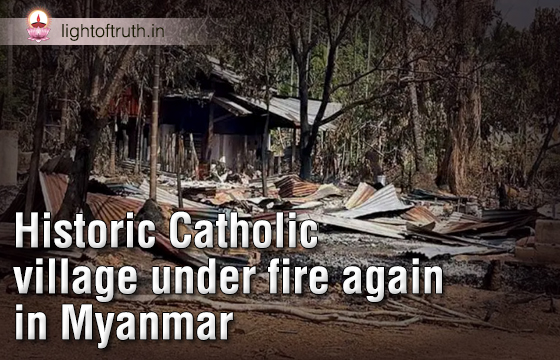
Historic Catholic village under fire again in Myanmar
The Myanmar military has continued to target a historic Catholic village in the country’s Bamar heartland while pressing ahead with attacks on religious buildings in predominantly Christian regions. At least 320 out of the estimated 350 households were burned down during a military raid on Chaung Yoe village in the Sagaing region on May 20, according to local sources.
Thousands of Catholic villagers were forced to flee their homes to nearby safe areas as junta troops set fire to one house after another. Houses in three nearby Buddhist villages were also set ablaze during the military raid on the same day.
Sources said Mary Help of Christians Church, convent and the priest’s house were not damaged. The latest attack came just four days before the annual celebration of Mary Help of Christians on May 24.
“We have no homes and no property. Where will we stay in the village when we return if the situation is deemed safe?”
“It’s so sad. I was in tears when I saw smoke coming out from my village as my house was also burned down,” said a Catholic woman who sought safety among her relatives in a nearby town.
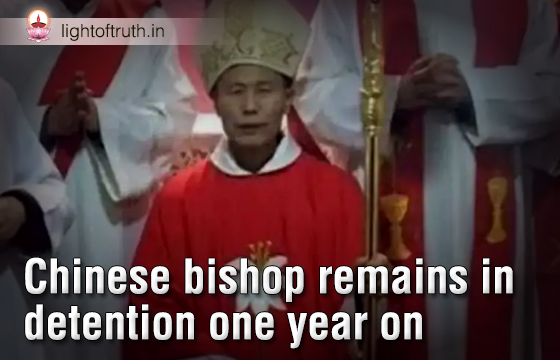
Chinese bishop remains in detention one year on
A Vatican-approved Chinese bishop remains in detention more than one year after his arrest for allegedly violating the communist country’s repressive regulations on religious affairs.
Bishop Joseph Zhang Weizhu of Xinxiang in Henan province was arrested on May 21 last year.
His arrest came a day after police arrested 10 priests and an unknown number of seminarians from a Catholic seminary in the diocese that was set up in an abandoned factory building.
About a year ago, authorities in Xinxiang shut down Catholic schools and kindergartens in line with a government ban on education by religious groups.
All those arrested were accused of violating China’s regulations on religious affairs and subjected to “political lessons” in detention, media re-ports said
The priests and seminarians were released after brief detention but remain under surveillance, while the seminary is still closed.
Since his secret ordination with a Vatican mandate in 1991, Bishop Zhang was under constant pressure and barred from carrying out his duties as Bishop.
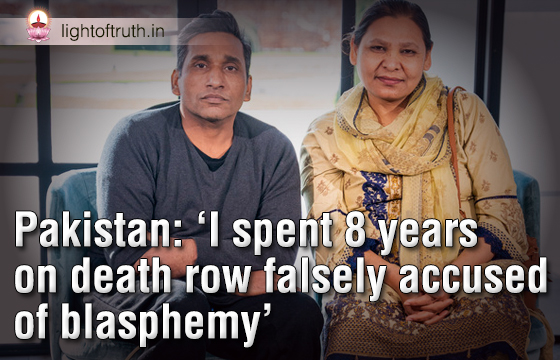
Pakistan: ‘I spent 8 years on death row falsely accused of blasphemy’
In July 2013, Shagufta and Shafqat Emmanuel, a Catholic couple in Mian Channu, a small town 155 miles south of Lahore, Pakistan, were arrested on false charges of blasphemy. After eight years on death row, separated from each other and from their four children, they were finally released on 3 June 2021 by the Lahore High Court. Free at last, Shagufta shares her story with ACN, in her own words.
“I was born into a family with a strong Christian faith. I regularly attended Mass and received Communion, and I was always very eager to go to the catechism and recite the rosary. My father and my mother taught me and my six brothers and sisters to be strong in our faith, and to be ready for all kinds of sacrifices or persecutions.
“Most families in our village were Muslim, but there was also a good number of Christians. We had very cordial relations with Muslims. I remember playing with Muslim girls and we visited each other’s homes and exchanged greetings and sweets during Christmas and Eid al-Fitr. My brothers also had very good Muslim friends. I do not remember any fight or dispute in the name of religion.
“A few years after marrying Shafqat Emmanuel we moved to Gojra, and my husband got a job there. Tragically he was paralysed by a stray bullet, while trying to break up a fight, about 12 years ago. Life was hard after that, but we were fortunate to get jobs at St John’s High School, in Gojra. After school hours, my husband used to repair cell phones, to make some extra money for family expenses.
“Then, one day in July 2013, we were terrified to see several police vans pull up, with dozens of officers. They raided our house and arrested my husband and I on charges of blasphemy in the form of an offensive message about Mohammed, sent via our mobile SIM card. The phone was registered in my name and was used by my husband as well. The offending message was written in English, a language neither my husband nor I speak or read. We were kept in police custody for one night; the next day we were transferred to jail.
“In jail, we were tortured. The officers told my husband that if he did not confess, they would rape me in front of him, and so he confessed, even though we were both innocent.
“We were in jail for eight months before a judge found us guilty and sentenced us to death. Our lawyer was not allowed to complete his closing arguments, and neither of us was heard.”

Hoping for divine intervention to save the Philippines
It has been five decades since the late Philippine dictator Ferdinand Marcos imposed martial law on Sept. 21, 1972. In this 50th year since the iron fist of repression was imposed, his son, Ferdinand “Bongbong” Marcos Jr., will soon be the country’s head of state. Sara Duterte, daughter of outgoing president Rodrigo Duterte, will serve as vice president.
Those who voted for them are rejoicing over the impending return of the so-called golden age, a mythical period of national prosperity, peace and order boastfully dubbed the “Bagong Lipunan” or “New Society.”
When I asked some of them why they were voting for Marcos and Duterte, they could not give clear answers. We can only hope against hope that they can answer this question honestly without being haunted by a not-so-erroneous conscience.
The apathetic others call on their fellow Filipinos to move on. Whatever the meaning of this call, they do not clearly comprehend it, sorry to say.
They can only heave a sigh of regret for their failure to combat the glaring impunity seen in the absence of punishment of human rights violators who roam free and enjoy positions of power.
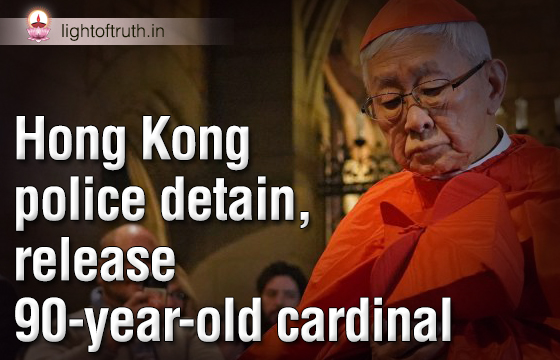
Hong Kong police detain, release 90-year-old cardinal
Hong Kong’s national security police released Cardinal Joseph Zen Zekiun, retired archbishop of Hong Kong, May 11 after detaining him for allegedly colluding with foreign forces.
The cardinal, 90, has been a very public supporter of pro-democracy and independence protests that have roiled the city for much of the past decade and came to a head in 2019 with unprecedented street marches and six months of spasmodic street battles with authorities. He was detained along with along with former opposition lawmaker Margaret Ng Ngoiyee and singer Denise Ho Wansze.
The independent Hong Kong Free Press tweeted a photo of a masked Cardinal Zen and said: “Cardinal Joseph Zen was released on bail from Chai Wan Police Station at around 11 p.m. on Wednesday. He did not speak. He then entered a private car parked outside the police station. The 90-year-old was accompanied by five people when he left the police station.”
The cardinal, Ng and Ho were among five trustees of the 612 Humanitarian Relief Fund, which was set up to offer financial assistance to those involved in anti-government protests in 2019 and which came under scrutiny of authorities over the past year.
A fourth trustee, former adjunct associate professor Hui Po Keung, was arrested by national security police May 10 as he was about to catch a flight to Germany, a source said. The South China Morning Post reported May 11 that Hui had been put on the list of people who would be stopped by law enforcers if they tried to leave the city via the airport or other control points.
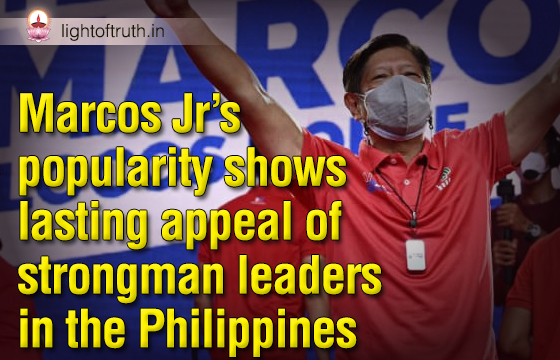
Marcos Jr’s popularity shows lasting appeal of strongman leaders in the Philippines
Nearly 70 million Filipinos headed to polling centres on May 9)to elect the next president of the Philippines, hoping their pick will turn around a country battered by the COVID-19 pandemic over the last two years.
The fight for the presidency was centred between Ferdinand “Bongbong” Marcos Jr, the son and namesake of the late Filipino dictator, and Vice President Maria Leonor ”Leni” Robredo, a human rights lawyer and economist. On May 11 Marcos Jr claimed victory, after partial unofficial counts covering 98 percent of the votes showed he had obtained 31 million votes, double that of Robredo. Sara Duterte-Carpio, President Rodrigo Duterte’s daughter and Marcos Jr’s vice presidential running mate, has also been reported to have won over three times more voters than that of her closest opponent.
In the past, the Marcos family added to the general hardship of Filipinos by plundering billions of dollars from state coffers Dis-illusioned by unfulfilled promises from the Duterte administration to lower costs of living, end labour contractualisation and clean up corruption, they believe Marcos Jr could deliver change. Marcos’ campaign, focused on unifying the country and bringing it back to the global stage must have resonated.
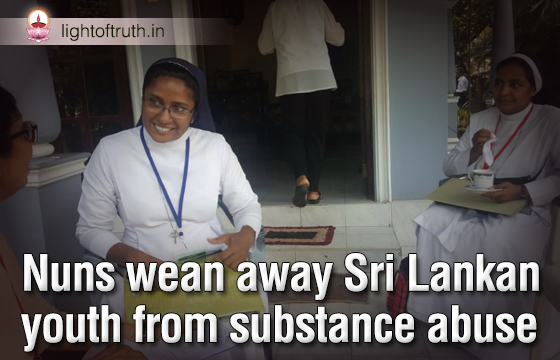
Nuns wean away Sri Lankan youth from substance abuse
Cletus (name changed) is just 24 but now undergoes treatment for heroin addiction at a rehabilitation centre in northern Sri Lanka.
The region, once the centre of the armed conflict between the Sri Lankan army and Tamil Tigers, now faces a new crisis – Substance Use Disorder, says Sister Theophane Cross, head of the Holy Family congregation’s Jaffna province.
The congregation in 2020 started its mission among sub-stance abuse victims when it celebrated its 200th anniversary of foundation.
The civil war ended in 2009, but the island nation is on another war – against drugs — “which is much more challenging and enslaving,” Sister Cross told.
The nuns, who are yet to open a de-addiction centre, refer their patients to the ‘Change Rehabilitation Centre’ managed by the Oblates of Mary Immaculate priests in Jaffna.
Sister Cross says she is deeply pained that most abuse victims are depressed young people with no jobs. “A lot of them are addicted to drugs and alcohol,” she bemoans.
Cletus was brought to the Oblate father’s centre in September 2021 by his wife, sister and mother on the advice of some Holy Family nuns who had visited them.

Pope tells Russian patriarch: ‘Don’t be Putin’s altar boy’
Warning that the Russian Orthodox patriarch should not “turn himself into Putin’s altar boy,” Pope Francis also said he would like to go to Moscow to meet Vladimir Putin in an attempt to end the conflict in Ukraine.
The Pope reiterated that he would not be going to Kyiv “for now,” but “I first must go to Moscow, I must first meet Putin,” he said in an interview with the Italian newspaper Corriere della Sera, published May 3. Vatican News also published most of the interview.
Pope Francis said he sent a message through Cardinal Pietro Parolin, Vatican secretary of state, “20 days after the war” started, to be delivered to Putin telling him, “I was ready to go to Moscow.”
“We still have not had a response, and we are still being persistent, even though I am afraid Putin may not be able to and may not want to have this meeting right now,” the Pope said. “I am doing what I can. If Putin were to open the door. …”
“But so much brutality, how do you not try to stop it? We saw the same thing with Rwanda,” he said, referring to the genocide against members of the Tutsi minority ethnic group in 1994, when at least 500,000 people were killed in about 100 days.
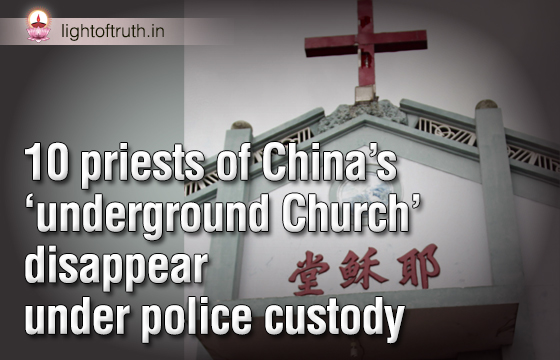
10 priests of China’s ‘underground Church’ disappear under police custody
At least 10 priests of the unofficial or “underground” Catholic community in the city of Baoding in the province of Hebei disappeared in the hands of the police since January this year.
At least four of those who went missing disappeared on the 29th and 30th of April, said a report on AsiaNews.
The underground Catholic community in Baoding is one of the oldest and most numerous in China even as its bishop, Giacomo Su Zhimin, has been in the hands of the police for at least 25 years, having already spent more than 40 years in forced labor in the 1970s.
Another Catholic priest in the city, Liu Honggeng, is in prison for seven years already. The unofficial community of Baoding split after its vicar, Francis An Shuxin, decided to join the “official Church” after spending decades in prison.