

For more than three decades, Ruma Brizita Biswas had sung several popular liturgical and devotional songs with incorrect notations and lyrics because nobody taught her the correct versions.
“One of my favorite songs is Jishu ghrinar rajjye enechho tomar prem (Jesus, you brought your love to the kingdom of hatred), but I had been singing it incorrectly all my life as ‘Jesus brought love to your kingdom of hatred.’ The same happened to other songs as well,” Biswas, a Bengali Catholic, told..
The 40-year-old is choir leader of St. Joseph’s Cathedral Parish of Khulna Diocese in southern Bangladesh. The parish has about 5,000 Catholics.
A church-sponsored mu-sic training program in national capital Dhaka has helped her correct her wrong lyrics, she said.
Biswas was one of 50 participants in the national training on liturgy and church music by the Catholic bishops’ commission for liturgy and prayer at Holy Spirit Major Seminary from June 3-9. They included two priests, 11 nuns and laypeople representing eight Catholic dioceses of Bangladesh.
Category Archives: Asian
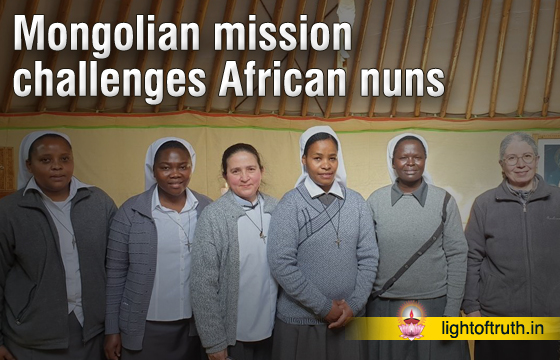
Mongolian mission challenges African nuns
For Sister Tireza Gabriel Usamo, a 38-year-old Catholic nun from Ethiopia in Africa, the climate and customs of Mongolia have been a constant challenge ever since she went there as a missionary. She is part of a three-member team of nuns from Consolata Missionaries working in Arvaikheer town in central Mongolia. The Church in Mongolia was re-established when three Immaculate Heart of Mary missionaries arrived there in 1992, a year after democracy was restored after the fall of communism. The Catholic Church was active in Mongolia in the 13th century but its role was ended by the Yuan Dynasty in 1368. Christianity was then for-bidden in a country sandwiched between China and Russia.
As the Church marks 30 years of its reincarnation in 2022, it has two Mongol priests, 22 foreign missionaries and about 35 missionary nuns including Sister Usamo. They work for some 1,400 Catholics under the Ulaanbaatar Apostolic Prefecture, which covers the entire country of some 3.3 million people. Ulaanbaatar’s Italian Bishop Giorgio Marengo is among 21 bishops that Pope Francis will make cardinals in a consistory in August. Bishop Marengo, also a Consolata missionary, met the pope in May with a team of Buddhists in an effort to promote interfaith collaboration in Mon-golia.

Japanese Catholic toils 40 years on world’s tallest Marian statue
An elderly Catholic sculptor in Nagasaki, Japan, is all set to complete and install the world’s tallest wooden statue of the Virgin Mary after four decades of time, energy and money.
Eiji Oyamatsu, 88, a Catholic from Fujisawa, Kanagawa prefecture, will unveil the 10-meter wooden statue of Mary with the child Jesus at the end of June, reported Japanese newspaper Asahi Shimbun.
The statue pays tribute to thousands of Christian martyrs of Nagasaki in the 17th century.
The single-handed effort by Oyamatsu encouraged a group of volunteers to form the Citizens’ Association for Minami-Shimabara World Heritage in 2018. The group from Nagasaki prefecture has bought land to install the statue to honour the martyrs of the Shimabara-Amakusa Rebellion, aiming to turn the site into a popular shrine.
The revolt, mostly by local Catholic peasants, stemmed from grievances over excessive taxation and abuses by officials of the Shimabara peninsula and the Amakusaretto islands. It was brutally crushed by the 120,000-strong army of the military government of the Tokugawa Shogunate. The suppression between 1637 and 1638 left about 37,000 Christians dead and effectively ended Christianity in Japan until its revival in the 19th century.
The purge forced all remaining Christians to renounce their faith publicly. However, many Christians continued to practice their faith secretly and came to be known in modern times as kakure kirishitan (hidden Christians).
“It seems fateful that I set about this work without being commissioned by anybody, and the statue will now be hosted in a place that deserves it the most.”
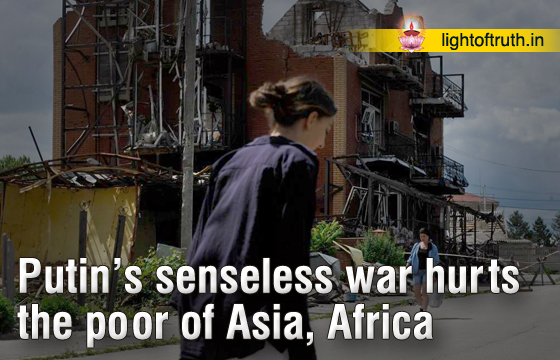
Putin’s senseless war hurts the poor of Asia, Africa
Russia’s invasion is causing inflation and threatening millions of people who depend on Ukrainian produce
The savage war of Vladimir Putin against the peaceful people of Ukraine is the work of a man with ambitions bent on trying to secure his place in Russian history as the leader who restored the false “glory” of the Russian Soviet Union that disintegrated in 1989. There was no glory there but oppression, occupation of half of Europe and a Cold War that threatened nuclear annihilation of the world.
Putin’s massively destructive war, with continuous atrocities and war crimes, is now threatening another form of annihilation — that of millions of people in Asia and Africa who depend on Ukrainian wheat, maize and cooking oil as do other poor nations of the world.
The Russian president has blocked the export of millions of tons of Ukrainian cereals and cooking oil from Odessa on the Black Sea. He wants sanctions lifted before he will lift the blockade. In the meantime, evidence has emerged that Russia is stealing Ukrainian grain and shipping it to Crimea and then to Syria. It is a war tactic to starve the world and force Western nations to lift sanctions while millions go hungry and many die.
Ukraine was exporting 4.5 million tons of agricultural produce per month through its ports on the Black Sea. There are around 20 million tons of grain stockpiled in silos and there will be no storage facilities available for this year’s harvest of wheat, barley and grapeseed. Despite the war and the departure of up to 5 million Ukrainians, the farmers have continued to plant crops but have nowhere to store them. The sales are needed for national survival.
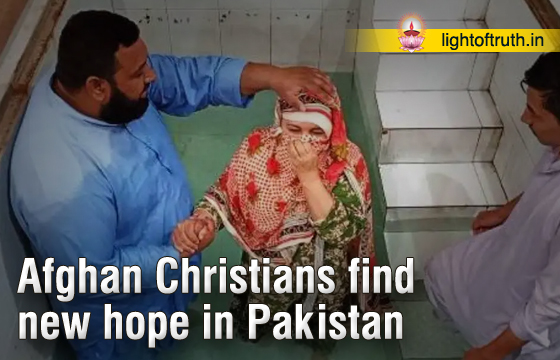
Afghan Christians find new hope in Pakistan
Three days before the Taliban seized control of Kabul, Arifa Rahimi received a threatening phone call. “You have been traced. We know that you are a Shia kafir [infidel] and a journalist reporting against us,” said the unknown caller.
In September 2021, Rahimi hired a car to reach the Chaman-Spin Boldak border with her younger brother and four nephews, aged 8-14. Wearing a light blue chadori (the head-to-toe burqa), she entered Quetta in Pakistan’s restive Balochistan province without a visa.
“Each passenger cost 6,310 afghani (US$71). However, the driver charged half-payment for children,” said 24-year-old Rahimi, who used to report for Kabul-based Farhang Press. Luckily for them, the border security wasn’t tight in the early days of the Taliban takeover. And waiting for legal documentation could have meant risking arrest and possible execution “My elderly parents couldn’t join us,” says Rahimi, who now shares one of the four rooms in a rented house with other Afghan families in Quetta. She deleted Taliban call logs to avoid scrutiny by Pakistani border and security personnel and now uses a local SIM card.But as an unregistered refugee, Rahimi doesn’t have any income. Her brother, a tailor, supports the family.
“I accepted Christ as I read in the Bible John 3:16. On one side our own people were trying to kill us while a pastor was helping us with rations and money. I found Christ as my savior” In November, she was baptized by Pastor Irfan James in a small church in Quetta.”I accepted Christ as I read in the Bible John 3:16. On one side our own people were trying to kill us while a pastor was helping us with rations and money. I found Christ as my savior,” she told UCA News.She is among the 100 believers who have received a copy of the Bible from Pastor James, who is running an underground ministry from Jalalabad in eastern Afghanistan. He has to grow a beard and leave church documents behind before crossing the border using local contacts. They also help him in relocating underground Christians.
“Changing physical gestures is crucial for survival,” Pastor James told UCA News via WhatsApp. “Many have changed their phone numbers to avoid persecution. The Afghani converts along with defense personnel and spokespersons of the former government are on the Taliban’s hit list.”
Some 450 Afghan families, living in an Islamabad park, have been holding protests for months demanding legal status, with many seeking onward passage to European nations.
The protesting families, including children, carry mock coffins and wear white shirts emblazoned with messages in red paint saying “Kill us or rescue us.”
Instead of initiating a police crackdown on the protesting Afghans, the government of Pakistan should shelter the refugees on a humanitarian basis, said Pastor James.”Women have vanished and families are forced to sell their children due to crippling hunger and economic crisis. Church groups should invest in small business enterprises and medical camps for the converted Afghans,” he added.
“The Taliban have access and followers in Quetta. My nephews depend on me. Everything is so expensive but I do not want to return. We need help”Since the Taliban takeover, the persecution watchdog Christian Solidarity International and two local churches have been helping 400 Afghan refugees in Quetta and Chaman, another border town of Pakistan.
They are among 250,000 Afghans who have crossed into Pakistan after the Taliban seized full control of the country next door.
The United Nations High Commissioner for Refugees (UNHCR) has estimated that 1.3 million Afghan refugees are registered in Pakistan. In Afghanistan, the estimated 10,000 to 12,000 Christians are all converts from Islam and forced to worship secretly in homes or other small venues.

Filipino prelate gets another top Vatican post
Pope Francis has appointed Manila’s former archbishop Cardinal Luis Tagle as a member of the Congregation for Divine Worship and the Discipline of the Sacraments.
Cardinal Tagle’s appointment, along with several other leading churchmen including Myanmar’s Cardinal Charles Maung Bo, was announced by the Holy See’s press office on June 1.
The Congregation for Divine Worship forms the part of the Roman Curia — the administrative institution of the Holy See — that handles most affairs relating to liturgical practices of the Latin Church and some technical matters relating to the sacraments.
Its functions were originally exercised by the Sacred Congregation of Rites, set up in January 1588 by Pope Sixtus V. The current prefect is English Archbishop Arthur Roche, whom the Pope appointed as a cardinal on May 29.
Cardinal Tagle’s appointment to the congregation was welcomed by Filipinos around the world.
“Congratulations, Your Eminence! May the Lord be with you and guide you as you undertake yet another mission for the Roman Curia,” a group of Filipino domestic workers in Italy posted on social media.
On Dec. 8, 2019, Pope Francis named Cardinal Tagle as prefect of the Congregation for the Evangelization of Peoples, a post he still holds
Catholics living in the United States said the appointment showed yet again the pope had the utmost trust and confidence in the Filipino cardinal.
“Another appointment at the Vatican by Pope Francis? I am not surprised given his [Tagle’s] humility and love for the Church,” Arlyn Reyes from New York told.
On Dec. 8, 2019, Pope Francis named Cardinal Tagle as prefect of the Congregation for the Evangelization of Peoples, a post he still holds.
He is also the first Filipino to be afforded the title of cardinal-bishop, the highest rank within the College of Cardinals.
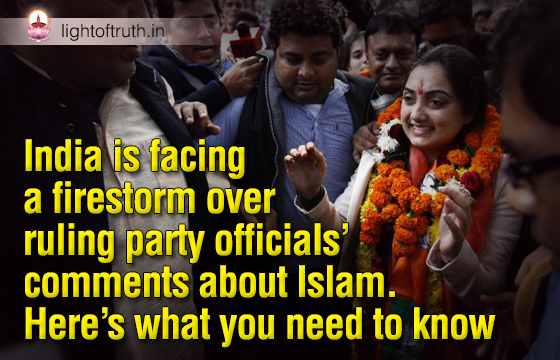
India is facing a firestorm over ruling party officials’ comments about Islam. Here’s what you need to know
India is trying to contain the diplomatic fallout as outrage grows in the Muslim world following derogatory comments made by ruling party officials about the Prophet Mohammed.
The United Arab Emirates, Malaysia, Oman, and Iraq are among at least 15 Muslim-majority nations to have condemned the remarks, which were described as “Islamophobic,” with several countries summoning India’s ambassadors.
The incident sparked protests in neighbouring Pakistan and prompted calls from around the region to boycott Indian goods.
India’s Hindu nationalist ruling Bharatiya Janata Party (BJP) disciplined the two officials involved, but the firestorm involving India’s major Arab trade partners is yet to die down.
Here’s what you need to know.
At the centre of the controversy is Nupur Sharma, now suspended national spokesperson for the BJP — the party of Indian Prime Minister Narendra Modi.
On May 26, Sharma made comments during a televised debate on an Indian news channel about the Prophet Mohammed that were widely deemed offensive and Islamophobic.

Thailand just decriminalized cannabis. But you still can’t smoke joints, minister says
On June 9 Thailand became the first country in Asia to decriminalize cannabis — but tough penalties will still apply to those who use the drug to get high, according to the minister who spearheaded the change.
Speaking to CNN in an interview ahead of the move, Thai Health Minister Anutin Charnvirakul said he expected legal cannabis production to boost the economy but cautioned that recreational use of the drug remains illegal. “It’s a no,” said Anutin, who is also a deputy prime minister. “We still have regulations under the law that control the consumption, smoking or use of cannabis products in non-productive ways.”
Under decriminalization, it is no longer a crime to grow and trade marijuana and hemp products, or use parts of the plant to treat illnesses. Cafes and restaurants can also serve cannabis-infused food and drinks — but only if the products contain less than 0.2% tetrahydrocannabinol (THC), the plant’s main psychoactive compound.
Harsh penalties remain in place under the Public Health Act, including up to three months in jail and an $800 fine for smoking cannabis in public.

One-on-one with priest leads Japanese atheist to baptism
Kazuhiro Sasahara met the priest suggested by his Catholic wife, a member of Kitami Church on Japan’s island of Hokkaido
One-on-one with priest leads Japanese atheist to baptism
Kazuhiro Sasahara was born into a family of the Buddhist Jodo Shinshu sect but considered him-self an atheist. Because his wife, whom he met as a student, was baptized as an infant, their wedding was held in a Catholic church and their three children were baptized as infants.
“I went to church once a year at Christmas and I didn’t say anything about the faith of my wife or children, leaving that to my wife. Besides going to church on Sundays, my wife doesn’t say much about her faith. However, compared to the beginning of our marriage, statues of Mary and crosses have multiplied all over the house,” said the 63-year-old Japanese man.
After his retirement from years as a principal of elementary and junior high schools, Sasahara engaged in after-school children’s classroom activities with the board of education until April of last year.
At that time, “I thought it might be better to have the same faith as my wife.” He did not believe in God’s existence, but as his remaining years “shortened” he wanted to go into the future “with the same attitude as my wife with whom I’ve shared life for so many years.”
His wife, a member of Kitami Church on Japan’s northern island of Hokkaido, suggested that he meet the parish priest, Father Masahiro Uesugi of Sapporo Diocese. Since July 2020, they have met once a month.
“At the time, I didn’t have any strong desire for baptism or to attend any study sessions,” said Sasahara. “I just wanted to talk with the priest. I talked about books I had read, movies I had seen, TV dramas, and the state of the world today, and the priest talked about his interests.”
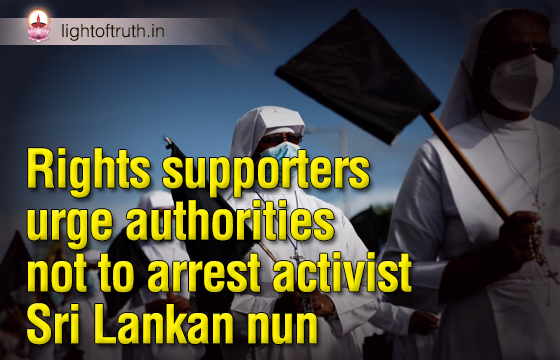
Rights supporters urge authorities not to arrest activist Sri Lankan nun
Activists called on Sri Lankan authorities not to arrest an activist nun who has supported anti-government pro-testers.
Sister Mary Sonali of the Congregation of the Apostolic Carmel was summoned by police June 7 to record a statement about an arson attack.
Shehan Malaka Gamage, a social activist and national convener of the Coalition of Catholic Lay Organizations, said June 8 that Sister Sonali was accused of aiding violence and inciting people to set fire to houses.
“We stand against the continuing state repression and the large number of arrests. Police have arrested many social activists to satisfy the needs of politicians and by now they have begun to touch the clergy as well. That is a very serious matter,” Gamage said.
“Several Buddhist monks were recently imprisoned on absurd charges but eventually the court released them. Even Father Cyril Gamini was prepared to be arrested in the same manner, but the police failed,” he said.
Father Gamini is former director of the National Catholic Center for Social Communications and has been an outspoken critic of how government agencies handled the investigation of the Easter 2019 attacks — including two on Catholic churches — that killed 279 people in three cities.