
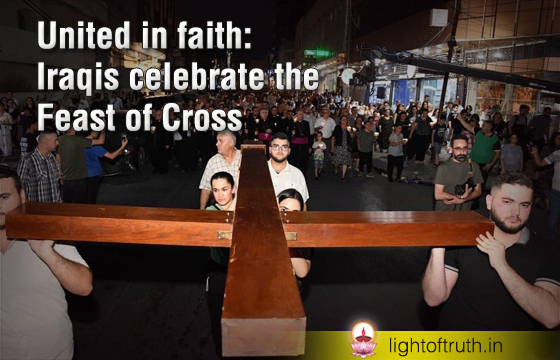
A historic moment in Erbil, northern Iraq. In Ankawa, a suburb of the capital city of Iraqi Kurdistan located in the north of the country, hundreds of Christians are participating in the Feast of the Cross, which began on Monday 9 September and will continue until Friday. The joyous event is marked by high hopes given that the Christians of various traditions are coming together for the celebration – Catholic, Orthodox and Assyrian – the first time united together in celebrating the memory of the finding of the Holy Cross on which our Lord died for the redemption of all.
The focus of the celebrations underscores the faith that unites Christians. They are praying every day in a different church and participating in the various cultural meetings organised in the streets of the suburb, made festive with special lights and colours. All the events are part of the preparations for the liturgical Feast of the Exaltation of the Holy Cross, which will take place on 14 September for churches following the Gregorian calendar or 27 September for those following the Julian calendar.
At the opening of the festivities on Monday 9 September, a large cross was carried in procession to the Assyrian Church of the East of St. John the Baptist. The solemnity of the celebration was reflected in the hymns sung by the clergy and faithful holding large lit candles, a sign not only of praise and adoration but also of sharing and peace. “Churches used to celebrate this commemoration separately every year. But this year is wonderfully different,” underscored Monsignor Bashar Matti Warda, arch-parish priest of the Chaldean Catholic Diocese of Erbil, who organised the event with the blessing of Mar Awa III, Patriarch of the Assyrian Church of the East, and the Bishops of the Syro-Catholic and Syro-Orthodox Churches.
In his address during the festival, Patriarch Mar Awa III explained how “the celebration of the Feast of the Finding of the Cross of our Lord Jesus Christ represents an important milestone in the divine plan in the Church of the East. When we look at the cross, we remember the sufferings of Christ, but also his glorious resurrection from the dead. And when we make the sign of the cross over ourselves, we proclaim our expectation of his Second Advent and our faith in eternal life.”
The celebrations of the Feast of the Holy Cross represent a further and concrete step in ecumenism to which the Catholic Church attaches great importance, as Pope Francis affirmed in his Apostolic Exhortation Evangelii Gaudium: “commitment to ecumenism responds to the prayer of the Lord Jesus that ‘they may all be one.’”
The events also represent a positive sign for the future of Iraqi Christians: over time, wars, political instability and the rise of the Islamic State have driven thousands of Christians of all denominations out of the country. Just some time ago, Monsignor Bashar Matti Warda himself, in the absence of official statistics, declared that “in all of Iraq there are around 300,000 Christians remaining.” But hope remains alive despite the reduced numbers of this flock, as the Ankawa festival is proving.
Category Archives: Asian
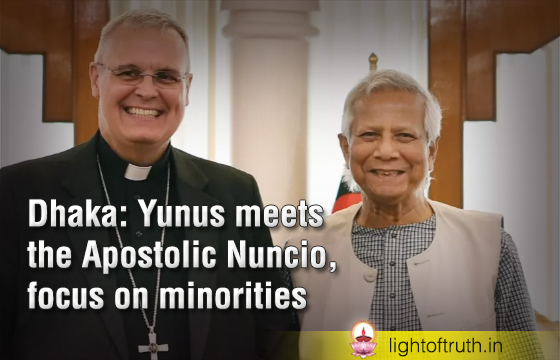
Dhaka: Yunus meets the Apostolic Nuncio, focus on minorities
On 9 September the Apostolic Nuncio to Bangladesh, Msgr Kevin S. Randall, met with Muhammad Yunus, Chief Advisor to the interim government created after former Prime Minister Sheikh Hasina fled to India.
At the Rashtriya Guest House Jamuna in Dhaka, the two discussed various issues, including the protection of religious minorities in the country. The nuncio proposed the creation of an institution for interreligious dialogue between the Vatican Delegation for Interreligious Dialogue and Bangladeshi scholars of Islam.
He went on to emphasise the need to increase humanitarian assistance for over one million Rohingya refugees living in camps in Cox’s Bazar. To which the Chief Advisor responded by asking for the Vatican’s support. After the meeting, Msgr Randall told AsiaNews he shared with Yunus ‘that Pope Francis is always concerned about the plight of the displaced people. The Church in Bangladesh, through Caritas, has been helping the Rohingya since 2017’.
On the other hand, Yunus, who won the Nobel Peace Prize in 2006 for fostering the development of microcredit in Bangladesh, emphasised that the interim government’s main goal is to improve security after last month’s protests (strikes and demonstrations are still ongoing in some outlying areas) and to implement major reform programmes.
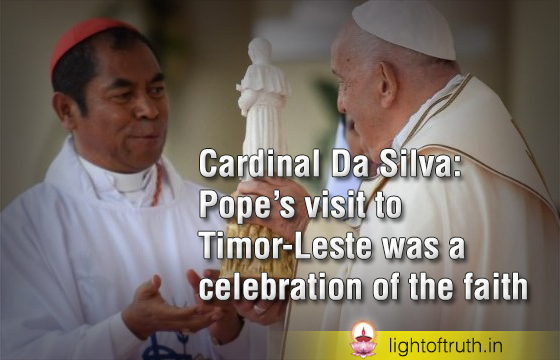
Cardinal Da Silva: Pope’s visit to Timor-Leste was a celebration of the faith
“It was a historical event, a celebration for the people of Timor, a celebration of the faith of the Catholic Church in Timor, years after the first visit of St. Pope John Paul II, and the first visit to our homeland as a sovereign nation.” In an interview with Vatican News’ Fr. Bernardo Suate, Cardinal Virgilio do Carma da Silva, Archbishop of Dili, described Pope Francis’ just-concluded Apostolic Visit to the nation, calling it “successful” thanks to all who made the Journey possible.
“The Pope’s visit,” Cardinal Da Silva observed, “affirmed and confirmed our identity, saying to the Timorese: ‘Even though we are small as a country, we have something unique, and that is our Catholic faith.'” “We are not Indonesians, nor are we Australians, but we are Timorese,” he said, noting that, as such, “we have our own unique Timorese and Catholic identity.” The fruits that “will be reaped from Pope Francis’ presence, for the Church, country, and society,” he insisted, are “reinforcing the faith” and “bringing peace to the young people of Timor.”
Even though Pope John Paul II visited the country when “we were still a colony under Indonesia, in a state of desperation,” the Cardinal highlighted that the former Pope’s message was “one of hope, namely to ‘Be firm in your faith, continue to be salt and light to the world.'” “After two decades of independence, the visit of Pope John Paul II, followed by Pope Francis’ visit, during these two decades of transition in the process of building a nation and a new identity,” Cardinal Da Silva expressed, “there was a new birth in this corner of the world.”
The Holy Father’s stay in the overwhelmingly Catholic-majority island nation, he noted, “was an opportunity to share with the world the reality of the Timorese people,” especially “the faith of the Timorese people, living the Catholic faith in this corner of the world.”
The Cardinal also recalled the “strong messages” the Holy Father left the nation’s young people, namely to be joyful and exuberant, and secondly, “to respect their elders, their parents, and the children.”
“When all young people and children continue to cultivate in their hearts this attitude of respect for others,” Cardinal Da Silva argued, “it will be a big step for us and will make a difference, especially after the Pope’s visit.”
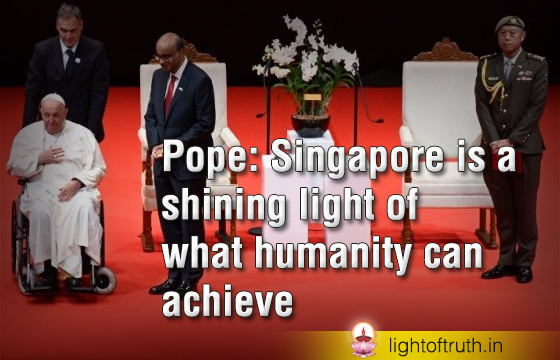
Pope: Singapore is a shining light of what humanity can achieve
Addressing Authorities, Representatives of Civil Society, and members of the Diplomatic Corps at the National University of Singapore (NUS) , Pope Francis expressed his gratitude for the warm reception extended by the Singaporean authorities. He then opened his reflections by highlighting Singapore’s unique role in the world today as “a commercial crossroads of primary importance and a place where different peoples meet”.
The Pope emphasised the city-state’s transformation from its “humble origins” and commended its “unwavering commitment to carry out projects and initiatives” that have helped it develop. He noted that this progress was not achieved by chance, but through “rational decisions” and careful planning. Recalling, then, Lee Kuan Yew, Singapore’s first Prime Minister, the Pope noted his legacy, highlighting how his vision and leadership laid the foundation for the country’s rapid growth and transformation.
Pope Francis then went on to note that Singapore’s dedication is not only to economic growth but also to social justice and the common good. He acknowledged the country’s efforts in ensuring that all citizens benefit from progress, through policies that provide public housing, high-quality education, and an efficient healthcare system and he expressed his hope that these efforts will continue, “until all Singaporeans are able to benefit from them fully.”
However, the Pope also warned against the risk of placing “pragmatism or merit above all things,” which, he said, may inadvertently lead to the exclusion of the marginalised. In this regard, he stressed, as he often does, the importance of remembering the poor and the elderly, and of protecting the dignity of migrant workers. “These migrants contribute a great deal to society and should be guaranteed a fair wage”, he said.
The Pope then took some time to underscore the importance of nurturing authentic human relationships, particularly in the digital age. He urged Singaporeans to use technological advancements to “promote understanding and solidarity” rather than to isolate individuals in a “false and intangible reality.”
He also emphasised Singapore’s “harmonious” coexistence of various ethnicities, cultures, and religions. This inclusivity, said the Pope, is “facilitated by the impartiality of public authorities who engage in constructive dialogue with all,” ensuring that every individual can contribute to the common good. This mutual respect, dialogue, and cooperation, he continued, are essential in “avoiding conflict and chaos,” and in ensuring that development remains balanced and sustainable.
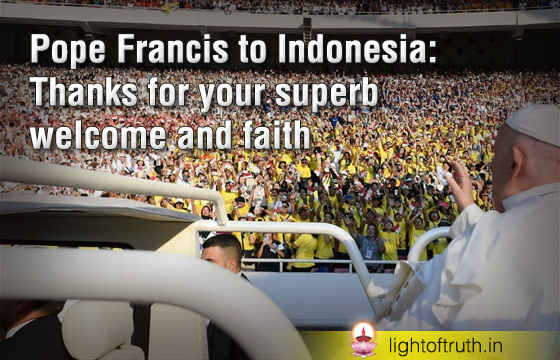
Pope Francis to Indonesia: Thanks for your superb welcome and faith
“May God bless you and make you grow and persevere in peace and fraternal love!”
This was the heartfelt wish Pope Francis offered the Church in the country of Indonesia at the conclusion of the Holy Mass for the faithful on 5 September. Catholics in the country make up about 3 percent of the population, numbering around 8 million. Addressing those gathered in Jakarta’s Gelora Bung Karno Stadium, the Pope thanked Cardinal Ignatius Suharyo Hardjoatmodjo, Archbishop of Jakarta, and the other Bishops of the Church in Indonesia.
He expressed his appreciation for the service of the country’s priests and deacons, who, he said, “serve the holy people of God in this great country.” The Pope also thanked the consecrated men and women, all the volunteers, and, “with great affection, the elderly, sick, and suffering who have been praying for us.” “My visit among you is drawing to an end, and I wish to express my joyful gratitude for the superb welcome that I have received,” he said. Renewing his gratitude to the President of the Republic, civil authorities and security services, the Holy Father expressed his appreciation to the entire Indonesian people. “Dear brothers and sisters,” Pope Francis concluded, “may God bless you and make you grow and persevere in peace and fraternal love!”
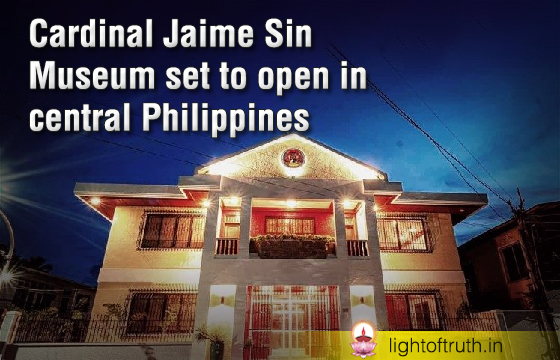
Cardinal Jaime Sin Museum set to open in central Philippines
The Cardinal Jaime Sin Museum will open on September 1, 2024, as announced by the local government of New Washington and the Diocese of Kalibo in the central Philippines.
This museum, the first ecclesiastical museum in Western Visayas, will showcase the life and legacy of Cardinal Sin, who played a key role during the 1986 Edsa People Power Revolution. “Already, we are thankful to the Serviam Foundation and the Kalibo Diocese for making the house of Cardinal Sin a museum,” said Mayor Jessica Panambo of New Washington.
The local chief executive said the government plans to open the museum to the public, especially the youth “so that they would learn all the good things about the good Cardinal.”
The National Museum in Visayas has been training the museum staff since June to prepare for the opening. Exhibits will include personal belongings of Cardinal Sin, preserved by the Serviam Foundation.
Fr. Rufino Sescon, Jr., former personal secretary to Cardinal Sin and current rector of the Minor Basilica and National Shrine of Jesus Nazareno in Quiapo, has donated items and memorabilia to the museum.
The opening events will include a cultural event on August 30 at the New Washington Community Center, followed by an unveiling and blessing on August 31, coinciding with what would have been Cardinal Sin’s 96th birthday. Fr. Justy More, chair of the Historical Research and Cultural Council and project coordinator, said the idea for the museum was proposed at the Catholic Bishops’ Conference of the Philippines meeting in Kalibo to mark the 50th-anniversary jubilee of the Kalibo Diocese in 2026.
The Kalibo Diocese has been preparing for this event since July 2023, following an agreement with the Serviam Foundation to secure and display the late Cardinal’s memorabilia.
Cardinal Sin, the 30th Catholic Archbishop of Manila and the third Filipino cardinal, was a prominent figure during the 1986 Edsa People Power Revolution. Hailing from Chinese-Filipino descent, he left a significant legacy in both the Church and national history.
He was born in New Washington on August 31, 1928. He died of kidney complications due to diabetes on June 21, 2005.
China officially recognizes formerly ‘underground’ bishop, Vatican says
The Vatican announced on August 27 its “satisfaction” that China has officially recognized Bishop Melchior Shi Hongzhen as bishop of Tianjin. “This provision is a positive fruit of the dialogue established over the years between the Holy See and the Chinese government,” reads a Holy See statement released Aug. 27. According to Reuters, 95-year-old Shi had once been placed under house arrest after refusing to join the church officially backed by the Chinese government.
Shi was ordained a priest in the Catholic Church on July 4, 1954, and consecrated coadjutor bishop of Tianjin on June 15, 1982. He was ordained bishop of the Diocese of Tianjin on June 8, 2019. According to the Holy See statement, 56,000 Catholic faithful – distributed across 21 parishes served by 62 priests – belong to the Diocese of Tianjin. Under Pope Francis, the Holy See has expanded dialogue with China and engaged in talks regarding provisional agreements on the appointment of bishops in the Asian nation.
The controversial Sino-Vatican Agreement, first signed in 2018, which has never been made public, is said to stipulate that the Catholic Church is allowed to have bishops in communion with Rome who are at the same time recognized by Chinese authorities in the country. It was renewed in 2020 and 2022.
In 2021, the Holy See sent a delegation led by a member of the then-Congregation for the Evangelization of Peoples (now known as the Dicastery for Evangelization), Archbishop Claudio Maria Celli, to meet with Chinese authorities and negotiate the two-year renewal of the Sino-Vatican Agreement before it expires.
Negotiations between the Vatican and China resumed Aug. 28–Sept. 2, 2022, when a Holy See delegation was sent to meet with local authorities in Tianjin.
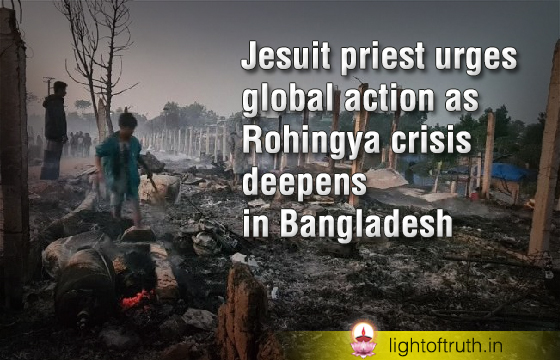
Jesuit priest urges global action as Rohingya crisis deepens in Bangladesh
Seven years after over 700,000 Rohingya fled Myanmar to escape violence, escalating tensions and dwindling aid in overcrowded camps threaten their survival. In an AsiaNews report, Father Jerry Gomes, a Jesuit priest and head of Jesuit Refugee Service (JRS) programs in Bangladesh,warned that Bangladesh cannot continue to bear the burden alone, urging the international community to take action.
“The violence in the camps continues, with incidents of theft, vandalism, murder, and kidnappings,” said Fr. Gomes, who has worked in Cox’s Bazar for seven years. As Myanmar’s civil war rages, more Rohingya refugees continue to flee, further straining Bangladesh’s resources. He stressed that repatriation is not viable without peace in Myan-mar. “A peaceful and favourable atmosphere must be created so that all ethnic communities can live in harmony,” he said.
Since 2020, JRS has partnered with Caritas Bangladesh to provide education, psychological support, and vocational training to over 6,000 Rohingya children and adolescents.
However, a 70 percent funding gap hampers efforts. Out of 400,000 school-age children, only 300,000 attend learning centres. Rising violence in the camps further jeopardizes progress.
Fr. Gomes echoed Pope Francis’ 2017 call for global compassion and justice for the Rohingya, emphasizing the need for the international community to step up.
“The international community should address the issue of repatriation since Bangladesh cannot hold them for long,” he said, urging global action to secure peace in Myanmar and support the refugees.
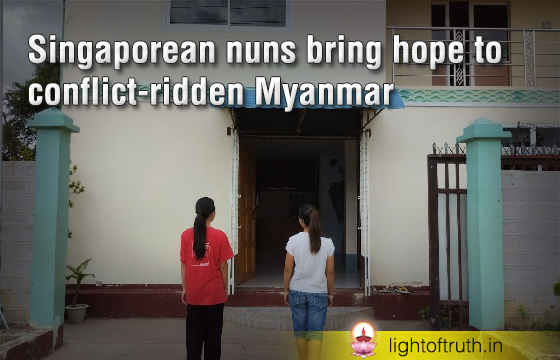
Singaporean nuns bring hope to conflict-ridden Myanmar
In 2021, a military junta seized power in Myanmar, plunging the country into a state of civil conflict, substantially worsening what was already a difficult humanitarian situation. For several decades, the Canossian Daughters of Charity, a religious congregation with a strong presence in Singapore, have been at work in the country, aiming to build a brighter future for Myanmar’s youth.
Canossian Sisters from Singapore first began making trips to Myanmar in 1996 – a journey of around 2,000 kilometres. They went, says Sr. Wang, in response to a request for help from the late Burmese Archbishop Matthias U Shwe, then Bishop of Taunggyi.
The Archbishop had invited them to educate the country’s young, and to help with the formation of groups of young evangelizers. Volunteers travelled regularly from Singapore to Myanmar on mission outreach trips for more than a decade, organising everything from leadership camps and English lessons to Bible courses.
Then, in 2008, the Canossians set up their first centre in the country, which became home to a small group of Sisters and lay partners. That community began a programme aimed at the integral formation of educators, with the motto: “Serve With Love.”
In 2012, they opened Canossa Home, which housed residential facilities for the formation of educators, as well as a boarding house for children from poor families living in villages with no schools.
These educators are trained to give quality care to children and teenagers staying in boarding houses run by the local Church – who otherwise would have no access to professional training – by educating them to one day become teachers themselves.
Since the centre was opened in 2008, the Sisters have trained about 350 young women, most of whom have now returned to serve in communities throughout Myanmar.
In 2017, meanwhile, the Sisters opened a preschool for children in the area.
Since the COVID-19 restrictions in 2020 and the military coup in 2021, volunteers from Singapore have not been able to travel to Myanmar. The Sisters and volunteers in Singapore keep in touch by sending parcels with food and other necessities. The communities in Myanmar, meanwhile, are kept running by six local Canossian Sisters and trained local lay staff, mentored by an experienced Sister from Singapore.
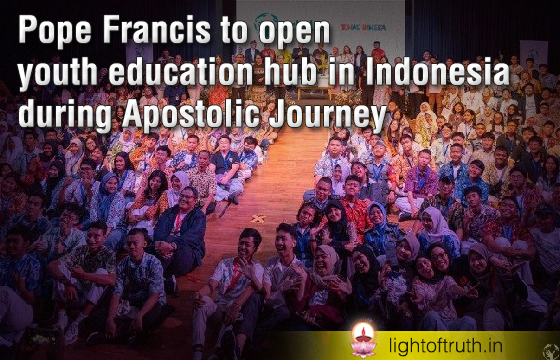
Pope Francis to open youth education hub in Indonesia during Apostolic Journey
Pope Francis will inaugurate the first regional headquarters of Scholas Occurrentes in Southeast Asia during his visit to Indonesia from Sept. 3 to 6.
The global educational project, which started in 2001 under his leadership as Archbishop of Buenos Aires, focuses on engaging youth in education, art, and sports.
On September 4, Pope Francis will visit the “Grha Pemuda” Youth House in Jakarta, where he will meet 200 Indonesian students from various islands, schools, and religions, according to a report by AsiaNews.
The visit will highlight the values of unity in diversity and the culture of encounter, key principles of Scholas Occurrentes.
Scholas Occurrentes will also launch the Scholas Citizenship program in Southeast Asia. This initiative is in partnership with Indonesia’s Ministry of Education, Culture, Research, and Technology and the Global 5P Movement.
The program will train university students and young teachers in the Scholas methodology, which they will implement in their communities.
Scholas Occurrentes said that the approach seeks to address the needs of Indonesian society, where the youth population is growing rapidly.
Scholas Occurrentes started as a project in Buenos Aires to bring together students from public and private schools, regardless of religious background, to work for the common good.