
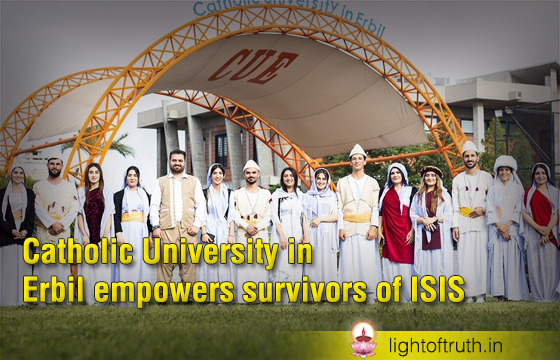
Founded in 2015, the Catholic University in Erbil, located in the Kurdistan region of northern Iraq, offers education, scholar-ships and support to the Iraqi minority groups that suffered under ISIS. In 2014, so-called Islamic State swept across nor-thern Iraq, capturing vast swathes of territory. The invasion led to mass displacement, particularly of minority groups such as Christians, Yazidis, Turkmen and Shabak. Many of these re-fugees fled to the Kurdish region of northeast Iraq, where – says Fr Karam Shahmasha, a priest of the local Chaldean Catholic Archdiocese – the local Church sought to provide them with housing, food, and medical care.
In time, Fr Shahmasha tells Vatican News, these charitable initiatives gave rise to an even bigger project: the founding of the Catholic University in Erbil, or CUE, which aimed to be a “beacon of light in the midst of chaos”. The goal was to welcome students of all backgrounds, particularly to those who had suffered the most from recent violence.
In a talk at Boston College in 2023, Archbishop Bashar Warda, CUE’s Chancellor and Chairman of the Board of Trustees, stressed that “We opened the doors of CUE to those most affected by ISIS: the forcibly displaced, the Christians, and the Yazidis … We are committed to being a strong voice for the hurt.”
Category Archives: Asian

Israel invades the famous Pater Noster church in Jerusalem and sparks diplomatic conflict with France
On November 7, Israeli police entered the grounds of the Pater Noster Church on the Mount of Olives, briefly detaining two French security officers and igniting a diplomatic dispute. The site, managed by France for over 150 years, is one of four proper-ties in Jerusalem under French control, but this unprecedented breach has stirred deep concerns in Paris.
France’s Foreign Minister, Jean-Noel Barrot, had been set to visit the church complex–known as Eleona in French – but abruptly canceled after learning of the police intrusion, calling it “unacceptable.” France’s Mini-stry of Foreign Affairs responded swiftly, declaring it would summon Israel’s ambassador to address what it described as a violation of diplomatic protocol.
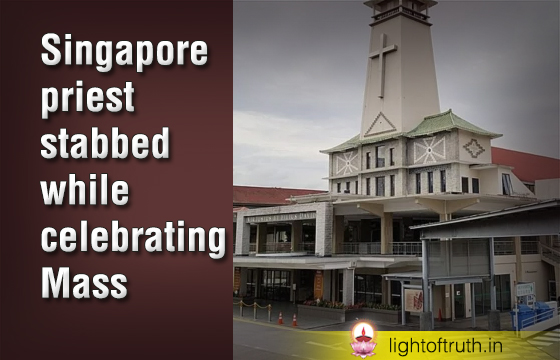
Singapore priest stabbed while celebrating Mass
The parish priest of St Joseph’s Church in Upper Bukit Timah, Singapore, was stabb-ed during Mass on Saturday evening, re-ported Channel News Asia. Father Christo-pher Lee, 57, whose stabbing occured dur-ing Communion, was taken to Singapore’s National University Hospital and is said to be in stable condition. The attacker, a 37-year-old Singaporean, has been arrested.
According to Singapore’s Police Force, he had been disar-med by members of the congre-gation, before later being arrested by police officers, the Singapore Police Force said in a statement, noting the assailant has past antecedents for serious hurt and misuse of drugs offences. “Based on the preliminary investigations, the man,” they noted, “is believed to have acted alone and the police do not suspect that this is an act of terrorism, for now.” “The public,” the po-lice urged, “is urged to remain calm and refrain from specula-tion as investigations are ongoing to ascertain the motive behind this incident.”
Cardinal William Goh, the head of the Catholic Church in Singapore, said he was “shocked and deeply saddened that violence has been committed against one of our beloved priests in the house of God while he was celebrating Mass.” “I am also very concern-ed,” he added, “about the psy-chological impact this incident may have had on our children and all who witnessed this attack.” “I ask,” Cardinal Goh urged, “the faithful to remain calm, not to speculate on the incident or pass judgment without knowing all the facts. We must allow the authorities to investigate the matter.”
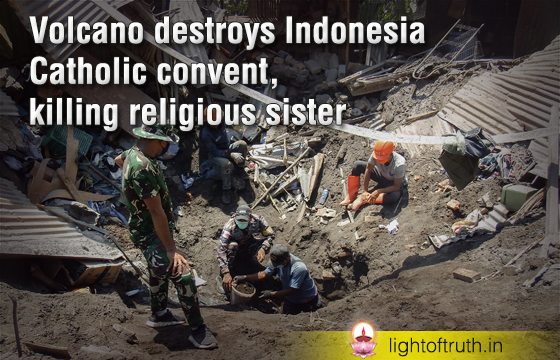
Volcano destroys Indonesia Catholic convent, killing religious sister
A volcanic eruption destroyed a monastery in Indonesia on Nov. 3, leaving at least 10 people dead, including a Catholic sister.
Just minutes before midnight on Sunday, Mount Lewotobi Laki-Laki on the Island of Flores erupted, spewing ash 6,500 feet high and destroying local villages, causing residents to evacuate. Locals did not receive alarms or warnings of the eruption, according to a report by Asia News. Sister Nikolin Padjo, head of a local monastery in Boru, Wulanggitang, died in the eruption, according to a report by Union of Catholic Asian News. Padjo was a Missionary Servant of the Holy Spirit (SSpS) and lived in the Hokeng Sisters Monastery. Another sister reportedly went missing as the sisters fled amid the volcanic ash, according to the Associated Press.

The remains of one of the oldest churches in the world found in the ancient capital of the Kingdom of Armenia
A group of scholars recently announced the discovery of the remains of a fourth-century church in Artaxata, the ancient capital of the kingdom of Armenia. For experts, the building represents one of the oldest places of worship in the world and the oldest in the area where the kingdom once ruled, which is also the first in history to have embraced Christianity as an official religion.
The remains of the octagonal-shaped church were unearthed in Artaxata, the ancient capital of the Kingdom of Armenia, by a joint team of archaeologists from the University of Münster (Germany) and the National Academy of Sciences of Armenia, who have been working at the site since September.
The discovery “consists of an octagonal building with cruciform extensions” that “corresponds to early Christian memorial buildings,” reads the press release by the German university.
The researchers also found fragments of marble that show that it was “lavishly decorated” with valuable imported materials. “In the cross-shaped extensions, the researchers discovered the remains of wooden platforms, which were radiocarbon dated to the mid-4th century CE,” the statement goes on to say.
This dating enabled the researchers to determine that the structure “is the oldest archaeologically documented church in the country – sensational evidence for early Christianity in Armenia,” said Prof Achim Lichtenberger of the University of Münster.

Holy See and China extend Provisional Agreement on appointment of bishops
“In light of the consensus reached for an effective appli-cation of the Provisional Agree-ment regarding the Appointment of Bishops, after appropriate consultation and assessment, the Holy See and the People’s Repu-blic of China have agreed to extend further its validity for four years from the present date,” according to a communiqué released by the Holy See Press Office on Tuesday, 22 October 2024.
“The Vatican Party,” the statement continues, “remains dedicated to furthering the respectful and constructive dialogue with the Chinese Party, in view of the further development of bilateral relations for the benefit of the Catholic Church in China and the Chinese people as a whole.”
This is the third renewal of the Agreement that, with the signing on 22 September, 2018, opened a historic chapter in relations between the Holy See and the People’s Republic of China, and within the Church itself in China, allowing all bishops to be in full hierarchical communion with the Pope.
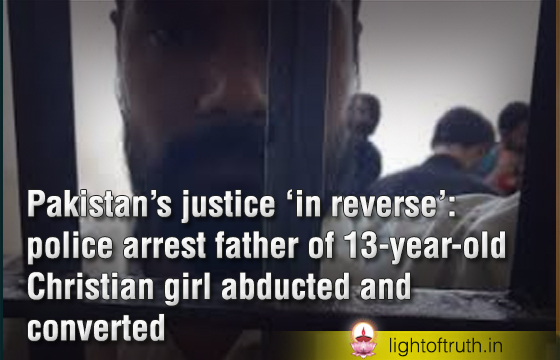
Pakistan’s justice ‘in reverse’: police arrest father of 13-year-old Christian girl abducted and converted
Shakeel Masih was asking for justice. Instead, the father of Roshani Shakeel, a 13-year-old Christian girl abducted, forcibly converted to Islam, and given in marriage against her will in March, was taken into custody last Friday and held for three days on the order of Judge Farooq Latif. Such an episode represents yet again justice “in reverse”, another human rights violation in Pakistan, where being part of a religious minority continues to be a serious risk factor for one’s own safety and that of loved ones.
Roshani was taken from her family on 13 March. With the complicity of an imam, local authorities facilitated her conversion, falsely registering her as an 18-year-old, and renaming her Zehra Bibi. She was married to Muazzam Mazher, and the union registered as consensual by local officials, effectively handing her over to her captor. Eventually, the girl managed to escape after hearing her captor talk about plans to sell her.

Storm Leaves Scores Dead and Widespread Damage in the Philippines
Tropical Storm Trami (also known as Typhoon Kristine) mo-ved over the Philippines leaving more than 150 people dead and entire communities ravaged by flooding and mudslides.
Trami hit the island of Luzon, which includes the capital Mani-la, bringing two months’ worth of rain to some areas in just 24 hours. It made landfill at the Vietnamese city of Danang after crossing the South China Sea.
The Philippines’ Archdiocese of Lipa, which includes some of the areas south of Manila that have suffered serious mudslides, said in a Facebook post that Archbishop Gilbert Garcera is “calling for help and prayers for the victims of Typhoon Kristine in the province of Batangas.” “I continue to pray for our province, because after the storm hit us, many are suffering and many are in need of prayer. For now I am asking for help from you, espe-cially to our brothers and sisters who were hit by the typhoon,” Garcera said.
According to the archdiocese, based on the latest report from the Lipa Archdiocesan Social Action Commission (LASAC), the death toll in Batangas provin-ce has reached 43 while the search continues for at least 22 missing. Currently, about 13,000 families – more than 44,000 individuals – are temporarily housed in 277 evacuation centres in different parts of Batangas, the archdiocese said.
Caritas Manila, a charitable agency of the Church, is expected to send food packs and non-food items as additional help to meet the needs of families in evacua-tion centres, the archdiocese concluded. The Philippines, one of the most disaster-prone count-ries in the world, is hit by some 20 tropical storms and typhoons every year.
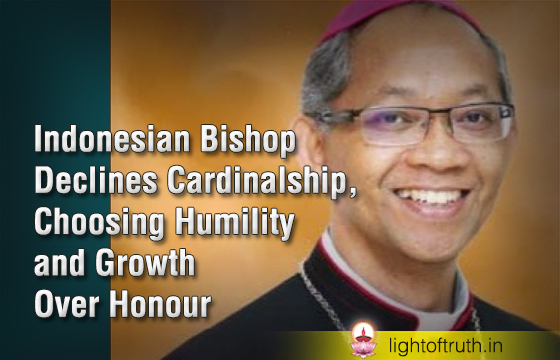
Indonesian Bishop Declines Cardinalship, Choosing Humility and Growth Over Honour
In a rare and humbling move, Bishop Paskalis Bruno Syukur of Bogor, Indonesia, has declined the honour of being elevated to cardinal in the upcoming Consistory on December 7, 2024. The Franciscan bishop’s decision to forego this prestigious role stems from his deep desire to continue growing in his personal priesthood and to further serve the Church and the people of God. As a result, the number of new cardinals set to receive their red hats from Pope Francis has been reduced from 21 to 20. The Vatican’s Press Office, headed by Matteo Bruni, confirmed the news in a statement: “His Excellency Paskalis Bruno Syukur, Bishop of Bogor, Indonesia, has asked the Holy Father not to be made cardinal during the upcoming Consistory. His Excellency’s request is motivated by his wish to grow further in his priestly life, in his service to the Church and the people of God.”
This decision has sparked interest and admiration within the Catholic world, not only because of its rarity but also because it reflects a profound sense of humility and dedication to spiritual growth—a testament to Bishop Syukur’s Franciscan values.
The 62-year-old Franciscan was consecrated bishop of Bogor, a diocese just south of Indonesia’s capital city of Jakarta, in February 2014. From 2001–2009, Syukur was the Franciscan provincial minister of Indonesia. In 2009, he became the general delegate for the Asia and Oceania region, which includes India, Pakistan, Japan, Australia, New Zealand, and Indonesia. The bishop has also held leadership positions in the Indonesian bishops’ conference.
With Syukur’s withdrawal, as of Dec. 7, the total number of eligible cardinal electors will be 140, 110 of whom were chosen by Pope Francis. This means the current pontiff has named 79% of the men who will one day elect his successor.

Religious sister honoured for service to Indigenous People in the Philippines
Sr. Minerva Caampued of the Franciscan Apostolic Sisters was recognized for her dedi-cated service to the Indigenous people of Sta. Ana town, where she has worked to preserve their heritage while promoting edu-cation and sustainable liveli-hoods. The award, established in 1983 by the AY Foundation, the philanthropic arm of the Yuchen-gco Group of Companies, and the Manila Jaycees, celebrates outstanding individuals whose selfless service reflects the charitable legacy of Mother Teresa. Sr. Minerva was honoured during a cere-mony on October 4, a significant date as the count-ry marks Indigenous Peoples’ Month.
The awarding organizations praised Sr. Minerva’s comprehensive efforts in uplifting Agta’s quality of life through various initiatives, according to a report by CBCP News. ”She remains a shining example of compassion, inspiring hope, and trans-formation–elevating lives through selfless service,” the organization said. Her programs encompass education, environmental protection, hea-lthcare, and feeding initiatives, with the goal of addressing the marginalization faced by the Indigenous community.
In her message, Sr. Minerva shared her gratitude, dedicating the recognition to the Agta people. “I am not called to be successful, but to be faithful,” she said.
“I dedicate it to the Agta communities, who continue to face the challenges of defending their ancestral domain, asserting their rights, and preserving their rich cultural heritage amidst marginalization,” she said. “Their strength and resilience are a constant source of inspiration to me. This award is not mine alone, but a tribute to their unwavering spirit,” the sister added.
Sr. Minerva emphasized the persistent challenges that indigenous communities in the Philippines encounter, particularly the struggle to protect their ancestral lands from external threats.