
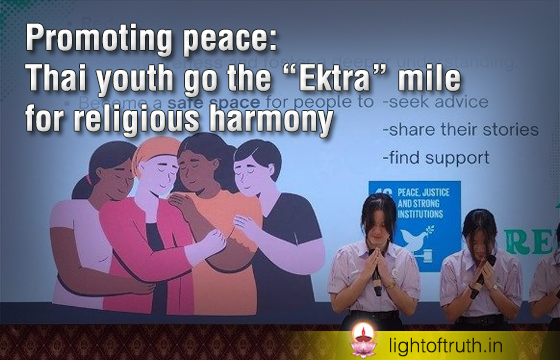
Over 200 students from more than 40 schools in Thailand came together at the Sarasas Suvarna-bhumi Institute of Technology in Bangkok to present creative solu-tions for fostering interreligious harmony.
The event, titled “Extra Pea-ce: Project Presentation Compe-tition” held on Nov. 30, showcas-ed the ideas of 10 finalists from more than 40 schools, tackling some of the country’s most pressing issues related to religious understanding and coexistence.
The competition was inspired by the success of “Extra Peace,” a student team from Sarasas Ektra School, which received 100,000 THB in funding during the MISSION POSSIBLE: Youth Social Hackathon held in July.
The team used the funding to implement a project aimed at promoting dialogue among di-fferent religious groups, serving as a blueprint for the competition.
Finalists proposed diverse strategies to address challenges such as religious discrimination and fostering interfaith under-standing among youth.
Ideas ranged from creating immersive educational games and producing films to using rap music and augmented reality maps to highlight paths to inter-religious harmony and causes of religious conflict.
Chulabhat Tantichaibori-boon, leader of the Extra Peace team, said Catholic schools “are guided by values of love, compa-ssion, and respect,” adding, “Yet, our community is beauti-fully diverse, with students from many religious backgrounds.
Category Archives: Asian
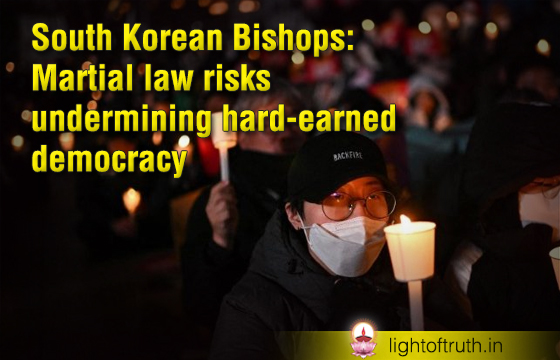
South Korean Bishops: Martial law risks undermining hard-earned democracy
In a strongly worded state-ment released on December 4, the Korean Bishops’ Conference emphasized the importance of safeguarding democracy and called for an explanation and apology from President Yoon Suk Yeol over his declaration of martial law.
“The imposition of a state of emergency last night must have kept many Koreans awake,” the statement read. “Unless there is an urgent need, the government and administrative procedures of a state should be carried out in a normal manner and be known to the citizens.” The unprecedented move by President Yoon was announced live on television at 10 p.m. on December 3. He declared martial law, citing the need to “eliminate the pro-North Korean forces and protect the democratic constitutional order.”
“Constitutional lawyers agree that President Yoon’s declaration of the state of emergency raises numerous problems of procedural legitimacy. Although the state of emergency was lifted following a parliamentary vote, it is questionable whether the matter was serious and urgent enough to justify such a declaration, which was lifted after only six hours,” the statement read.
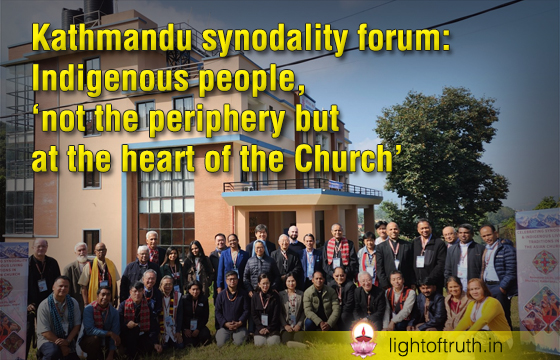
Kathmandu synodality forum: Indigenous people, ‘not the periphery but at the heart of the Church’
The Asian Forum on Celebrating Synodality and Indigenous Living Traditions in the Church in Asia was held in Kathmandu (Nepal) from 10 to 16 November 2024 to celebrate “Synodality and Indigenous Living Traditions in the Church in Asia”.
Various groups and individuals – lay people, priests, men and women religious, and bishops – belonging the Network of Ministries among Indigenous Peoples in Asia (NMAIPA) came together for the forum. Participants came from 13 Asian countries and various Indigenous communities, brought together by the Federation of Asian Bishops’ Conferences (FABC).
On December 08, the Solemnity of the Immaculate Conception of the Blessed Virgin Mary, the Forum released its final statement.
“We have resolved to continue to journey on the path of a synodal Church with a preferential option for Indigenous Peoples, with renewed hope and determination to celebrate and safeguard Indigenous living traditions within the local Churches in Asia,” the press release reads.
The forum in Nepal noted the need to provide continuity to the reflection that led to the establishment of the ROOTS network-Catholic Network Among Indigenous Peoples of Asia.
“The network plans to bring together institutions and individuals interested in working for the well-being of Indigenous People towards deeper study, theological and pastoral reflection, and concerted action,” writes Fr George Plathottam, on behalf of the organising committee. “The Network is currently drawing up a detailed action plan – including organising training leaders in transformative community-based leader-ship”.
Participants were divided into four study groups “to continue study and reflection on major issues affecting the Indigenous Peoples of Asia.” The event provided an opportunity to celebrate “Indigenous wisdom”, which combines ancient practices with the values of sharing, acceptance, co-responsibility and healing.
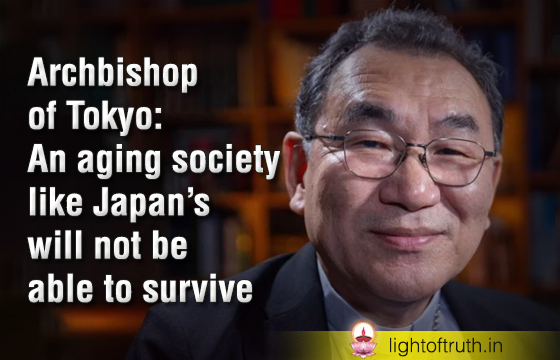
Archbishop of Tokyo: An aging society like Japan’s will not be able to survive
Archbishop Tarcisio Isao Kikuchi of Tokyo, who will be installed as a cardinal on Dec. 7, spoke to the Vatican new agency Fides about the present and future state of the country.
The archbishop said that “an aging society like Japan’s will not be able to survive,” pointing to the dangers of the country’s demographic winter.
Faced with this reality, he noted that the government “is hesitant to fully accept migrants” for fear of entering into territory never previously explored in Japan, a nation little accustomed to receiving migrants.
“Until now, Japan has been a remarkably homogeneous country. However, the reality is that without the presence of migrants, Japanese society cannot sustain itself. This is a fact. It’s true that migrants come in with different types of visas but, due to the reluctance of institutions, many of them are forced sooner or later to face bureaucratic problems related to their immigration status,” he said.
Kikuchi said that Japanese society often perceives migration as a “problem” and that even within the Church there is talk of the “immigrant problem.” The archbishop believes that this language reflects the “negative perception” of many Japanese about this reality.
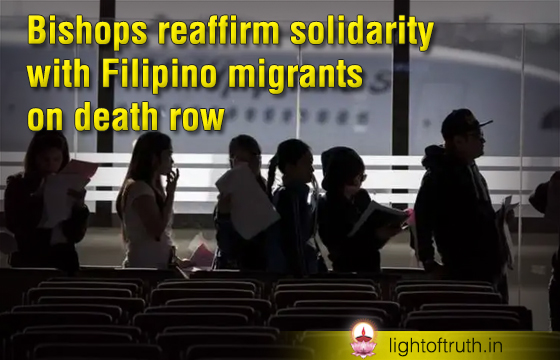
Bishops reaffirm solidarity with Filipino migrants on death row
Bishop Ruperto Santos of Antipolo, the vice-chairman of the Philippine Bishops’ Commi-ssion on Migrants and Itinerant People, said that the Church is in solidarity with Filipino convicts abroad, Radio Veritas Asia (RVA) reported on Saturday.
“We continue to advocate for your rights and seek justice on your behalf,” Bishop Santos said in a message broadcast via Chur-ch-run Radio Veritas Philippines, while assuring them that they were not forgotten. According to the state-run Department of Migrant Workers, 44 migrant Filipinos are on death row – 41 in Malaysia, two in Brunei and one in Saudi Arabia.
Urging the Filipinos on death row to find strength in the knowledge that they are not alone, Bishop Santos emphasised that the entire nation is standing behind them, praying for them, and hoping for a “just resolu-tion,” of their cases.
The prelate made the remarks after Filipino woman Mary Jane Veloso, who spent 14 years on death row in Indonesia after being charged with drug trafficking, was reportedly being pardoned by Indonesian government.
Last week, Philippine Presi-dent Ferdinand Marcos confir-med that Indonesian authorities have approved Veloso’s repatri-ation to the Philippines, media reports say. Veloso was arrested in Indonesia in 2010 while carrying a suitcase lined with 2.6 kilograms of heroin. She was sentenced to death by firing squad.
The case of the mother-of-two sparked an uproar in the Philippines. Veloso’s family and supporters repeatedly claimed that she was innocent and had been set up by an international drug syndicate. Bishop Santos said Filipino bishops make renewed appeals to governments, particularly in Asia, to ensure the rights of migrant workers with due process and show compassion for those caught in legal battles.
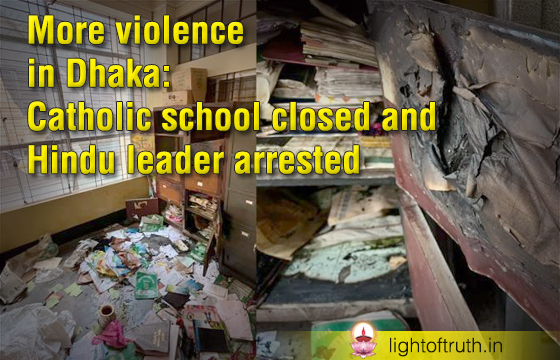
More violence in Dhaka: Catholic school closed and Hindu leader arrested
St Gregory’s High School & Co-llege, a historic Catholic educational establishment in Dhaka founded in 1882. Located in the old city, it has closed its doors indefinitely after it was damaged from recent violence involving thousands of students, with at least a hundred injured, plus wi-despread destruction of its facilities.
At the same time, a leader of Bangladesh’s Hindu minority, the cleric Chinmoy Krishna Das of the International Society for Krishna Consciousness (ISKCON), was arrested yesterday afternoon, at the capital’s airport, on charges of “sedition.” These two incidents say a lot about the early days of the country’s interim government under Muhammad Yunus. After more than one hundred days, it has failed to stop a rising Islamist wave against minorities, despite several attempts at reforms.
The Nobel Prize laureate who took over the country to lead it towards democratic elections is not living up to the hopes of those who thought that the flight of Prime Minister Sheikh Hasina, after 15 years in power, would allow Bangladesh to really turn the page, and build a country without discrimination and inclusive of all. On Nov. 24, around 5 pm, a mob of more than 500 unidentified people attacked St. Gregory’s High School & College. The attackers broke through the security fence, injuring two guards, Nazmul Haque and Suman Gomes, who were hospitalised. The crowd vandalised classrooms, shattered window panes, destroyed documents, and damaged CCTV cameras, even with explosives. Brother Placido Peter Ribeiro, the principal, expressed his dismay at the destruction. “This was a premeditated assault,” he said.
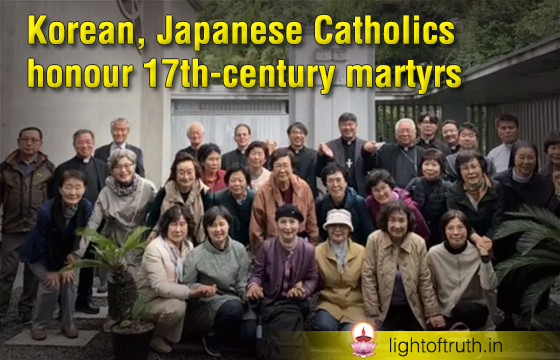
Korean, Japanese Catholics honour 17th-century martyrs
Catholics from South Korea and Japan have jointly marked the 400th anniversary of the martyrdom of two Catholics who were martyred for their faith in Japan.
Catholics from the Archdiocese of Daegu in Korea and the Archdiocese of Nagasaki in Japan joined the ceremony to honour Blessed Kaiyo and martyr Diego Koichi, at the St. Philip Cathedral in Nagasaki on Nov. 15.
Bishop Jonh Bosco Jang Shin-ho, vicar general of the Daegu Archdiocese, cele-brated a memorial Mass on the occasion concelebrated with Archbishop Michiaki Nakamura of Nagasaki. A group of Korean Catholic pilgrims, including priests, led by the Korean Women’s Association, joined the ceremony as part of their tour of holy sites in Japan. ”Let us join hands with the two martyrs and become one in love and forgiveness,” Archbishop Nakamura said in his homily. “Let us all become one in acce-ptance, prayer, and evangeli-zation to all.”After the Mass, a wreath-laying ceremony was held at the monument to the two martyrs in the 26 Saints Memorial Hall.
The Archdiocese of Daegu and the Archdiocese of Nagasaki jointly erected and blessed this monument in 2016.The two dioceses have maintained ex-changes for a long time. The common denominator is that they are the closest countries and the churches have grown based on devotion to the two martyrs.
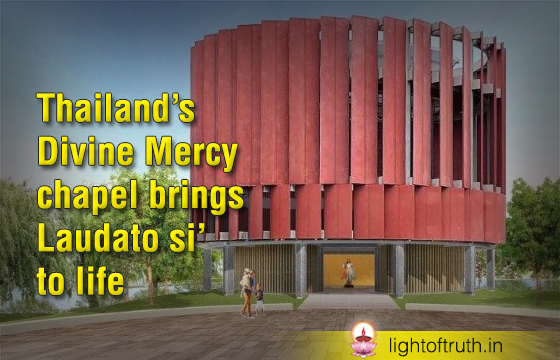
Thailand’s Divine Mercy chapel brings Laudato si’ to life
The Divine Mercy Chapel in Bang Bo District, Samut Prakan Province, is being hailed as a landmark of environmentally conscious design that integrates faith and care for creation. “Root-ed in the principles of Laudato si’, the chapel is built as an energy-efficient structure that respects and celebrates the natural world,” said Fr. John Wirach Amornpattana, a Redemptorist priest overseeing the project. Speaking to LiCAS News, the priest described the chapel as a tangible manifestation of Pope Francis’ call for ecological conversion.
Pope Francis’ 2015 encyclical Laudato si’ addressed the global environmental crisis, urging collective action to protect “our common home.” Fr. Amornpattana said the chapel’s construction reflects the document’s principles and aligns with broader sustainability efforts. “Beyond just advocating for ecological conversion,” he explained, “Laudato si’ aligns with the global move-ment toward sustainability, as articulated in the United Nations’ Sustainable Deve-lopment Goals (SDGs). However, we must remem-ber that true care for creation springs from our faith in God as the Creator.”
The Thai Catholic Church has embraced this mission, incorporating ecological awareness into diocesan projects, schools, parishes, and community initiatives.
Fr. Amornpattana pointed to widespread efforts to instill the idea that “the world is our common home,” inspiring collective action across various levels of society.
The Divine Mercy Chapel itself exemplifies this commitment. Designed with sustainability in mind, the building features a 12-meter-high ceiling and strategically placed wall panels to optimize light and airflow.
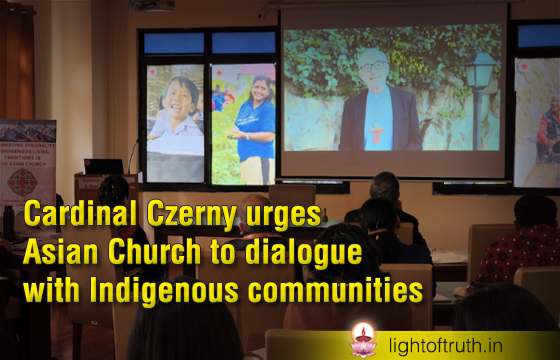
Cardinal Czerny urges Asian Church to dialogue with Indigenous communities
In a video message addressed to partici-pants at the Asian Forum on “Celebrating Synodality & Indigenous Living Tradition in the Asian Church” in Nepal, Cardinal Michael Czerny, Prefect of the Dicastery for Promoting Integral Human Development, emphasized the importance of recognizing and dialoguing with the Indigenous peoples. “For recognition and dialogue will be the best way to transform relationships whose history is marked by exclusion and discri-mination,” said Cardinal Czerny, underscor-ing the Church’s role in fostering inclusivity.
Speaking to an audience of bishops, Indigenous pastoral leaders, priests, nuns, lay leaders, and theologians from across Asia, he highlighted the significance of indigenous traditions, wisdom, and spiritual practices, encouraging the Church to embrace these as valuable contributions to synodality. “As members of the Church in Asia, you have the opportunity to deepen your engagement with the Indigenous peoples as principal dialogue partners with their chanters, healers, herbalists, midwives, shamans, wisdom keepers, and sharers,” Cardinal Czerny said.
The forum, organized by the faith-based group Circle of Sacred Rice, provided a platform for faith leaders to reflect on how the Church can incorporate Indigenous per-spectives while advancing social justice, environmental protection, and cultural pre-servation.
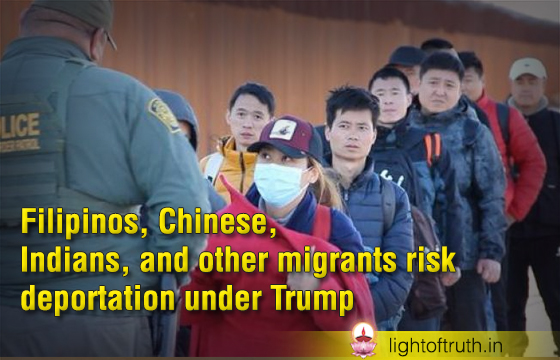
Filipinos, Chinese, Indians, and other migrants risk deportation under Trump
The Philippine Department of Migrant Workers (DMW) announced its readiness to assist 370,000 undocumented Filipinos living in the United States who might be deported following the election of Donald Trump. The DMW is set to help returning Filipinos with financial aid and job placement, but is also consi-dering the possibility of sending workers to other countries (in particular Croatia, Slovenia, Ger-many, Hungary, and Japan).
According to Rappler, a Phi-lippine online news website, to meet its commitment to 370,000 returnees, the Philippine govern-ment would have to find 18.5 billion pesos (over 5 million) to ensure proper assistance for all. Between 2014 and 2024, about 10,600 Filipinos were expelled from the US (a thousand per year on average), including some 3,500 during Trump’s first term in office (2017-2021).
The Philippine ambassador to the United States, Jose Manuel “Babe” Romualdez, issued an advisory telling undocumented Filipinos to leave the country voluntarily. Most Filipinos in the US are granted a regular work visa, but once it expires, many prefer to stay, often working illegally.
Irregular migrants in the United States do not come only from Latin America. The latest data (2022) indicates that about 1.7 million out of 11 million are from Asia. More than half are from India and China, followed by the Philippines, South Korea, Vietnam, Pakistan, Nepal, Thai-land, Afghanistan, and Bangla-desh. In 2023-2024, 1,100 In-dians were deported out of an estimated population at 725,000 unauthorised Indian immigra-nts in 2022.