
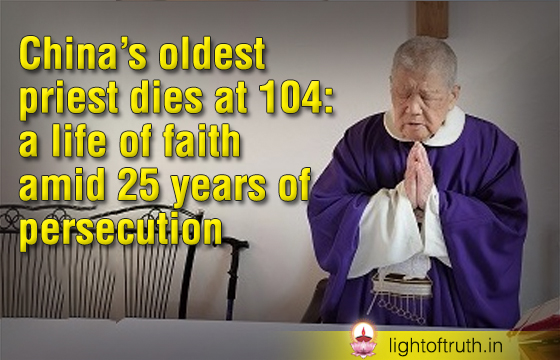
China’s oldest priest has passed away, leaving behind a legacy of brave adherence to the faith of the Catholic Church in the face of persecution. Father Joseph Guo Fude, SVD, died on Dec. 30, 2024, two months from what would have been his 105th birthday. He was one of the few remaining Catholic priests in China who had been ordained prior to the establishment of the People’s Republic of China.
“Father Guo is a symbol of the courageous faith and extraordinary suffering of China’s Catholics,” Benedict Rogers, human rights activist and author of “The China Nexus: Thirty Years in and Around the Chinese Communist Party’s Tyranny,” told CNA. Rogers noted that although the priest had “spent a quarter of a century in prison,” he continued serving and ministering to his people through his 90s. “He treated prison not as the harsh injustice that it was but as an opportunity to grow in faith, spirituality, and prayer.” According to AsiaNews, which reported the Chinese cleric’s passing, Guo spent a total of 25 years in prison during his lifetime.
“Looking back on my life,” Guo reportedly wrote following the occasion of his 100th birthday, “prison became a place where I could reflect, pray, and grow spiritually … My imprisonment gave me the strength to face life’s challenges and continue to serve God, knowing that every trial was part of his divine plan. My experience in prison taught me that earthly riches are ephemeral, while faith in God is the only true wealth.”
Category Archives: Asian
One step closer to sainthood: Thailand honours its blessed martyrs
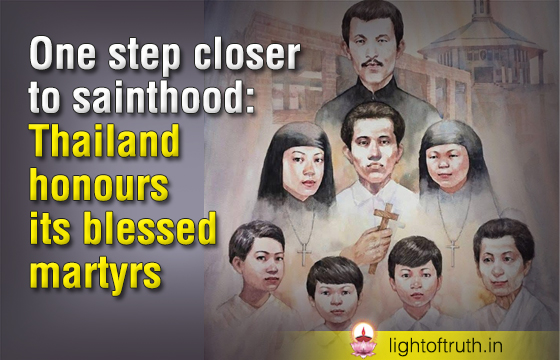
Before the Eucharistic celebration comme-morating the Feast of Blessed Nicholas Bunkerd Kritbamrung in Samphran, west of Bangkok, on January 12, the Apostolic Nuncio to Thailand, Archbishop Peter Bryan Wells, presented relics of the eight martyrs to Archbishop-elect Francis Xavier Vira Arpondratana of the Metropolitan Archdiocese of Bangkok and to six bishops and representatives from its suffragan dioceses: Ratchaburi, Chanthaburi, Nakhon Sawan, Chiang Mai, Chiang Rai, and Surat Thani.
The relics, encased in newly crafted reliqua-ries, symbolize the unity of these eight martyrs, who lived and died for their faith during a time of persecution in the mid-20th century.
In his homily, Archbishop Wells highlighted the martyrs’ courage, saying, “They were bap-tized into Christ first in water and then in blood.” He challenged the faithful to draw inspiration from their sacrifices and to live out their baptismal promises with convi-ction.
Last year, the Catholic Bishops’ Conference of Thailand (CBCT) resol-ved to unify the canonization causes of Blessed Nicholas Bunkerd Kritbam-rung of Bangkok and the Seven Blessed Martyrs of Songkhon. The decision underscores their shared witness to Christ during a period of political and social turmoil between 1940 and 1944, when Christianity was targeted as a “foreign religion.”
Blessed Nicholas, a priest from Samphran, his hometown, ministered to his flock amid persecution. Sentenced to 15 years of imprison-ment, he baptized 66 fellow prisoners while incarcerated. Despite enduring nine months of illness, he remained steadfast in his faith and passed away in prison in 1944 at the age of 49.
Meanwhile, in the Catholic village of Song-khon, catechist Philip Siphong and six women, including two nuns, who chose martyrdom rather than renouncing their faith.
Their sacrifices were recognized by Pope John Paul II, who beatified the seven Songkhon martyrs in 1989 and Blessed Nicholas in 2000.
New church in Jordan reflects national desire for closer ties with Christendom
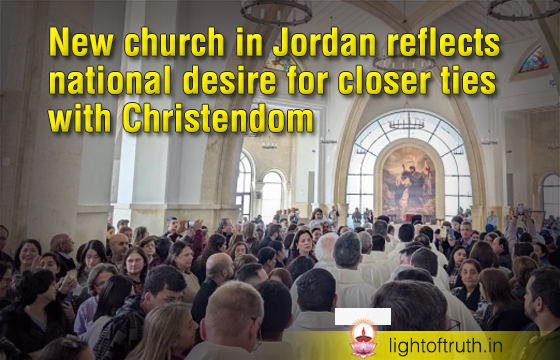
The Jan. 10 inauguration of a vast church on the very spot where Jesus Christ was baptized by St. John the Baptist in the Jordan River was an event of significant symbolic importance, both spiritually and diplomatically.
It also reflected the Hashemite kingdom’s determination to establish itself as an essential stop-off point for pilgrims to the Holy Land as well as a haven of peace for the world’s Christian faithful, who are increasingly reluctant to travel to a region torn apart by geopolitical and ethnic-religious conflicts.
“So many biblical events and figures meet here that we could say that this place embraces the entire expectation of the Old Testament as directed to the coming of Christ, the manifestation of the Father,” said the Vatican’s secretary of state, Cardinal Pietro Parolin, at the ceremony of consecration of the altar, also attended by the patriarch of Jerusalem, Cardinal Pierbattista Pizzaballa, and Prince Ghazi bin Muhammad, grandson of King Talal of Jordan and cousin of King Abdullah II of Jordan.
Initiated following the donation by the king of a 30,000-square-meter (almost-7.5-acre) plot of land on the outskirts of the historic site of Al-Maghtas (also known as Bethany Beyond the Jordan, in the Qafra region) in 2003, the project was completed just in time for the silver jubilee of the grand annual pilgrimage, which for the past 25 years has taken place every January around the feast of the Baptism of Christ. This jubilee also coincides with the celebrations of the Catholic Church’s 2025 Jubilee.
From Shanghai to Filipino prisons the Churches of Asia open the Jubilee
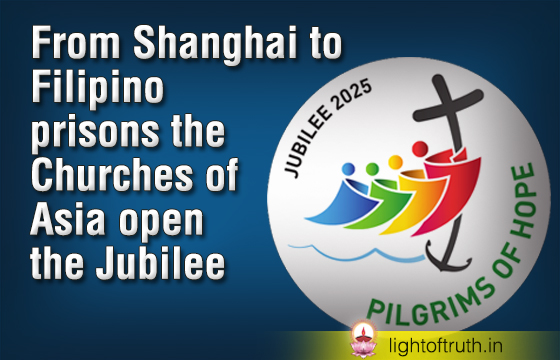
All the dioceses of the world are now experiencing the local opening of the Holy Year 2025, which by the will of Pope Francis has as its theme “Pilgrims of hope”. The celebration is also involving many Churches in Asia with significant gestures.
In Shanghai, the opening Mass of the Holy Year was presided over by Bishop Shen Bin in Xujiahui Cathedral. In his homily, Bishop Shen Bin urged all priests and faithful to put into practice the call to hope, fanning the flame with the power of the Word of God. He also called for transforming this hope into concrete actions to become peacemakers, bearers of life, and to bring hope to those in need: to needy brothers and sisters, the poor, the sick, the young, migrants and the lonely elderly.
In the Vietnamese capital Hanoi, the Jubilee was opened with a celebration presided over by Archbishop Joseph Vu Van Thien. Priests administered the Sacrament of Reconciliation in the courtyard of the archbishopric. Then in procession, crossing Nha Chung Avenue, the community reached the cathedral forecourt where the renewal of baptismal promises took place, followed by Mass on the Feast of the Holy Family.
In Tokyo, Card. Tarcisio Isao Kikuchi presided over the opening celebration of the Jubilee in St Mary’s Cathedral. For the big metropolis, as many as 15 churches have been designated as destinations for the Jubilee pilgrimage.
In the Philippines, Cardinal Pablo Virgilio David, Bishop of Kalookan and President of the Bishops’ Conference, appealed for the release of at least political prisoners in the Holy Year. He did so on 26 December, celebrating Mass in the Bagong Diwa prison in Bicutan on the day Pope Francis opened the Holy Door in the Rebibbia prison. “I will consider it a wonderful gesture on the part of the government,” said Card. David – if at the beginning of the Jubilee Year of Hope 2025, the last political prisoners still languishing in prison after several decades of waiting for trial will be granted amnesty, pardon or permanent release on humanitarian grounds”
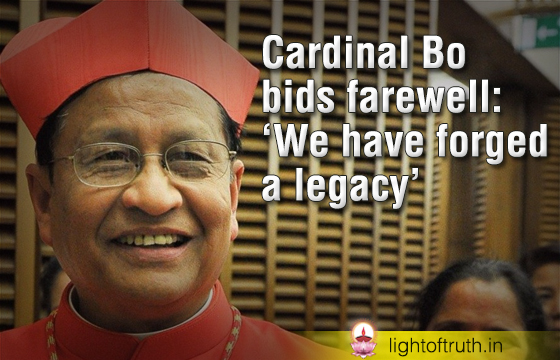
Cardinal Bo bids farewell: ‘We have forged a legacy’
Myanmar’s Cardinal Charles Maung Bo of Yangon has issued a farewell message as he concludes his second three-year term as the President of the Federation of the Asian Bishops’ Conferences (FABC), saying he is “filled with profound gratitude and humility.” “Our journey together,” he reflected, “has been one of profound growth, learning, and shared commitment to the Christian values that unite us.” As he thanked all those who have been crucial to helping the FABC in this sense, he noted that “we have been motivated by Jesus and a Christological vision for Asia.”
“Through our collective efforts,” Cardinal Bo observed, “we have made significant strides in fulfilling our mission.” “Amo-ng our greatest achievements has been the ongoing synodal journey, where we have embraced the spirit of collaboration, dialogue, and mutual understanding,” he said, adding that it has “not only strengthened the bonds within FABC but has also allowed us to discern more clearly our shared vision and purpose.” Moreover, he commended the FABC’s continued engagement “in mean-ingful conversations that have led to concrete actions in many areas, ensuring that our faith remains vibrant and relevant in the contemporary world.” Cardinal Bo recalled that, over the course of the last six years, much has been accomplished and much progress has been made.
Sri Lankan cardinal mandates male-only altar servers in Colombo Archdiocese
Sri Lankan Cardinal Malcolm Ranjith has mandated that girls are not permitted to serve as altar servers in parishes within the Archdiocese of Colombo. “No girls should be invited to serve at the altar, as altar servers, in the archdiocese,” Ranjith wrote in an October 22 letter to parish priests that was made public in December. According to the letter, the cardinal issued the order because serving as an altar server can be a pathway to the priesthood and should therefore be a position reserved for boys.
“It should always be young boys because this is one of the main sources of vocations to the priesthood in Sri Lanka and it will affect the number of candidates entering the seminaries, which [is a] risk we cannot take” the letter continues. “Since females are not allowed to be ordained priests, we have made that decision.”
Ranjith noted in the letter that “several parishes” within the archdiocese have been “appointing girls as altar servers” but told the priests that this order “cannot be changed at your discretion.” “Please carry this out as faithfully as possible and do not think that it is your faculty to [use your own discretion],” the letter adds. “I thank you in anticipation of your usual cooperation and wish you God’s blessings.” Ranjith said in the letter that he had first told the priests about this order during a presbyteral meeting held on Oct. 21, the day prior to the letter.
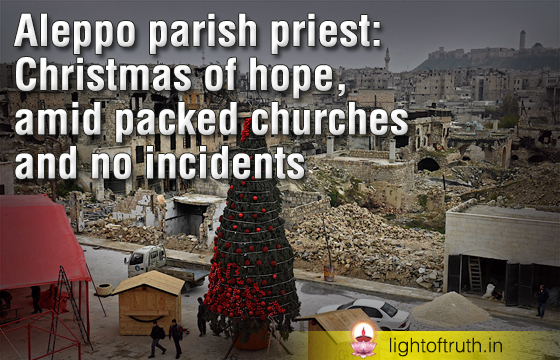
Aleppo parish priest: Christmas of hope, amid packed churches and no incidents
A ‘very peculiar’ Christmas amid ‘reassurances’ from the new authorities that the faithful will be able to ‘continue to practise’ and episodes of sectarian violence in the days leading up to the holiday. Despite fears and uncertainties, Syrian Christians participated in the celebrations, as emerges from the account given to AsiaNews by Fr Bahjat Karakach, parish priest of the Church of St Francis of Assisi in Aleppo. A community that ‘groaned’ in the churches amidst imposing security measures as the country ‘moves towards a real rebirth’, albeit with the fear of ‘intrusions’ by forces ‘that are interested in destabilising Syria’. Nevertheless, he adds, ‘there is no lack of positive signs of curbing these tendencies’.
In less than two weeks, the militias of Hay’at Tahrir al-Sham, once affiliated with the al-Nusra Front (formerly al-Qaeda), overthrew the regime of Bashar al-Assad, who had managed – with the support of Russia and Iran – to remain in power despite 14 years of civil war. They were led by Hts leader Abu Mohammed al-Jolani, who in these days of Christmas celebrations has repeatedly assured tolerance towards all Syrians, including Christians, promising ‘to protect all sacred places to whatever religious community they belong to’. Meanwhile, militias launched an operation in the coastal area of Tartous, an Alawite stronghold linked to the former president, where 14 policemen had been killed the day before.
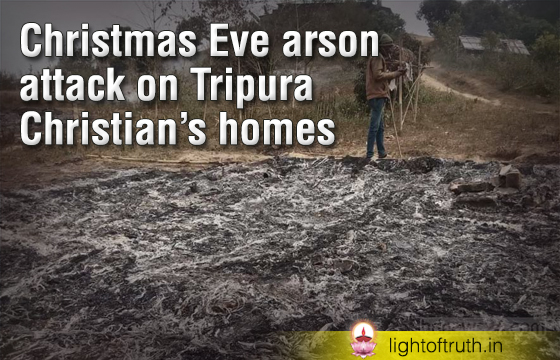
Christmas Eve arson attack on Tripura Christian’s homes
A fire engulfed the houses of 17 Christian families of the Tripura ethnic group in the area of Sarai Tangojhiri, in the upazila lama of Bandarban, in southeastern Bangladesh, late in the evening of 24 December.
The villagers claim that the fire was an act of arson, possibly related to extortion demands made earlier by some thugs. The tragic incident occurred in the Notun Betchhara Tripura neighbourhood, while the villagers had gone to attend Christmas celebrations at a nearby church in the Tangojhiri area, as their neighbourhood does not have its own church. When they returned, they discovered their houses reduced to ashes. The fire destroyed all their belongings, including furniture, solar panels, household utensils, clothes and important documents. The displaced families were left homeless and took shelter under the open sky in the charred remains of their neighbourhood.
Villagers reported seeing the flames around 1 a.m., but could not identify the perpetrators, as the neighbourhood was uninhabited at the time. Of the 18 families residing in the area, only one house was spared from the flames, as its occupants were present and able to deter the attackers. Residents claim that this attack is part of a long-standing pattern of oppression against the indigenous hill communities in the three hill districts. Influential groups are often involved in these incidents, creating an atmosphere of fear and insecurity. The victims demand justice and immediate support to rebuild their lives.

Christians in Aleppo feel an uneasy calm amid rebel takeover of Syrian city
An uneasy calm hangs over Aleppo, Christian leaders report, following the recent lightning takeover of Syria’s second-largest city by Islamist rebels driving out forces of Syrian President Bashar Assad. Concerns also mount over government airstrikes.
“A relatively calm day compared to previous days,” a Catholic priest in Aleppo, who asked not to be identified given the sensitivity of the situation, wrote in a letter made available to OSV News.
“However, this doesn’t mean there haven’t been problems of various kinds: Certain food supplies are already running low in the modest market available, and the survival instinct is pushing people to gather anything that can feed them, starting with bread. Several distribution points in the city are emptying quickly,” he added.
“The situation is confusing. We don’t know what will happen. People outside cannot reach Aleppo because it is closed off and under occupation,” Andrea Avveduto, communications chief for Pro Terra Sancta, told OSV News by phone.
Pro Terra Sancta, based in Jerusalem and Milan, Italy, supports the Franciscan Custody of the Holy Land. Since the start of the conflict, it has aided Franciscan fathers in Syria by opening four emergency centers in Damascus, Latakia, Aleppo, Knayeh and Yacoubieh.

Asian Church must commit to interfaith talks: Cardinal Kikuchi
Cardinal Tarcisio Isao Kiku-chi of Tokyo has urged the Catholic Church in Asia, which is an “absolute minority” in the region, to commit itself to inter-religious dialogue. Kikuchi emphasized that the commitment towards inter-religious dialogue “is not a compromise of our con-viction, but to synergize our po-tential to create [a] better world,” the Crux reported on Dec. 9.
The Asian Church’s actions will aid in realizing the will of God through “peacebuilding, protection of human dignity, protection of the environment, eradication of poverty, and assisting people in difficult life situations,” Kikuchi added.
Kikuchi pointed out that the movement of people over national boundaries has been “a major cause of creating a challenging environment for many in Asia.” “The Asian Church is expected to be a champion of protecting [the dignity of people on the move],” Kikuchi emphasized.
Kikuchi who also serves as the president of Caritas Inter-nationalis, the Vatican’s social service wing, said that his appointment shows Francis’ “expectation for Caritas to be a front-runner of the Synodal Church.” “Being Synodal Chur-ch is what Caritas has been doing for many years all over the world,” Kikuchi remarked.
Kikuchi pointed out that having several cardinals among Asian bishops – especially among the leaders of the Federation of Asian Bishops’ Conferences (FABC) – symbolizes the Catho-lic Church’s expectation for the Asian Church to be “a front-ru-nner for the protection of human dignity.”