
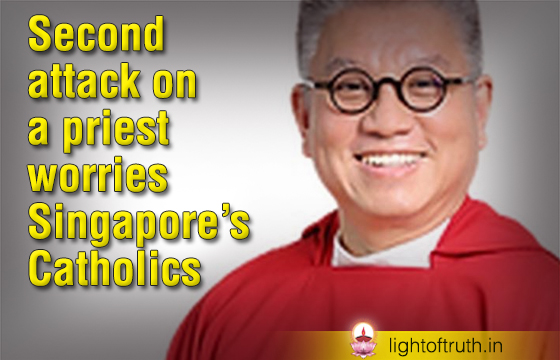
Yet another attack against a priest in Singapore. The second episode in a few months after the one last November, which is beginning to ring more than a few alarm bells in an area where there are strict controls and, at least until now, no serious episodes of violence against Catholics have been recorded. This time it was Fr Cary Chan of the Archdiocese of Singapore who was attacked by a man inside the Church of the Holy Spirit on Upper Thomson Road on 10th February 2025. The assailant, a 22-year-old young man from the city-state of Chinese origin and with special needs, punched the priest in the head, causing minor injuries to his face.
Interviewed by the local media, Fr Chan gave his testimony about the attack: ‘He gave me a hard blow to the head. I feel a bit shaken; I did not expect such a strong blow from him’. Taken by surprise, the priest had no way to defend himself. According to Fr Chan, the attacker is a regular churchgoer and is partially blind, which is why he may not have recognised the priest. Meanwhile, the police say in a note that they have arrested a 22-year-old man involved in the attack on the Upper Thomson Road church. The police emphasise that the young man will be sent to the Institute of Mental Health for further and more thorough assessment.
Category Archives: Asian
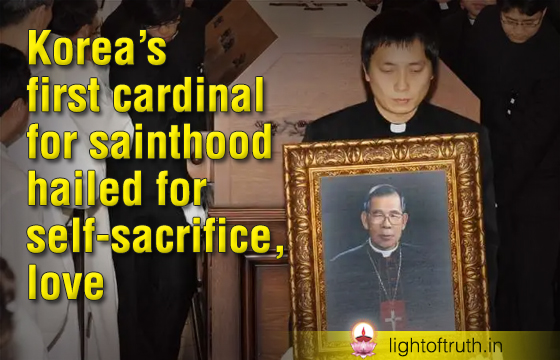
Korea’s first cardinal for sainthood hailed for self-sacrifice, love
Late South Korean Cardinal Stephan Kim Sou-hwan, a candidate for sainthood, has been praised as a model of self-sacrifice and love, and for his lasting influence on Christians and people of other faiths during a special symposium on his life and contributions. “As we convene for this symposium, we are called to reflect upon the life and virtues of Cardinal Kim, striving to emulate his extra-ordinary example,” said Auxiliary Bishop Job Yobi Koo of Seoul Archdiocese on Feb. 7. Yobi made his remarks at “The Symposium on the Beatification Process of Servant of God Cardinal Stephen Kim Sou-hwan: A Celebration of Life, Virtue, and Legacy” held in the capital Seoul. He reflected on Kim’s life devoted to the service of others and his philosophy which was “one of selfless dedication,” Seoul archdiocese said in a statement. Yobi also serves as chair of the committee spearheading Cardinal Kim’s (1922-2009) beatification. He is currently venerated as a “Servant of God.” The Seoul archdiocesan Committee for Promotion of Beatification and Canonization and the Research Foundation for Korean Church History organized the symposium which was attended by laity and priests from various locations.
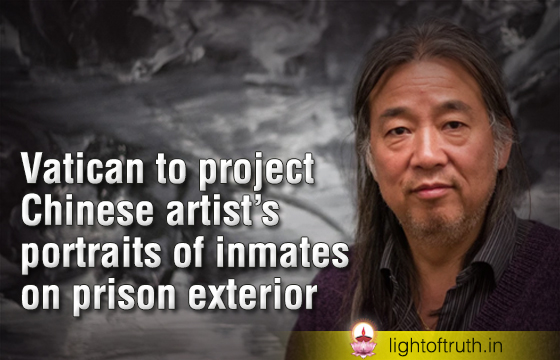
Vatican to project Chinese artist’s portraits of inmates on prison exterior
A Chinese artist’s paintings of inmates living inside one of Rome’s most well-known prisons will be projected on the prison building’s exterior and displayed in a new exhibit space near the Vatican as part of 2025 Jubilee initiatives.
The 64-year-old Yan Pei-Ming is a contemporary artist who has been living in France since 1981. He is known for his “epic-sized” portraits of figures such as Chairman Mao, St. Pope John Paul II, Bruce Lee, and Barack Obama. Pei-Ming’s latest portrait series, 27 prisoners living inside Regina Coeli Prison, will be displayed on the side of the prison building. The works, created at the request of the Vatican’s education and culture dicastery, will be the inaugural exhibit of a new art space on Via della Conciliazione, the main street leading to St. Peter’s Basilica.
The Vatican will highlight the work of contemporary artists during the 2025 Jubilee Year and beyond with the new exhibit space, called “Conciliazione 5,” to be inaugurated Feb. 15, during the Jubilee of Artists and the World of Culture. The Vatican has planned a slew of events for the Feb. 15-18 Jubilee of Artists, including the opening of the contemporary art space, Sunday Mass with Pope Francis, and the first-ever visit by a pope to the film studios of Cinecittà. The Vatican expects more than 10,000 people from across the wider art and cultural environments – hailing from over 100 countries and five continents – to participate in events over the four days.
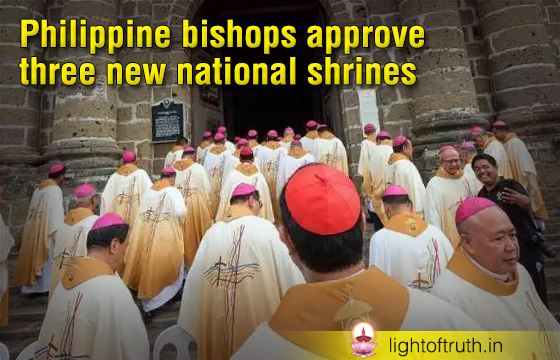
Philippine bishops approve three new national shrines
The Catholic Bishops’ Conference of the Philippines (CBCP) has designated three churches as national shrines, says a report. The Mary Queen of Peace Shrine, popularly known as the EDSA Shrine, the Our Lady of Loreto Shrine, both in the Manila Archdio-cese, and the Shrine of Our Lady of Aranzazu, from the Diocese of Antipolo, were elevated to the status of national shrines. The bishops’ announcement came on the first day of their plenary assembly, CBCP News reported on Jan. 26. Some 70 bishops from across the country are attending Jan. 25-27 meeting. With the latest approvals, the Philippines has 33 national shrines.
The Catholic Church recognizes national shrines for their historical, spiritual, or cultural significance. Shrines are often linked to popular devotion, significant religious events, miracles, or apparitions. Before receiving the status of a national shrine, a church must first be designated as a diocesan shrine by the local bishop or archbishop. This requires the church to be a pilgrimage site for a specific piety, offering superior worship, Christian formation, and social services. Once these conditions are met, the parish can petition for canonical elevation.
Diocesan shrines can petition the national bishops’ conference for recognition as national shrines when devotion grows. The newly elevated shrines have a history, making them a hub of Catholic devotion in their locations.
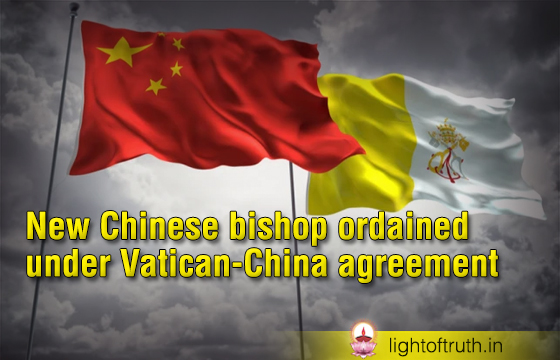
New Chinese bishop ordained under Vatican-China agreement
The Vatican announced that Pope Francis has erected a new diocese in China and appointed Father Anthony Ji Weizhong as its first bishop. The pope decided last October to suppress the Diocese of Fenyang in mainland China, which was originally erected in 1946 by Pope Pius XII, and at the same time erect the new Diocese of Lüliang.
Diocesan borders have been an area of dispute between the Vatican and China in the decades since the Chinese Communist Party came to power and started to redraw diocesan lines, seeking to bring them more in line with Chinese administrative boundaries.
Indeed, the territory of the newly-created Diocese of Lüliang conforms to the territory of the city of Lüliang, located about 400 miles southwest of Beijing in western Shanxi province. It will serve a total population of 3.3 million people, of whom approximately 20,000 are Catholics. A total of 51 priests and 26 religious sisters serve in the diocese.
Pope Francis appointed Weizhong as bishop of Lüliang on Oct. 28, 2024, having approved Weizhong in the context of the “Provisional Agreement,” better known as the Vatican-China deal, which appears to give the Chinese Communist Party (CCP) some ability to choose episcopal candidates.
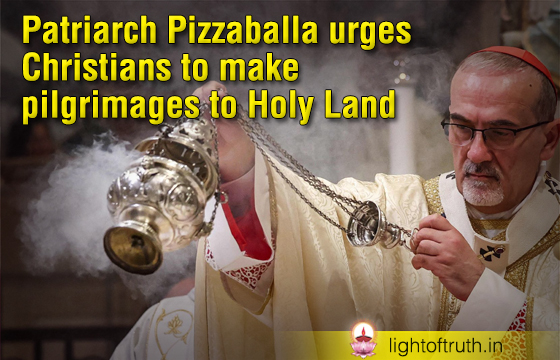
Patriarch Pizzaballa urges Christians to make pilgrimages to Holy Land
Cardinal Pierbattista Pizzaballa, the Latin Patriarch of Jerusalem, invites Christians to return to the Holy Land on pilgrimage, saying their presence makes residents feel part of the universal Church. “This ceasefire is a turning point that has been marked in the life of the Holy Land.” Patriarch Pierbattista Pizzaballa offered that assessment in a video message recorded from the Church of the Holy Sepulchre in Jerusalem.
The Latin Patriarch of Jerusalem was joined by the Custos of the Holy Land, Fr. Francesco Patton, in inviting Christians to make plans to visit the Holy Land on pilgrimage in the near future. “Last year was a difficult year,” said Patriarch Pizzaballa. “For this year, I want to express the appreciation we have for all the universal Church, for the support, for the prayer, or the unity and solidarity they expressed for the Holy Land.” He urged Christians worldwide to express their solidarity with the Holy Land, saying Jerusalem is safe, especially with the ceasefire between Israel and Hamas that went into effect on Jan. 19.
“The source and origin of hope is here at the Holy Sepulchre with Jesus, the Risen Lord,” he added. “So, it’s about time to take courage to come here. We are waiting for you.”
In the video, Fr. Patton agreed with Patriarch Pizzaballa, highlighting the importance of pilgrimage to the land where Jesus was born, died, and rose again.
Standing in front of the Holy Sepulchre, he said Christians are “waiting for you, because when you come as pilgrims to the Holy Land, our small Christian community feels that we are part of a great family, the great family of the Catholic Church and Christians living all around the world.” “Please, don’t fear,” concluded Fr. Patton. “Don’t be afraid. Come!”

Indonesian archbishop rejects government energy plans in majority Catholic island of Flores
Indonesian Archbishop Paulus Budi Kleden, SVD, has spoken out against government-backed geothermal projects in Flores, the country’s most Catholic island located in East Nusa Tenggara.
According to UCA News, Indonesia’s Energy and Mineral Resources Ministry designated Flores a “geothermal spot” in 2017, identifying 16 project sites on the island in spite of strong opposition from local villagers.
“After hearing testimonies from several people, from Sokoria and Mataloko, and discussions with several priests, I have decided to reject geothermal projects in three vicariates,” Kleden said in a Jan. 10 video message.
Kleden, who became archbishop of Ende in August 2024, said residents have complained of the depletion of water springs in Sokoria and hot mud eruptions in Mataloko, UCA News reported.
Kleden is the first Indonesian archbishop to speak out publicly against the government’s energy plans in Flores, insisting that the projects have triggered a life-threatening “ecological disaster” on the island.
In addition to encouraging priests in the Ende Archdiocese to take a stand against the social and environmental harm caused by mining activities, Kleden said local residents should be encouraged to seek appropriate legal advice to protect their land.
Father Simon Suban Tukan, JPIC coordinator for the Society of the Divine Word in West Flores, told that the new law is important to protect the rights of environmental activists who feel threatened by a “government agenda that emphasizes investment.”
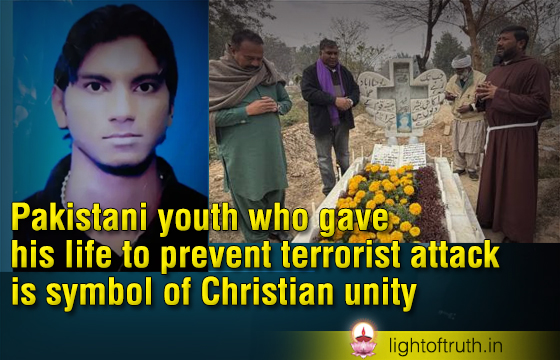
Pakistani youth who gave his life to prevent terrorist attack is symbol of Christian unity
During this year’s Week of Prayer for Christian Unity, a group of believers from different Christian denominations made a pilgrimage to the tomb of Akash Bashir, the young Pakistani Salesian who sacrificed his life in 2015 to prevent a terrorist attack at his church.
In Pakistan, a traditionally Islamic nation, everyone considers Servant of God Akash Bashir a martyr, according to the Vatican news agency Fides. His figure has become one “that unites Christians of all confessions.” Muslims also venerate him. “His sacrifice, giving his life to protect the innocent people praying in St. John Church in Lahore, transcends the boundaries of the Church and stands as a bridge for interreligious dialogue with the Muslim community,” Fides noted. As part of this year’s Week of Pra-yer for Christian Unity activities, an ecumenical prayer service took place at his burial place in which the participants “entrusted the lives of Christians in Pakistan to the intercession of this young man.”
Among them were a Catholic priest, Father Lazar Aslam, and two Protestant pastors, I.B. Rocky and Samuel Ashan Khokhar. The latter recalled that fateful day of March 15, 2015, when Bashir saved many lives by bravely confronting a terrorist who intended to blow himself up inside the church.
“I was in charge of receiving the bodies, placing them in the morgue and making a list of those who had tragically lost their lives. I remember in particular writing the name of Akash Bashir on one of the body bags,” Khokhar said.

Black Nazarene procession attracts millions in the Philippines
The Black Nazarene procession in Manila, Philippines, which annually attracts one of the world’s largest crowds for a reli-gious devotion, attracted hundreds of thousands of enthusiastic pilgrims on Jan. 9. Taking place each year in January, the procession, known locally as “Traslacion,” sees devotees carry across Manila a replica of a famous life-size statue of Jesus carrying a black wooden cross. The Philippines and East Timor are the only countries in Asia that are majority Catholic, with over 80% of the population of the Philippines belonging to the Church.
The procession’s organizers estimated that about 220,000 people attended Mass before the start of the procession, Rappler reported, and at least 800,000 peo-ple were gathered at the church Thursday evening, according to the Philippine Star. Hundreds of thousands more joined the proce-ssion as it went by. As in past years, many of the devotees were barefoot and some even jumped onto the float and clutched at the cross carried by the famous statue.
The image of Jesus used in the procession is believed to have been brought from Mexico to Filipino shores in 1606 by missio-naries of the Order of Augustinian Recollects. The life-size statue of Jesus is today enshrined in the famous minor basilica popularly known as the Quiapo Church, located in the Archdiocese of Manila. First enshrined at St. John the Baptist Church in Luneta, the image was transferred to Quiapo in 1868.
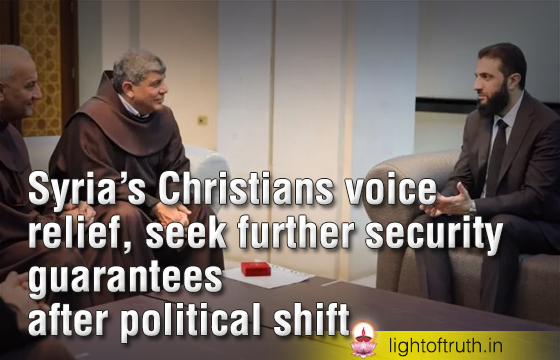
Syria’s Christians voice relief, seek further security guarantees after political shift
More than a month after Syria’s political shift, Christians there are vocalizing a sense of relief as initial assurances for their safety and security by the de facto government have report-edly been provided. Christians continue to seek more concrete guarantees, although opinions differ on what form these guara-ntees should take.
For some Christians, the Church remains their primary safeguard, as it has been since Ottoman rule. In this view, clergy are in charge of representing their communities in political and legal arenas.
The Greek Orthodox Patriarch, John X (Yazigi), is the most visible Christian leader in Syria, along-side the Latin apostolic vicar, Bishop Hanna Jallouf. The latter enjoys a longstanding and strong relationship with the new authori-ties. He recently visited his home-town and parish (Al-Qaniya, Idlib countryside) for the first time since his episcopal appointment, where he was warmly received.
Despite an important meeting between church leaders and re-presentatives with Ahmed Al-Sharaa, the head of Syria’s new administration, three patriarchs based in Damascus were notably absent. The absence was report-edly due to the customary visit of Patriarch Yazigi to congratulate the new leader – a visit that tradi-tionally precedes any other meet-ings with clergy.