
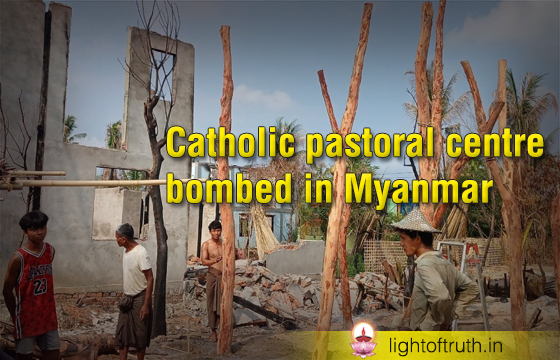
Myanmar’s military has bombed a Catholic pastoral centre in the northern Kachin State. According to the Vatican’s Fides news agency, the St. Mi-chael’s Catholic Church pastoral centre in the rural area of Nan Hlaing in the Diocese of Banmaw was struck and destroyed on 3 March by a bombing carried out by the Burmese army. The church has over one hundred years of history.
Jesuit Fr. Wilbert Mireh, who assists the parish priest, told Fides that five shells and two air bombs were fired at their church complex, hitting and causing damage to the structure, but without any casualties. The local Catholic community in Kachin State is enduring a fierce conflict that continues between the regular army and the ethnic Kachin forces, which have taken over positions near the city of Banmaw. The Kachin Independence Army (KIA), which fights for self-determination in the state, is one of the best-organized ethnic militias, active for decades, and has joined the resistance against the ruling military junta.
The war has intensified, and in the past two years, it has affected nine out of the thirteen parishes in the Diocese of Banmaw, increasing the number of refugees. Fr. Mireh explained that to report the incident, he had to travel to a distant location to find a place with electricity and an internet connection. “Electricity, phone service, and utilities,” he explained, “have been completely cut off in our area since July 2024.”
Category Archives: Asian
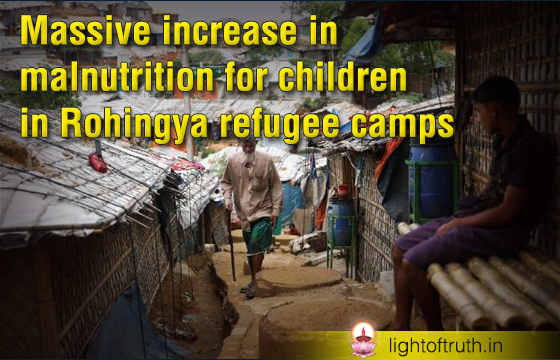
Massive increase in malnutrition for children in Rohingya refugee camps
Severe acute malnutrition in the Rohingya refugee camps in Bangladesh is soaring, the United Nations Children’s Fund has warned, stating it has surged by 27% in February 2025 compared to the same period last year. Recent figures, UNICEF pointed out, show the crisis is worsening. In January 2025, cases of severe acute malnutrition rose by 25% compared to the same month last year, and February saw the even sharper increase at 27%, causing concerns for a dangerous upward trend.
Multiple compounding factors, the organization explained, are contributing to the disturbing escalation. In 2024, there were prolonged monsoon rains that worsened sanitation and triggered spikes in severe diarrhea and outbreaks of cholera and dengue. Also worsening conditions were the impact of intermittent food ration cuts over the previous two years, leading to poor quality diets deteriorating further, as well as a growing number of families fleeing violence and seeking shelter in the camps in recent months.
Moreover, families are facing emergency levels of nutrition in Cox’s Bazar, the world’s largest refugee settlement, home to more than a million Rohingya refugees, including more than 500,000 children. In the camps, more than 15 percent of children are now severely malnourished, marking the highest levels recorded since the mass displacement of Rohingya refugees in 2017.
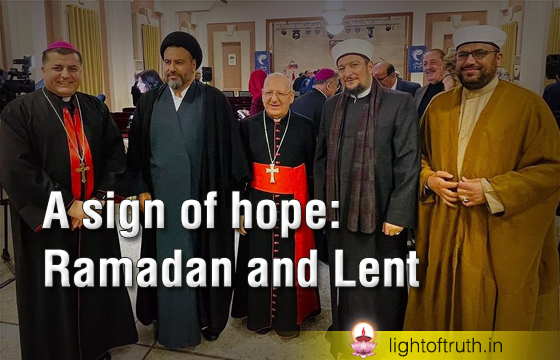
A sign of hope: Ramadan and Lent
This year the month of Ramadan overlaps with the Christian season of Lent. The significance of this coincidence between these two great periods of fasting has not been lost on His Beatitude Louis Raphael Sako, Chaldean Patriarch of Baghdad, who has just announced in an official message to the Muslim and Christian faithful in Iraq that “it is a sign of hope”.
“On this special occasion”, he said, “I extend my warmest congratulations and best wishes to all Muslims in the Holy Month of Ramadan and to all Christians at the beginning of the Great Lent, with hope that God Almighty will include them all in His merciful and loving care, and grant peace and security to our beloved country and to our neighbours in the wider region”.
The patriarch said that both Ramadan and Lent are “times of fasting, prayer, repentance and forgiveness, purification from vices, almsgiving and charity, and a time of quenching one’s thirst at the fountain of divine values, in the spirit of love and tolerance”.
His Beatitude did not refrain from lamenting that today, not only have so many people turned away from God, the God of love and mercy, but that “people have turned away from each other, from tolerance and forgiveness, and from charity and doing good”. He recalled that, during this season of fasting, “all believers need the light of God to illumine their hearts and minds so that they can transform God’s will into an honest and righteous lifestyle.”
In his message, Cardinal Sako extends his gaze to his beloved homeland, saying that, for the sake of lasting stability and security in Iraq, there is no other solution than “to submit to the logic of the State and to cooperate with it, so that Iraq can establish justice, the rule of law, national unity, equal citizenship and avoid sectarianism”. “We will only achieve this by embracing a culture of learning and education that respects all faiths and all peoples in a pluralistic society.”
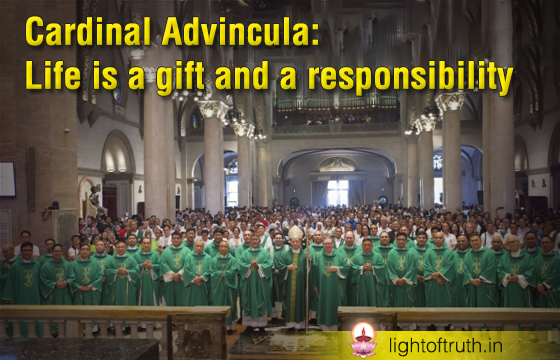
Cardinal Advincula: Life is a gift and a responsibility
During Sunday Mass (February 23) at the Manila Cathedral for the 2025 Walk for Life, Cardinal Jose Advincula of the Archdiocese of Manila emphasized the sacredness of life and the responsibility that comes with it. “Let us continue marching and proclaiming that life is beautiful, that it is an undeserved gift, and that it is also a task and a responsibility to uphold and protect,” he said in his homily.
The archbishop of Manila, the capital of the Philippines, spoke out against various threats to human dignity, including abortion, the commodification of sex, and what he described as the “manipulation of human procreation.” He strongly condemned euthanasia, referring to it as “mercy killing” and calling it “morally indefensible.” Furthermore, he reiterated that extrajudicial killings are “evil” and go against the dignity of human life.
This year’s Walk for Life, an annual event promoting the sanctity of human life and the family, gathered over 3,500 participants. The faithful walked a two-kilometre route from Rizal Park to the Manila Cathedral at dawn on Sunday, publicly affirming their commitment to defending life, especially the unborn. Organized by the Sangguniang Laiko ng Pilipinas, or Philippines’ Council of the Laity, the event was held in partnership with the Episcopal Commission on Family and Life (ECFL) of the Catholic Bishops’ Conference and the Manila Archdiocesan Office for the Promotion of the New Evangelization.
Bishop Jesse Mercado of the Diocese of Parañaque, who serves as ECFL chairman, highlighted the importance of collective action in upholding life and family values. “Our presence here is a clear message to the world that life is sacred, family is a gift, and unity is our strength,” Mercado said. He further expressed hope that the united voices of the faithful would inspire a culture that respects every human life from conception to natural death. “Hope that our collective voice will continue to shape a culture that values every human person from conception to natural death,” the bishop added.
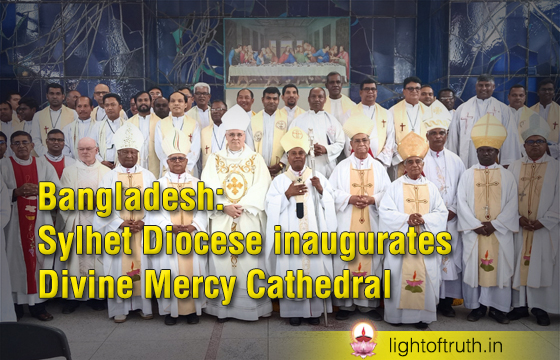
Bangladesh: Sylhet Diocese inaugurates Divine Mercy Cathedral
In a momentous and spiritually uplifting event, the Sylhet Diocese in Bangladesh celebrated the inauguration and blessing of the newly built Divine Mercy Cathedral on February 22. After years of anticipation, the Christian community in Bangladesh joyfully gathered to witness the grand opening of the sacred place of worship. The theme of the event, “A Meeting of Faith, Unity, and Blessings,” resonated throughout the ceremony as thousands of faithful, clergy, and distinguished guests participated in the historic occasion.
Archbishop Kevin S. Randall, the Apostolic Nuncio of the Holy See to Bangladesh, graced the event as the chief guest, alongside Bishop Shorot Francis Gomes of Sylhet Diocese. The event commenced with a solemn Holy Mass, during which Bishop Gomes led the blessing of the cathedral. As prayers and hymns echoed through the newly built church, the faithful gathered in deep reverence and gratitude. Archbishop Randall explained the significance of the cathedral and said, “This cathedral is not just a structure; it stands as a testament to the unity, faith, and service of the Christian community. It calls upon us to keep our hearts open to the Lord.”
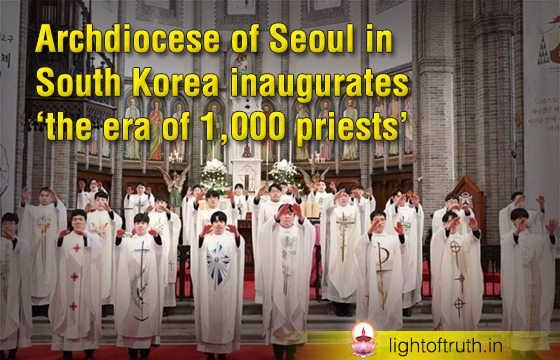
Archdiocese of Seoul in South Korea inaugurates ‘the era of 1,000 priests’
The Archdiocese of Seoul in South Korea has reached “the era of 1,000 priests” upon ordaining 26 new priests for the local Church on Feb. 7. Archbishop Peter Chung Soon-taick, who presided over the ceremony, called on the new priests to carry out their ministry “with true love and constant joy.”
“Priests are called to serve the people of God as collaborators of the bishop and united with the bishop through their priestly ministry,” the archbishop recalled in his homily. He added: “Remember that you have been chosen and appointed from among men to carry out the work of God.” He also urged them to “always take as an example the Good Shepherd who came not to be served but to serve, and to seek and save the lost sheep.” The Archdiocese of Seoul reached the milestone 194 years after its creation.
With these 26 ordinations, the number of priests in the most important archdiocese of the Asian country, which will host the next World Youth Day in 2027, rose from 974 (including a cardinal, an archbishop, three bishops, and four monsignors) to exactly 1,000.
In total, the Korean Church has 5,721 priests, according to the latest figures from the episcopate. In its history, the local Church has ordained more than 7,000 priests, St. Andrew Kim Taegon being the first person to receive holy orders in 1845. At the Feb. 7 ceremony, the second deaf Korean priest (and the fourth in all of Asia) was also ordained. In a statement to the Archdiocese of Seoul, Father Kim Dong-jun said he wants to “serve deaf culture in the manner of Jesus Christ, with sensitivity and warmth toward the weak.”
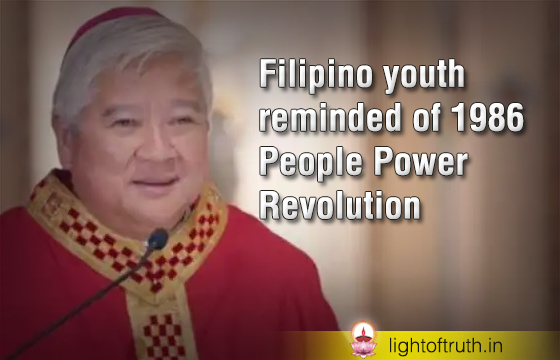
Filipino youth reminded of 1986 People Power Revolution
A Catholic bishop in the Philippines has urged youth in the Catholic-majority nation to conti-nue advocating for social change while seeking out truth, drawing lessons from the People Power Revolution. Archbishop Socrates Villegas of Lingayen-Dagupan made his remarks in a message sent to Radio Veritas Philippines ahead of the 39th anniversary of the 1986 popular protest, Radio Veritas Asia reported on Feb. 21.
“In February 1986, we, your grandparents, stood for four days at the Epifanio delos Santos Avenue [EDSA] in Quezon City, between Camp Aguinaldo and Camp Crame,” Villegas said. “We offered food and prayed the rosary to the soldiers who had been deployed to disperse us. We sang Bayan Ko [‘Our Fatherland,’ a protest song] and slept on the streets,” Villegas added. The pre-late noted that on Feb. 25, 1986, following a peaceful protest, the “dictator and thief” Ferdinand Marcos Sr. fled to Hawaii in exile. “We ousted the dictator without violence and bloodshed,” Villegas emphasized.
An estimated 2 million Fili-pinos participated in the non-violent People Power Revolution from Feb. 22-25, 1986, which ended Marcos’ 20-year-long dictatorship and restored demo-cracy in the nation. Villegas underlined the significance of standing up for what is right and refusing to ignore the wrongdoings of leaders or those in power.
“Abp Socrates loves you. I will not lie to you. I will not mis-lead you. I was there. I saw the corruption, torture, killings, and illegal arrests. That is what ha-ppened,” Villegas said. Villegas pointed out that the revolution was the response of God-loving Filipi-nos to “evil men and evil deeds.”
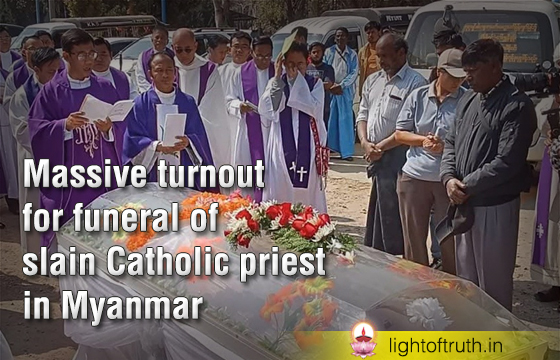
Massive turnout for funeral of slain Catholic priest in Myanmar
More than 5,000 mourners gathered in the village of Pyin Oo Lwin, defying the dangers and prevailing violence, to honour the late father Donald Martin Ye Naing Win, the Catholic priest who brutally murdered on February 14 in his parish of Our Lady of Lourdes in the Archdiocese of Mandalay.
Priests, religious figures, and the faithful assembled at the Catholic Church of the Assumption of the Virgin Mary, where Archbishop Marco Tin Win presided over the funeral Mass, offering condolences and prayers for the slain priest’s family. The moving ceremony included the reading of messages from the Apostolic Nunciature in Yangon and the Bishops’ Conference of Myanmar, which expressed their deep solidarity with the grieving community.
According to sources from Fides News Agency, the overwhelming turnout at the funeral reflected the high regard in which Father Donald was held among the local people.
During his homily, Archbishop Tin Win condemned the cycle of violence gripping the nation, saying, “Violence only brings death and destruction; it is always a defeat.”
He called upon “all armed groups and actors involved in the conflict to lay down their weapons and take a path of peace and reconciliation.”
Father Donald, who was the first parish priest of Our Lady of Lourdes Church, was known for his dedication to the community, particularly in organizing educational initiatives for children and young people. Due to the ongoing civil war, many schools in the region remain closed, leaving religious leaders and catechists to provide informal education.
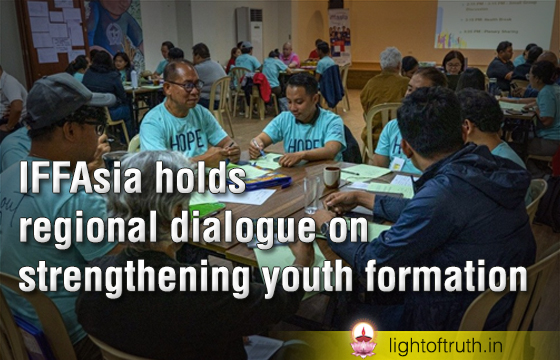
IFFAsia holds regional dialogue on strengthening youth formation
The Institute of Formation Fondacio Asia (IFFAsia) has gathered stakeholders for a dialogue aimed at nurturing partnerships and collaboration “to shape a stronger future” for youth formation in the region. “Today we come together, not as individuals, but as a community deeply committed to the formation of young people in Asia, walking alongside them as they navigate life, faith, and purpose,” said IFFAsia Director Florence Alexius during the opening program.
Some 57 representatives from various Church institutions and civil society groups across 10 Asian countries are participating in the dialogue, which runs from February 9 to 11 in Tagaytay City, Philippines. Ms. Alexius said the dialogue hopes to explore ways “to be a Synodal Church to the young people in their ordinary part of life” and how institutions and organizations “be helpful in enabling and engaging the present generation for the local Church and communities in Asia.”
“This was our guiding objective when designing this program. We truly hope that everyone here sees themselves as collaborators in this journey,” she added. The dialogue process is guided by the principles of Syno-dality–the Christian way of ‘walking toge-ther’–which emphasizes listening, discern-ment, and participation.
IFFAsia is a discipleship and mission school for young adults and laypeople in Asia. Founded by laity from Malaysia and the Philippines within the Catholic lay association Fondacio, it addresses the need for formation programs equipping young laypersons for social and pastoral work.
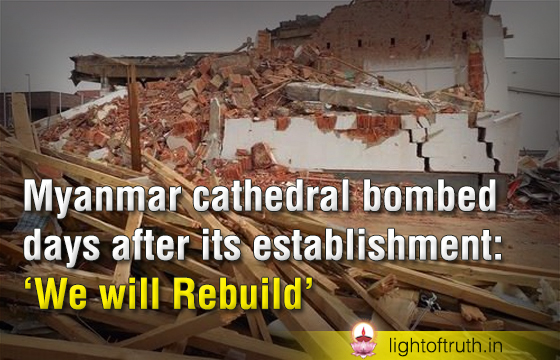
Myanmar cathedral bombed days after its establishment: ‘We will rebuild’
A newly-designated Catholic cathedral in Myanmar was bomb-ed by the military regime last week amid an ongoing conflict in the region. The Sacred Heart of Jesus Church in Mindat was severely damaged by airstrikes by the Myanmar military regime in Chin, Myanmar’s only Christian-majority state.
Though the damage took place on Feb. 6, news of the bombing has only recently come to light. The church’s roof and stained-glass windows were destroyed, rendering the church unusable, according to Fides, the informa-tion service of the Pontifical Mission Societies. No injuries were reported and the area had recently been evacuated.
Less than two weeks before the bombing, on Jan. 25, Pope Francis designated the church a cathedral for the newly-formed Diocese of Mindat. In the days leading up to the attack, local Catholics were planning upcoming liturgical celebrations, including the consecration of the newly-appointed bishop, Father Augus-tine Thang Zawm Hung, Fides reported.
The newly-formed Diocese of Mindat has a total population of almost 360,000, with more than 14,000 Catholics and 23 parishes, according to the Holy See. A local priest, identified as Father Paulinus, told Fides that the faithful are determined to rebuild. “We are very sad that our church has been hit by the bombs. It is a wound in our heart. But we will not let ourselves be defeated. We will rebuild it,” the local priest said. “We are certain that the Lord will ‘bombard’ us with his grace and blessing: This will bring peace and prosperity to our people.”