
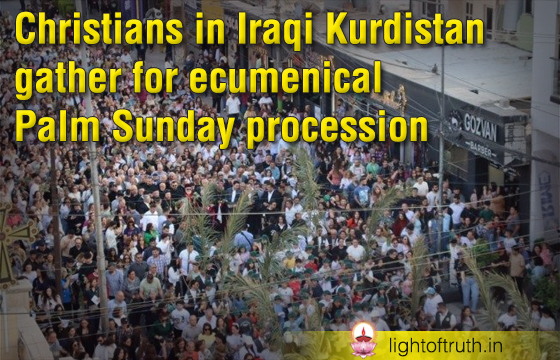
The Christian faithful of Ankawa, a suburb of Erbil in Kurdistan Region, Iraq, came together on Saturday, 12 April, to witness their faith and ecumenical unity during the annual Palm Sunday Procession. Organized by the Catechetical Committee of the Chaldean Catholic Archdiocese of Erbil, the event was organized under the theme: “Hosanna in the highest, blessed is He who comes in the name of the Lord.” The event drew hundreds of participants in a celebration rooted in shared faith and common witness, bringing together leaders and faithful from various Christian denominations in a shared act of worship and unity, culminating in prayer at the Shrine of Mar Elia.
The procession commenced at the Patriarchal Cathedral of St. John the Baptist of the Assyrian Church of the East and proceeded toward the historic Shrine of Mar Elia, a sacred site for the Chaldean Catholic faithful. Leading the event were high-ranking Church leaders, including His Holiness Mar Awa III, Patriarch of the Assyrian Church of the East, Abp Bashar Warda, Chaldean Catholic Archbishop of Erbil, Abp Nicodemus Daoud Sharaf of the Syriac Orthodox Church, and Archbishop Natha-nael Nizar Agam of the Syriac Catholic Church. They were join-ed by priests, deacons, catechists, and representatives from the Kurdistan Regional Government, all united in prayer and song.
The procession was marked by the active participation of children enrolled in catechetical programs, many of whom led the faithful in hymns and carried palm and olive branches—symbols of peace, hope, and the triumphant entry of Christ into Jerusalem. Syriac Orthodox Scouts and Syriac Catholic catechism students accompanied the march with chants and spiritual songs.
Upon arrival at the Shrine of Mar Elia, the faithful gathered for a concluding prayer service, offering gratitude for the gift of Christian fellowship and the enduring presence of Christ in their midst. The procession, now in its 14th consecutive year, has become a cornerstone event in the life of the Christian community in Ankawa—an annual moment of renewal, identity, and interchurch collaboration.
Category Archives: Asian
Airstrikes destroy another Catholic church in Myanmar
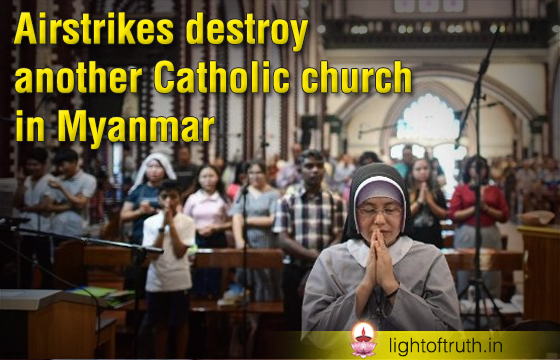
As fighting between the military junta and resistance forces continues despite the recent earthquake, the regular army bombs the Church of Christ the King in the town of Falam, Chin State. Airstrikes by the regular army have destroyed another Catholic church in Chin, Myanmar’s only Christian-majority state, marking yet another tragic chapter in country’s ongoing civil war between the military junta and resistance forces that continues to severely impact Christians and their places of worship.
The Church of Christ the King in the town of Falam, part of the Diocese of Hakha, was hit on April 8. According to Fides local sources the church’s roof and interior have been devastated, but the building’s walls are still standing. The church had only been recently built with great sacrifice to meet the needs of the local Catholic community of around one thousand faithful. It had been consecrated and opened for worship in November 2023, replacing a small chapel that had existed for 75 years. “There is great sadness now in the community, but also the desire and determination to rebuild,” the source told Fides.
Southeast Asia: Traffickers pose as Christian missionaries, pilgrims to exploit victims
Investigations have revealed that Human traffickers in Southeast Asia are increasingly posing as missionaries or pilgrims to deceive authorities and avoid detection at international borders. According to a report by the Vatican’s Fides News Agency, this emerging tactic involves victims and traffickers disguising themselves as Christian missionaries or volunteers engaged in religious activities abroad.
Police operations, supported by wiretaps and coordinated investigations, have uncovered several cases using this “religious cover.” Police described a method where “a regular traveler, acting as a smuggler, accompanies groups of passengers under false pretenses, who become victims of trafficking.” Law enforcement agencies across Southeast Asia–including the Philippines, Indonesia, Malaysia, Thailand, and Cambodia–have intensified joint operations to combat these networks.
In the Philippines, the Catholic Foundation PREDA (People’s Recovery, Empowerment, and Development Assistance), founded by Irish missionary Fr Shay Cullen, has long denounced trafficking schemes that exploit young women. Fr Bryand Restituto, Assistant to the Secretary General of the Catholic Bishops’ Conference of the Philippines, strongly condemned these deceptive practices. ”We strongly condemn individuals and trafficking networks that exploit vulnerable populations and use language, clothing, and presumed religious practices to commit criminal acts,” he said. In Thailand, Sister Marie Agnes Buasap of the Hospitaller Sisters of Saint Paul of Chartres and coordinator of the Talitha Kum Thailand network, is among those leading anti-trafficking efforts. Talitha Kum promotes awareness among youth, families, and educators, and supports the reintegration of survivors.
Pope Francis prays for Myanmar, Thailand after deadly earthquake
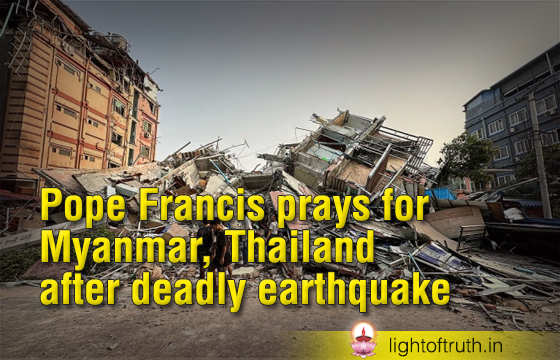
Pope Francis sent his condolences to Church and civil authorities in Myanmar and Thailand after a powerful earthquake killed more than 150 people and caused widespread devastation in the region. “Deeply saddened by the loss of life and widespread devastation caused by the earthquake in Southeast Asia, especially in Myanmar and Thailand, His Holiness Pope Francis offers heartfelt prayers for the souls of the deceased and the assurance of his spiritual closeness to all affected by this tragedy,” said the message sent on the pope’s behalf by Vatican Secretary of State Cardinal Pietro Parolin. “His Holiness likewise prays that the emergency personnel will be sustained in their care of the injured and displaced by the divine gifts of fortitude and perseverance.”
The 7.7-magnitude earthquake struck near Mandalay, Myanmar’s second-largest city, on March 28 at 12:50 p.m. local time. It was followed by a 6.4-magnitude aftershock. Myanmar’s government has reported at least 144 deaths and more than 700 injuries. In neighboring Thailand, at least eight people were killed in Bangkok, where a 33-story building under construction collapsed. Officials fear the death toll could rise, as at least 90 people remain missing in the Thai capital, according to Defense Minister Phumtham Wechayachai. The disaster comes amid Myanmar’s ongoing civil war and a worsening humanitarian crisis. The country’s military junta has declared a state of emergency in the capital, Naypyidaw, and five other regions, while appealing to the international community for humanitarian assistance.
Catholic communities in Myanmar were also affected by the quake. Several churches in Mandalay sustained damage, according to the Pontifical Mission Societies’ Fides News Agency. St. Michael’s Catholic Parish was reportedly the hardest hit, while St. Joseph’s Cathedral in Taunggyi, the capital of Shan State, was also damaged. Local Church leaders have urged Catholics to support those left homeless. Rescue operations are ongoing as emergency teams search for survivors amid widespread destruction.
Authorities in both Myanmar and Thailand are assessing the full extent of the damage while coordinating relief efforts.
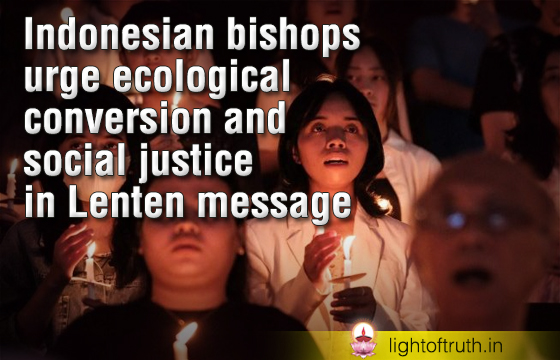
Indonesian bishops urge ecological conver-sion and social justice in Lenten message
“I came so that they might have life and have it more abundantly” (John 10:10) — With these words of Christ as their inspiration, the bishops of the Ecclesiastical Province of Ende in Indonesia have issued a Lenten pastoral letter calling for ecological conversion, justice for the poor, and a renewed commitment to Gospel values. The statement, released at the conclusion of their annual synod, invites the faithful to a deeper journey of reflection, repentance, and concrete action amid pressing environmental and social concerns affecting communities in Flores, Lembata, and Denpasar.
Signed by Archbishop Paulus Budi Kleden, SVD (Ende), along with Bishops Silvester San (Denpasar), Fransiskus Kopong Kung (Larantuka), Siprianus Hormat (Ruteng), Edwaldus Martinus Sedu (Maumere), and Maksimus Regus (Labuan Bajo), the letter speaks with pastoral urgency to the over two million Catholics entrusted to their care—approximately 1.9 million across Flores and Lembata, and 50,000 in Denpasar.
In their message, the bishops express concern over ongoing geothermal energy developments in the region, especially in the mountainous and water-scarce islands of Flores and Lembata. While acknowledging the need for progress, they warn that “unwise exploitation harms the environment, food security, social balance, and cultural sustainability.” They question whether such extractive projects, though presented as beneficial, are instead “endangering the future,” and stress that geothermal development is not suitable for the region’s unique ecological and geographical context.
Rather, they propose alternative energy options—such as solar power—that align more harmoniously with the local environment and with Pope Francis’s encyclical Laudato si’, which calls for integral ecology and care for our common home. “The vision for Flores and Lembata,” the bishops write, “is not one of exploitation, but of sustainable development rooted in the richness of our agricultural, marine, and cultural heritage.”
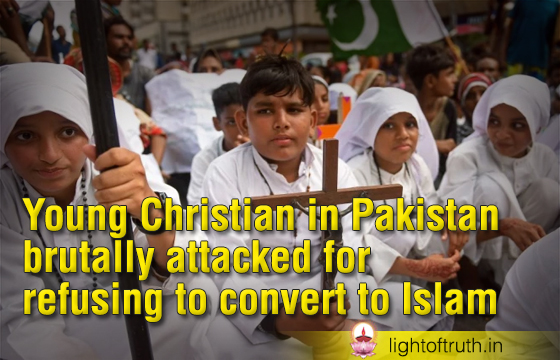
Young Christian in Pakistan brutally attacked for refusing to convert to Islam
Amid the persecution of Christians in Pakistan, a 22-year-old man was “brutally attacked” on March 22 by his supervisor after refusing to convert to Islam. The pontifical foundation Aid to the Church in Need (ACN) reported the attack, pointing to it as yet another example of “the persistent religious intolerance present in much of Pakistani society.” Of the 208 million inhabitants of the South Asian country, 96.47% are Muslim and 1.9% Christian. The remainder are Buddhists, Hindus, agnostics, and members of other local religions. Attacks against Christians in Pakistan intensified in August 2023 after Muslims looted and burned more than 25 churches and at least 85 homes in Jaranwala. The local Church reported that “people are frightened and feeling hopeless.”
This weekend, at the Subhan Paper Mills in Punjab, young Christian Waqas Masih “suffered severe neck injuries” after his supervisor, identified by ACN as “Zohaib,” accused him of desecrating pages of the Quran found in the trash. The attacker was arrested by police and is charged with attempted murder. “I pray for his speedy recovery and for the well-being of his entire family. The attack on Waqas Masih is a harsh reminder of the challenges faced by religious minorities in Pakistan and the urgent need for social change to promote tolerance and protect the rights of all citizens,” Capuchin Franciscan Lazar Aslam, who visited Masih in the hospital, told ACN. “We humbly call on the international community to pray for the victims and their families as well as to raise awareness about the difficult situation for marginalized communities in Pakistan, ensuring that their voices are heard and their rights protected,” he added.
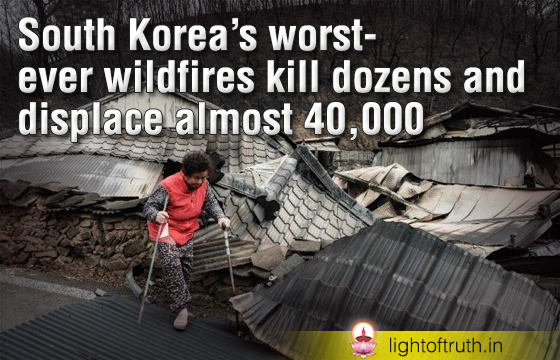
South Korea’s worst-ever wildfires kill dozens and displace almost 40,000
The country’s worst-ever wildfires, which engulfed a forest on March 27, have destroyed thousands of homes, infrastructure, places of worship and vehicles. The multiple wildfires, fueled by strong winds and dry weather, have been raging across South Korea’s southeastern regions. The government has mobilized thousands of personnel, dozens of helicopters and other equipment to extinguish the blazes, but the wind is hampering their efforts.
Light rain is expected, but meteorologists say it probably won’t help much in extinguishing the blazes.
Amongst the victims is the pilot of a helicopter that crashed during efforts to contain a fire Wednesday and four firefighters and other workers who died earlier after being trapped by fast-moving flames. Authorities, who suspect human error may have caused several of the wildfires, say most of the civilians who died were elderly or people who found it difficult to escape quickly or who even refused orders to evacuate.
In Cheongsong, a Buddhist temple is at risk of burning. In the southeast, two villages, including Puncheon, home to a UNESCO World Heritage Site founded around the 14th century, was ordered to evacuate. In Uiseong, about 20 of the 30 structures at the Gounsa temple complex, which was said to have been originally built in the 7th century, have burnt to the ground. Among them were two state-designated “treasures.” The deputy head of the government’s disaster response centre said the wildfires show “the reality of climate crisis that we have yet experienced.”
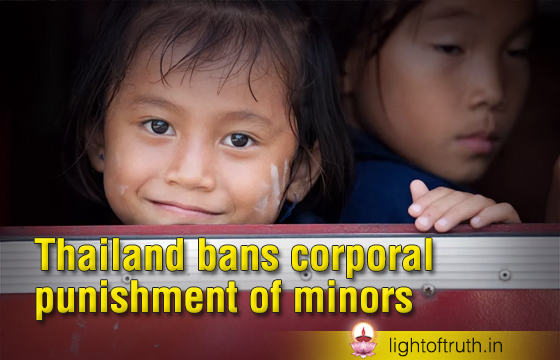
Thailand bans corporal punishment of minors
Thailand has banned corporal punishment of minors. With this important step, the Southeast Asian country is aligning with the UN Convention on the Rights of the Child, in force since 1990, a source of debate, especially in school and families. Traditionally, the practice was tolerated in many families, and affected a high percentage of children and teenagers. According to the latest survey by the National Statistical Office, published in 2022, 54 per cent of Thais under the age of 14 received some form of physical or psychological punishment at home.
Although down from 75 per cent in 2005, the figure is still too high for UNICEF, which is promoting the total ban of the practice. With the publication of the measure in the Royal Gazette, Thailand became the 68th country in the world to prohibit the use of coercion or violence against minors for disciplinary purposes. UNICEF Thailand welcomed the news, defining the change as a model to follow to ensure the total protection of young people from all forms of violence or exploitation.
At the same time, it stresses the importance of the government backing the ban with adequate educational campaigns, especially directed at families, where the use of force as an educational tool is still widely accepted. This will not be an easy task. In Thailand the traditional idea of family remains strongly ingrained, even when it comes with excessive behaviours. Attempts at reforms have always met with resistance in the country’s military establishment and among nationalist circles who prefer “traditional” values.
It is no coincidence that, back in 2021, during the country’s periodic review, the Global Partnership to End Violence Against Children reiterated that under international human rights law – the Convention on the Rights of the Child and other human rights instruments – states have an obligation to ban corporal punishment in all areas, including in the family.
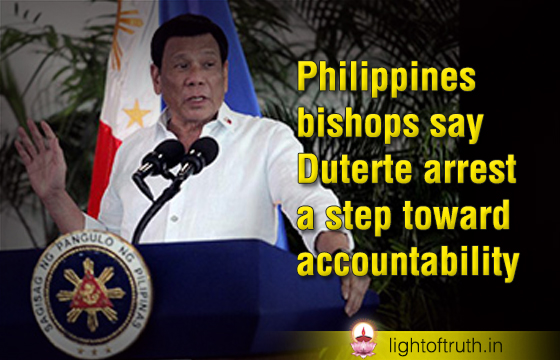
Philippines bishops say Duterte arrest a step toward accountability
Bishop Jose Colin Bagaforo of Kidapawan said Mr Duterte’s arrest is a crucial move toward justice for the thousands killed in his deadly drug war. “True justice … is about accountability, transparency, and the protection of human dignity,” said Bishop Bagaforo, who is also president of Caritas Philippines. “For years, former president Duterte has claimed that he is ready to face the consequences of his actions. Now is the time for him to prove it,” he said. Mr Duterte is in police custody after Interpol served him with an arrest warrant from the International Criminal Court for alleged crimes against humanity upon his arrival at Manila’s international airport. The ICC has been investigating the brutal anti-drugs crackdown that Mr Duterte oversaw while he was in office. According to UCA News, human rights groups and Church organisations estimate that between 12,000 to 30,000 people, mostly poor drug suspects from squalid ghettos and underbellies of the Catholic-majority nation, were killed during Mr Duterte’s regime.
Mr Duterte withdrew the Philippines from the ICC in 2019, but an appeals judge ruled that prosecutors still had jurisdiction over the alleged crimes because they occurred when the country was still a member. Most cases investigated by the ICC took place between 2016 and 2019. The probe also covers alleged crimes committed when Mr Duterte was mayor of Davao.
Bishop Gerardo Alminaza of San Carlos emphasised the need for justice, stating that the victims and their families deserve truth and reparations. “These killings were not random; they were part of a policy that violated the fundamental right to life,” said Bishop Alminaza, who is also vice president of the national Caritas. “The families of the victims deserve truth, reparations, and justice. As a nation, we must ensure that such crimes never happen again,” he said.
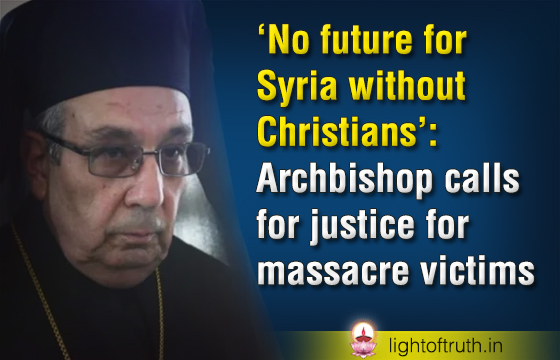
‘No future for Syria without Christians’: Archbishop calls for justice for massacre victims
The Greek-Catholic archbishop of Homs, Jean-Abdo Arbach, condemned the massacres of civilians that occurred in Syria last weekend – which left at least 1,000 dead – and urged Christians to maintain hope for an end to the violence and a return to unity and reconciliation.
Arbach emphasized the importance of the Christian community for the country’s future, telling the pontifical foundation Aid to the Church in Need (ACN) that “without Christians, there can be no future for Syria” and urged the faithful to remain steadfast despite the trying circumstances.
“Christians are the roots of Syria and Syria is the cradle of Christianity. In Damascus we can still find the places where St. Paul converted to Christianity in the first century. We still have first-century churches and monasteries, and we have kept Aramaic, the language Jesus spoke, alive,” the prelate emphasized. Furthermore, the archbishop urged those responsible to stop the hostilities: “We do not want more bloodshed. We call for unity and reconciliation. After 14 years of war, we do not need another conflict.” The attacks, which claimed more than 1,000 lives, have been attributed to militants from the Hay’at Tahrir al-Sham group, a coalition of Sunni Islamist insurgent groups that have seized power in the Middle Eastern country by overthrowing the regime of President Bashar al-Assad.