
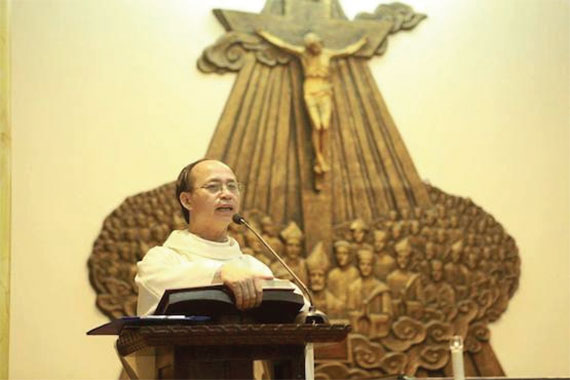
Father John Luu Ngoc Quynh from the Redemptorist Community in Hanoi was stopped by security officials at Noi Bai Airport on Dec. 5 and prevented from traveling to France, the community said in a statement. He is the second Redemptorist priest to be prevented from leaving the country this year. Father Quynh was invited to attend the vow-taking ceremony of a Vietnamese Cistercian on Dec. 8 in France, the statement added. The Cistercian is one of the priest’s alumni. Security officers told Father Quynh that he “was banned from traveling abroad for the protection of national security, social order and safety.”
Category Archives: Asian
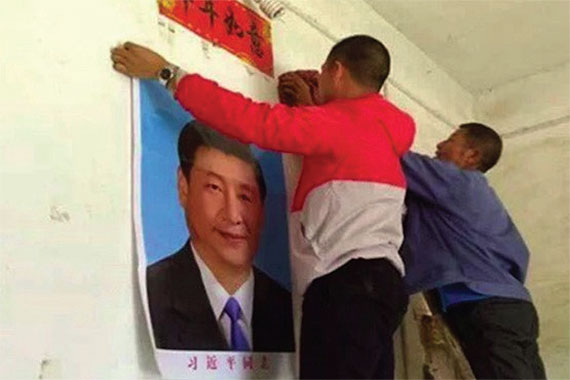
China officials replace in-home pictures of Jesus with Xi Jinping
Officials in China’s Eastern Jiangxi Province have replaced religious images dis-played by Christian families with portraits of the country’s leader Xi Jin-ping. On November 12, pictures were uploaded to an account on the popular social messaging service WeChat account of Huangjinbu town government, Yugan County, showing officials removing images of the cross and other religious subjects.
The message from officials stated that the Christians involved had “recognized their mistakes and decided not to entrust to Jesus but to the (Communist) Party” claiming the Christians voluntarily removed 624 religious images and posted 453 portraits of Xi.
The officials also claimed they were “converting” Christ-ians to Party loyalty through poverty alleviation and other schemes to help the disadvant-aged. Nearly 10% of Yugan County’s largely impoverished one million population is Christian.

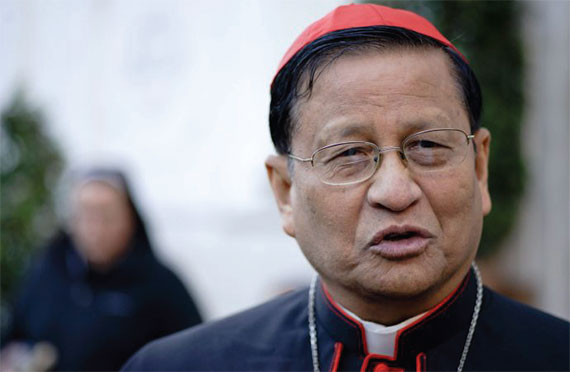
Cardinal Bo urges Pope Francis not to use the word ‘Rohingya’ during Myanmar visit
In 2006, while he was visiting Regensburg, Germany, Pope Emeritus Benedict XVI delivered an address in which he cited a 14th century dialogue between a Byzantine emperor and a Persian, unleashing a firestorm of protest across the Islamic world.
Benedict’s quote cited the emperor saying: “Show me just what Mohammad brought that was new, and there you will find things only evil and inhuman, such as his command to spread by the sword the faith he preached.”
The citation was shot out of a media cannon with deadly consequences. An Italian nun was shot to death in Somalia, churches were firebombed on the Gaza strip, and the pontiff was burned in effigy in the streets of Ankara.
Myanmar’s first-ever cardinal, Charles Maung Bo, who will be hosting Pope Francis during his Nov. 27-30 visit to the Asian nation, fears that a similar situation could unfold, though this time Muslims wouldn’t be the protesters but the victims.
Bo, created cardinal by Francis in February 2015, spoke with Crux in Rome ahead of the papal visit to Myanmar, the first by a Pope, and Francis’s first to a Buddhist majority country.
During the 30-minute conversation with the pontiff, the cardinal acknowledged that if Francis chose to use the term ‘Rohingya,’ “there could be demonstrations at once, going after the Muslims.”
The “R” word, used by a Muslim minority in Myanmar to define themselves, is causing controversy ahead of the Pope’s visit.
The United Nations is accusing Myanmar’s military of carrying out ethnic cleansing against the Rohingya in Rakhine State, and the international community is concentrating its energy on the persecuted minority. Yet Bo is all but begging the Pope not to call the Rohingya by their name.
“If he doesn’t use it, the international community will say something,” Bo acknowledged. “If he does use it, then it could be very bad for the military, the government and the Buddhist community.”
By political connotation, Bo explained, he meant that the Pope wouldn’t be supporting the idea the estimated million Rohingya living in Myanmar – though it’s believed that half of them have fled to Bangladesh in recent months – should be given citizenship.

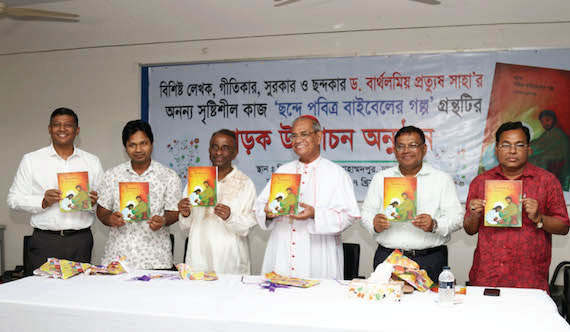
Bangladesh author writes rhyming Bible stories
A prominent Bangladeshi Catholic musician has written a book containing Bible stories that rhyme to help Christian children read and understand the Bible better. Card Patrick D’Rozario of Dhaka launched the book called Chhonde Pobitro Bibeler Golpo (Selected Stories from the Holy Bible in Rhyme) written by Bartholomew Prottyush Shaha on Nov. 19 in Dhaka.
The 56-page Bengali language book is a collection of 25 stories from the Bible in verse form.
“Children like rhymes and they can easily memorize them. My intention is to offer children an opportunity to learn and grow an interest in the Bible at an early age. I hope this book will be use-ful for children in schools and at home,” Shaha, told.
The income from the book would go to Pratibeshi Prakashani, the publisher and publication wing of Catholic Bishops’ Christian Commu-nication centre, he said.
Over the years, he has composed over 100 religious songs and 45 have found place in Geetaboli (Songs), a popular Bengali Mass hymnal widely used in church liturgy.

Laos’ first cardinal aims for interfaith unity
In the Cathedral of the Sacred Heart in Vientiane a large banner is hard to miss.
The “17 Martyrs of Laos” banner hangs from the ceiling of Vientiane’s only Catholic Church and commemorates a group of Catholics, including several priests, who died between 1954 and 1970 in a crackdown on the religious by the communist government.
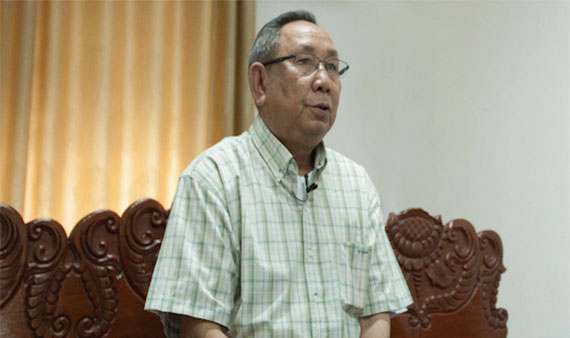
Each year, on Dec. 16, Louis-Marie Ling Mangkhanekhoun, 73, makes sure that the martyrs are not forgotten. “We remember them with a ceremony, because they were witness to the faith,” Ling said inside the cathedral.
Ling, who grew up in a poor family without a father and was raised with the Khmu ethnic minority in Laos’ mountainous Xiengkhouang province, can also be described as a “witness to the faith.” Ling, who became the first cardinal of Laos on June 28, was sent to prison in 1984. Not for committing a crime, but because of his work as a priest travelling around the country.
He spent three years behind bars. But the cardinal sees the jail time as a spiritual experience during which his faith was tested. “There were some difficulties when I was locked up, health diffi-culties for example,” he says. “But it didn’t trouble me a lot. It didn’t disturb me in my personal life. Because we can take it as a test; where is your faith?” The appointment of Cardinal Ling, who studied theology and philosophy in Canada, came as a surprise to many. Including the man himself, who was in the small southern Laotian city of Pakse – where he serves as a bishop – when he heard the news.
“I was walking around when somebody called me, and said: ‘grandfather, you are selected as a cardinal.’ I said ‘no, this is not a time to joke,’ because I didn’t believe it,” he says laughing. “Then it was confirmed, and I had to go to Rome.”
There are an estimated 45,000 Catholics in Laos, according to a 2007 US government report on international religious freedom. But Cardinal Ling believes the true number is closer to 50-60,000, as the Lao Catholic population has grown slowly but steadily. Some live in the main cities along the Mekong river. Others live in remote areas, often with no church nearby.
In the entire country, there are only four bishops and 20 priests. But the low number doesn’t bother Cardinal Ling too much. “For me it’s not the number of priests that count, but the quality. We have to do our best to make them qualified as a priest. And even with nothing we can still do something.”


Catholic bishop leads search for missing Marawi Christians
A number of Christians remain missing in Marawi a month after the Philippine military liberated the city from terrorist gunmen following a five-month siege that killed more than a thousand people. The Humanitarian Emergency Action and Response Team of the Autonomous Region in Muslim Mindanao reported that as of last week at least 293 people on a Red Cross list remained unaccounted for, although it was not clear how many were Christians. The number of missing could be much higher, according to NGOs working in the region.
Priest criticizes Vatican over Indonesian bishop case
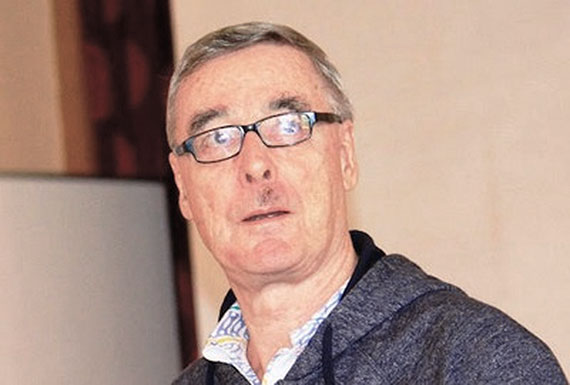
A British-born priest who has served in Indonesia for more than 40 years has called on the Vatican to end its tradition of keeping disciplinary cases involving the clergy confidential and demanded changes to the way bishops are appointed.
In an opinion piece published in Hidup, a weekly magazine published by the Jakarta Archdiocese, Divine Word Father John Mansford Prior, a missiology lecturer at the Catholic School of Philosophy in Maumere on the Catholic majority island of Flores said the handling of moral cases involving clergy must be “completely transparent, just like in the state system.”
“If the Holy See compels a bishop to withdraw, the results of the trial [of a bishop] must be officially announced,” he argued.
Father Prior, who also works at the Candraditya Centre for the Study of Religion and Culture in Maumere is a former consultor of the Pontifical Council for Culture and the Federation of Asian Bishops’ Conference (FABC). His article, published in the Oct. 29 edition of Hidup, specifically addressed the resignation of Bishop Hubertus Leteng of Ruteng.
Pope Francis approved Bishop Leteng’s resignation on Oct. 11 after an investigation into allegations of misappropriating more than US$100,000 of church funds and an illicit relationship with a woman. In its official announcement, the Vatican did not give a reason for Bishop Leteng’s resignation.
Father Prior told ucanews.com on Nov. 1, that in addition of transparency, the church should also encourage due process.
“If there were credible accusations, the clergy, whether it’s a priest or bishop being accused, should be immediately discharged, certainly with innocent prejudice,” he said.
The church is not credible in handling such cases, he argued because “priest investigates priest, bishop investigates bishop and it is done in private.” “Who can really believe in the results of such a process?”
Filipinos back bishops’ call for national healing amid drug war
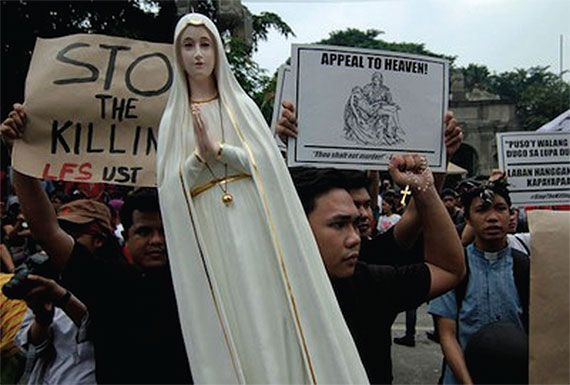
Thousands of Filipino Catholics are expected to join a religious procession to call for “national healing” that will be held in a major thoroughfare in Manila on Nov. 5. A statement from the Bishops Conference of the Philippines said the event will be a “prayerful gathering for the healing of the nation.”
The country’s bishops declared Nov. 5 as “Lord Heal Our Land Sunday” that is highlighted by the procession on Epifanio delos Santos Avenue, site of the 1986 “people power” revolution. An image of the Our Lady of Fatima, which was brought by devotees during the revolt that toppled the 20-year rule of Ferdinand Marcos, will be carried in next week’s procession.
Abp Socrates Villegas, president of the bishops’ conference, said the activity is not meant to encourage attempts to destabilize the government.
“We ask the Lord for healing of our land, healing of our people so we can move forward in peace, in prosperity, for all,” said the Archbishop of Lingayen-Dagupan. “Healing does not mean turning a blind eye but being conscious to what is happening in our societies and owning to our mistakes,” added the prelate. He said the “signs of the times” is calling Filipinos back to God’s fold because “we turned our back to God.”
Indonesian Protestants embrace papal teaching document
Indonesian Protestants celebrating the start of the Reformation 500 years ago have embraced Pope Francis’ Apostolic Exhortation on the Proclamation of the Gospel in Today’s World, calling it a document that can significantly help mend ties among Christians in a country blighted by growing religious intolerance.
The Protestant Reformation began on Oct. 31, 1517, when Martin Luther, a German pastor sent his Ninety-Five Theses on the power and Efficacy of Indulgences to the Archbishop of Mainz in which he criticized the Catholic Church and the papacy.
During celebrations in Jakarta on Oct. 31 to mark the event Indonesian Protestant leaders said the pope’s message in his 2013 Apostolic Exhortation Evangelii Gaudium or The Joy of the Gospel, in which he a called for churches to avoid blaming each other, held special meaning in Indonesia as fears grow over rising intolerance in the country.
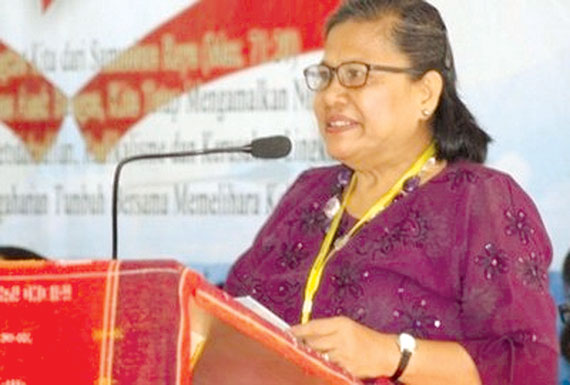
“The invitation by Pope Francis in the document is very relevant, asking churches to distant ourselves from blaming and slandering attitudes,” Rev. Herniette T. Lebang, chairwo-man of Communion of Churches in Indonesia, said at the Oct. 31 gathering.

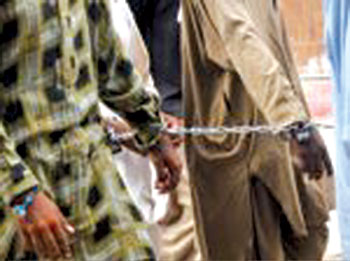
Christian prisoners denied visits from chaplain
In Pakistan, Christian prisoners are denied the consolation of faith offered by chaplains denounces The World Watch Monitor, granted permission to visit detainees in prisons across the country. The Rev. Maurice Shahbaz, director of the Prison Mission Society of Pakistan, says he has been trying to get consent for visits to prisoners by missionaries, evangelicals, and pastors for more than a year. This would allow Christians, already discriminated against by cell companions because of their faith, to have at least the consolation of faith.
Tariq Mehmood Khan Babar, deputy general inspector, says the ban on imam visits to detainees dates back to early 2015, in conjunction with the approval of the National Action Plan. This is the terrorism prevention plan launched by Islamabad following the Taliban massacre at the Peshawar military school in December 2014, which resulted in the deaths of 132 children.