Category: Asian

  • CHINA BANS ONLINE BIBLE SALES, RELIGIOUS BLUEPRINT RELEASED

    CHINA BANS ONLINE BIBLE SALES, RELIGIOUS BLUEPRINT RELEASED

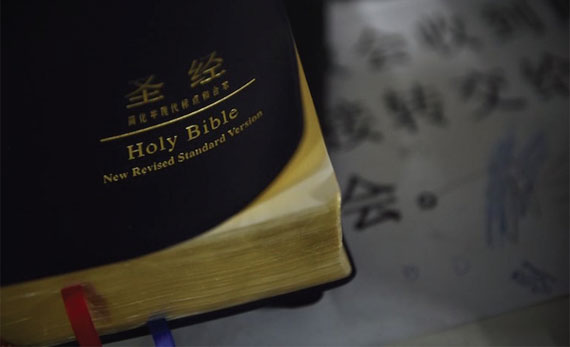
    On Holy Saturday, China’s communist government, deep in talks with the Vatican on a deal to appoint bishops, issued a ban on internet sales of the Bible. Four days later, it issued its first white paper on religious freedom in 21 years, only a week after hauling Bishop Vincent Guo Xijin of Mindong away from his diocese for a few days during Holy Week.

    A notice issued on Twitter like Chinese site Weibo banned online bookstores, such as Tabao and Dangdang, China’s equivalents of Amazon, from selling Bibles.

    People searching for Bibles on these sites were greeted with the message: “Sorry! No products in this category available.”

    One observer noted that there is a long-standing rule that the Bible cannot be sold publicly or on the internet in China but that oversight of this rule has been allowed to slide over the years.

    “It can only be sold in churches that the government permits — it looks like the government has started to take the matter seriously,” the observer noted.

    William Nee, a researcher for Amnesty International, told that the Chinese government should immediately reverse its ban on the sale of Bibles and ensure that all Christians and people of other religions can exercise their faith without government interference or intimidation.

  • Chinese Government Official: No Religion ‘Transcends Nations’


    A Chinese government official who oversees religious affairs said that government restrictions on bishop appointments are not a violation of religious freedom, as he emphasized that religions in China must “adapt to socialist society.” “I believe there is no religion in human society that transcends nations.”

  • Parish in Manila in hot water for high wedding rates

    Parish in Manila in hot water for high wedding rates

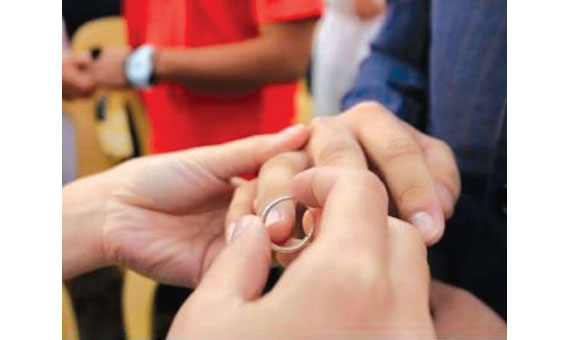
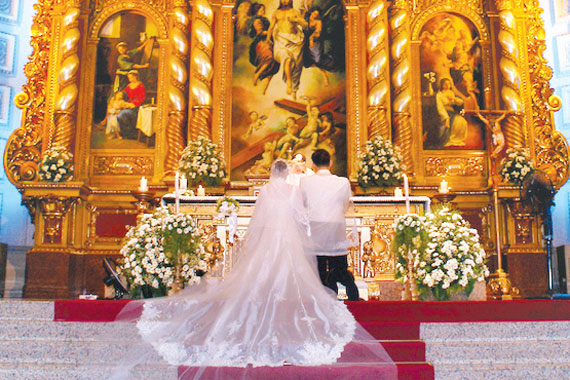
    A Catholic parish in a posh area of the Philippine capital’s business district, Makati, has drawn flak for proposing to charge more than US$1,000 for weddings held in the parish church. A barrage of social media posts has condemned Santuario de San Antonio Parish in Makati’s exclusive Forbes Park village for raising its wedding rates from about US$767 to US$1,250.

    The parish church has slots for 936 weddings each year. Of US$1,000 for every wedding held, the parish gets US$936,000 or about 490 million pesos a year.

    Most churches in the Philippines charge a wedding fee of about US$100 to US$400.

    Special discounts are also given to parishioners, or if couples decide to hold their wedding on a weekday. Air-conditioned churches charge extra to cover electricity and other operational costs.

    Santuario de San Antonio Parish also announced on March 15 that it would raise annual accreditation fees for wedding planners, florists, musicians, videogra-phers and photographers.

    The parish also planned to charge wedding planners an annual accreditation fee of as much as US$1,000 while photographers and videographers would be charged at least US$575.

    Wedding blogger and photographer Dominic Barrios said the new rates are “excessive.” He said those getting married in the church will be burdened because they will pay for the suppliers.

    Parish priest Reu Jose Galoy, a Francis-can, immediately withdrew the new rates following the slew of criticism.

    “We apologize if the regulations and the rates caused you all concern as it was never our intention to do so,” said the priest in a statement released by the parish.

    He said that “while we feel the regulations … were fair and well thought out, we now realize that they should be considered a work in progress rather than the final product.” The new regulations and rates for weddings were presented during the parish’s first “wedding congress” held on March 15.

  • Goodbye to the Religious Affairs Bureau: religions are now under the direct control of the Party

    Goodbye to the Religious Affairs Bureau: religions are now under the direct control of the Party

    The State Administration for Religious Affairs (SARA), also known as the “Religious Affairs Bureau,” so far under the authority of the Council of State, has passed under the direct rule of the Communist Party. The move is among a detailed program of reforms on the Party and the state institutions released.

    The decision to eliminate SARA was passed in the third plenary session of the 19th Communist Party’s Central Committee in late February. Part of the program was reviewed in the recently concluded National People’s Congress, China’s parlia-ment. Detail of the program was made public on March 21, with indication that the reform should be implemented by the end of 2018.

    Among the reforms, religious affairs are now managed by the United Front Work Department (UFWD), an organ of the Commu-nist Party’s Central Committee, whose main function is to manage relations with the non-Communist elite, including individuals and organizations, such as religious groups. Also now under the management of the UFWD are the Overseas Chinese Affairs Office and the Ethnic Affairs Commission, both also originally under the State Council.

    The structural change received mixed views among Chinese Christians and observers. “There won’t be big change to religious environment, neither loosen nor tighten. It is only a change on management structure and they will do the same thing,” said Father Liu, a priest who serves in a Southern province.

  • Catholic church in China has crosses removed

    Crosses on Shangqiu South Church (Cathedral of the Sacred Heart of Jesus) in China have been removed by the district govern-ment. It is the first Catholic Church in Henan province to have crosses removed. Officials later installed new ones but they were much smaller in numbers and size. A source who asked to be unnamed told ucanews.com that street office and district committee officials on March 8 asked the church to remove its crosses. Church staff reported the incident to both the municipal and district religious affairs bureaus. They also disagreed with the crosses’ removal but the street office and the district committee insisted. Officials from both bureaus visited district officials, who refused to listen and removed the crosses on March 9 by using a crane.

    The South Church comprises an old small church, a cathedral and a gate tower. A total of 10 crosses were removed — six above the cathedral, one above the door of the cathedral, and three above the old church next to the cathedral. After their removal, a few Catholics went to the cathedral and prayed outside. An old lady was seen crying.

    Several incidents have targeted Christianity in Henan recently, including the removal of crosses and the posting of signs prohibiting minors to enter churches, but Father John believes Henan is not a particular target.

  • Church survey says more Filipinos approve of divorce 

    Church survey says more Filipinos approve of divorce 

    More Filipinos support the legalization of divorce in the country, a Church-initiated public survey showed.

    The survey conducted by Church-run Radio Veritas revealed that 39% of the 1,200 respondents strongly agree with the proposed measure in Congress, while only 35% strongly dis-agreed. 13% of those surveyed said they somewhat agree while another 13% said they somewhat disagree.

    The survey, dubbed “Veritas Truth Survey (VTS),” was conducted from December 2017 until last January. Fr Anton Pascual, president of Radio Veritas, said this survey result is a wake-up call to the Catholic Church. “This is a wake-up call and a big challenge to the Catholic Church, especially since many of the faithful are in favour of the legalization of divorce here in the Philippines, the only country aside from the Vatican without a divorce law,” he lamented. The priest said this means the Church needs to preach more on marriage. Of the female respondents, 43% said they strongly agree with the legalization versus 35% who said they strongly disagree.

  • Filipino archbishop honoured as ‘hero of the environment’

    Filipino archbishop honoured as ‘hero of the environment’

    A Catholic Archbishop in the Philippines has been named a “hero for the environment” for his strong advocacy against mining, especially in the northern part of the country.

    The Gawad Bayani ng Kalikasan award was given to Archbishop Sergio Utleg of Tuguegarao for his “exemplary deeds and initiatives” to advance environmental protection. The award is given to those who “serve as an example” in protecting the environment by activist groups led by the Centre for Environmental Concerns. “We honour the efforts of extraordinary environmental defenders who are fighting through various forms and capacities,” said Owen Migraso, executive director of the organization.

    The award recognized Archbishop Utleg’s “passion, commitment, and integrity” to carry on his advocacy for the environment “amidst life-threatening circumstances.”

    “He is recognized for being a rock and foundation of pro-environment movements that successfully closed down illegal mining operations,” said Migraso. In a message read during the awarding ceremony, Archbishop Utleg said he was “sharing this award with all the people who stand for the protection of all creation, the promotion of human rights and the dignity of life.”

    Danggayan, an activist group in Cagayan nominated Archbishop Utleg for the award. “He is not just a good shepherd but also a fierce environment defender,” said Isabelo Adviento, the group’s leader.

  • Wounded priest in Indonesia forgives attacker

    Wounded priest in Indonesia forgives attacker

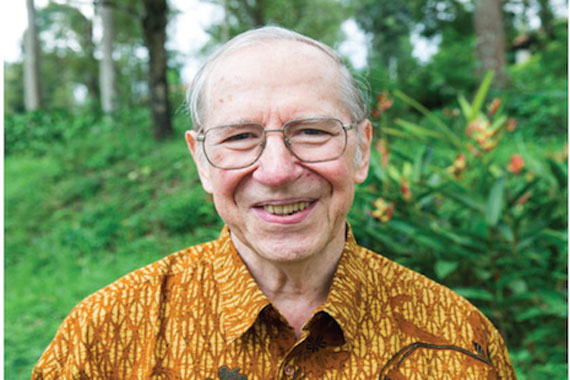
    Dutch-born Jesuit Father Karl-Edmund Prier, 80, was the victim of a sword-attack on Feb. 11 when he was celebrating Mass.

    A priest in Indonesia attacked and wounded in his church by a sword-wielding man says he has forgiven his attacker.

    A suspected Muslim extremist called Suliyono attacked Dutch-born Jesuit Father Karl-Edmund Prier, 80, during a Mass at St. Lidwina Church in Yoyakarta on Feb. 11.

    Three other Catholics were injured in the attack, which also saw the attacker decapitate Mary and Jesus statues, before being shot and wounded by police.

    “I forgive Sulyono with sincerity. Every day I pray the Our Father prayer, which states that as we forgive those who trespass against us,” wrote Father Prier in a letter posted on the bishops’ commission on social communication website on Feb. 24.

    Father Prier said he could have run away during the assault but did not.

    “However, my conscience said: ’Do not go. The good shepherd should not run when wolves come.’ I remained standing on the altar to divert the attacker’s attention to me,” he said.

    “He had the sword raised high and shouted, Allahhu akbar! As he ran down the aisle toward me,” he added.

    He also said Muslims were very kind and helped clean up the church after the attack.

  • Family of Pakistani blasphemy suspect demands answers

    Family of Pakistani blasphemy suspect demands answers

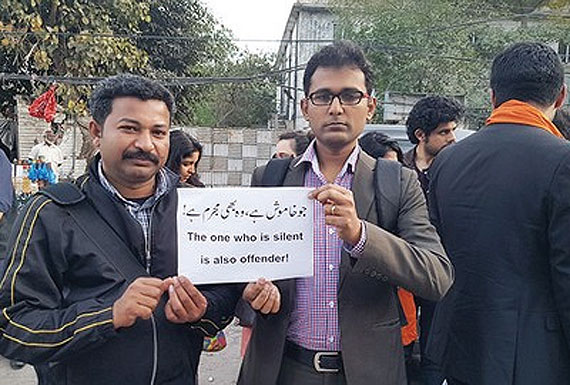
    The family of a young Christian man who sustained serious injuries while allegedly escaping sexual abuse is demanding to know how he was implicated in a blasphemy case.

    Sajid Masih, 24, was due to have surgery on Feb. 27 after jumping from the fourth floor of the Punjab headquarters of the Federal Investigation Agency (FIA) in a suicide attempt on Feb. 23. He was being interro-gated with his cousin Patras Masih, 18, who was arrested on Feb. 19 for allegedly posting an insulting photo of the burial place of the Prophet Muhammad on a Facebook account.

    Sajid claims he was being punished for an act allegedly committed by his cousin and that security authorities had ordered the two men to engage in a homosexual act as they attempted to force confessions from them both. Critics say police duress in such cases is common in Pakistan.

    Abid Masih Ghouri, Sajid’s father, was called by a govern-ment hospital official shortly after the suicide attempt that sparked a nationwide outcry from mino-rity circles and civil society. “My senses faded after seeing his bloody body on a hospital trolley. I have never cried so much in my life,” Ghouri, 46, a sanitary worker, told ucanews. com.

  • Female theologians in Pakistan say “women are being dominated and de-womanised”

    Female theologians in Pakistan say “women are being dominated and de-womanised”

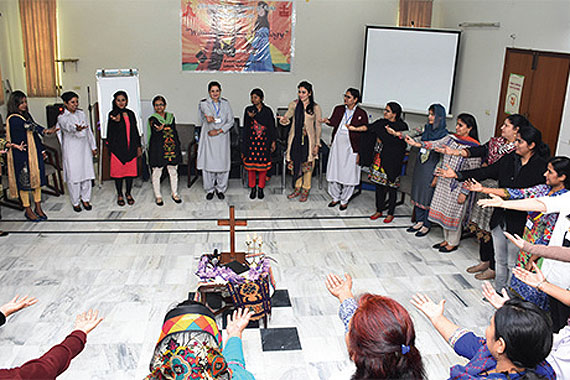
    A group of female theologians from different churches in Pakistan have gathered to discuss equal opportunities for men and women to participate in mission and witness. The national consultation on “Women Doing Theology” brought together 33 female theologians from a range of Christian groups, including the Church of Pakistan, last week in Lahore. Addressing the question “what it means by ‘doing theology in Asian Context, especially in Pakistan,’ the participants said that “men and women are equals before God, both bearing the image of God.”

    The continued: “God calls upon both men and women to fulfil the roles and responsibilities specially designed for them. However, in all spheres of Asian society, women are being dominated and de-womanised. In the Church and society women are being treated with bias”.

    The participants challenged the gender based discrimination in the church and society, and said that “biblical and theological exegesis often grant men fuller participation than women in the life of the church [and] restricts the role of women to inferior levels.”