
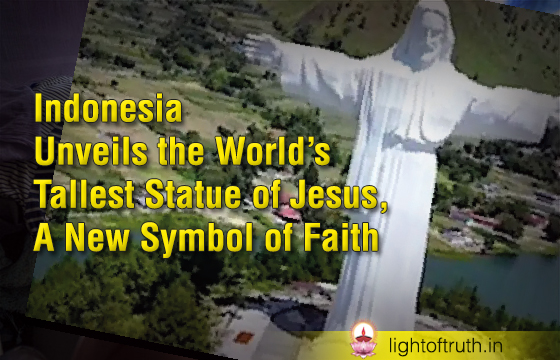
In a stunning display of faith and craftsmanship, Indonesia has unveiled the world’s tallest statue of Jesus Christ, rising majesti-cally above Sibeabea Hill in North Sumatra. Towering at 61 meters, the “Jesus Christ the Saviour” statue now stands as a new global landmark, surpassing Rio de Janeiro’s famous “Christ the Redeemer” by over 20 me-ters. This monumental structure overlooks the scenic Toba Lake in Samosir Regency, blending natural beauty with spiritual significance.
The statue was officially inaugurated on September 19 by Bishop Antonius Subianto Bunja-min, President of the Indonesian Bishops’ Conference, in a cere-mony that drew both local and international attention. Just weeks before, on September 6, Pope Francis himself blessed a minia-ture version of the statue during a special event at the Vatican embassy in Jakarta. The Pope also signed a prayer plate that now sits at the base of the tower-ing statue, echoing his words: “What is admired about Jesus the Saviour is his infinite love.”
The unveiling of this statue is more than a ceremonial act—it is a testament to Indonesia’s co-mmitment to interfaith harmony, despite being a predominantly Muslim nation. In this spirit, the statue serves as a symbol of inclusivity and a beacon for all who seek solace and spiritual reflection.
Bishop Bunjamin re-marked during the inauguration, “This is a hill blessed by God, expected to be a place where people’s faith can grow stronger.” Located in an area of Indonesia with a significant Christian population, North Sumatra is home to more than a million Catholics and over four million Protestants, according to the Central Statistics Agency. The statue thus holds deep meaning for the region’s Christian community, who now have a monumental representation of their faith that also draws thousands of tourists and pilgrims each year.
All posts by Light of Truth
Pakistan: Christian woman sentenced to death for blasphemy
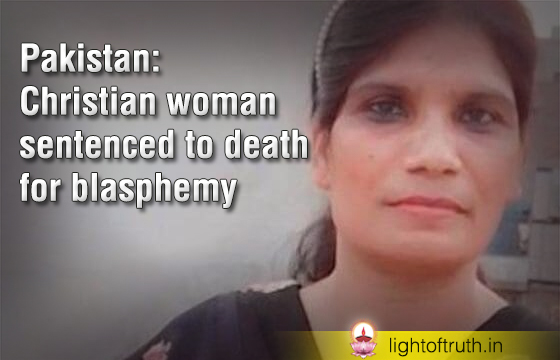
Shagufta Kiran, a 40-year-old Pakistani Christian woman, has been found guilty of blasphemy and sentenced to death under Article 295-C of Pakistan’s Penal Code, which punishes offences against the Prophet Muhammad.
The charge stems from a message shared on the social media platform WhatsApp. According to Fides News Agency, Kiran’s lawyer, Rana Abdul Hameed, reported that the judgment was handed down by a lower court judge in Islamabad, under the Prevention of Electronic Crimes Act (PECA). Along with the death sentence, Kiran has been fined 300,000 rupees (approximately 1,000 US dollars) following a legal process that lasted three years.
Her defence team argued that Kiran was not the author of the offensive content but had simply forwarded it in a group chat without reading it, yet this defence was insufficient to prevent her conviction.
Shagufta Kiran, who is a wife and mother to four children, was arrested by the Federal Investigation Agency (FIA) on July 29, 2021, in Islamabad for sharing blasphemous content in a WhatsApp group in September 2020. She is currently being held in the Central Adyalaa prison in Rawalpindi, where she will remain until her sentence is carried out.
Her lawyer has announced plans to appeal the decision to the Islamabad High Court. He emphasized that “the person who originally wrote the incriminating message is still free, while the one who merely shared it without endorsing it is condemned.” There is a strong belief that Shagufta has been targeted because she is Christian, making her an easy and vulnerable scapegoat.
In Pakistan, there is an increased focus on monitoring potential blasphemy offences online, with Islamic organizations viewing such actions as a growing threat that must be met with the harshest penalties. FIA’s Cyber Crime Wing is tasked with monitoring and reporting online content deemed blasphemous, leading to further police action.
Cardinal Ranjith urges new Sri Lanka president to prioritize the poor
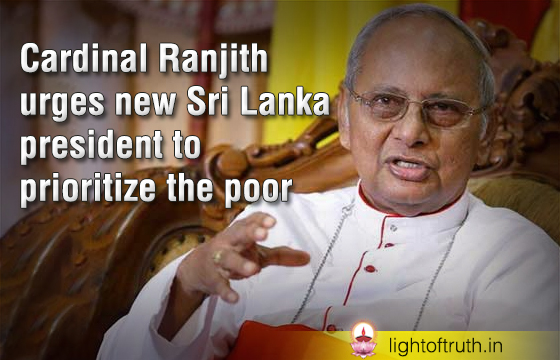
During a meeting at the Archbishop’s House in Colombo on September 23, Card. Ranjith congratulated President Dissana-yake on his electoral victory. He emphasized the significant res-ponsibilities awaiting the new president, particularly in addre-ssing the challenges faced by the nation. He offered the President his blessings and full support for the tasks ahead and stressed the importance of prioritizing the welfare of the impoverished seg-ments of society.
In response to a query from the press, Cardinal Ranjith high-lighted President Dissanayake’s pledge to thoroughly investigate the Easter attacks, ensuring that the truth would be uncovered and justice served.
President Dissanayake’s day continued with visits to other reli-gious landmarks, including the Dawatagaha Mosque in Colom-bo, where he participated in cere-monies and received further ble-ssings. Sri Lanka’s new leader assumed the presidency on Mon-day, ushering in promises of change for a nation that has been predominantly ruled by powerful political dynasties and is currently recovering from its most severe economic crisis in over seventy years.
Millions cast their votes for Dissanayake, an opposition parliamentarian, drawn by his commitment to combat corruption and support the country’s tenuous economic revival.
During his inaugural address at the president’s office, Dissanayake, aged 55, pledged his dedication to protecting and promoting democracy, acknowledging the challenging times ahead. “Our politics needs to be cleaner, and the people have demanded a different political culture,” he said. “I am ready to commit to that change.”
Preparations for World Youth Day 2027 in Seoul, Korea unveiled
On Tuesday 24 September at the Holy See Press Office, orga-nizers and promoters of the next global gathering of youth pre-sented World Youth Day (WYD) 2027 to be hosted by the Catholic Church in Seoul, South Korea.
The theme for this 41st World Youth Day (2026 and Seoul 2027) is taken from John’s Gospel, re-calling Jesus’ words: “Take courage! I have overcome the world.” (Jn 16:33). Also announ-ced was the theme for the 40th World Youth Day coming up before that in 2025, also from John’s Gospel when Jesus says: “You also are my witnesses, because you have been with me” (Jn 15:27).
Presenting details of the Seoul global celebration of faith were Cardinal Kevin Farrell, Prefect of the Dicastery for Laity, Family and Life, the Vatican office over-seeing the WYD events; Arch-bishop Peter Soon-Taick Chung of Seoul, South Korea, and Pre-sident of the Local Organizing Committee of Seoul 2027; Bishop Paul Kyung Sang Lee of South Korea, General Coordinator of WYD Seoul 2027; and Ms. Ga-briela Su-Ji Kim, a young Korean who participated and previous World Youth Days who shared her experiences and hopes.
In his address Bishop Kyung-sang Lee thanked Pope Francis for the choice of the theme, “Take courage! I have overcome the world.” (Jn 16:33), saying it “re-sonates deeply with the circum-stances faced by the Catholic Church of Korea and the chall-enges confronting today’s youth.”
He also noted that “Korea stands in a unique context distinct from previous World Youth Day hosts, characterized by the harmonious coexistence of diverse religious traditions” that can offer a unique and rich experience for youth from around the world. In reference to the division of Korea, he said “the Church has diligently worked to resolve the conflicts inherent in this division over the past seven decades, seeking peace and unity for the Korean people.”
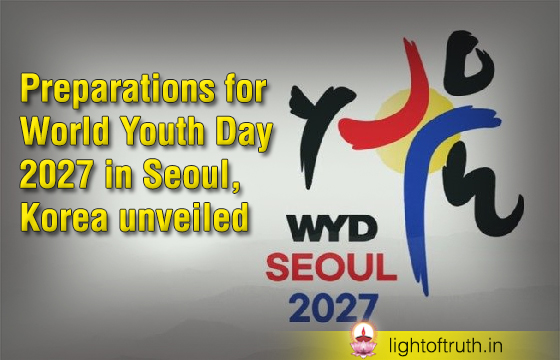
In addition to presenting organizational details and events for promoting WYD 2027, Bishop Kyung-sang Lee presented the logo for the event, noting that central to the logo is a cross with the red and blue colours symbolizing Christ’s triumphant victory over the world. The left element, reaching upward, signifies God in Heaven, while the right element, pointing downward, symbolizes Earth, illustrating the fulfilment of God’s will on Earth through their unity, all inspired by traditional Korean art.
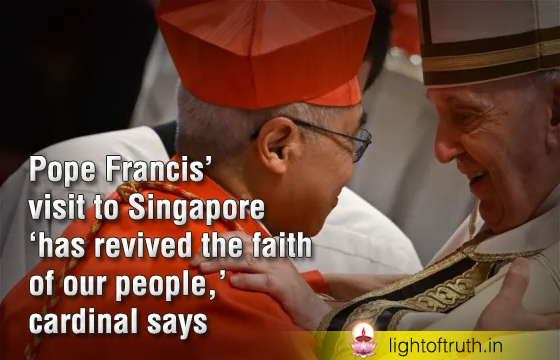
Pope Francis’ visit to Singapore ‘has revived the faith of our people,’ cardinal says
“I believe his visit has revived the faith of our people. His visit has caused many of our Catholics to work together,” said Cardinal William Goh, archbishop of Singapore, in an interview with Vatican News about Pope Francis’ recent visit to the country.
“It’s a very rare occasion when all Catholics come together to work side by side. All of them have been very enthusiastic and have felt that it is a great privilege to be part of this entire organizing committee, to plan and work for the success of the papal visit,” he added.
For the cardinal, the papal trip will inspire the intention to “build ourselves as one Church,” to unite around the figure of the bishop of Rome, and to further promote the message of the Gospel among those who need it most.
It is precisely the quest to bring the good news to all humanity that prompted the pope to visit Asia, Goh explained. An effort to make the Catholic Church “truly a sacrament of the mercy and compassion of Jesus toward others.”
“I think that these types of messages, such as reaching out to the marginalized, to the poor, to those who suffer, to the vulnerable, and respecting other religions, the dignity of life, the protection of the family, and young people, respecting young people and encouraging young people to be bold, without forgetting the elderly either, all these messages that the Holy Father constantly speaks about resonate throughout the world, even for us Singaporeans,” the cardinal reflected.
Furthermore, he said the country’s Catholics are grateful because the pope “has rejuvenated” their faith, which in the long term will imply “a more dynamic and lively desire” for fraternity and to lead others to Jesus.
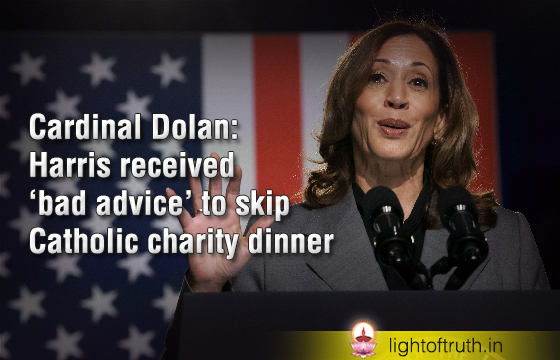
Cardinal Dolan: Harris received ‘bad advice’ to skip Catholic charity dinner
Cardinal Timothy Dolan said on 24 September that Vice President Kamala Harris’ decision to skip the Al Smith dinner, a prominent Catholic charity event in New York, wasn’t a wise political move.
While Republican presidential nominee Donald Trump said Harris’ decision to skip the dinner reveals her “anti-Catholic” sentiments, Dolan, who leads the Archdiocese of New York, blamed bad advice.
“Different people are reading motives into it; I don’t know the motives,” he said, speaking on his podcast. “She simply said she’s got to use it for campaigning. This isn’t a campaign event, but it certainly is good visibility, you know, I mean it’s a national audience and everybody covers it; now the news is that she’s not there. So, I don’t know who’s advising her but she’s not getting good advice.”
The $5,000-a-plate charity event taking place on Oct. 17 is hosted by the Archdiocese of New York; the Alfred E. Smith Memorial Foundation Dinner has been attended by nearly every major presidential candidate since 1960.
According to Dolan, President Joe Biden had committed to attending the dinner earlier this year before dropping out of the race. Harris’ campaign team, however, reportedly notified the archdiocese on Saturday that she would not be attending the event.
Instead of attending the event, Harris’ team has said she will use the time to campaign in critical swing states, according to the New York Post.
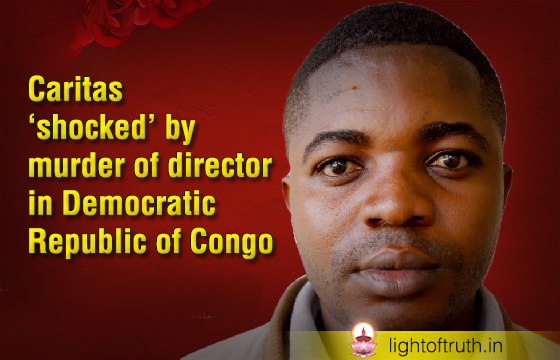
Caritas ‘shocked’ by murder of director in Democratic Republic of Congo
The director of Caritas in Congo was shot and killed by an armed militant group while approaching a roadblock, Caritas Internationalis announced.
In a statement published on social media Sept. 23, Caritas International said it was “shocked by the news of the death of our colleague, Dieudonné Barondezi, director of the Caritas branch in Kalonge, in the Democratic Republic of Congo.”
“Dieudonné was shot in the head on Sept. 19 at a roadblock, in the village of Cholobero, by members of an armed group who demanded he pay the toll, even though, as a humanitarian, he was not obliged to do so,” the Catholic charitable organization said. Barondezi was taken to a hospital following the shooting, where he was declared dead. “Let us pray for him, his family, and all humanitarians worldwide who lose their lives to help others,” Caritas said.
Barondezi’s death is the latest in a string of violent attacks targeting humanitarian aid workers in the country, where armed rebel groups continue to fight against Congolese forces for control of gold and other resources.
According to a July report by The Associated Press, the United Nations Office for the Coordination of Humanitarian Affairs in Congo called for the protection of aid workers in the region where some 170 security incidents targeting humanitarian workers were reported.
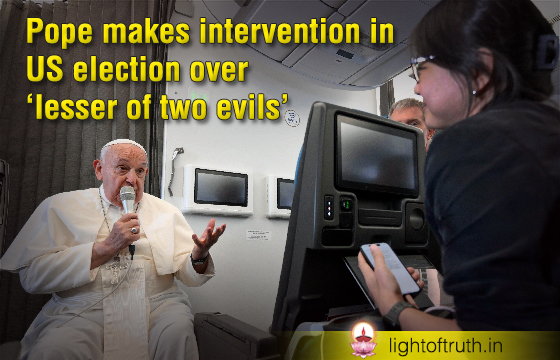
Pope makes intervention in US election over ‘lesser of two evils’
Pope Francis waded into the U.S. presidential elections during his press conference on the flight back to Rome on Septem-ber 13, saying of the choice between Vice President Kamala Harris and former president Donald Trump, “One must choose the lesser of two evils. Who is the lesser of two evils? That lady or that gentleman? I don’t know.
“They are both against life. The one who throws away the migrants as well as the one who kills children,” the pope said. “Both are against life.” Trump has indicated he plans a mass deportation of migrants if he regains the White House, and Harris has promised to try and restore abortion rights nationwide if she is promoted by voters.
Pope Francis said Catholics had to form their consciences when deciding for whom to vote. The U.S. bishops, in adopting a new introductory statement to their quadrennial document on voting, “Forming Consciences for Faithful Citizenship”, were less even-handed in their app-raisal of the two major political parties. Last year, they voted to state that abortion is “our pre-eminent priority” in the 2024 election, repeating phrasing first used in the 2020 version of the statement. Previous iterations of the document had refrained from such explicit emphasis on one issue, because that level of specificity is precisely where conscience formation is required. It is not clear that this year’s federal elections will have any consequence on national abortion policy, given the evenly divided Congress, so making that issue a priority strikes many observers as odd.
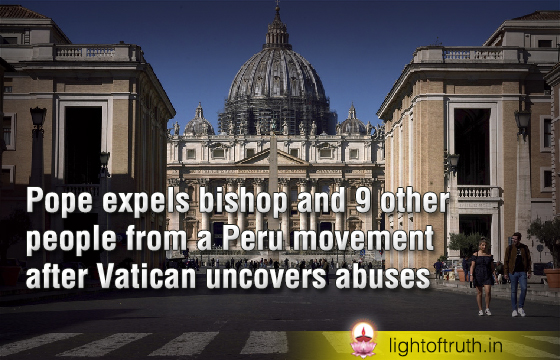
Pope expels bishop and 9 other people from a Peru movement after Vatican uncovers abuses
Pope Francis took the unusual decision to expel 10 people – a bishop, priests and laypeople – from a troubled Catholic move-ment in Peru after a Vatican inve-stigation uncovered “sadistic” abuses of power, authority and spirituality.
The move against the lead-ership of the Sodalitium Chri-stianae Vitae, or Sodalitium of Christian Life, followed Francis’ decision last month to expel the group’s founder, Luis Figari, after he was found to have sodo-mized his recruits. The decision was announced by the Peruvian Bishops Confe-rence, which posted a statement from the Vatican embassy on its website.
The statement was astoni-shing because it listed the abuses uncovered by the Vatican investi-gation and the people responsible: It reported physical abuses “in-cluding with sadism and viol-ence,” sect-like abuses of consci-ence, spiritual abuse, abuses of authority, economic abuses in administering church money and the “abuse in the exercise of the apostolate of journalism.”
The later was presumably aimed at a Sodalitium-linked journalist who has attacked critics of the movement on social media.
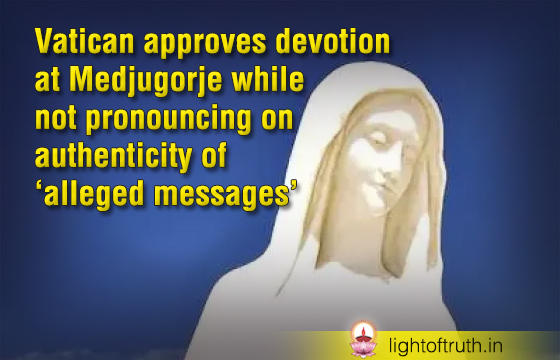
Vatican approves devotion at Medjugorje while not pronouncing on authenticity of ‘alleged messages’
In a highly anticipated report on the alleged decades long apparitions of the Blessed Virgin Mary in Medjugorje, the Vatican’s doctrinal office on 19 Sept. endorsed prudent devotion to Mary at the popular pilgri-mage site in Bosnia and Herze-govina yet withheld any decla-ration on whether the alleged visions are supernatural in origin.
The Sept. 19 note from the Dicastery for the Doctrine of the Faith (DDF), signed by prefect Cardinal Víctor Manuel Fernández and approved by Pope Francis in an Aug. 28 audience, grants a “nihil obstat” to the spiri-tual experience at Medjugorje. The authori-tative judgment means that pilgrims may continue to visit and pray at the site, as some 40 million people from around the world have done since the apparitions allegedly first began 43 years ago.
Six children, who are now middle-aged, first reported experiencing visions of the Blessed Mother, originally on a hilltop near the rural village of Medjugorje, on June 24, 1981. The Vatican’s report notes that the remote site, formerly part of Yugoslavia, is now widely “perceived as a space of great peace, recollection, and a piety that is sincere, deep, and easily shared.”
While it offers no definitive judgment on the supernatural authenticity of the alleged apparitions, the Vatican’s report highlights the abundant good fruits that have come from Medjugorje.
“The positive fruits are most evident in the promotion of a healthy practice of a life of faith, in accordance with the tradition of the Church,” the report states.
It points to “abundant conversions, a frequent return to the sacraments (parti-cularly, the Eucharist and reconciliation), many vocations to priestly, religious, and married life, a deepening of the life of faith, a more intense practice of prayer, many reconciliations between spouses, and the renewal of marriage and family life.”
“It should be noted,” the report emphasizes, “that such experiences occur above all in the context of pilgrimages to the places associated with the original events rather than in meetings with the ‘visionaries’ to be present for the alleged apparitions.”
Fernández presented the report in a two-hour-long press conference at the Holy See Press Office on Sept. 19. The prelate quoted Cardinal Joseph Ratzinger’s 1985 statement that emphasized separating the question of supernatural origin from spiritual fruits.
Fernández pointed out that Ratzinger said even if modern critical thinking might question some aspects, “this doesn’t detract from the fact that those pilgrimages were fruitful, useful, important for the life of the Christian people.”
On this view, he added, Pope Francis said there was “no magic wand” to determine the authenticity of the phenomena, but “the spiritual pastoral fact cannot be denied.”