All posts by Light of Truth

Poll: The ‘Trump bump’ is over, especially among white Christians

President Trump’s job approval ratings among some faith groups jumped in March as the number of coronavirus infections began to spread across the country. But that “Trump bump” has all but disappeared.

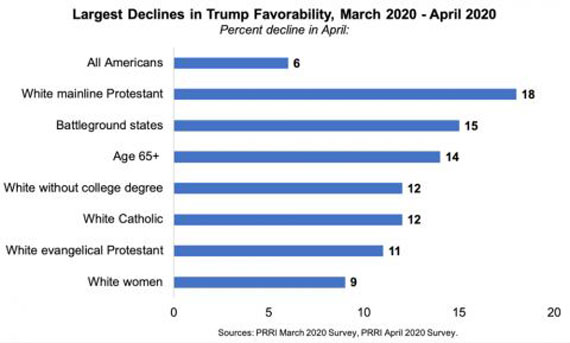
A new poll released on April 30 from PRRI shows Trump’s approval has fallen on average by 6 percentage points and is now more in keeping with 2019 levels among most demographic groups.

Among white evangelicals, Trump’s favourability ratings fell to 66% from a high of 77% in March. White Catholic approval ratings of the president dropped to 48% from 60%. Perhaps the largest drop was among white mainline Protestants. Only 44% approved of the president in April, down from 62% in March. (Among non-white Protestants, Trump’s favourability ratings did not change). Overall, 43% of Americans hold mostly or very favourable views of Trump (about the same as in February shortly after he was acquitted of impeachment charges).

In mid-March, it was 49%.

“The jump we saw in March was unusually high, particularly for white evangelicals,” said Natalie Jackson, research director at PRRI. “It was one of the highest favorability records we saw for Trump among that group. What we’re seeing in April is a return to where they had been previously.”

Jackson attributed the March bump to a “rally around the flag” effect, as more Americans saw Trump on TV daily responding to the virus as part of the White House briefings.

The poll also found that white Christians in counties less affect-ed by the coronavirus are more likely to view Trump favourably than those in more affected counties (63% vs. 50%).

“There is no such difference among other religious groups,” according to the survey.

Trump’s favourability among white Christians in battleground states — Arizona, Florida, Michigan, North Carolina, Pennsylvania and Wisconsin — dropped to 48% from 75% in March. Over-all, the president’s approval rating in battleground states dropped from 53% in March to 38% in April.

Polls Show Faith Is Getting Americans Through The Coronavirus Crisis

Two separate polls show that Americans are relying more on their faith to help persevere through the coronavirus pandemic.

The Pew Research Centre, in a survey released on April 30, showed that nearly one-fourth of all Americans say their faith has grown stronger during the pandemic, while only 2 percent said it had grown weaker.

Catholics, according to Pew, are very much in line with the overall survey results. Among Catholic respondents, 27% said their faith had grown stronger with 2 percent saying it had gotten weaker. In addition, 63% said their faith had not changed much at all, and another 7% said the question was not applicable because “I am not a religious person and this hasn’t changed.”

A poll by Fordham University released on April 28 showed that Americans are being helped by their religious or spiritual faith during the pandemic, and the more often they go to church, the more they feel it has helped.

For those who go to church regularly, 68% said they have been “helped a lot,” and another 22% said they have been “helped somewhat.”

Pope Francis calls people of all religions to pray for end of pandemic

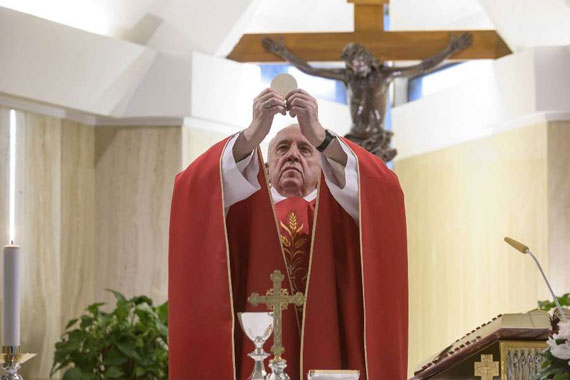
Pope Francis urged people of every religion to fast and pray on May 14 for an end to the coronavirus pandemic and “other pandemics” of hunger and war.

“Today all of us, brothers and sisters of all religious traditions, pray in a day of prayer and fasting, of penance, called by the Higher Committee of Human Fraternity. Each of us prays… united in the brotherhood that unites us in this moment of pain and tragedy,” Pope Francis said in his homily on May 14.

The Pope said that this interfaith day of prayer, fasting, and charity is not an expression of “religious relativism,” but “a day of fraternity” and prayer.

“Perhaps there will be someone who will say: ‘This is religious relativism and it cannot be done.’ But how can we not pray to the Father of all?” Pope Francis said in the Santa Marta chapel.

He continued: “Everyone prays as he knows, how he can, as he has received from his own culture. We are not praying against each other, this religious tradition against this, no. We are all united as human beings, as brothers, praying to God, according to our culture, according to our own tradition, according to our beliefs, but brothers praying to God. This is the important thing.”

Priest, nurse fortify Nigerian villagers against lockdown hunger

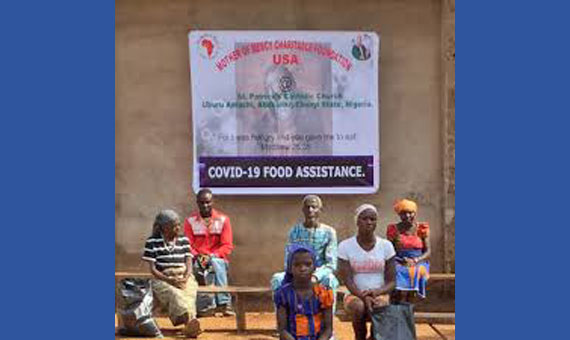
God willing, Father Edward Inyanwachi will soon again celebrate Mass for the members of his rural southeastern Nigerian parish. Until then he’s trying to keep them from starving.

The pastor of St Patrick Parish and two mission churches in the Diocese of Abakaliki in Nigeria’s impoverished Ebonyi State.

Over the last two months, he has travelled in a truck over dirt roads outside the village to buy food staples that are out of reach — physically and financially — for some parish families amid the coronavirus pandemic.

“The cost of food items, especially the staple foods, is rising each day,” he shared in an April 24 email to longtime Holy Name of Jesus parishioner Angela Testani from the village of Uburu-Amachi.

Father Inyanwachi and Testani, a retired San Francisco nurse, met at the parish when the priest visited during his studies at the University of San Francisco. In 2016 they co-founded Mother of Mercy Charitable Foundation out of a mutual desire to improve the lives of the rural poor in Ebonyi, the third-poorest State in Nigeria.

Sweden’s approach to pandemic a risk to elderly, minorities, cardinal says

Unlike most countries, Sweden has chosen a more relaxed approach to preventing the spread of the coronavirus, sparking a debate on how governments should confront the deadly pandemic.

Sweden’s high death rate among elderly men and women living in retirement homes have many, including the nation’s only cardinal, questioning whether measures meant to protect the most vulnerable have worked.

“Not being an expert, it’s difficult to judge, but I would say that many people here in Sweden are very worried and, also, the authorities have recognized that we have not been able to give elderly people the protection they needed,” Card. Anders Arborelius of Stockholm told Catholic News Service on May 7.

Although Swedish authorities called for people to work remotely and restricted gatherings of more than 50 people at the start of the crisis, restaurants and bars, as well as schools for children under the age of 16, remained open.

Anders Tegnell, the country’s chief epidemiologist, told CNBC on May 7 that cases in Stockholm, the epicentre of the outbreak, have peaked and that the numbers of those in hospitals “is clearly falling.”

Women played an intriguing role in Catholic revival in Germany, author says

In his book,  Disruptive Power: Catholic Women, Miracles, and Politics in Modern Germany, 1918-1965, Marist College professor Michael O’Sullivan explores the revival of Catholic faith in Germany from 1920-1960, fueled in large part by Marian devotion. Yet ironically, this new sense of devotion, primarily from traditionalist Catholics, unintentionally weakened the institutional Church, O’Sullivan argues.

His book, which won the Waterloo Centre for German Studies Book Prize, explores this turbulent period in German Catholicism, and in an interview with Crux, O’Sullivan offers his thoughts on what it means for one of the most influential Catholic nations in the world today.

“I have trouble thinking of an era in European history where popular religion and sainthood was not politicized. In an example from the medieval period, my colleague at Marist College, Janine Larmon Peterson, just wrote a book that shows how the political situation on the Italian peninsula during the thirteenth and fourteenth centuries shaped the reception of local and unsanctioned saints’ cults” Michael O’Sullivan said.

Nurse Says God Asked Her To Work Covid Ward

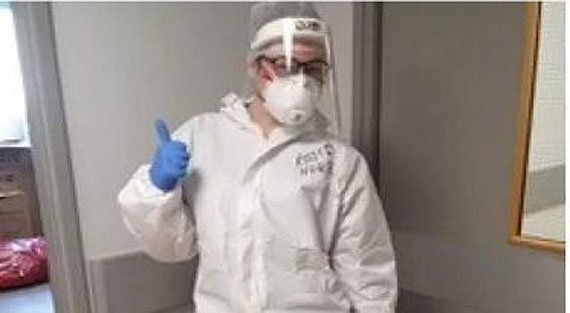
Former United Reformed Church Youth Moderator, Katie Henderson, voluntarily switched from working on a paediatric ICU ward to an adult ICU coronavirus ward after she felt led by God to help battle the disease.

“I very much feel like this was a calling for me to do,” she told Premier. “It’s not something I never would have imagined I would have done. And I’ve always said I’m very much a paediatric nurse. I love children. I never thought I could work with adults.

“God’s nudged me to do this and to test me. But I think he’s put me there as well to be there for these patients when literally no one else can because the families can’t come in and there’s not enough nurses.”

Henderson said although she felt by God to join the frontline, it’s been a big emotional challenge.

“There has been some deaths from workers from my hospital. It’s challenging and every day we go in and we’re not sure what the situation with PPE is. [I think] ‘am I going to be protected enough?’ We crack on because that’s what we have to do.”

She added: “Every day I go into work unsure what personal protective equipment we will have. Right now, we are having to wear white boiler suits imported from Turkey that come in one size, that doesn’t fit all. Why? Because there are no gowns left. They are so hot that people are sweating through the scrubs underneath. We are living in scary times and now more than ever I find myself reliant on my faith.”

Henderson said regularly talking to her Christians friends on Zoom and worshipping together has been vital for her during the corona virus pandemic. She said throughout all the challenges God’s presence has been evident.

China uses Covid-19 to ratchet up religious oppression

There are already clear signs that the ruling Chinese Communist Party (CCP) is leveraging the Covid-19 crisis to increase repression and cultural destruction in Tibet and Xinjiang.

Christianity is also in its sights and it’s highly likely that under-ground/house churches will be the key focus of a fresh round of repression that will take advantage of the blanket ban on all worship that was enacted in February as China was locked down.

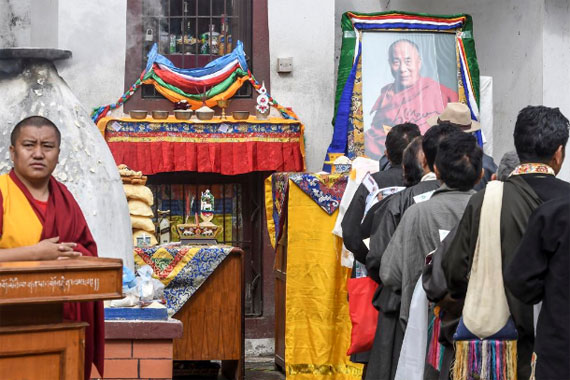
On May 1, controversial new regulations on “ethnic unity” came into effect in the Tibet Autonomous Region (TAR). The “Regulations on the Establishment of a Model Area for Ethnic Unity and Progress in the Tibet Autonomous Region” were adopted by the TAR’s People’s Congress on Jan. 11. The TAR spans about half of traditional Tibet, a historically independent country that China has brutally occupied for more than 60 years.

“The regulations explicitly depart from the principle of ‘preferential treatment’ for Tibetans, which was supposed to guarantee that Tibetans could maintain their culture and traditional way of life in their own homeland,” the International Campaign for Tibet noted.

Pakistani Islamic group exploits virus to convert minorities

Human rights activists are condemning an Islamic missionary group for trying to convert non-Muslims while distributing rations amid Pakistan’s corona-virus lockdown. A cleric of Ma-dani Channel broke the news of one conversion at the Faizan-e-Madina head office of Dawat-e-Islami in Karachi. A clip shared on Facebook has been viewed more than 500 times.

“Here is good news for you. I just received a message from Faizan-e-Madina where a welfare program is being run. Moments ago a non-Muslim came for rations. They become Muslims after reciting Kalma [the Islamic proclamation of faith],” he said.

“He was named Muhammad Ramzan. He already had sehri [pre-dawn meal in Ramadan] and will observe his first fast. We are trying to make worshipers while delivering food and knowledge of faith at home. Remember us in your donations.”

Minority activists slammed the news. Catholic professor Anjum James Paul, chairman of the Pakistan Minorities Teachers’ Association, requested Dawat-e-Islami to stop using food for religious conversion.

Christian nurses, doctors on Covid-19 front line in Bangladesh

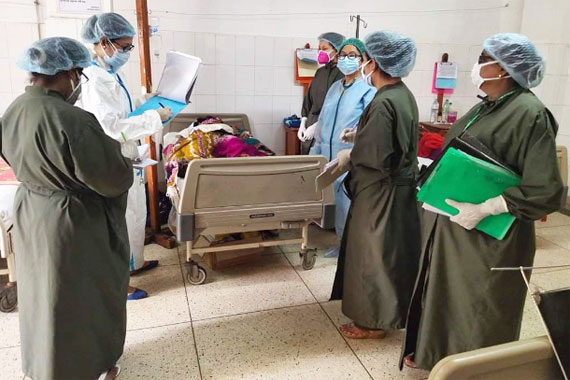
Christian nurses and doctors in Bangladesh are vowing to continue their battle against the Covid-19 pandemic on the front line as they mark International Nurses Day on May 12.

Clara Biswas, 34, is a Catholic and senior nurse who has worked in private and government hospitals for 11 years. She now works at a state-run hospital in capital Dhaka that treats both Covid-19 and other patients despite various challenges.

“I have not worked in such a situation in my life. This is a very risky time for us and other medical personnel, though all medical staff are using personal protective equipment (PPE) for safety,” Biswas told UCA News.

In addition to the fear of infection, the wearing of PPE for more than eight hours is tough as it gets hot and she feels sick, while the hospital does not allow them to use a common toilet and provides no food, she noted.

Joyanta Mrong, 32, is an ethnic Garo Catholic who works at state-run Dhaka Medical College Hospital. He is aware that his wife and son face risks because of his job.

“I know how to handle myself, but they are not medical persons, so I’m afraid for them,” Mrong told UCA News.

There are 2,500 nurses and 170 doctors from the Christian community actively fighting the deadly virus in Bangladesh, according to church officials.