All posts by Light of Truth

Squads ensure Christian burial for Kerala pandemic victims

As fear and confusion persist about burying Covid-19 victims in some parts of India, the Kerala-based Syro-Malabar Church has formed squads to give a dignified burial to people dying from the pandemic.

As Covid-19 began to claim lives in the southern Indian state, several burials led to disputes as ill-informed villagers opposed burials, fearing the spread of the disease from buried bodies.

Confusion about safety, non-availabi-lity of undertakers and an inability to dig graves 10 feet deep as per government norms often resulted in Catholics not having a Christian burial.

“We want to ensure a dignified burial to all Catholics and formed volunteer groups in every diocese to assist the parish priest in burying those who die of Covid-19,” said.

The Eastern-rite Church has 35 dioceses across the world with close to five million faithful, but 18 dioceses and some four million Catholics live in Kerala.

Fr. Kavilpurayidam told UCA News on July 27 that the Church has asked all its dioceses to form burial squads – if needed, in parishes too – to help Covid-19 victims “get a decent and dignified burial.” The volunteers are trained to handle bodies as per Covid-19 protocols to ensure that “we follow government guidelines strictly,” he said.

One such burial was that of Varghese Pallan, a 72-year-old Catholic of Irinjalakuda Diocese, on July 26. He was buried with all customary funeral prayers and in compliance with government protocols at St Thomas Cathedral Church on the same day he died.
Case filed against bishop for breaking corona restrictions

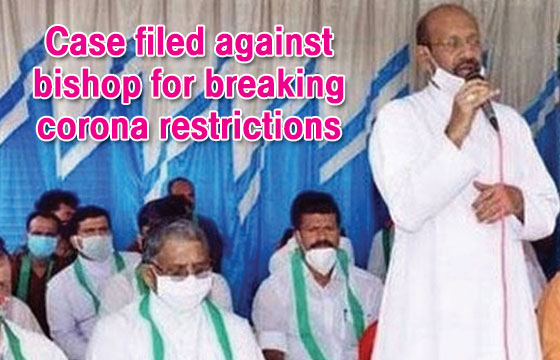
Police in Kerala have registered a case against Bishop Remigiose Inchananiyil of Thamarassery for breaking coronavirus restrictions.

The Syro-Malabar prelate is among 40 people charged by the police for participating in a protest at the Forest Range Office in Thamarassery, near Kozhiko-de, a town in northern Kerala.

A collective of 15 farmer organizations under the banner of the Karshika Purogamana Samiti (KPS, Forum for the advancement of agriculture) staged a fast at Sulthan Bathery on June 25, raising a series of demands including effective steps to tackle the increasing wildlife attacks in the district.

Bishop Inchananiyil, who opened the protest, said that wildlife attacks had increased considerably in Kerala over the past decade, especially in hilly areas such as Wayanad.

Though a tribal youth was mauled to death by a tiger at Pulpally in Wayanad, the Forest department officials could not capture the animal, the bishop said. He said that successive governments in Kerala had not taken any steps to address the issue. The collective protest by the farming community against the escalating wildlife attacks was the need of the hour, he added.

The protesters demanded that the administration capture the man-eater, adopt scientific steps to divide forest areas and human habitations, amend Forest Acts, erect of hanging fences on the fringes of forests to curb man-animal conflicts, and increase the compensation for crop losses suffered in wildlife raids.

Indian bishop appeals to Supreme Court against rape charge

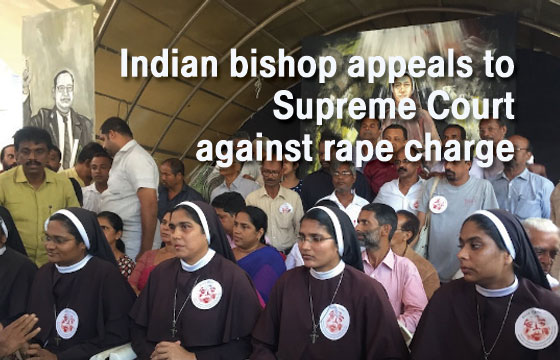
Bishop Franco Mulakkal of India’s Jalandhar Diocese, who is facing trial on charges of raping a Catholic nun, has appealed to the country’s top court to clear him, pleading innocence after two lower courts rejected a similar petition.

The Supreme Court of India registered Bishop Mulakkal’s discharge plea on July 24 and agreed to hear him, according to court records published on its website. However, the court has not given a date to hear the case.

Lawyers connected with the case told UCA News that the 56-year-old bishop moved the top court after the High Court in Kerala State dismissed his dis-charge plea on July 7.

His appeal in the High Court came after a district court in Kottayam in Kerala dismissed a similar plea on March 16.

Bishop Mulakkal’s applica-tion pleaded innocence. It said a 43-year-old nun, former superior general of the Missionaries of Jesus, a diocesan congregation under his patronage, complained against him with malafide inten-tion following his differences with her.

The nun, based in Kerala, filed a police complaint in June 2018 accusing the bishop of raping her 13 times from 2014-16. The crimes happened when the Bishop, based in northern India, visited her convent in the southern state.

The Supreme Court did not give the Bishop any immediate relief as both the prosecution and the petitioner nun had moved separate caveats before the Supre-me Court pleaded not to decide on the case without hearing them.

Rome gifts a basilica to Syro-Malabar faithful

The faithful of the Syro-Malabar rite now have a basilica for worship. The community coordinator, Fr Biju Muttathu-nnel, comments: “We are all celebrating, it is a great gift from the diocese and the Vatican.” An estimated 7 thousand faithful belonging to this rite live in the Italian capital and surrounding province: originating in Kerala (Southern India), they are now integrated within the Italian community.

According to Catholic tradi-tion, this Eastern rite church traces its origins to the preaching of St Thomas the Apostle on the subcontinent. For more than 25 years it was sui iuris, and there-fore has the right to erect its own communities where the faithful have emigrated.

There is a large presence of Syro-Malabarians in Chicago, Melbourne, Canada and the United Kingdom. In Europe the community has an apostolic Visitor, Msgr Stephen Chirappa-nath, who coordinates the com-munities of Zurich, Cologne, Frankfurt and Vienna.

Indian Protestant bishop breaks away, declares free church

A bishop of the Protestant Church of North India (CNI) has broken away and declared his diocese autonomous following differences with the church’s national administrative body. Bishop Basil B. Baskey of Chotanagpur Diocese in Jharkhand State was asked to go on leave soon after he announced the rebellious move.

The CNI synod, its top decision-making body, constituted a probe into the bishop’s move to decide what action to take.

“I have already declared the diocese as an autonomous church and have no link with the CNI to follow its order,” Bishop Baskey told UCA News on July 22.

The synod’s disciplinary action against him came on July 21, four days after the bishop declared his diocese independent of the mother church.

The synod has appointed Chotanagpur diocesan secretary pastor Joljas Kujur as diocesan administrator and formed a new committee to assist him until other arrangements are made for the management of the diocese.

Bp Baskey claimed to have the support of all the pastors ser-ving in the diocese’s 52 parishes.

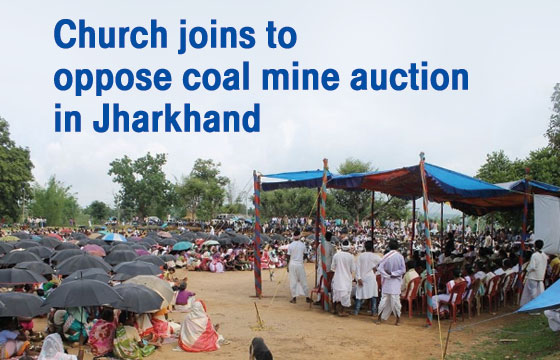
Church joins to oppose coal mine auction in Jharkhand

Church leaders and activists have joined political leaders in opposing the federal government’s decision to auction coal blocks for commercial mining in the eastern Indian State of Jharkhand, which they say will disturb biodiversity and cause displacement.

Hearing the case on July 15, the Supreme Court asked the federal government’s opinion on Jharkhand State government challenging the federal decision to go ahead with the auction of coal blocks.

“Tribals in the state dependent on farming and forestry, so allotting land for mining will destroy vast areas of the forest as well as the farmland resulting displacement and migration,” said Father Vincent Ekka. He heads the department of tribal studies at the Jesuit-run Indian Social Institute in New Delhi.

“I even doubt the central government’s claim of job opportunities for locals. Mining goes on in several states for decades without concern about its impact. If it provides job for locals, why there is a mass migration from these states,” Father Ekka said.

“There are other ways for the government to generate income and stabilize the nation’s economic condition without disturbing the livelihood of tribal people, who are the protectors of the environment,” the Jesuit priest added.

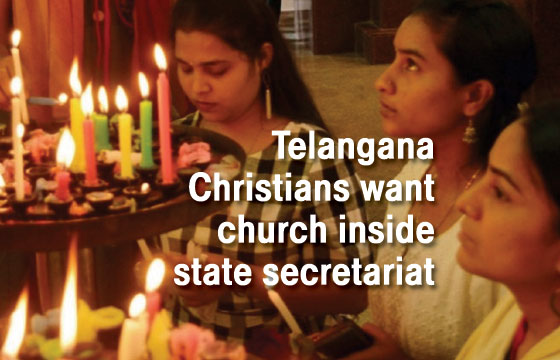
Telangana Christians want church inside state secretariat

A body representing prominent churches in the southern Indian State of Telangana has urged the state government to build a church along with a temple and a mosque in the new secretariat.

The Federation of Telugu Churches, a body of churches in the state, also reminded their Chief Minister K. Chandrashekar Rao about a regular prayer previously conducted in the old secretariat building.

“Christian workshops were conducted every Wednesday during the lunch break,” in the old secretariat, according to Father Anthoniraj Thumma, executive secretary of the Federation.

Father Thumma said in a press note on July 13 that “this time we have requested a different church building, which the mosque and temple had. “On previous occasions, we have requested the government for the allotment of land in the secretariat. This is a long-pending request.”

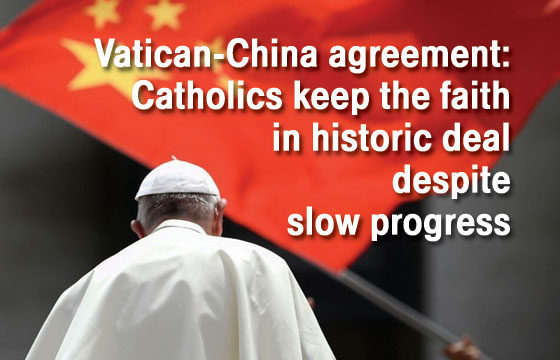
Vatican-China agreement: Catholics keep the faith in historic deal despite slow progress

This is the last in a three-part series examining the role of the Roman Catholic Church in China and how the difficult and complex relationship between the Vatican and Beijing has shifted and evolved since the Communist Party broke diplomatic ties in 1951. This instalment looks at how Catholics continue to be persecuted despite a landmark deal being signed between the Vatican and Beijing in 2018.

If James Su Zhimin is still alive, he would have turned 88. While he has not been seen for 17 years, Su is still listed by the Holy See, the worldwide govern-ment of the Catholic Church, as the Bishop of Baoding in China’s Hebei province.

Between 1956 – five years after the Vatican and Beijing  broke off diplomatic relations – and 1997, Su was arrested at least eight times, spending more than 30 years in prisons and labour reform facilities for refusing to switch allegiance from the Pope to China’s state-sanctioned Catholic Church.

He was last seen in 2003, when he was in hospital. Since then, no one has had any news about him and the authorities have been silent about his whereabouts and status. Many fear he might already be dead. Hopes rose that the Chinese government might be more willing to share information about so-called underground bishops like Su.

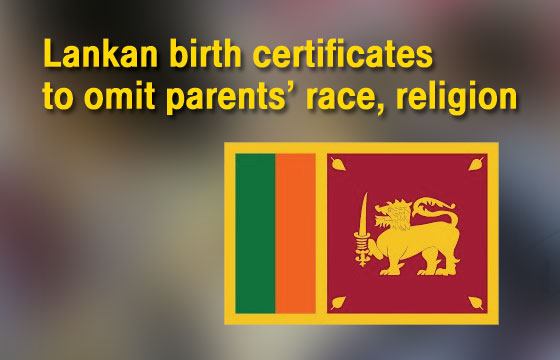
Lankan birth certificates to omit parents’ race, religion

Sri Lankan authorities on July 22 announced that birth certificates for new born children in future will not mention their parents’ race, religion or the marital status. Registrar General of the Registrar General’s Department, N.C. Vithanage told local media that all details pertaining to marriage, ethnic group and religion will be removed from the application form for the registration of a birth in Sri Lanka although this was mandatory earlier.

Local media reports said that the decision was taken after many children in the country were reportedly facing issues due to the details of the marriage of parents, especially when enrolling a child in school. Under the new system, a 12-digit serial number is to be issued for all new birth certificates and this number can be used to obtain a national identity card when a child completes 15 years of age, Vithanage said.

Low birth rate in South Korea could destroy the economy in 80 years

If current trends are not reversed, the South Korean popu-lation will be halved in 80 years. At the same time, the “Asian tiger” will see its GDP drop to 20th place, this according to a study by the prestigious medical journal Lancet.

The birth rate is hot issue in the Asian country, beset by wage discrimination against women and an unfettered capitalism that leads young couples not to have children in order not to have career problems.

At present, the total popula-tion is around 53 million. It should peak in 2031 at 54.29 million, before plunging to 26.78 million by 2100. At the same time, the economy is likely to take huge steps backwards.

According to Lancet, fewer people “might reduce innovation in economies and fewer workers in general might reduce domestic markets for consumer goods, because many retirees are less likely to purchase consumer durables than middle-aged and young adults.”

Experts estimate that high-income countries with low fertility rates will be forced to adopt more liberal immigration policies and prepare their socie-ties to assimilate newcomers. Otherwise, they can expect economic, fiscal and geopolitical collapse.