
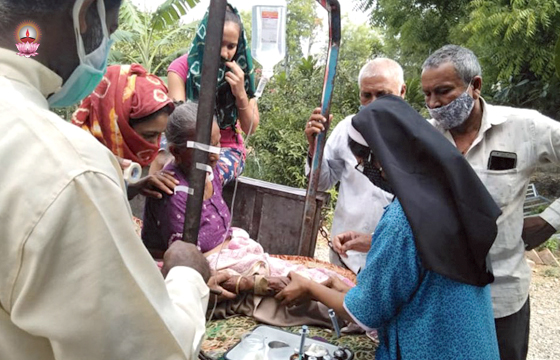
When some 30 people thronged a church-managed clinic run by three Carmelite sisters in the western Indian state of Gujarat early April 7, Sr. Lisset Vadakkekara saw it as an unusual sign to bear witness to her role as a Catholic nun and a follower of Christ in a predominantly Hindu area.
Vadakkekara, a member of the Congregation of the Mother of Carmel, is the supervisor of the Jyoti (light) clinic in Chachana, a remote village in Gujarat state’s Surendranagar district that falls under the Rajkot Syro-Malabar Eparchy.
The 58-year-old nun said she had not seen so many people seeking medical help at the same time in her 28 years as a nurse in the five-bed clinic. She and two other sisters, also nurses there, scurried to fashion an open-air clinic with donated cots on Jyoti’s campus to handle the overflow.
In Indian villages, nuns run clinics, called dispensaries, often the only health care available to the local people. Facilities like Jyoti are small with an outpatient section and a few beds. Seriously ill patients are referred to a city hospital.
When Vadakkekara approached the crowd that day, she was surprised to see them looking so pale as they experienced the fever, cough and throat pain symptoms of COVID-19.
“They seemed frightened and utterly helpless. With folded hands, they asked me to check their health and provide medicines,” Vadakkekara told Global Sisters Report.
The three Carmelite nuns checked temperatures, blood pressures and pulse rates.
All posts by Light of Truth
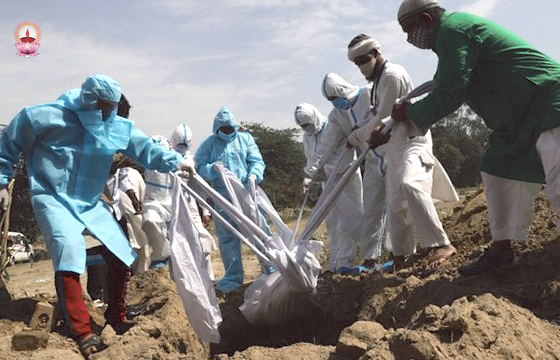
Study estimates 1.21 million Indians have died from Covid-19
It was three weeks ago when journalists combing obituary pages in Prime Minister Na-rendra Modi’s home state of Gujarat found authorities were concealing Covid-19 deaths that people started asking hard questions about the real number of Indian coronavirus fatalities. Now, epidemiologists and scientists around the world are struggling to solve the question.
The latest to enter the fray is top epidemiologist Bhramar Mukherjee, who holds the biostatistics chair at the University of Michigan. She calculates that 1.2 million Indians had died and 495 million had been infected by the virus up to mid-May. These fatality and infection totals contained in her preprint study, meaning it still must be peer-reviewed, are vastly higher than the government’s numbers which showed a cumu-lative 25 million Covid cases and 270,000 deaths on May 15.
“I’ve tried to be very con-servative in terms of the assu-mptions we’ve made in the mathematical model.”
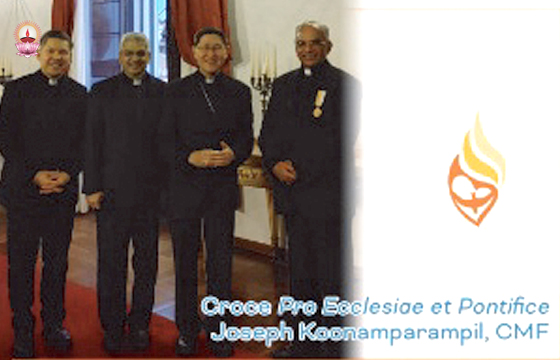
Indian Claretian receives Vatican honour
The Congregation for the Evangelization of Peoples has honoured an Indian Claretian priest for his two decades of service. Fr Joseph Koonamparampil received insignia of honour from Card. Luis Antonio Tagle, prefect of the congregation. The occasion also marked the Father Koonamparampil’s golden jubilee in the Claretian congregation.

China’s new child policy means more babies but no freedom
The communist regime of China, the world’s most populous country of 1.4 billion people, announced on May 31 that it will allow married couples to have up to three children.
The decision came from the Politburo, the highest policy-making body of the Chinese Communist Party (CCP), chaired by President Xi Jinping. It signals a major shift in demographic policy of a country where everything from life to death is strictly controlled by the state.
The state-run Xinhua News Agency reported that the government seeks “to ensure continued economic growth, national security and social stability” with the policy.
However, the main driving force behind the change is a worrying decline in the birth rate that poses serious threats to China’s economy from an aging population.
Data from China’s National Bureau of Statistics released in May showed the country recorded 12 million births in 2020, the lowest number since the 1960s. It was a significant decrease from 18 million births in 2016.
China now has a below-replacement-level fertility rate of 1.3 children per woman, way down from the replacement level of 2.1. China is on a par with aging societies in Japan and Italy.
That is evident in China’s genocidal treatment of Uyghur Muslims in Xinjiang, where many men and women are subject to forced sterilizations and forced abortions, resulting in a significant fall in birth rates. On the flipside, the authorities are encouraging educated Han Chinese women to have more babies.
China’s so-called “inclusive family planning policy” is no guarantee of basic human rights such as sexual and reproductive rights for all citizens and is just a flimsy attempt to cover up rising economic shortfalls that pose a serious threat to the communists’ grip on power in the long run.
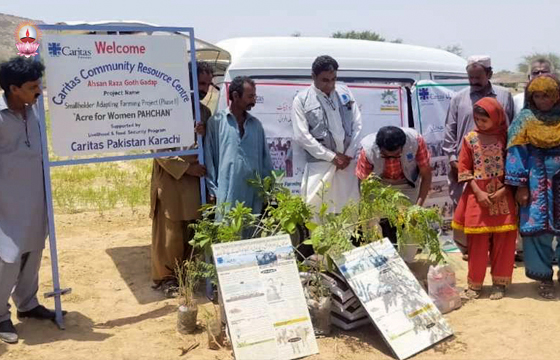
Caritas empowers female farmers in remote Pakistani villages
Caritas Pakistan Karachi under its Smallholder Adaptive Project launched its “Acre for Women” campaign to empower smallholder female farmers in the remote villages of Gharo and Gadap on the city’s outskirts.
The female farmers are owners of one-acre plots where they grow vegetables for their self-sufficiency to fight against malnutrition and hunger.
Caritas Karachi formed women’s farming groups in Gharo and Gadap and distributed kitchen gardening kits including summer vegetable seeds, organic manure and tools as well as offering training on climate change adaptation.
“Our main objective is train women farmers to build their capacity in view of climate change and grow different vegetables for their own consumption and to fight against malnutrition and hunger,” regional coordinator Amir Robin said.
Mansha Noor, executive secretary of Caritas Pakistan Karachi, said the project was aimed at promoting healthy and organic produce for self-sufficiency and to improve nutrition among women and children. He further highlighted the importance and benefits of growing different vegetables as a group.
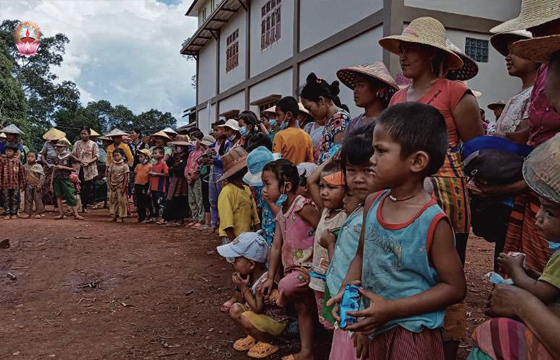
Myanmar Church calls for end to attacks on places of worship
A priest from Loikaw Diocese in eastern Myanmar’s Kayah state has called for an end to attacks on religious buildings following military assaults on three Catholic churches within the space of two weeks.
“We appeal to armed groups not to deploy troops, attack and burn down places of worship such as temples, mosques and churches as well as hospitals and schools,” Father Celso Ba Shwe, apostolic administrator of Loikaw, said in the letter released on June 8.
Without specifying the military, he warned that intentionally attacking places of worship, hospitals and schools constitutes war crimes under the Hague Conventions.
The priest said churches, convents and monasteries have opened their doors to fleeing civilians — especially the elderly, children, women, the sick and the disabled — regardless of religion and race as fighting escalates in Kayah state and neighboring Shan state.
Civilians who have taken refuge in churches and temples have had to flee to other areas for safety, often accompanied by priests and nuns, according to Father Ba Shwe.
The priest took the role of apostolic administrator of Loikaw on December 21, 2020, following Bishop Stephen Tjephe’s death on Dec. 16.
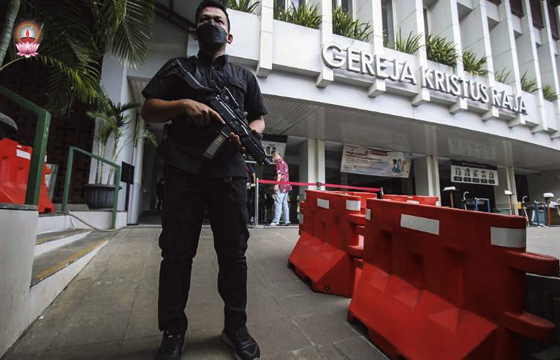
Indonesian Christians must always be on their guard
Christians in Indonesia have increasingly become the target of terrorist attacks, with the latest plots being aimed at a Catholic archbishop and several churches in the Papua region.
Extremist groups, one after the other, are trying to send a message, particularly among Muslim communities, by attacking Christians. Last month the Islamic State-linked Jemaah Ansharut Daulah (JAD) terror group plotted to kill Archbishop Petrus Canisius Mandagi, whom Pope Francis recently appointed to lead Merauke Archdiocese in Papua and who is scheduled to receive the pallium from the pope on June 22.
In a message sent early this month to Indonesian Bishops’ Conference chairman Cardinal Ignatius Suharyo of Jakarta, Archbishop Mandagi said a man came to his chancery twice pretending to be a visitor some time in January and on May 30 to die with him in a suicide attack.
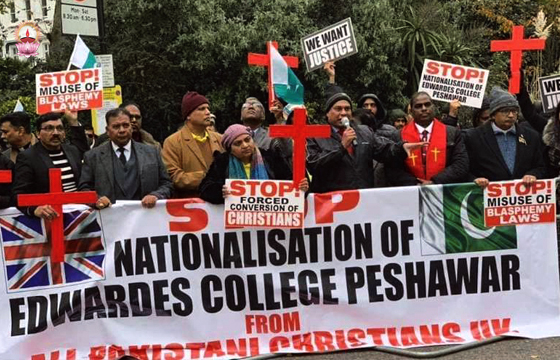
Pakistani court nationalizes Christian college
Pakistan’s top court has handed over the management of the oldest missionary education institution in Khyber Pakhtun-khwa (KPK) province to the local government.
Three judges of the Supreme Court of Pakistan on June 3 rejected a petition filed by Church of Pakistan Bishop Humphrey Peters of Peshawar seeking a review of a Peshawar High Court 2019 order that declared Edwar-des College Peshawar as a na-tionalized educational institution.
However, the property re-mains owned by the Church of Pakistan’s Diocese of Lahore.
“We are afraid that the contention of the petitioner is not correct. The government of KPK shall propose the criteria for appointment of the principal, Edwardes College Peshawar,” stated the Supreme Court order.
“The same shall be conveyed to Diocese of Lahore … Edwardes College shall be run and managed strictly on professional lines under the overall supervision of the board of governors headed by the worthy governor, KPK.”
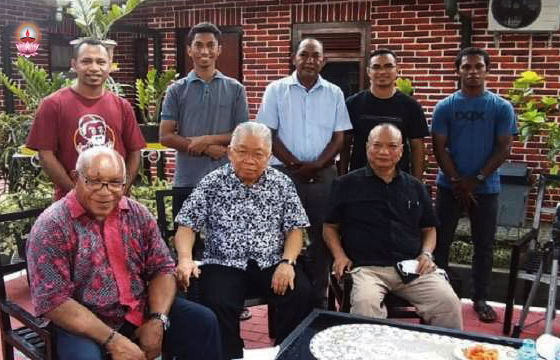
Indonesian archbishop invites Pope Francis to Papua
Sacred Heart Archbishop Petrus Canisius Mandagi of Merauke has called on the Indonesian Bishops’ Conference (KWI) to invite Pope Francis to visit his archdiocese in Papua to help create peace in the country’s restive easternmost region.
He expressed his wish to have the pope visit during a meeting with officials from the Asso-ciation of Indonesian Catholic Intellectuals (ISKA), his arch-diocese and seminarians on June 1 at his residence.
“An official invitation must come from the KWI. I hope it and the Catholic Church in Indonesia will give it a go,” he told UCA News over the phone on June 3.
“I do not want to break the rules. But I really hope it will not take too long. It would be great if a visit can be arranged soon after the Covid-19 pandemic ends,” he said, adding that an official invitation to the pope should be sent through the Indonesian ambassador to the Holy See.

Pope orders visitation of Vatican’s Congregation for Clergy
Pope Francis earlier this month asked an Italian bishop and expert in canon law to conduct visitation of the curial Congregation for Clergy, much like the one that recently concluded of the Vatican’s liturgy department.
In a letter to diocesan priests widely reported on by Italian news outlets, including Italian newspapers La Stampa and L’Unione Monregalese and the official online news outlet of the Italian bishops, SIR, Bishop Egidio Miragoli of Mondovì said he had been tasked with the job. Miragoli, who holds a doctorate in canon law from Rome’s Pontifical Gregorian University, was appointed to lead the Diocese of Mondovì by Pope Francis in September 2017.
In his letter, sent out the morning of June 7 to all priests in his diocese, Miragoli said he was approached by Pope Francis, who wanted “to ask me for a favour,” during the Italian bishops’ recent plenary assembly late last month.
On that occasion, he said, the pope asked him “to make a visitation, in his name, to the Congregation for Clergy.” On June 3, the two had a private meeting at the pope’s residence in the Vatican’s Santa Marta guesthouse where the pope “explained his expectations to me better.”
“Needless to say, the request took me by surprise, and of course I gave my availa-bility,” Miragoli said, explaining that he will begin meeting with individual staff members Wednesday, June 9, and that the visitation will likely take up the entire month of June, “albeit not continually.” Miragoli assured his priests that commitments already on the calendar, including a swath of confirmations, will be unchanged.