
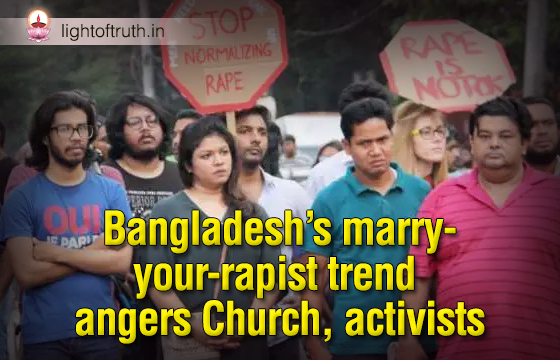
A rising trend of rape victims settling for marriage with their rapists has triggered an angry response from female activists in Bangladesh who termed it unethical and unacceptable in a civilized society.
“Instead of punishment, a rapist is being allowed to marry a rape victim. This is absolutely unethical and it undermines women’s rights. If the perpetrators get away this way, then more rape will happen in our society,” said Rita Roselin Costa, convener of the women’s desk at the Catholic Bishops’ Laity Commission.
In Bangladesh, women and minor girls are socially ostracized when they become victims of rape, she said, adding that even if they go for trial, they lose patience for justice due to the lengthy and complex legal system. “And then the criminals take the opportunity, marry the victims and get relieved from the punishment,” she said.
Costa, a social activist and mother of three, was speaking after a court granted bail to a police officer after he married the woman he raped in June 2020. The inspector was jailed and convicted of rape.
On March 23, Judge Mehedi Hasan Talukdar of the Women and Children Repression Prevention Tribunal in Panchagarh district in northern Bangladesh granted bail to police sub-inspector Abdul Jalil after he married his rape victim on the court’s premises.
Jalil, 45, was arrested and imprisoned after the woman filed a case against him on March 25, 2021, alleging she was raped during an investigation into a land dispute she was involved in.
Local media reported the marriage took place on the premises of the district lawyers’ association office within the court in the presence of Jalil’s first wife, who gave consent for the marriage.
The court granted bail after Jalil applied for bail on the condition that he would marry the victim, his lawyer Mehedi Hasan told.
All posts by Light of Truth
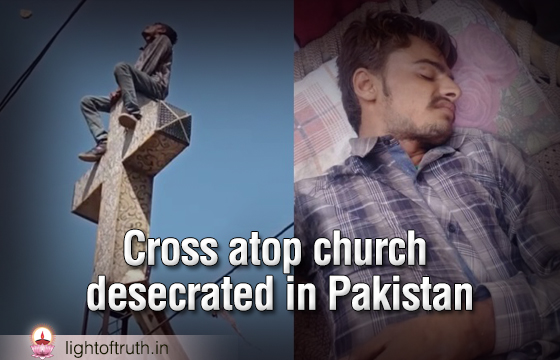
Cross atop church desecrated in Pakistan
A Pakistani Muslim youth who climbed a church roof and sat on the cross chanting “Allahu Akbar” (Allah is great) was arrested and charged with blasphemy by police in Punjab province.
Videos circulating on social media showed Muhammad Bilal mounting the cement cross standing 12 meters from the ground on the rooftop of One in Christ Church in the Hafiz Chowk area of Lahore.
“He climbed the church roof at 10 am from the adjacent lattice factory and first tried to break the cross. Later he sat on the cross and kept chanting ‘Allahu Akbar’ for half an hour,” said M.M. Akash, a local evangelist who called the police helpline.
Bilal was detained by police in Kasur district, 49 kilometres from Lahore, after a first information report (FIR) under section 295-A of the blasphemy law was registered by Akash on March 16.
“As people gathered in the street, Bilal came down. He was arrested but later released by the police after an initial investigation. The same evening we gathered at the police station to register the FIR and gave witnesses [statements] about the blasphemy in front of the super-intendent of police. Bilal was rearrested late at night,” Akash said.
Church authorities have urged the community to remain peaceful. About 400 Christian families are members of the church built in 1985.

Archbishop seeks transparent and free election in Timor-Leste
Timor-Leste, the predominantly Catholic country in Southeast Asia, goes to the polls on March 19 to elect a new president. The influential Catholic Church wants to ensure a “transparent and free” election.
Salesian Archbishop Virgilio do Carmo da Silva of Dili, in an exclusive interview, shared issues affecting the Church in the tiny country of 1.3 million people, 98 percent of them Catholics. Protestants and Muslims share the other 2 percent equally.
The Portuguese brought the Catholic faith to the nation that occupies the eastern half of Timor island in the 16th century. Indonesia occupied it in 1975 after the Portuguese Timor-Leste became a free and democratic nation after decades of struggle for independence after an UN-sponsored referendum at the beginning of the current millennium. But two decades after political freedom, the nation continues to face crippling poverty, corruption, and political uncertainty.
Pope Francis is expected to visit the country soon amid political uncertainty that continues to threaten democratic freedoms and values. The 54-year-old archbishop says the Church — which serves Timor-Leste under three dioceses of Díli, Baucau, and Maliana — keeps reminding politicians of the need to have a free and democratic nation.
Archbishop Da Silva said: “Since it is the celebration of all, we have to avoid all attitudes that will contribute to violence and foster a friendship that will nurture freedom and respect each other during the campaigns.”
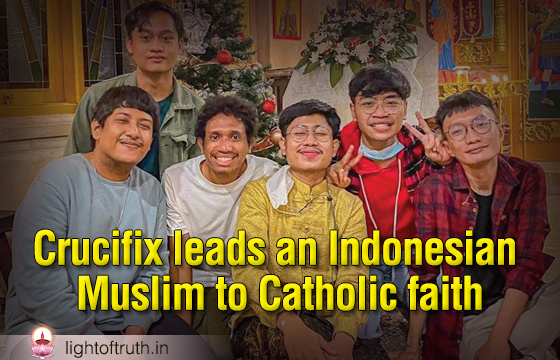
Crucifix leads an Indonesian Muslim to Catholic faith
Vicky Adam Ubaid Akram had a dream that helped him choose the Catholic faith.
In the dream, he walked in an alley that had many houses of worship including mosques, temples and churches on both sides. But his eyes remained fixated on a Catholic church with a cross on top.
He then fell down and woke up from his sleep. “In that falling position, I looked up again and my eyes were still on the crucifix,” he recalled.
Protestant churches normally do not display a crucifix — a cross with an image of Christ’s body on it — but prefer only a simple cross.
Vicky soon began to read more about Catholicism. “The more I knew, the more interested I became,” he said. Jesus’ teaching about the law of love as “the first and foremost law” was deeply touching, he said. “I really like that part, which for me is the key to being a good human being,” he recalled.
Gradually, Vicky began to visit the Catholic church in Ma-lang. The 24-year-old had grown up in a devout Muslim family in Malang in Indonesia’s East Java, a predominantly Muslim province.
Just like his father, Vicky strictly followed Islamic rituals such as praying five times a day. But three years ago he first felt “a spiritual dryness” and lost interest in his family’s religion.
“In 2018 while I was studying in college, I began to feel that I could not find peace when carrying out Islamic religious rituals such as praying,” he said.
He even began to feel that Islam was ineffective in “communicating with God and finding him peace” and began to search for other religions.
That was when Vicky turned toward Christianity, his mother’s former religion. A Protestant Christian, she had converted to Islam to marry his father and ever since followed Islamic precepts strictly.
Islamic customs and traditions were strong in Vicky’s family, just like most families in the province, where 94 percent of its 39 million people are Muslims.
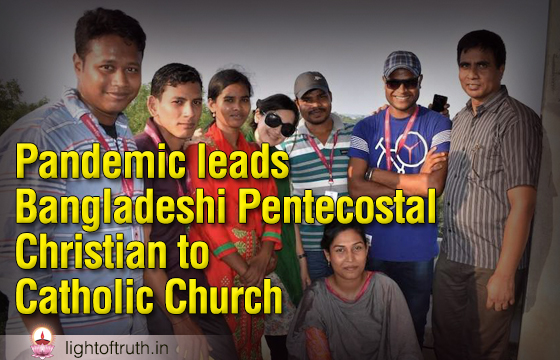
Pandemic leads Bangladeshi Pentecostal Christian to Catholic Church
Kaushik Hembrom lost his job as a computer operator with an insurance company in Bogura city of northern Bangladesh due to the Covid-19 pandemic.
The 35-year-old Pentecostal Christian was forced to return to his native village Dighalchan in neighboring Dinajpur district where he spent more than a year confined to his house without any spiritual assistance.
He would watch his Catholic neighbors attend their parish church and receive pastoral care from priests throughout the protracted lockdown. But he and his family members had no church or prayer meeting to attend in the locality.
Hembrom approached the parish priest of St. Francis of Assisi Church in Dhanjuri under Dinajpur Diocese and expressed his desire to join the Catholic Church.
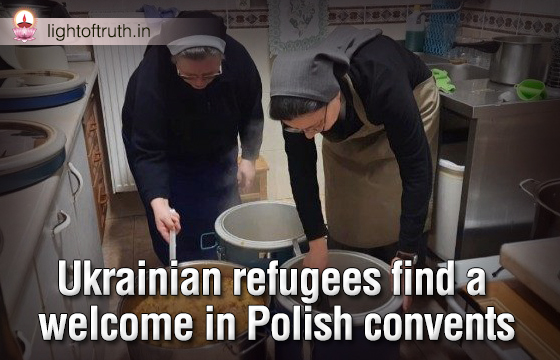
Ukrainian refugees find a welcome in Polish convents
Olga and her youngest children are safe in Poland, but she is consumed with worry for her husband and oldest son, who are still in Ukraine.
And her heart breaks when the little ones ask questions, including about why Russia invaded Ukraine when so many Russians live in Ukraine and when so many of their families are intermarried.
Everything is difficult to explain to the children, Olga said. “The youngest (two) don’t notice so much, but the oldest asks when he will see his father. I tell him the truth. He asks why uncles shoot at his father. And ‘When daddy dies, will he come to us?’”
“I don’t know how to answer these questions and I want to cry,” she said. Olga and her three children — Dima, 2, Natasha, 4, and Nazar, 6 — and her friend Alina and Alina’s 4-year-old son, Alexander, and 19-year-old daughter, Anna, found safe haven with the Missionary Sisters of the Holy Family in Lublin. The Ukrainian women asked that their real names not be used.
The Polish Conference of Major Superiors of Women said March 15 that an estimated 18,000 refugees from Ukraine were receiving spiritual, psycho-logical, medical and material help at 924 convents in Poland and that close to 500 of those communities are sheltering almost 3,000 adults – mostly women – and more than 3,000 children. Olga and Alina met at a prayer group near their homes in the Dnepropetrovsk Oblast (district) in southeastern Ukraine.

Is Putin a ‘Real’ Christian? To Understand This Conflict We Need to Ask Different Questions
Vladimir Putin’s campaign of violence in Ukraine has brought to the fore questions about his longstanding religious connect-ions, prompting scholars and journalists to challenge his well-markete d piety and seemingly deep devotion to Russian Ortho-dox spirituality—the latter of which is often expressed in its deep ties to the post-Soviet Moscow Patriarchate. In the study of religion, it’s long been common to question whether the categories of sincere or authentic religious belief are adequate for analyzing the complex motivations and actions of adherents or believers.
When practitioners are public figures with global geopolitical aims, the classification of true religious subjectivity is often suspended in favour of assuming a kind of charlatanism, or spiritually spurious intentions built to curry favour with faith com-munities. Our goal here isn’t to argue about Putin’s personal faith; rather, we want to reflect on how academic assumptions about individual religious practices and beliefs are often analysed through categories that typically begin and end with western conceptions of what counts as correct or wholehearted spirituality. In other words, we want to question the questioning of Putin’s faith.
Patriarch Kirill isn’t just a willing participant in the trans-national expansion of Russian power, culture, and Christianity-he’s a co-conspirator in this world building project of faith and politics.
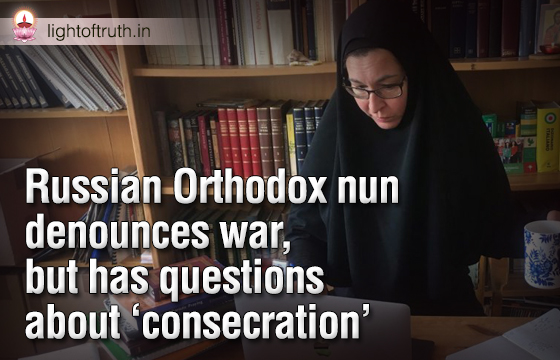
Russian Orthodox nun denounces war, but has questions about ‘consecration’
One of the Orthodox scholars who signed a statement condemning as “heresy” the political vision of Russian Orthodox Patriarch Kirill of Moscow is a U.S.-born Russian Orthodox nun and scholar of Byzantine liturgy.
Sister Vassa Larin, a nun of the Russian Orthodox Church outside Russia, also is host of the popular podcast and video series, “Coffee with Sister Vassa.”
Living and working in Vienna, Sister Vassa also serves on the liturgical and canon law commissions of the Russian Orthodox Church, and now she is helping support a Ukrainian Catholic mother and her two children who fled Russian President Vladimir Putin’s war on Ukraine.
In an interview with Catholic News Service March 18, she denounced the war as “evil” and Patriarch Kirill’s approach to it as a “horrible, horrible thing.”
For decades, the patriarch has been promoting a teaching called “Russkii Mir” (Russian World), which claims a special status for the Russian Orthodox Church and the Russian nation working closely together to govern politically and spiritually not only Russia, but all Russian speakers and the people they believe are closely related to them: Ukrainians and Belarussians.
“It is not a Christian thing,” Sister Vassa said, even if Patriarch Kirill and President Putin try to cloak it in Christian language and present themselves as defenders of traditional Christian values.
“What unites us is not being Russian; that’s not the primary thing in the mystery of the church,” she said. “The church is a mystery of unity, a sacrament of unity, based on the oneness of the Body of Christ. It’s not based on ethnicity.”
While she describes herself as “a big Pope Francis fan,” Sister Vassa said that as an Orthodox Christian, she does have some questions about his plan to consecrate Russia and Ukraine to the “Immaculate Heart of Mary” on March 25.
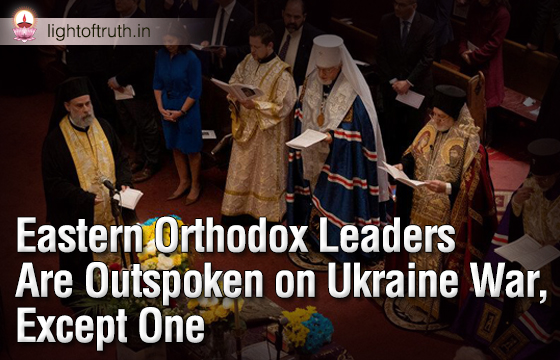
Eastern Orthodox Leaders Are Outspoken on Ukraine War, Except One
Last week, more than a dozen religious and political leaders sat on the dais of the Ukrainian Orthodox Cathedral of Saint Volodymyr on the Upper West Side, listening to solemn prayers and fiery speeches denouncing Russia and extolling Ukrainian resistance to the invasion that began two weeks earlier.
They gave speeches, one by one: the leaders of the Ukrainian, Greek and American Orthodox churches; a prominent rabbi; the leader of the Roman Catholic Archdiocese of New York; even Gov. Kathy Hoch-ul of New York.
But one group was missing from this interfaith tableau: the Russian Orthodox Church, whose leader, Patriarch Kirill of Moscow and All Russia, is an ally of President Vladimir V. Putin. Organizers said Russian Orthodox leaders in New York had been invited but did not reply.
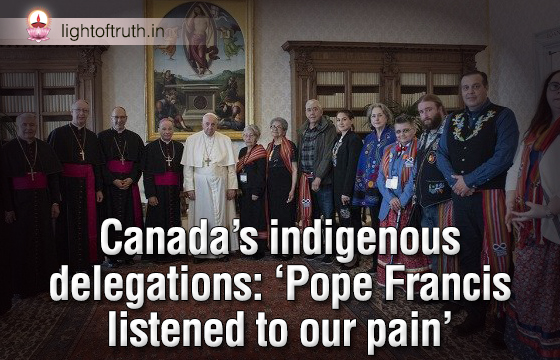
Canada’s indigenous delegations: ‘Pope Francis listened to our pain’
Following Pope Francis’ two audiences with delegations of Canada’s Métis and Inuit peoples, members of the Métis Nation say the Pope sought to listen to the stories of survivors of residential schools.
“Truth, justice, healing, reconciliation.”
Those words express the goals which delegations from several of Canada’s indigenous peoples came to share with Pope Francis in the last week of March, in an effort to heal the pain caused by residential schools.
Two delegations met with the Pope on March 28 in successive audiences—one from the Métis Nation and another from the Inuit People. They were accompanied by several Bishops from the Canadian Catholic Bishops’ Conference, with each delegation meeting with the Pope for roughly an hour.
The Director of the Holy See Press Office, Matteo Bruni, said in a statement that the audiences were focused on giving the Pope the opportunity to “listen and to offer space for the painful stories shared by the survivors.”
In his Angelus address on June 6, 2020, Pope Francis shared with the world his dismay at the dramatic news which had come a few weeks earlier, of the discovery in Canada of a mass grave in the Kamloops Indian Residential School, with more than 200 bodies of indigenous people.
The discovery marked a symbol of a cruel past, which sought, from 1880 to the final decades of the 20th century saw government-funded institutions run by Christian organizations, to educate and convert indigenous youth and assimilate them into mainstream Canadian society, through systematic abuse.
The discovery in June 2020 led Canada’s Bishops to make an apology and set up a series of projects to support survivors. The importance of the process of reconciliation is shown by the Pope’s willingness to receive the delegations in the Vatican on Monday and on 31 March, in view of a future papal visit in Canada, which has been announced by not yet officially confirmed.